

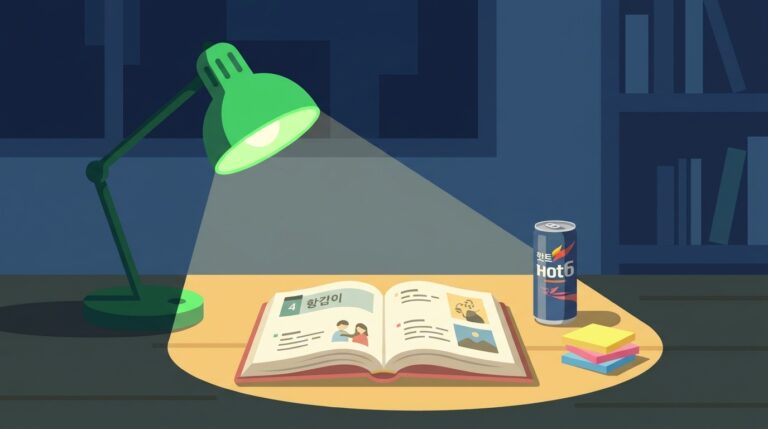
Phase 1: Empathy (스토리 몰입형 오프닝)
안녕하세요! Your Korean bestie and senior editor at Daily Hangul is here! ☕️✨
If you have ever stepped into a Korean convenience store (pyeon-ui-jeom) during middle or final exam season, you might have noticed a peculiar vibe. The air is thick with tension, and the shelves stocked with energy drinks like Hot6 or Monster are virtually wiped clean. You see students hovering around the microwave, yawning, clutching a canned coffee in one hand and a high-caffeine beverage in the other.
As an international student or professional in Korea, trying to keep up with this intense study culture can feel like running an extreme marathon. You want to ask your Korean classmates how they survive, or maybe express just how exhausted you are without sounding like a textbook robot. Today, we are going to dive deep into the real-world Korean expressions used during the legendary “Exam Period” (sihyeom gigan) and explore Korea’s fascinating (and highly caffeinated) survival culture. By the end of this guide, you’ll be able to talk about your fatigue like a true local and understand the cultural engine driving Korea’s busy nights!
Phase 2: Deep Dive into 3 Core Expressions
Let’s unpack the three absolute essentials that every intermediate learner must know to describe the high-caffeine hustle.
1. 벼락치기하다 (byeo-rak-chi-gi-ha-da)
- Pronunciation: byuh-rak-chee-ghee-hah-dah (Sounds like “byuh-rock” + “cheeky” + “hah-dah”)
- Meaning: Cramming (Literal meaning: “To do lightning-striking”)
- K-Culture Moment: In K-Dramas like Sky Castle or Reply 1988, you often see characters piling up books the night before an exam, desperate to memorize everything under the flash of a metaphorical lightning bolt.
- Editor’s Insight: Why “lightning”? Because lightning strikes suddenly and intensely. It implies you didn’t study consistently, but you’re packing 100 hours of study into one stormy night.
- Situation Spectrum: Casual ✅ / Semi-formal ✅ / Formal ⚠️ (Use “벼락치기 공부” in semi-formal writing).
- 🤔 Think About It: In your native language, is cramming described with a nature metaphor like lightning? Why do you think Korean culture relates urgent study to a sudden storm?
2. 밤을 새우다 (bam-eul sae-u-da) / 밤새다 (bam-sae-da)
- Pronunciation: bah-meul sah-oo-dah / bahm-sah-dah
- Meaning: To pull an all-nighter (Literal meaning: “To make the night leak” or “to let the night pass without sleeping”)
- K-Culture Moment: Used constantly in college vlogs (gongbu-vlog) on YouTube, where students film their 12-hour study sessions through the dead of night.
- Editor’s Insight: In daily casual conversation, “밤을 새우다” is almost always shortened to “밤새다” or “밤샜어” (I pulled an all-nighter).
- Situation Spectrum: Casual ✅ / Semi-formal ✅ / Formal ✅
- 🤔 Think About It: How is staying up late viewed in your culture? In Korea, “밤새우다” is often worn like a badge of honor, symbolizing dedication.
3. 정신을 차리다 (jeong-sin-eul cha-ri-da)
- Pronunciation: jung-shin-eul chah-ree-dah (Sounds like “jung-shin” + “eul” + “chah-ree-dah”)
- Meaning: To snap out of it, to focus, to regain consciousness (Literal meaning: “To set up/prepare one’s spirit”)
- K-Culture Moment: A character pours cold water over their face or downs a shot of espresso, shaking their head saying, “정신 차려!” (Snap out of it! / Pull yourself together!).
- Editor’s Insight: When you are drowsy from caffeine crashes, this is the perfect verb. It can be a command to oneself (정신 차리자!) or a gentle advice to a friend.
- Situation Spectrum: Casual ✅ / Semi-formal ✅ / Formal ✅
- 🤔 Think About It: “정신” (spirit/mind) is a vital concept in Korean culture, representing your focus and mental strength during tough times.
Phase 3: Textbook Korean vs. Real Korean
Let’s bridge the gap between classroom Korean and the actual words vibrating through university group chats.
Situation 1: Expressing extreme tiredness
- 📖 Textbook Korean: “매우 피곤합니다.” (maeu pigonhamnida) – “I am very tired.”
- 🗣️ 진짜 한국어 (Real Korean): “진짜 피곤해 죽겠어요.” (jinjja pigonhae jukgesseoyo) – “Seriously, I’m tired to death.”
- 💡 왜 다를까? Koreans love using “-어 죽겠다” (to death) to emphasize physical sensations. Saying “피곤해 죽겠다” sounds infinitely more natural and emotionally expressive to native ears.
Situation 2: Explaining why you drank caffeine
- 📖 Textbook Korean: “잠을 깨기 위해 에너지 음료를 마셨습니다.” (jameul kkaegi wihae eneoji eumryoreul masyeotseomnida) – “I drank an energy drink to wake up.”
- 🗣️ 진짜 한국어 (Real Korean): “잠 깨려고 에너지 음료 때려 넣었어요.” (jam kkaeryeogo eneoji eumryo ttaeryeo neoheosseoyo) – “I literally slammed/shoved down an energy drink to stay awake.”
- 💡 왜 다를까? “때려 넣다” (to strike/shove in) is a highly colloquial, dramatic expression meaning to consume something quickly and forcefully for survival. It perfectly captures the desperation of exam season.
Phase 4: K-Culture 딥다이브 & 비언어적 매너
4-1. 눈치(Nunchi) & Gestures
When studying in Korea, sharing is caring—even when it comes to stress. If you see a classmate yawning heavily, it is common Nunchi (tact/situational awareness) to silently slide a cold can of coffee or an energy drink onto their desk.
* The “Fighting” Gesture: When giving the drink, do a light fist pump and whisper, “아자, 아자! 화이팅!” (Go go! Fighting!).
* The Head-Massage: Rubbing your temples while sighing deeply (하~) immediately communicates that you are in “벼락치기” mode.
4-2. Culture Code: “Kagongjok” and the Holy Grail of Convenience Stores
Korea’s caffeine addiction peaks during midterms. The term 카공족 (ka-gong-jok) refers to the “Cafe Study Tribe” who occupy cafe seats for hours. To survive, they rely on the convenience store “2+1” promotions on drinks. One infamous legend is the “Snoopy High-Caffeine Milk” (스누피 더 진한 커피우유) which contains more caffeine than a double shot of espresso, earning it the nickname “the devil’s milk” among students.
Phase 5: 실전 롤플레이 시나리오 (Real-life Roleplay)
Setting: A university library lounge during midterm week. Sarah (an international student) runs into Min-jun (her Korean classmate) near the vending machines at 11:30 PM.
- 민준: (🎭 Rubbing his eyes sleepily) 어, 세라 씨! 아직 안 갔네요?
(Eo, Sera-ssi! Ajik an gannelyo?)
“Oh, Sarah! You haven’t gone home yet?” - 세라: (🎭 Pointing at her stack of books) 네, 내일 전공 시험이라 벼락치기하고 있어요.
(Ne, naeil jeongong sihyeomirado byeorakchigihago isseoyo.)
“Yeah, I have a major exam tomorrow, so I’m cramming.” - 민준: (🎭 Sighing) 저도 그래요. 벌써 이틀째 밤새고 있어요. 머리가 안 돌아가요.
(Jeodo geuraeyo. Beolsseo iteuljjae bamsaego isseoyo. Meoriga an doragayo.)
“Me too. I’ve been pulling all-nighters for two days now. My brain isn’t working.” - 세라: (🎭 Handing him a cold can from her bag) 이거 마셔요. 고카페인 음료인데 정신 차리는 데 최고예요.
(Igeo masyeoyo. Go-kapein eumryoinde jeongsin charineun de choegoyeyo.)
“Drink this. It’s a high-caffeine drink, best for snapping out of it.” - 민준: (🎭 Smiling gratefully) 와, 고마워요! 이거 마시고 정신 차려야겠어요.
(Wa, gomawoyo! Igeo masigo jeongsin charyeoyagesseoyo.)
“Wow, thank you! I need to drink this and wake my brain up.” - 세라: 우리 오늘 밤새고 시험 잘 봐요!
(Uri oneul bamsae-go sihyeom jal bwayo!)
“Let’s pull an all-nighter tonight and ace the exam!” - 민준: 그래요, 같이 화이팅해요!
(Geuraeyo, gachi hwaitinghaeyo!)
“Right, let’s fight together!”
🔀 Choose Your Next Move!
Min-jun asks: “시험 끝나면 우리 뭐 할까요?” (What should we do after the exam?)
- Option A: “일단 집에서 기절할래요.” (I’m going to pass out at home first.)
👉 Best Choice! “기절하다” (to faint/pass out) is the most natural native way to say you’re going to sleep deeply after hard work. - Option B: “공부 더 해요.” (Let’s study more.)
👉 Bad Choice! Unless you want to lose a friend! Min-jun might cry. - Option C: “술 마시러 가요!” (Let’s go drink alcohol!)
👉 Risk Alert! Fun, but mixing extreme caffeine fatigue with alcohol is a recipe for an instant blackout. Your body will protest!
Phase 6: 10초 감정 섀도잉 드릴 (10-Sec Shadowing Drill)
Read these out loud, mimicking the emotional flow and pauses (/):
[🥺 지쳐서 쓰러질 듯이 - Exhausted to the bone]
“어제 / 겨우 한 시간 잤어요… / 진짜 / 피곤해 죽겠어요.”
(Eoje / gyeou han sigan jasseoyo… / jinjja / pigonhae jukgesseoyo.)-
[🤪 에너지 음료 마시고 텐션 업! - Hyper on caffeine]
“에너지 드링크 마셨더니 / 이제 좀 / 정신이 번쩍 드네요!”
(Eeneoji deuringkeu masyeotdeoni / ije jom / jeongsini beonjjeok deuneyo!)
Phase 7: K-Culture 미니 사전 (Mini-Dictionary)
- 카공족 (Ka-gong-jok) | Cafe Study Tribe | People who study at cafes for long periods.
- 박카스 (Bacchus) | Bacchus | Korea’s legendary energy/fatigue recovery drink, famous since the 1960s.
- 붕붕드링크 (Bung-bung Drink) | Bung-bung Mocktail | An infamous homemade high-caffeine mix (historically made by mixing energy drinks, vitamin powders, and coffee) used by desperate students.
- 카페인 수혈 (Caffeine Su-hyeol) | Caffeine Transfusion | Humorous slang for drinking coffee or energy drinks purely to stay alive/functional.
Phase 8: 여행자를 위한 생존 키트 (Survival Kit)
Survival Phrases:
- 이거 고카페인 음료예요? (Igeo go-kapein eumryoyeyo?) – Is this a high-caffeine drink? (Use when checking labels!)
- 1+1(원플러스원) 행사 상품인가요? (Won-plus-won haengsa sangpumingayo?) – Is this a buy-one-get-one-free item?
- 잠 깨는 음료 어디 있어요? (Jam kkaeneun eumryo eodi isseoyo?) – Where are the drinks for waking up?
💡 Editor’s Travel Note:
To make payments easy while buying your late-night fuel, download the KakaoPay app or keep your physical T-money card handy. Most Korean convenience stores are fully automated for self-checkout at night, and having these apps ready will save you from sweating at the register!
Phase 9: “한 발 더 깊이” (Deepening Thought)
Korea’s intense relationship with caffeine isn’t just about loving coffee; it’s deeply rooted in the “빨리빨리” (Palli-Palli / Hurry-Hurry) culture and the highly competitive education and work environment. From a young age, Koreans are taught that effort correlates directly with time spent awake. While this has propelled the nation to incredible modern achievements, it has also made “caffeine transfusion” a humorous yet bittersweet survival mechanism.
💬 Your Turn: how does your country’s study or work culture compare? Do people rely heavily on energy drinks, or do they prioritize a healthy 8-hour sleep? Let us know in the comments below!
Phase 10: FAQ & 오해 방지 (FAQ Schema)
Q: Can I use “밤새우다” to talk about partying all night?
A: Yes! “밤새다/밤새우다” simply means staying up all night. It works perfectly for both studying hard and partying hard. For example: “어제 밤새 술 마셨어요” (I drank all night yesterday).
Q: What is the difference between “정신 차려” and “집중해”?
A: “집중해” (jipjunghae) means “focus on this specific task.” “정신 차려” is much broader—it means to shake off your drowsiness, recover your mental sanity, or pull yourself out of a daze.
Q: Is Bacchus (박카스) considered an energy drink?
A: Historically, it’s classified as a “fatigue recovery drink” (피로회복제). It contains taurine and royal jelly but actually has less caffeine than modern chemical energy drinks like Monster or Hot6.
🚨 흔한 실수 (Common Mistakes) 경고판:
- Mistake 1: Saying “잠을 안 자다” to mean pulling an all-nighter.
- Correct Action: Use 밤을 새우다 instead. “잠을 안 자다” just means “not sleeping,” which sounds dry and lacks the active struggle context.
- Mistake 2: Using “벼락치기” for long-term projects.
- Correct Action: Only use 벼락치기 for urgent, last-minute cramming.
- Mistake 3: Saying “정신을 만들다” for waking up.
- Correct Action: Always use 정신을 차리다. “만들다” (to make) does not collocate with spirit/focus.
Phase 11: 액션 미션 & 참여 유도 (Action Mission)
- 🥉 Bronze Mission: Write the phrase “오늘도 정신 차리자!” (Let’s focus today too!) on a sticky note and place it on your study desk.
- 🥈 Silver Mission: Go to a convenience store or look online, find a Korean energy drink (like Hot6), and post a picture of it on social media with the hashtag
#DailyHanguland the caption “벼락치기 중!“. - 🥇 Gold Mission: Use “밤샜어요” in your next Korean conversation class or with a language exchange partner to explain why you look tired!
Phase 12: 인터랙티브 퀴즈 챌린지 (Quiz)
Test your knowledge of Korean exam slang!
- Which word means “to cram” for an exam at the very last minute?
- A) 밤새다
- B) 벼락치기하다
- C) 정신 차리다
- Fill in the blank: “잠 깨려고 커피를 마셨더니 이제 좀
___________ 차렸어요.”- A) 기절
- B) 피곤
- C) 정신
👉 Click here to reveal the answers & explanations!
1. Answer: B) 벼락치기하다. (벼락치기 means lightning strike, referring to lightning-fast preparation!)
2. Answer: C) 정신. (정신을 차리다 is the complete set phrase meaning to recover your focus/consciousness!)







