

Navigating Korea’s ‘Parking Wars’: How to Handle Parking Issues and Fines Like a Local
Phase 1: Shared Empathy (Welcome to the Real Korea!)
안녕하세요! Welcome back to another edition of Daily Hangul, your ultimate guide to mastering Korean culture and language.
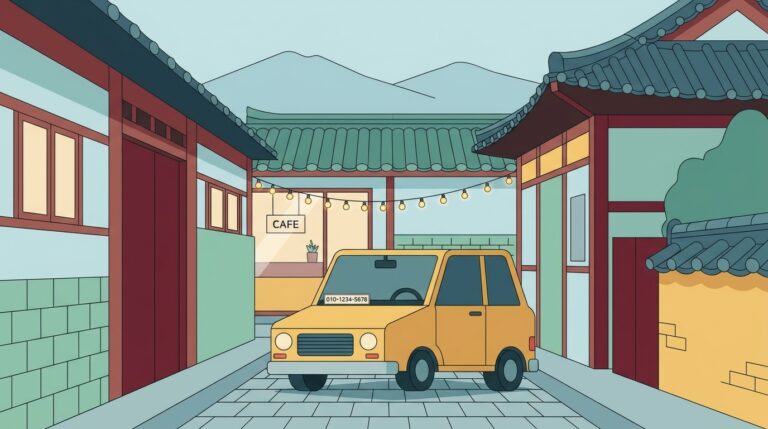
Imagine this scenario: You’ve rented a car for an amazing road trip to Jeju Island or a scenic drive through the outskirts of Seoul. You find what looks like a perfect spot in a cozy alleyway, park the car, and go enjoy a beautiful afternoon at a local cafe. But when you return, a bright yellow sticker is staring back at you from your windshield.
Oh no. Is that… a parking ticket?
Welcome to the reality of Korean city life. Korea is incredibly convenient, but because of high population density, parking space is a premium resource. Finding a spot can feel like a strategic game, and local drivers often refer to it as 주차 전쟁 (ju-cha jeon-jaeng), which literally means “parking war.”
Don’t let the fear of getting a ticket or a confrontation ruin your road trip! Based on real-life stories from our global learners at Daily Hangul, we’ve put together this survival guide. By the end of this post, you’ll know exactly how to read parking situations, communicate politely with frustrated drivers, and handle any unexpected fines like a seasoned local.
Phase 2: In-Depth Analysis of 3 Key Expressions
Let’s break down the three most crucial expressions you’ll need when navigating parking dilemmas in Korea.
1. 딱지 끊겼어요 (ttak-ji kkeun-gyeot-seo-yo)
- Pronunciation: ttak-ji kkeun-gyeot-seo-yo (Think of “ttak-ji” like the paper-folding game in Squid Game, and “kkeun” like the first syllable of “kun-do”)
- Meaning: I got a parking ticket. / I got fined.
- K-Culture Moment: You often see this in K-dramas when a character is already having a terrible day. They run to their car only to find a bright yellow paper on the glass, crying out, “아, 진짜 오늘 일진 안 좋네! 딱지까지 끊기고…” (Ah, my luck is so bad today! Even got a parking ticket…).
- Editor’s Insight: 딱지 (ttak-ji) originally refers to a folded paper tile, but in everyday slang, it means a traffic ticket. The verb 끊기다 (kkeun-gi-da) means “to be cut,” but here it is the passive form of “issuing” a paper ticket. Saying “딱지 끊겼어요” is much more natural and conversational than the formal “과태료 부과를 받았습니다” (I received a fine penalty).
- Situation Spectrum: Casual (✅) / Semi-formal (✅) / Formal (⚠️ – Use 과태료 처분을 받았습니다 in legal contexts)
- 🤔 Think About It: Why do you think Koreans use the playful word 딱지 (paper tile) for something as frustrating as a parking ticket? How does your native language use slang to soften stressful situations?
2. 여기 주차해도 돼요? (yeo-gi ju-cha-hae-do dwae-yo?)
- Pronunciation: yeo-gi ju-cha-hae-do dwae-yo?
- Meaning: Can I park here?
- K-Culture Moment: When driving into a narrow street near a famous restaurant in Hongdae or Itaewon, you’ll see drivers roll down their window to ask a nearby store owner or building security guard this exact question.
- Editor’s Insight: The grammar pattern -아/어도 되다 means “to be allowed to do something.” Because parking rules in Korea can be highly ambiguous (especially on residential narrow streets), asking a local or worker nearby is always safer than guessing.
- Situation Spectrum: Casual (⚠️ – use only with friends) / Semi-formal (✅ – safe for everyone) / Formal (✅)
- 🤔 Think About It: In Korea, public spaces are often semi-privatized by neighborhood communities. Asking for permission shows that you respect their local domain.
3. 차 좀 빼 주세요 (cha jom ppae ju-se-yo)
- Pronunciation: cha jom ppae ju-se-yo (Focus on the double consonant ㅃ in ppae. It sounds like the “pe” in “pen” but with a tensed, popped sound.)
- Meaning: Please move your car.
- K-Culture Moment: This is the ultimate “Seoul call.” If someone double-parks behind your car, they will always leave their phone number on the dashboard. You dial their number and say this phrase politely.
- Editor’s Insight: The verb 빼다 (ppae-da) means to pull out, remove, or subtract. Adding 좀 (jom), which literally means “a little,” is a crucial polite buffer. Without 좀, saying “차 빼세요” (Move your car) sounds aggressive and demanding.
- Situation Spectrum: Casual (⚠️) / Semi-formal (✅) / Formal (✅)
- 🤔 Think About It: How does your culture handle situations where someone blocks your driveway or parking space? Is it normal to call them directly on their personal phone, or would you call a towing service immediately?
Phase 3: Textbook Korean vs. Real-Life Korean
Let’s compare the sterile sentences you find in traditional textbooks with how Koreans actually speak in stressful parking situations.
Scenario 1: Asking someone to move their double-parked car
- 📖 Textbook: “실례지만, 제 차가 나갈 수 있게 귀하의 차를 다른 곳으로 이동해 주시겠습니까?”
(Excuse me, could you please move your car to another location so that my car can get out?) - 🗣️ Real-Life: “안녕하세요, 이중 주차 되어 있어서 그러는데, 차 좀 빼 주시겠어요?”
(Hi, sorry to bother you, but you’re double-parked, so could you please pull your car out?) - 💡 Why the difference? The textbook phrase is grammatically correct but sounds incredibly robotic and overly formal. Real Koreans use the phrase “~어/어서 그러는데” (I’m contacting you because…) to softly introduce the reason before making the request.
Scenario 2: Explaining a parking ticket to a rental car agent
- 📖 Textbook: “지정되지 않은 구역에 주차하여 과태료 고지서가 발급되었습니다.”
(Because I parked in an undesignated zone, a fine notice has been issued.) - 🗣️ Real-Life: “골목에 세워뒀다가 딱지 끊겼는데, 이거 어떻게 처리해야 하나요?”
(I parked it in an alley and got a ticket. How should I handle this?) - 💡 Why the difference? In conversation, instead of dry legal terms like 발급되었습니다 (issued), locals use active, narrative verbs like 세워뒀다가 (parked it temporarily and then…) and 딱지 끊겼다.
Phase 4: K-Culture Deep Dive & Non-Verbal Manners
4-1. Nunchi (눈치) & Visual Manners
- The Dashboard Phone Number (주차 번호판): This is non-negotiable in Korea. Almost every driver has a little temporary phone number card on their dashboard. If you rent a car, make sure there is a phone number displayed (usually the rental company’s or your own temporary Korean number). Leaving your spot without a contact number in Korea is considered incredibly rude!
- Emergency Flashers (비상등): The orange hazard lights are used constantly in Korea as a multi-tool. If you are parking temporarily on the side of the road, or if you want to say “Thank you/Sorry” to the driver waiting behind you, turn on your hazard lights (비상등) immediately. It’s the visual equivalent of bowing.
4-2. The Double Parking (이중 주차) Culture
In many apartment complexes or crowded alleys, there simply aren’t enough spaces. This led to the development of 이중 주차 (i-jung ju-cha – double parking).
Drivers will park horizontally behind parked cars, put their gear in Neutral (N) instead of Park (P), and leave the handbrake off. If someone needs to get their car out, they will literally push your car forward or backward manually to make room. It’s a fascinating display of community trust and space-saving ingenuity!
Phase 5: Real-Life Roleplay Scenario
Setting: You are visiting a trendy cafe in a narrow alley in Yeonnam-dong, Seoul. You parked your rented car in front of a small residential villa. Just as you sit down with your iced americano, your phone rings. It’s an unknown local number.
Characters:
- 빌라 주민 (Villa Resident): A slightly rushed, but polite local resident trying to get their car out of the villa garage.
- Alex (You): An intermediate Korean learner trying to stay calm and polite.
[Phone rings]

빌라 주민: 여보세요? 혹시 12가 3456 차주분 되시나요?
           (Yeo-bo-se-yo? Hok-si yeol-du-ga sam-sa-o-ryuk cha-ju-bun doe-si-na-yo?)
           "Hello? By any chance, are you the owner of car number 12-Ga-3456?"

Alex: 🎭 (Answering politely but nervously)
      아, 네! 제 차 맞아요. 무슨 일이시죠?
      (Ah, ne! Je cha maj-a-yo. Mu-seun il-i-si-jyo?)
      "Ah, yes! That's my car. What's going on?"

빌라 주민: 🎭 (Pointing out the window at the blocked driveway)
           여기 빌라 주차장 앞이라서 차가 못 나가고 있거든요. 차 좀 빼 주셔야겠어요.
           (Yeo-gi bil-la ju-cha-jang ap-i-ra-seo cha-ga mot na-ga-go it-geon-deun-yo. Cha jom ppae ju-syeo-ya-get-seo-yo.)
           "You parked in front of the villa driveway, so my car can't get out. You need to move your car."

Alex: 🎭 (Realizing the mistake and apologizing sincerely)
      아, 정말 죄송합니다! 제가 그 자리에 주차하면 안 되는 줄 몰랐어요.
      (Ah, jeong-mal joe-song-ham-ni-da! Je-ga geu ja-ri-e ju-cha-ha-meyon an doe-neun jul mol-las-seo-yo.)
      "Ah, I am so sorry! I didn't know I wasn't allowed to park in that spot."

빌라 주민: 🎭 (Calming down a bit after hearing the polite apology)
           여기가 소방차 전용 구역이기도 해서 주차하면 딱지 끊겨요. 빨리 이동해 주세요.
           (Yeo-gi-ga so-bang-cha jeon-yong gu-yeok-i-gi-do hae-seo ju-cha-ha-myeon ttak-ji kkeun-gyeo-yo. Ppal-li i-dong-hae ju-se-yo.)
           "This is also a fire truck zone, so if you park here, you'll get a ticket. Please move it quickly."

Alex: 🎭 (Nodding and preparing to run out of the cafe)
      네, 지금 바로 나가겠습니다! 다시 한번 죄송합니다.
      (Ne, ji-geum ba-ro na-ga-get-sum-ni-da! Da-si han-beon joe-song-ham-ni-da.)
      "Yes, I'm heading out right now! Sorry once again."

빌라 주민: 네, 수고하세요.
           (Ne, su-go-hae-se-yo.)
           "Okay, take care."
🔀 Interactive Choice Points
What would you say if the resident sounded very angry on the phone? Choose your response:
- A) “제 차 아닌데요?” (It’s not my car.) and hang up.
- B) “죄송합니다! 제가 지금 카페에 있는데 5분 안에 가서 차 빼 드릴게요!” (I’m sorry! I’m in a cafe right now, I’ll go and move it for you within 5 minutes!)
- C) “거기 주차 금지 표시 없었잖아요!” (There was no ‘No Parking’ sign there!)
💡 Feedback on Your Choice:
- Selection A (Bad): 🚫 Risk! Leaving your car there and lying will likely result in your car being towed immediately (견인) and could lead to a hefty fine from the local district office (구청).
- Selection B (Best): ✅ Perfect! Offering a specific time frame (like 5 minutes) and apologizing immediately cools down the caller’s anger. Koreans highly value quick actions and polite responsibility.
- Selection C (Worst): ⚠️ Danger! Getting defensive will escalate the situation. In Korea, even without a physical sign, parking in front of driveways or yellow lines is common-sense illegal parking. Arguing will guarantee a call to the tow truck.
Phase 6: 10-Second Emotional Shadowing Drill
Practice saying these high-frequency sentences out loud. Focus on the emotional cues and pauses (/).
- [🥺 Frustrated and panicking slightly]
“아, 대박… / 여기 황색 선이라 / 주차 딱지 끊겼나 봐요!”
(Ah, oh my god… / It’s a yellow line, so / I think I got a parking ticket!) -
[😌 Extremely relieved]
“휴, 다행히 / 차에 번호 남겨놔서 / 견인은 안 됐네요.”
(Whew, thank goodness / I left my number in the car, / so it didn’t get towed.) -
[😊 Super polite and apologetic]
“죄송한데, / 차 앞에 이중 주차를 해놔서요, / 혹시 기어 중립으로 놓으셨나요?”
(Excuse me, / because I double-parked in front of your car, / did you happen to leave your gear in neutral?)
Phase 7: K-Culture Mini Dictionary
- 황색선 (Hwang-saek-seon) | Yellow Road Lines
- Standard road lines in Korea. A single yellow solid line means parking is restricted depending on the day/time. Double yellow lines mean parking or stopping is strictly forbidden at all times.
- 견인 지역 (Gyeon-in ji-yeok) | Tow-away Zone
- Areas designated where illegally parked cars will be immediately towed. Look out for the red and black tow truck sign!
- 모두의 주차장 (Modu-ui Ju-cha-jang) | Everyone’s Parking App
- A wildly popular Korean lifestyle app that lets you find and buy unused private parking spots or find cheap public parking nearby.
- 이중 주차 (I-jung Ju-cha) | Double Parking
- Parking parallel behind already parked cars, common in overcrowded Korean urban residential areas.
Phase 8: Survival Kit for Travelers
Top 3 Phrases to Memorize:
- 주차장 어디에 있어요? (Ju-cha-jang eo-di-e is-seo-yo?)
- “Where is the parking lot?” (Ask this to cafe or restaurant owners before trying to park on the street.)
- 여기에 잠깐 세워도 돼요? (Yeo-gi-e jam-kkan se-wo-do dwae-yo?)
- “Can I pull over here for a quick moment?” (Great for when you need to run into a convenience store.)
- 주차 요금이 어떻게 돼요? (Ju-cha yo-geum-i eo-tteo-gye dwae-yo?)
- “How much is the parking fee?”
🚗 Editor’s Travel Note:
Finding parking in busy areas like Gangnam or Hongdae is nearly impossible. To save your sanity, we highly recommend installing the Naver Map App or search for “공영 주차장” (Public Parking Lot) on your map. Public parking lots in Korea are surprisingly cheap, safe, and save you from the 40,000 KRW to 80,000 KRW parking fines!
Phase 9:
Frequently Asked Questions (FAQ)
Q: What does "딱지 끊겼어요 (ttak-ji kkeun-gyeot-seo-yo)" mean in Korean and how do you pronounce it?
A: In Korean, "딱지 끊겼어요 (ttak-ji kkeun-gyeot-seo-yo)" is pronounced [ttak-ji kkeun-gyeot-seo-yo (Think of "ttak-ji" like the paper-folding game in Squid Game, and "kkeun" like the first syllable of "kun-do"] and means: I got a parking ticket. / I got fined.
Q: What does "여기 주차해도 돼요? (yeo-gi ju-cha-hae-do dwae-yo?)" mean in Korean and how do you pronounce it?
A: In Korean, "여기 주차해도 돼요? (yeo-gi ju-cha-hae-do dwae-yo?)" is pronounced [yeo-gi ju-cha-hae-do dwae-yo?] and means: Can I park here?
Q: What does "차 좀 빼 주세요 (cha jom ppae ju-se-yo)" mean in Korean and how do you pronounce it?
A: In Korean, "차 좀 빼 주세요 (cha jom ppae ju-se-yo)" is pronounced [cha jom ppae ju-se-yo (Focus on the double consonant ㅃ in ppae. It sounds like the "pe" in "pen" but with a tensed, popped sound.] and means: Please move your car.







