

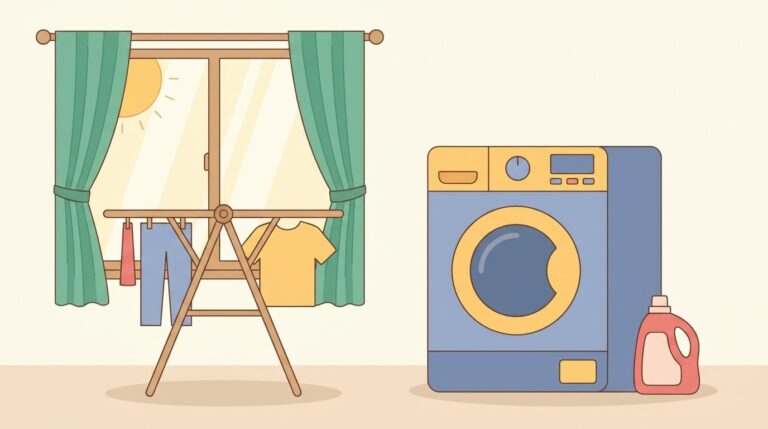
Master Laundry Day in Korea: Friendly A1 Phrases for ‘빨래하기’ (Doing Laundry)
Phase 1: Empathy (Your Laundry Day Companion)
안녕하세요! (Annyeonghaseyo!) Hello there, my dear friend! I’m your Daily Hangul editor, your cozy Korean companion.
Have you ever stood frozen in front of a Korean washing machine, staring at a dozen buttons labeled in Korean characters like 표준 (Standard) or 탈수 (Spin Dry), feeling like you’re about to launch a spaceship instead of washing your favorite t-shirt? Or maybe you’ve watched a K-drama where characters cutely hang laundry together on a rooftop (옥탑방) under the warm sun and wished you knew exactly what they were saying?
Don’t worry! You are definitely not alone. Many of our beginner students tell us that doing laundry (빨래하기) is one of the most confusing daily chores when living in or visiting Korea. Today, we are going to change that. By the end of this guide, you will feel confident enough to talk about doing your laundry in Korean and navigate any laundry situation like a real local!
Phase 2: Core 3 Expressions Deep Dive
Let’s look at the absolute essential expressions you need for laundry day. These are beginner-friendly and incredibly practical!
1. 빨래를 하다 (ppal-lae-reul ha-da)
- Pronunciation: ppal-lae-reul ha-da (The ‘pp’ is a tense, crisp ‘p’ sound, like the ‘p’ in ‘spy’. The rest sounds like lah-eh-reul ha-dah.)
- Meaning: To do laundry (literally, “to do wash-things”).
- K-Culture Moment: This is the universal phrase you will hear in every slice-of-life K-drama. Think of a character coming home after a long day, sighing, and saying, “아, 빨래해야겠다!” (Ah, I must do laundry!)
- Editor’s Insight: 빨래 means the dirty clothes/laundry itself, and 하다 is the magic verb “to do”. Together, they make the perfect pair!
- Situation Spectrum:
- Casual: 빨래해 (ppal-lae-hae) ✅
- Semi-formal: 빨래해요 (ppal-lae-hae-yo) ✅
- Formal: 빨래합니다 (ppal-lae-ham-ni-da) ✅
- 🤔 Think About It: In many Western countries, laundry is just a chore. In Korea, saying “빨래를 하다” often carries a feeling of refreshing your life and starting clean. How does doing laundry make you feel?
2. 세제를 넣다 (se-je-reul neo-ta)
- Pronunciation: se-je-reul nuh-tah (The ‘eo’ sound in ‘neo’ is like the ‘u’ in ‘cup’. The ‘h’ in ‘넣다’ merges with ‘다’ to sound like a sharp ‘t’.)
- Meaning: To put in detergent.
- K-Culture Moment: Picture a romantic K-drama scene where a couple is sharing a small apartment, and one person playfully scolds the other for putting in too much detergent!
- Editor’s Insight: 세제 (se-je) means detergent. 넣다 (neo-ta) means to put in or insert. It’s a highly useful verb you’ll also use when cooking (e.g., “put in salt”)!
- Situation Spectrum:
- Casual: 세제 넣어 (se-je neo-eo) ✅
- Semi-formal: 세제 넣어요 (se-je neo-eo-yo) ✅
- Formal: 세제 넣습니다 (se-je neop-seum-ni-da) ✅
- 🤔 Think About It: Do you measure your detergent precisely, or do you just pour it in with your heart?
3. 빨래를 널다 (ppal-lae-reul neol-da)
- Pronunciation: ppal-lae-reul nuhl-dah (The ‘l’ sound at the end of ‘neol’ is light, like the ‘l’ in ‘leaf’.)
- Meaning: To hang out the laundry (to dry).
- K-Culture Moment: Because traditional Korean homes didn’t historically use mechanical dryers, drying racks on balconies or sunny rooftops are incredibly common. You’ll often see scenes of laundry fluttering in the wind on a bright afternoon.
- Editor’s Insight: 널다 means to spread out or hang clothes to air out. Even if you use a dryer, knowing this phrase is key to understanding daily Korean life!
- Situation Spectrum:
- Casual: 빨래 널어 (ppal-lae neol-eo) ✅
- Semi-formal: 빨래 널요 (ppal-lae neol-eo-yo) ✅
- Formal: 빨래 넙니다 (ppal-lae neom-ni-da) ✅
- 🤔 Think About It: Hanging clothes to dry can be almost meditative. Do you prefer hanging clothes or using a dryer?
Phase 3: Textbook Korean vs. Real Korean
Sometimes, textbooks teach us phrases that are a bit too stiff for a cozy home setting. Let’s look at how native Koreans actually speak!
Situation 1: When the washing machine is finished.
- 📖 Textbook Korean: “세탁이 완료되었습니다.” (se-tak-i wan-ryeo-doe-eot-seup-ni-da. – “The wash has been completed.”)
- 🗣️ Real Korean: “빨래 다 됐다!” (ppal-lae da dwaet-da! – “The laundry is all done!”)
- 💡 Why the difference? The textbook version is what the electronic washing machine actually speaks in its robotic voice! But in real life, a human would say “다 됐다!” (da dwaet-da – “It’s all done!”) which sounds warm, casual, and natural.
Situation 2: Asking someone if they ran the washing machine.
- 📖 Textbook Korean: “세탁기를 작동시켰습니까?” (se-tak-gi-reul jak-dong-si-kyeot-seup-ni-ka? – “Did you operate the washing machine?”)
- 🗣️ Real Korean: “빨래 돌렸어?” (ppal-lae dol-lyeot-eo? – “Did you run the laundry?”)
- 💡 Why the difference? Koreans love the verb 돌리다 (dol-li-da), which means “to spin” or “to run (a machine)”. Saying “빨래를 돌리다” (to spin the laundry) is the most natural way to say you started the machine!
Phase 4: K-Culture Deep Dive & Non-verbal Manners
4-1. The Art of “Tterg-gi” (털기 – Shaking Out the Wrinkles)
When hanging laundry in Korea, there is a silent rule: you must shake each piece of clothing vigorously 2 to 3 times before hanging it. This action is called 털기 (teol-gi). If you just hang it wet without shaking, it will dry with stubborn wrinkles! If you live with a Korean roommate, showing them that you shake your clothes before hanging them will instantly win you major brownie points!
4-2. The “Late Night Laundry” Taboo (층간소음)
Most Koreans live in apartments or multi-family villas where walls can be thin. Doing laundry late at night (usually after 10:00 PM) is considered a big neighborly mistake because of the vibrating noise of the washing machine. This noise is a part of 층간소음 (cheung-gan-so-eum – noise between floors). To keep the peace, always run your machine during the day!
Phase 5: Real-Life Roleplay Scenario
Setting: A cozy share-house in Mapo, Seoul. You want to wash your favorite hoodie, but you aren’t sure how to use the washing machine. Your friendly Korean housemate, Minji, comes to the rescue!
Dialogue (A1 Level)
- You: 민지 씨, 저 빨래하고 싶어요.
(Minji-ssi, jeo ppal-lae-ha-go sip-eo-yo.)
🎭 Action: Pointing to your laundry basket with a shy smile.
“Minji, I want to do laundry.” -
Minji: 아, 그래요? 세탁기 여기에 있어요.
(Ah, geu-rae-yo? se-tak-gi yeo-gi-e is-seo-yo.)
🎭 Action: Guiding you to the laundry room and opening the washing machine door.
“Ah, really? The washing machine is here.” -
You: 세제는 어디에 있어요?
(se-je-neun eo-di-e is-seo-yo?)
🎭 Action: Looking around for the detergent.
“Where is the detergent?” -
Minji: 여기 있어요! 세제 조금만 넣으세요.
(yeo-gi is-seo-yo! se-je jo-geum-man neo-heu-se-yo.)
🎭 Action: Handing you a small cup of liquid detergent with a warm grin.
“Here it is! Put in just a little detergent.” -
You: 네, 넣었어요. 이제 돌려요?
(ne, neo-eot-eo-yo. i-je dol-lyeo-yo?)
🎭 Action: Pouring the detergent in and pointing at the start button.
“Yes, I put it in. Do I run it now?” -
Minji: 네, 이 ‘시작’ 버튼을 누르세요.
(ne, i ‘si-jak’ beot-eun-eul nu-reu-se-yo.)
🎭 Action: Gently tapping the flashing 'Start' button.
“Yes, press this ‘Start’ button.” -
You: 와, 감사합니다! 빨래 다 되면 알려주세요.
(wa, gam-sa-ham-ni-da! ppal-lae da doe-myeon al-ryeo-ju-se-yo.)
🎭 Action: Clapping your hands lightly in relief.
“Wow, thank you! Please let me know when the laundry is done.” -
Minji: 네, 같이 널어요!
(ne, ga-chi neol-eo-yo!)
🎭 Action: Giving you a cute thumbs up.
“Yes, let’s hang it dry together!”
🔀 Choose Your Path!
Your laundry finished spinning! What will you say to Minji?
- A) “민지 씨, 빨래 다 됐어요! 같이 널어요.”
- B) “민지 씨, 빨래를 만드세요!”
- C) “민지 씨, 세탁기 비싸요!”
Feedback on Your Choice:
- If you chose A (Best): Perfect! You said, “Minji, the laundry is done! Let’s hang it together.” This is highly polite, friendly, and uses your new expressions flawlessly. Minji will happily help you!
- If you chose B (Bad): Oops! This means “Minji, please make laundry!” which sounds like you want her to make her clothes dirty on purpose!
- If you chose C (Risk): Oh dear! This means “Minji, the washing machine is expensive!” While grammatically correct, it is highly random and might make her feel awkward!
Phase 6: 10-Second Emotional Shadowing Drill
Let’s practice speaking with real Korean emotion! Follow the pauses (/) and try to mimic the feeling in the brackets.
- [😊 Excited & helpful roommate tone]
- Sentence: 빨래 / 다 됐어요! / 같이 / 널어요!
- Pronunciation: ppal-lae / da dwaet-eo-yo! / ga-chi / neol-eo-yo!
- Meaning: The laundry is done! Let’s hang it together!
- [🥺 Cute, asking for help tone]
- Sentence: 세제 / 어디에 / 있어요?
- Pronunciation: se-je / eo-di-e / is-seo-yo?
- Meaning: Where is the detergent?
Phase 7: K-Culture Mini Dictionary
| Word (Korean) | Romanization | English Translation | Real-Life Usage Note |
|---|---|---|---|
| 세탁기 | se-tak-gi | Washing machine | Found in every home. Often placed in a small balcony space called ‘베란다’. |
| 섬유유연제 | seom-yu-yu-yeon-je | Fabric softener | Koreans love pleasant scents. ‘Pigeon’ (피죤) is a famous brand name often used to mean softener. |
| 건조기 | geon-jo-gi | Clothes dryer | Becoming popular in modern apartments, but still considered a luxury! |
| 빨래건조대 | ppal-lae-geon-jo-dae | Drying rack | A folding metal rack found in almost 100% of Korean households. |
Phase 8: Traveler’s Survival Laundry Kit
If you are traveling in Korea and staying at a hostel or Airbnb, you might need to find a laundromat! Here is your quick survival kit.
Survival Phrases
- 코인세탁소 어디에 있어요? (ko-in-se-tak-so eo-di-e is-seo-yo?)
- Meaning: Where is the coin laundromat?
- Pro Tip: Use this when you need self-service laundry!
- 세탁기 어떻게 켜요? (se-tak-gi eo-tteo-ke kyeo-yo?)
- Meaning: How do I turn on the washing machine?
- Pro Tip: Ask your host or hotel staff this if you’re stuck.
- 건조기 있어요? (geon-jo-gi is-seo-yo?)
- Meaning: Do you have a clothes dryer?
🗺️ Editor’s Travel Note:
Need to wash clothes during your trip? Open the Naver Map App and search for 코인세탁소 (Coin Laundry) or 빨래방 (Laundromat). Most of them are open 24 hours and have coin exchangers or card payment machines. It’s the perfect place to read a book or check your social media while enjoying the cozy smell of laundry soap!
Phase 9: “A Step Deeper” (Insights into Korean Daily Life)
In Korea, doing laundry is deeply connected to the concept of 정 (jeong – warm feeling of connection). Because drying space on balconies can be limited, hanging clothes is often a shared family activity. Sharing the chore of 빨래를 널다 (hanging laundry) is a subtle, unspoken way of showing love and cooperation in a household. Next time you see a drying rack full of freshly washed clothes in Korea, remember that it’s a small, beautiful sign of someone caring for their home and family.
💬 Your Turn: Do you hang your clothes to dry, or do you always use a dryer? Let us know in the comments below! We love reading your stories!
Phase 10: FAQ & Common Mistakes
Q: What is the difference between 세탁 (se-tak) and 빨래 (ppal-lae)?
A: Excellent question! 세탁 is a Sino-Korean word that translates to “washing clothes” and is more formal. You will see it on signs, machine buttons, or in dry-cleaning shops (세탁소). 빨래 is a native Korean word that refers to the actual pile of dirty clothes and is much more common in everyday spoken conversations.
Q: Can I use ‘빨래하다’ for dry cleaning?
A: No, 빨래하다 specifically refers to washing clothes with water (usually at home or a laundromat). For dry cleaning, you should say 드라이클리닝 맡기다 (deu-ra-i-keul-ri-ning mat-gi-da – “to hand over for dry cleaning”).
Q: How do I ask for bleach in Korean?
A: Bleach is called 표백제 (pyo-baek-je), but many locals also refer to it by a very famous brand name, 락스 (rak-seu – Clorox).
🚨 Common Mistakes Alert!
- Mistake: Saying “빨래를 만들다” (ppal-lae-reul man-deul-da – “to make laundry”).
- Why it’s wrong: Koreans don’t “make” laundry.
- Correct Action: If you have a pile of dirty clothes, say 빨래가 쌓였어요 (ppal-lae-ga ssah-yeot-eo-yo – “The laundry has piled up!”).
Phase 11: Action Missions
Are you ready to practice? Try these three fun challenges!
- 🥉 Bronze Mission: Go to your closet, point at your laundry, and say out loud: “빨래해야겠다!” (I should do laundry!)
- 🥈 Silver Mission: Write a comment below using the word 세제 (detergent) or 세탁기 (washing machine).
- 🥇 Gold Mission: If you live with a Korean friend, next time you see them near the wash, smile and say: “빨래 다 됐어요! 같이 널어요!”
Phase 12: Interactive Quiz Challenge
Test your new laundry Korean skills!
1. What does “세제” mean?
- A) Washing machine
- B) Detergent
- C) Drying rack
🔍 Click for the Answer
Answer: B) Detergent. Remember, 세제를 넣다 means “to put in detergent”!
2. Fill in the blank: “빨래를 ____.” (To hang out the laundry)
- A) 하다 (ha-da)
- B) 넣다 (neo-ta)
- C) 널다 (neol-da)
🔍 Click for the Answer
Answer: C) 널다 (neol-da). This means to hang clothes to dry!
3. True or False: It is completely fine and polite to run a loud washing machine in a Korean apartment at 11:00 PM.
- A) True
- B) False
🔍 Click for the Answer
Answer: B) False. Doing laundry late at night is considered bad manners due to 층간소음 (noise between floors). Always try to wash during daytime!
See you next time on Daily Hangul! 항상 화이팅! (Always cheering for you!)







