

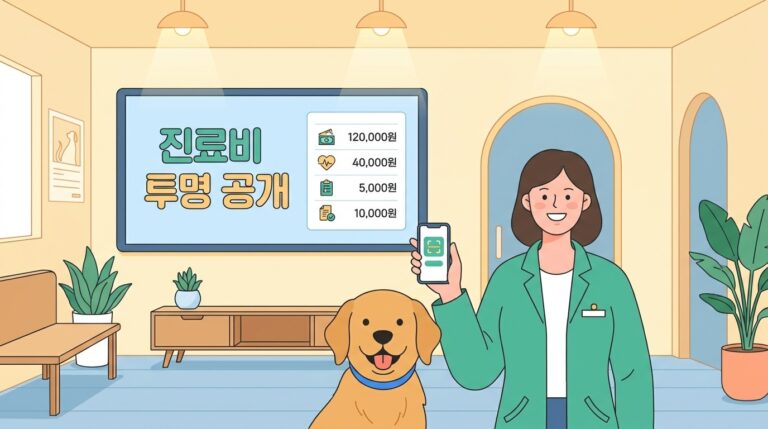
The Cost of Companionship: Navigating the Veterinary Fee Standardization Debate in Korea
Phase 1: 공감 (The Rising Cost of a Furry Family Member)
안녕하세요! Your reliable cultural navigator and Lead Editor at 매일한글 (Daily Hangul) is back!
Imagine this scenario: Your beloved dog, Choco, starts sneezing, and you rush to a local animal hospital in Seoul. After a brief consultation and a few routine tests, you are handed a bill that makes your jaw drop. You visit another clinic just three blocks away for the exact same issue, and the price is suddenly cut in half.
In Korea, this is a highly relatable pain point for millions of pet owners. As we enter the 반려동물 천만 시대 (The Era of 10 Million Pet Owners), our pets are no longer just “animals”—they are cherished family members (가족). However, the veterinary medical system has struggled to keep pace with this cultural shift, leading to a heated national debate over 동물 병원 진료비 표준화 (The Standardization of Veterinary Treatment Fees).
Today, we will dive deep into this socio-cultural phenomenon using sophisticated C2-level Korean terminology. This lesson is built on real-world feedback from expatriates navigating Korean vet clinics, giving you both linguistic mastery and practical survival skills.
Phase 2: 핵심 표현 3선 심층 분석 (Deep-Dive: 3 Essential Expressions)
1. 부르는 게 값이다 (bureuneun ge gapsida)
- Pronunciation: Boo-reu-neun ge gap-shi-da (Sounds like “The price is whatever they call out”)
- Meaning: The seller sets the price arbitrarily; arbitrary pricing.
- K-Culture Moment: You will hear this phrase constantly in Korean consumer affairs programs or morning talk shows when discussing unregulated markets—from tourist traps to veterinary procedures.
- Editor’s Insight: This idiomatic expression highlights a deep-seated frustration with a lack of market transparency. It implies that the consumer has zero leverage and must pay whatever astronomical fee is demanded.
- Situation Spectrum: Casual (✅) | Semi-formal (✅) | Formal (⚠️ – use ‘가격 책정의 자율성’ in academic settings)
- 🤔 Think About It: How does your home country regulate medical fees for pets? Is there a tension between veterinary business freedom and pet owner rights?
2. 진료비 편차가 심하다 (jillyobi pyeonchaga simhada)
- Pronunciation: Jin-ryo-bi pyeon-cha-ga shim-ha-da (Sounds like “The treatment fee deviation is severe”)
- Meaning: There is a massive discrepancy/variance in veterinary medical bills.
- K-Culture Moment: This is a staple phrase in news editorials and petition letters addressed to the Blue House (국민청원), urging the government to bridge the gap between low-cost and high-end clinics.
- Editor’s Insight: The word ‘편차’ (deviation/discrepancy) elevates your Korean to a highly professional, analytical level. It suggests structural inconsistency rather than a simple difference in price.
- Situation Spectrum: Casual (✅) | Semi-formal (✅) | Formal (✅)
- 🤔 Think About It: Does price variation necessarily mean lower quality, or is it a natural outcome of free-market competition?
3. 투명하게 공개하다 (tumyeonghage gonggaehada)
- Pronunciation: Too-myeong-ha-ge gong-gae-ha-da (Sounds like “To disclose transparently”)
- Meaning: To transparently disclose or publish (tariffs/fees).
- K-Culture Moment: Activists and progressive pet owner groups use this term when demanding the implementation of a mandatory veterinary fee disclosure system (진료비 공시제).
- Editor’s Insight: ‘투명성’ (transparency) is one of the most valued concepts in modern Korean public policy. Pairing it with ‘공개하다’ shows you understand the civil desire for systemic honesty.
- Situation Spectrum: Casual (✅) | Semi-formal (✅) | Formal (✅)
- 🤔 Think About It: Why is public disclosure considered the first step toward building trust in Korean society?
Phase 3: 교과서 한국어 vs 진짜 한국어 (Textbook vs. Real-World Korean)
Let’s compare stiff, textbook expressions with the organic, high-level prose actually spoken by advanced Korean speakers.
Situation 1: Expressing shock over a massive bill
- 📖 교과서 한국어: “동물 병원비가 너무 비쌉니다.”
(The animal clinic bill is very expensive.) - 🗣️ 진짜 한국어: “병원비가 완전히 ‘폭탄’ 수준이라 손이 떨려요.”
(The hospital bill is literally at a ‘bomb’ level, making my hands shake.) - 💡 왜 다를까? Koreans frequently use sensory metaphors like ‘폭탄’ (bomb/shell) to describe sudden, devastating costs (e.g., 세금 폭탄, 요금 폭탄).
Situation 2: Advocating for policy changes
- 📖 교과서 한국어: “정부가 동물 병원 가격을 통제해야 합니다.”
(The government should control animal clinic prices.) - 🗣️ 진짜 한국어: “진료비 가이드라인 제정을 통해 소비자의 알 권리를 보장해야 합니다.”
(We must guarantee the consumer’s right to know by establishing veterinary fee guidelines.) - 💡 왜 다를까? C2-level Korean relies heavily on Sino-Korean nouns (한자어) like ‘제정’ (enactment/establishment) and ‘알 권리’ (right to know) to frame arguments logically.
Phase 4: K-Culture 딥다이브 & 비언어적 매너 (Deep Dive & Non-Verbal Manners)
4-1. 눈치 (Nunchi) & Non-Verbal Manners at the Vet
When discussing high costs with a Korean veterinarian, raw confrontation is highly discouraged. Instead, employ polite skepticism.
* The Gesture: When handed an expensive estimate, do not slam the paper down. Instead, gently tilt your head, look down at the paper, and softly stroke your chin while letting out a gentle sigh: “하아… 생각보다 금액이 좀 세네요 (Phew… the amount is a bit stronger than I expected).” This allows the veterinarian to explain the breakdown without feeling defensive.
4-2. Cultural Context: The “Pet Butler” Phenomenon
In Korea, pet owners do not call themselves “owners” (주인). They refer to themselves as 집사 (jipsa – butler) for cats, or 엄마/아빠 (mom/dad) for dogs. Because pets are treated as absolute royalty, veterinarians are often put under immense pressure to provide human-grade medical care, which naturally drives up operational costs due to advanced equipment like animal MRIs.
Phase 5: 실전 롤플레이 시나리오 (Real-Life Roleplay Scenario)
Setting: A modern veterinary clinic in Gangnam, Seoul.
Characters:
* 지원 (Ji-won): A devoted “dog mom” who is highly conscious of consumer rights.
* 김 원장 (Director Kim): A compassionate but business-minded veterinarian.
지원: (걱정스러운 표정으로 초코를 안고 들어서며)
      "원장님, 우리 초코 오늘 스케일링이랑 기본 검진받았는데, 청구 금액이 지난번보다 왜 이렇게 많이 나왔죠?"

김 원장: (부드럽게 차트를 보며)
      "아, 지원 씨. 이번에는 마취 전 정밀 혈액 검사랑 잇몸 소독 처치가 추가되어서 그렇습니다."

지원: (영수증을 가리키며 씁쓸하게)
      "아니, 그래도 병원마다 부르는 게 값이라니 소비자 입장에서는 매번 가슴이 철렁해요."

김 원장: (공감하듯 고개를 끄덕이며)
      "충분히 이해합니다. 사실 우리 의료진 입장에서도 진료비 표준화가 되면 참 투명하고 좋을 텐데요."

지원: (목소리에 힘을 주며)
      "맞아요. 진료비 편차가 너무 심하니까 커뮤니티에서 집사들 사이에 불신만 쌓이는 것 같아요."

김 원장: (조심스럽게 카운터를 가리키며)
      "하지만 병원 규모나 보유한 의료 장비에 따라 투입되는 원가가 워낙 달라서 표준화가 말처럼 쉽지만은 않습니다."

지원: (한숨을 쉬며)
      "그렇더라도 최소한 기본 항목만큼은 사전 고지가 투명하게 이루어졌으면 좋겠어요."

김 원장: (미소를 지으며)
      "동감입니다. 정부에서도 '진료비 공시제'를 확대하고 있으니, 조만간 합의점이 도출되겠지요."
🔀 Interactive Choice Point
How should Ji-won respond to keep the conversation productive?
- Option A: “표준화가 안 되어 있으니 그냥 다른 병원으로 옮길게요.” (I’ll just move to another clinic since it’s not standardized.)
- Feedback (Risk): Too confrontational. It burns bridges with a veterinarian who already knows your pet’s medical history.
- Option B: “원장님 설명 청취 후: 네, 그럼 이번 추가 항목에 대한 세부 내역서를 좀 받아볼 수 있을까요?” (Yes, then could I please get a detailed breakdown of the added items?)
- Feedback (Best): Polite, logical, and assertive. Asking for a ‘세부 내역서’ (detailed statement) is a smart consumer move.
- Option C: “비싸니까 그냥 깎아주세요.” (It’s expensive, so just give me a discount.)
- Feedback (Bad): Highly culturally inappropriate in Korea. Veterinary services are not flea-market items.
Phase 6: 10초 감정 섀도잉 드릴 (10-Second Emotional Shadowing)
Practice these high-level sentences with the exact emotional intonation of a native speaker. The slashes / represent pause points.
- [🥺 Resentful and Frustrated]
“병원마다 / 부르는 게 값이라 / 매번 가슴이 철렁해요.”
(With clinics calling their own prices, my heart drops every single time.) -
[😤 Discontented and Analytical]
“진료비 편차가 / 너무 심하니까 / 집사들 사이에서 / 불신만 쌓이잖아요.”
(Because the fee discrepancy is so severe, it only breeds distrust among pet owners.) -
[🙏 Earnest and Resolute]
“사전 고지제도가 / 투명하게 정착되었으면 / 좋겠습니다.”
(I sincerely hope the prior notification system becomes transparently established.)
Phase 7: K-Culture 미니 사전 (The Pet Culture Mini-Dictionary)
- 반려동물 천만 시대 (banryodongmul cheonman sidae) | The Era of 10 Million Pet Owners. Refers to the socio-demographic shift where roughly 20% of the Korean population lives with pets.
- 진료비 공시제 (jillyobi gongsije) | Veterinary Fee Disclosure System. A newly mandated system in Korea requiring clinics with multiple vets to post pricing for common procedures publicly.
- 집사 (jipsa) | Butler. Originally meaning “deacon” or “butler,” it is now the universal self-deprecating slang for dedicated pet owners who serve their furry “masters.”
- 바가지 요금 (bagaji yogeum) | Rip-off / Exorbitant overcharge. A colloquial term for being charged way above the market rate.
Phase 8: 여행자/거주자를 위한 생존 키트 (Survival Kit for Expats & Travelers)
Survival Vocab TOP 3
- “세부 내역서 좀 발급해 주세요.” (Please issue a detailed statement of bills.) – Crucial for filing pet insurance.
- “동물등록번호 조회해 주세요.” (Please look up my pet’s registration number.) – Korea mandates electronic pet registration.
- “사전 고지 대상 항목인가요?” (Is this item subject to mandatory prior notification?) – High-level phrase to assert your consumer rights.
Editor’s Travel & Living Note
If you live in Korea with a pet, download the 네이버 지도 앱 (Naver Map App). Search for “동물병원” (animal hospital) and check user reviews (영수증 리뷰 – Receipt Reviews) to compare pricing transparency and see if they are certified as “착한 동물병원” (fair-price clinics).
(Note: Veterinary policies and regulations undergo frequent updates; always consult with local municipal offices for the latest guidelines.)
Phase 9: “한 발 더 깊이” (Cultural Reflection Essay)
Korea’s rapid urbanization and the dominance of apartment living have shaped a highly unique pet culture. Because space is limited, smaller breeds dominate, and pet care is hyper-managed. This intense emotional attachment makes owners willing to spend large sums of money, which some critics argue has allowed veterinary pricing to remain unchecked. Yet, the push for fee standardization represents a beautiful transition in Korean society: pets are no longer legally or socially viewed as mere property, but as subjects deserving of systematic healthcare protection.
💬 Your Turn: Does your country have a unified pricing system for veterinary clinics, or is it closer to Korea’s current system? Let us know in the comments below!
Phase 10: FAQ & 오해 방지 (FAQ & Common Mistakes)
Q: 왜 한국 동물병원은 건강보험이 적용되지 않나요?
A: 인간의 국민건강보험과 달리 반려동물은 사적 영역에 속하므로 국가 공적 보험 대상이 아닙니다. 대신 최근 민간 ‘펫 보험(Pet Insurance)’ 가입률이 증가하는 추세입니다.
Q: ‘진료비 공시제’는 모든 동물병원에 의무 적용되나요?
A: 현재 법안은 수의사가 2인 이상인 의무 대상 병원에 우선 적용되며, 점진적으로 1인 병원까지 확대 추진 중입니다.
Q: 외국인도 한국에서 기르는 반려동물을 의무 등록해야 하나요?
A: 네, 그렇습니다. 생후 2개월 이상의 개는 관할 구청에 의무적으로 동물등록(동물등록제)을 해야 하며, 위반 시 과태료가 부과됩니다.
🚨 흔한 실수 (Common Mistakes) 경고판
- ❌ Mistake 1: Vet에게 내 반려견을 지칭할 때 “그 개(That dog)” 혹은 “그것(It)”이라고 하는 것.
- ✔️ Correct Action: “우리 아이 (Our child)” 혹은 반려견의 이름을 불러주는 것이 훨씬 자연스럽고 애정 어린 시선을 받습니다.
- ❌ Mistake 2: 진료비가 비싸다고 카운터에서 “너무 비싸요, 깎아주세요!”라고 떼쓰는 것.
- ✔️ Correct Action: “혹시 비급여 항목 중에서 대체 가능한 저렴한 처치가 있을까요?”라고 우아하게 대안을 물어보세요.
- ❌ Mistake 3: 진료 후 세부 영수증을 챙기지 않는 것.
- ✔️ Correct Action: 항상 “상세 영수증(세부 내역서) 발행해 주세요”라고 요청하여 불필요한 과잉진료 여부를 검토하세요.
Phase 11: 액션 미션 & 참여 유도 (Action Mission)
- Bronze Mission 🥉: 오늘의 핵심 단어 ‘부르는 게 값’을 소리 내어 3번 읽고 다이어리에 적어보기.
- Silver Mission 🥈: 여러분의 반려동물 사진과 함께 “우리 집 세젤예(world’s prettiest) 반려동물도 표준화된 의료 혜택이 필요해요!”라는 문구를 인스타그램에 태그와 함께 업로드하기.
- Gold Mission 🥇: 한국인 친구 혹은 AI 튜터와 함께 Phase 5의 롤플레이를 각각 지원과 원장 역할을 맡아 감정을 실어 완독하기.
Phase 12: 인터랙티브 퀴즈 챌린지 (Interactive Quiz)
1. 빈칸 채우기 퀴즈
-
Q: 동물병원마다 가격 책정이 제각각이라 소비자들은 “완전히 ( )이/가 값이다”라며 불만을 토로합니다.
정답 보기
-
정답: 부르는 게
- 해설: ‘부르는 게 값이다’는 판매자가 가격을 정하는 대로 사야 하는 불공정한 상황을 이르는 고급 관용구입니다.
2. 상황 판단 퀴즈
-
Q: 병원비 세부 내역을 꼼꼼하게 따져보고 싶을 때 데스크에 요청해야 하는 서류 명칭은?
정답 보기
-
정답: 세부 내역서 (또는 진료비 상세 영수증)
- 해설: 단순히 금액만 적힌 영수증 대신 각 처치 항목이 세분화된 ‘세부 내역서’를 요청해야 과잉진료 여부를 판단할 수 있습니다.
3. O/X 문화 퀴즈
-
Q: 한국에서는 모든 동물병원이 의무적으로 진료비를 인터넷 홈페이지에 공시해야 한다. ( O / X )
정답 보기
-
정답: X
- 해설: 현재는 수의사 2인 이상인 대형 동물병원을 중심으로 의무화가 시행되고 있으며, 소규모 1인 병원은 아직 완전 의무화 단계는 아닙니다.







