

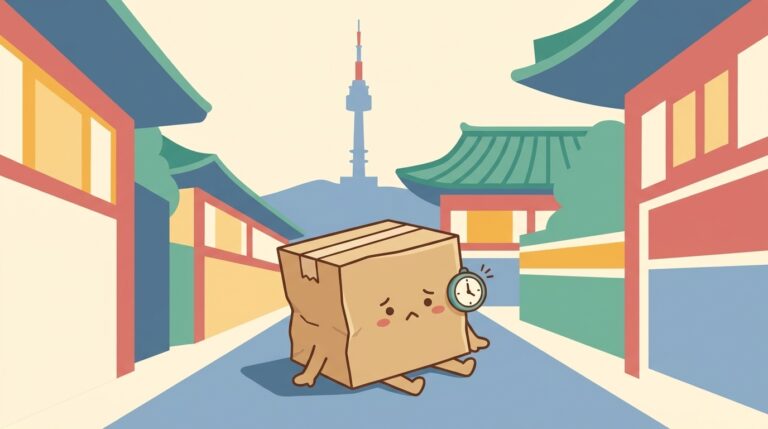
Phase 1: Oh No, Where is My Package? 📦
안녕하세요! (An-nyeong-ha-se-yo!) Hello! I am your Daily Hangul editor, your favorite Korean best friend.
Imagine this: You are sitting in your cozy room in Seoul, waiting for that beautiful K-beauty skincare set or your favorite K-pop album to arrive. Korea is famous for its super-fast shipping, but today… your package is late! You check your phone, look out the door, but there is nothing there.
Don’t worry! Shipping delays happen, and today we will learn how to handle this situation like a pro. Even if you are an absolute beginner (A1), these simple phrases will help you ask and track your packages with ease and confidence. Let’s dive in!
Phase 2: Core Expressions to Save Your Day
1. 언제 와요? (Eon-je wa-yo?)
- Pronunciation: “Eon-je wa-yo?” (Sounds like ‘Eon-jae’ + ‘wah-yo’)
- Meaning: When is it coming?
- K-Culture Moment: You will hear this expression all the time in Korean dramas when someone is eagerly waiting for a delivery, a friend, or delicious Korean fried chicken!
- Editor’s Insight: This phrase is short, sweet, and incredibly powerful. It uses the basic verb “오다” (to come). It is polite enough to use with staff and simple enough to remember under stress.
- Situation Spectrum: Casual: 언제 와? (⚠️) | Semi-formal: 언제 와요? (✅) | Formal: 언제 오십니까? (🚫 – too heavy)
- 🤔 Think About It: In English, we ask “When will it arrive?” but Koreans focus on the action of “coming” (오다). Why do you think Koreans treat packages like visitors?
2. 배송이 늦어져요. (Bae-song-i neu-jeo-jyeo-yo.)
- Pronunciation: “Bae-song-ee neu-jeo-jyeo-yo.” (‘Bae-song’ rhymes with ‘song’, ‘neu-jeo’ sounds like ‘nuh-juh’)
- Meaning: The delivery is late/delayed.
- K-Culture Moment: This is the standard status message you might see on your tracking screen on Coupang or Naver Shopping when winter snow slows things down.
- Editor’s Insight: “배송” means shipping or delivery, and “늦어지다” means to become late. Use this to explain your situation to your guesthouse host or customer support.
- Situation Spectrum: Casual: 배송이 늦어져 (⚠️) | Semi-formal: 배송이 늦어져요 (✅) | Formal: 배송이 지연됩니다 (✅)
- 🤔 Think About It: How does it feel to state the problem directly but politely? This phrase strikes the perfect balance!
3. 조회해 주세요. (Jo-hoe-hae ju-se-yo.)
- Pronunciation: “Jo-hoe-hae joo-seh-yo.” (‘Jo-hoe’ sounds like ‘joh-heh’)
- Meaning: Please track/check it for me.
- K-Culture Moment: Used at the reception desk of a hotel or guesthouse when you need help finding a package that hasn’t shown up.
- Editor’s Insight: “조회” means searching or tracking. Adding “주세요” (please do it for me) turns it into a very polite request.
- Situation Spectrum: Casual: 조회해 줘 (🚫) | Semi-formal: 조회해 주세요 (✅) | Formal: 조회해 주시기 바랍니다 (⚠️)
- 🤔 Think About It: Why do we use “주세요” (please give) for actions in Korean? It shows that you value the other person’s effort!
Phase 3: Textbook Korean vs. Real Korean
Let’s compare textbook phrases with what Koreans actually say in real life!
Situation 1: Explaining that the delivery is delayed
- 📖 Textbook Korean: 배송이 지연되었습니다. (Bae-song-i ji-yeon-doeeot-seup-ni-da.) – “Shipping has been delayed.”
- 🗣️ 진짜 한국어: 택배가 안 와요. (Taek-bae-ga an wa-yo.) – “My package is not coming.”
- 💡 왜 다를까? The textbook expression sounds like a formal company announcement. In daily conversations, using the word “택배” (parcel) and saying “안 와요” (not coming) is much more natural and friendly.
Situation 2: Asking to check the location of your package
- 📖 Textbook Korean: 위치를 추적해 주십시오. (Wi-chi-reul chu-jeok-hae ju-sip-si-o.) – “Please track the location.”
- 🗣️ 진짜 한국어: 택배 어디쯤 있어요? (Taek-bae eo-di-jjeum isse-o-yo?) – “About where is my package?”
- 💡 왜 다를까? “추적” (tracking/tracing) sounds like a detective movie! Koreans prefer saying “어디쯤 있어요?” (About where is it?) to make the conversation softer and warmer.
Phase 4: K-Culture Deep Dive & Manner Tips
4-1. Nunchi & Gestures
When you ask someone to help find your delayed package, do not just stand there! Show your phone screen with the tracking details. A slight, polite bow of your head and using two hands when showing your phone will show great respect. This makes the host or clerk instantly want to help you!
4-2. The “Palli-Palli” Culture 🚀
Korea is famous for “Palli-Palli” (빨리빨리 – Fast, Fast!) culture. Packages usually arrive in one day! Because of this ultra-fast speed, even a single day of delay can feel very long. However, Koreans always remain polite to delivery drivers, calling them “택배 기사님” (Taek-bae Gi-sa-nim – Mr. Delivery Driver) to appreciate their hard work.
Phase 5: Real-Life Roleplay
Setting: You are standing at the front desk of your cozy Seoul guesthouse. You are talking to Yujin, the super-friendly guesthouse host, because your package is late.
- Characters:
- You (Excited but worried A1 learner)
- Yujin (Warm and helpful guesthouse host)
Dialogue:
1. You: 저기요, 제 택배가 안 와요. (Jeo-gi-yo, je taek-bae-ga an wa-yo.) 🎭 [Looking worried, pointing to your phone] (Excuse me, my package is not coming.)
2. Yujin: 아, 정말요? 언제 주문하셨어요? (Ah, jeong-mal-yo? Eon-je ju-mun-ha-syeot-eo-yo?) 🎭 [Looking surprised and opening her tracking notebook] (Oh, really? When did you order it?)
3. You: 이틀 전에 주문했어요. 배송이 늦어져요. (I-teul jeon-e ju-mun-haess-eo-yo. Bae-song-i neu-jeo-jyeo-yo.) 🎭 [Showing the order details on your screen] (I ordered it two days ago. The delivery is late.)
4. Yujin: 송장번호가 있어요? 제가 조회해 볼게요. (Song-jang-beon-ho-ga isse-o-yo? Je-ga jo-hoe-hae bol-ge-yo.) 🎭 [Smiling warmly, typing on her computer] (Do you have the tracking number? I will check it for you.)
5. You: 네, 여기 있어요. 조회해 주세요. (Ne, yeo-gi isse-o-yo. Jo-hoe-hae ju-se-yo.) 🎭 [Handing over your phone politely with both hands] (Yes, here it is. Please track it.)
6. Yujin: 잠시만요… 아! 택배가 경비실에 있어요! (Jam-si-man-yo… Ah! Taek-bae-ga gyeong-bi-sil-e isse-o-yo!) 🎭 [Pointing downstairs with a bright smile] (Just a moment… Ah! The package is in the security office!)
7. You: 진짜요? 감사합니다! (Jin-jja-yo? Gam-sa-ham-ni-da!) 🎭 [Clapping your hands in relief] (Really? Thank you!)
8. Yujin: 네, 얼른 내려가 보세요! (Ne, eol-reun nae-ryeo-ga bo-se-yo!) 🎭 [Waving goodbye cheerfully] (Yes, go down quickly and check!)
🔀 Choose Your Path!
- Option A: Say “택배 빨리 주세요!” (Give me my package fast!) -> [Bad 🚫] This sounds extremely demanding and rude. Avoid using this!
- Option B: Say “조회해 주세요.” (Please track it.) -> [Best ✅] Extremely polite, natural, and gets the job done perfectly.
- Option C: Say “배송 왜 안 돼요?” (Why is delivery not working?) -> [Risk ⚠️] This can sound a bit aggressive depending on your facial expression.
Phase 6: 10-Second Shadowing Drill
Let’s practice speaking with real emotions! Pause at the / marks and match the feelings.
- “제 택배가 / 안 와요. 🥺”
- [Feelings: Sad, worried, and waiting eagerly]
- “여기 있어요. / 조회해 주세요. 😊”
- [Feelings: Polite, hopeful, and handing over your phone]
- “진짜요? / 감사합니다! 🎉”
- [Feelings: Super excited, relieved, and happy]
Phase 7: K-Culture Mini Dictionary
- 택배 (Taek-bae): Parcel / Package delivery. The lifeblood of modern convenience in Korea!
- 송장번호 (Song-jang-beon-ho): Tracking number. The magical digits you need to find your box.
- 배송 완료 (Bae-song wan-ryo): Delivery completed. The happiest text message you will ever receive!
- 경비실 (Gyeong-bi-sil): Security/Guard room. This is the golden safety zone where packages are kept in Korean apartments and guesthouses.
Phase 8: Guesthouse Survival Kit
Top 3 Survival Expressions
- “택배 왔어요?” (Taek-bae wass-eo-yo? / Did the package arrive?)
- “문 앞에 두고 가세요.” (Mun ap-e du-go ga-se-yo. / Please leave it in front of the door.)
- “경비실에 맡겨 주세요.” (Gyeong-bi-sil-e mat-gyeo ju-se-yo. / Please leave it in the security office.)
Editor’s Travel Note: When ordering items during your travel, always double-check the room number. If you need help finding address details, try searching on the Naver Map App for accurate English and Korean coordinates!
Phase 9: One Step Deeper
In Korea, delivery systems are incredibly fast and reliable, but heavy rain, snow, or major holidays like Chuseok (Korean Thanksgiving) can cause unavoidable delays. Instead of getting angry, Koreans show deep appreciation to delivery drivers by calling them “기사님” (Gi-sa-nim – master/driver) and waiting patiently.
💬 Your Turn: How is the delivery service in your country? Do packages arrive fast? Tell us your experience in the comments below!
Phase 10: FAQ & Common Mistakes
Q: My phone says “배송 완료” (Delivered), but I do not see my package. What should I do?
A: Don’t panic! Check the 경비실 (security office) or behind the shoe rack near your door. Drivers often leave packages in safe spots without calling you.
Q: Is it rude to ask “언제 와요?” (When is it coming?) to the front desk?
A: Not at all! It is a standard, polite way to ask about your package status when you add “요” at the end.
Q: Can I use “택배” when ordering fried chicken?
A: No! For food delivery, use 배달 (Bae-dal). Use 택배 (Taek-bae) only for parcels and online shopping boxes.
🚨 Common Mistakes Warning Board
- Mistake 1: Saying “배송 왜 안 돼요?” in a loud voice.
- Correct Action: Keep your tone soft and say “배송이 늦어져요.” to show respect.
- Mistake 2: Forgetting the “요” and saying “언제 와?”
- Correct Action: Always keep the polite “요” (언제 와요?) when talking to hosts or staff.
- Mistake 3: Saying “배달” for clothes.
- Correct Action: Say “택배” for shopping goods, and “배달” for food.
Phase 11: Daily Hangul Action Mission
- 🥉 Bronze: Say “언제 와요?” out loud 5 times in front of your mirror with a cute, worried face!
- 🥈 Silver: Write “제 택배가 안 와요. 조회해 주세요.” on your study notebook.
- 🥇 Gold: Next time you stay in Korea, try asking your accommodation host to track a delayed box using today’s phrases!
- 🎮 K-Culture Mission: Watch a modern Korean drama and try to catch the word “택배” or “기사님”! Let us know if you find one!
Phase 12: Interactive Quiz Challenge
🔍 Quiz 1: What does ‘조회해 주세요’ mean? (Click to reveal)
Answer: “Please track/check it for me.” Use this when you want someone to look up your package status on a computer!
🔍 Quiz 2: True or False? You should use ‘배달’ when your online K-pop album is late. (Click to reveal)
Answer: False! “배달” is for food. You must use 택배 for physical merchandise and packages!
See you in the next lesson! 다음에 또 만나요! (Da-eum-e tto man-na-yo!)







