

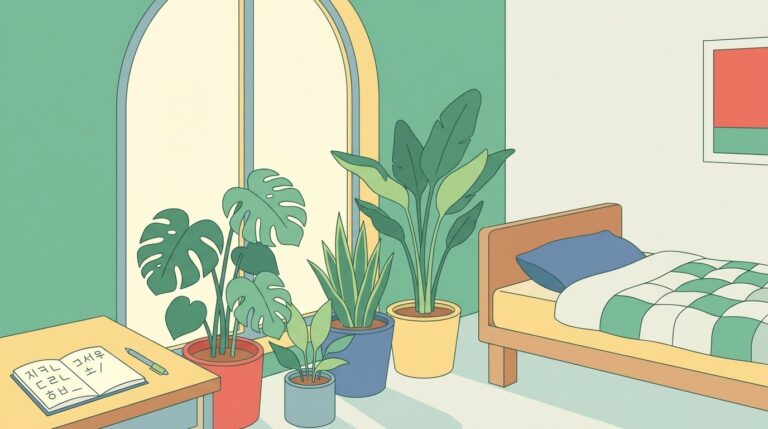
Master the Art of Korean ‘Planterior’: Essential Air-Purifying Plant Care for C1 Learners
Phase 1: Empathy (Welcome to the World of Sik-jip-sa!)
안녕하세요! (Annyeonghaseyo!) Welcome back to Daily Hangul. I’m your chief editor and local cultural navigator.
Imagine this: You are standing in your cozy, sunlit studio apartment in Seoul. Outside, the city is bustling, and maybe there’s a touch of fine dust (미세먼지) in the air. You look at your windowsill and sigh—your beautiful, air-purifying Monstera is looking a bit sad and yellow. You want to ask for help at the local plant market, but “Please help my plant” just doesn’t capture the subtle, affectionate relationship Koreans have with their green companions.
In Korea, plants aren’t just home decorations anymore; they are 반려식물 (companion plants). In this C1-level guide, we will dive deep into the botanical subculture of Korea, exploring how urbanites use plants to combat high-rise isolation, clean their indoor air, and master the linguistic nuances of plant parenting. If you’ve ever wanted to discuss soil conditions, watering cycles, and ventilation like a native, this guide is crafted just for you!
Phase 2: Core Expressions Deep Dive
To speak like a sophisticated plant parent in Korea, you need to move beyond basic vocabulary. Here are three crucial terms that will instantly elevate your conversational naturalness.
1. 식집사 (Sik-jip-sa)
- Pronunciation: [Sik-jip-sa] (rhymes with “seek-jeep-sah”)
- Meaning: Plant Butler (A portmanteau of 식물 [plant] and 집사 [butler/cat-parent])
- K-Culture Moment: You will see this term everywhere on Korean lifestyle YouTube channels and Instagram hashtags (#식집사). It reflects the shift from viewing plants as passive decoration to active companions that require dedicated care, much like a cat.
- Editor’s Insight: Historically, “집사” was only used for cat owners (who serving their feline “masters”). Extending this to plants implies a deep, nurturing devotion.
- Situation Spectrum: Casual ✅ / Semi-formal ✅ / Formal ⚠️
- 🤔 Think About It: Why do you think modern young Koreans, living in highly digitized urban spaces, identify so strongly with being a “butler” to a quiet, slow-growing plant?
2. 과습으로 죽이다 (Gwa-seup-eu-ro juk-i-da)
- Pronunciation: [Gwa-seub-eu-ro juk-ee-da] (sounds like “Gwah-seup-eu-roh jook-ee-dah”)
- Meaning: To kill (a plant) by overwatering / excessive moisture
- K-Culture Moment: If you visit a plant clinic or a local nursery (화원) complaining that your plant is dying, the owner will almost certainly say, “과습으로 죽는 경우가 제일 많아요” (Overwatering is the most common cause of death).
- Editor’s Insight: While textbook Korean teaches “물을 너무 많이 주다” (to give too much water), “과습” (excessive humidity/moisture) is the precise, professional term used by Korean gardeners.
- Situation Spectrum: Casual ✅ / Semi-formal ✅ / Formal ✅
- 🤔 Think About It: In Korean culture, excessive affection is sometimes compared to “overwatering”—suffocating someone with too much care. Can you see the poetic parallel?
3. 통풍이 잘되다 (Tong-pung-i jal-doe-da)
- Pronunciation: [Tong-pung-ee jal-doeda] (sounds like “Tong-poong-ee jahl-dwe-dah”)
- Meaning: To be well-ventilated / To have excellent air circulation
- K-Culture Moment: Because many Koreans live in high-rise apartments with thick double-paned windows, “통풍” is considered the absolute golden rule of indoor plant care, often prioritized even over sunlight.
- Editor’s Insight: If a plant looks withered despite getting plenty of water and light, a Korean expert will tell you to check the ventilation immediately.
- Situation Spectrum: Casual ✅ / Semi-formal ✅ / Formal ✅
- 🤔 Think About It: How does the architecture of your country affect the way you care for indoor plants compared to Korea’s apartment culture?
Phase 3: Textbook Korean vs. Real Conversational Korean
Let’s compare the dry, grammatical sentences from traditional textbooks with the vivid, emotional expressions used by real Korean plant enthusiasts.
Situation A: Explaining how to water a plant
- 📖 Textbook Korean: “일주일에 한 번 물을 주세요.”
(Give water once a week.) - 🗣️ Real Conversational Korean: “일주일 주기로 주기보다는, 겉흙이 마르면 듬뿍 주시는 게 좋아요.”
(Rather than on a weekly cycle, it’s best to water it thoroughly once the topsoil dries out.) - 💡 Why the difference? Real Sik-jipsas know that fixed watering schedules lead to plant death due to changing indoor humidity. The phrase “겉흙이 마르면 듬뿍” (thoroughly when the topsoil is dry) is the ultimate golden rule of Korean plant care.
Situation B: Recommending an air-purifying plant for a new home
- 📖 Textbook Korean: “이 식물은 공기를 깨끗하게 만듭니다.”
(This plant makes the air clean.) - 🗣️ Real Conversational Korean: “새집증후군 잡는 데는 이만한 공기 정화 식물이 없죠.”
(There’s nothing quite like this air-purifying plant for tackling Sick Building Syndrome.) - 💡 Why the difference? Koreans are highly sensitive to “새집증후군” (Sick Building Syndrome—chemical toxins from new wallpaper or paint). Recommending a plant specifically for this shows a high level of cultural and linguistic sophistication.
Phase 4: K-Culture Deep Dive & Non-verbal Manners
4-1. Nunchi & Physical Etiquette in Korean Nurseries
When you visit a botanical market like the famous Yangjae Flower Market (양재꽃시장), showing proper “Nunchi” (tact/social awareness) is key.
* Hands Off the New Shoots (새순): When examining delicate air-purifying plants like the Calathea or Ficus, never touch the tiny, soft new leaves (새순). It shows a lack of respect for the plant’s life cycle.
* The “Chopstick” Check: If you want to show a seller that you are a serious grower, ask if you can check the soil depth. Many Korean plant parents use a simple wooden chopstick (나무젓가락) plunged deep into the soil to check for hidden moisture before watering. Mentioning this trick will instantly win you the seller’s respect!
4-2. The Rise of “Sik-meong” (식멍)
Just as Koreans love “Bul-meong” (불멍 – staring blankly at a campfire) and “Mul-meong” (물멍 – staring at an aquarium), “Sik-meong” (식멍) is the act of staring blankly at your plants to destress. In a hyper-competitive society, taking 10 minutes to just look at a green leaf transpiring air is a form of active meditation.
Phase 5: Real-Life Roleplay Scenario
Setting: A trendy, jungle-like plant shop in Hapjeong, Seoul. You are looking for a plant that can purify the air in your bedroom but doesn’t require constant direct sunlight.
Characters:
* You (민우/Min-woo): A passionate plant lover looking to start a “planterior” project.
* Owner (지선/Ji-seon): A veteran plant shop owner who treats her plants like her own children.
Dialogue:
- 지선: 어서 오세요! 집 분위기 바꾸러 오셨나 봐요? 식물이 정말 많죠?
(Eo-seo o-se-yo! Jip bun-wi-gi ba-kku-reo o-syeot-na bwa-yo? Sik-mul-i jeong-mal manh-jyo?)
[😊 Welcoming and bright] Welcome! Are you here to change your home atmosphere? We have quite a collection, don’t we? -
민우: 네, 요즘 미세먼지 때문에 목이 칼칼해서요. 침실에 둘 만한 공기 정화 식물을 찾고 있어요.
(Ne, yo-jeum mi-se-meon-ji ttae-mun-e mok-i kal-kal-hae-seo-yo. Chim-sil-e dul man-han gong-gi jeong-hwa sik-mul-eul chat-go is-seo-yo.)
[😷 Touching throat, slightly concerned] Yes, my throat has been feeling scratchy lately because of the fine dust. I’m looking for an air-purifying plant to keep in my bedroom. -
지선: 아, 그러시구나. 침실이면 빛이 아주 잘 들지는 않겠네요? 초보자시라면 스투키나 몬스테라를 추천해 드려요.
(Ah, geu-reo-si-gu-na. Chim-sil-i-myeon bich-i a-ju jal deul-ji-neun anh-get-nae-yo? Cho-bo-ja-si-ra-myeon seu-tu-ki-na mon-seu-te-ra-reul chu-cheon-hae deu-ryeo-yo.)
[🤔 Nodding thoughtfully] Ah, I see. If it’s the bedroom, it might not get a lot of direct light. If you are a beginner, I highly recommend Stuckyi or Monstera. -
민우: 몬스테라가 예쁘긴 한데, 제가 물주기를 잘 맞출 수 있을지 걱정이에요. 저번에 다른 식물을 과습으로 보낸 적이 있거든요.
(Mon-seu-te-ra-ga ye-ppeu-gin han-de, je-ga mul-ju-gi-reul jal mat-chul su is-seul-ji geok-jeong-i-e-yo. Jeo-beon-e da-reun sik-mul-eul gwa-seub-eu-ro bo-naen jeog-i it-geon-deun-yo.)
[🥺 Shrugging sheepishly, feeling guilty] Monsteras are beautiful, but I’m worried I won’t get the watering cycle right. I actually “sent away” (killed) another plant due to overwatering last time. -
지선: 아휴, 식집사들이 한 번씩 다 겪는 일이에요! 몬스테라는 겉흙이 바짝 마른 다음에 물을 듬뿍 주면 절대 실패 안 해요.
(A-hyu, sik-jip-sa-deul-i han beon-ssik da gyeok-neun il-i-e-yo! Mon-seu-te-ra-neun geot-heulg-i ba-jjak ma-reun da-eum-e mul-eul deum-ppuk ju-myeon jeol-dae sil-pae an hae-yo.)
[👋 Waving hand dismissively, offering comfort] Oh, don’t worry, every plant butler goes through that at least once! With Monsteras, as long as you water them thoroughly after the topsoil is completely dry, you can’t fail. -
민우: 그렇군요! 그리고 침실 문을 자주 닫아두는데, 통풍이 많이 중요할까요?
(Geu-reot-gun-yo! Geu-ri-go chim-sil mun-eul ja-ju dad-a-du-neun-de, tong-pung-i ma-ni jung-yo-hal-kka-yo?)
[🧐 Leaning in curiously] I see! Also, I often keep my bedroom door closed. Is ventilation really that important? -
지선: 네, 아무리 물을 잘 줘도 바람이 안 통하면 뿌리가 썩어요. 하루에 한 번은 꼭 창문을 열어주시거나 서큘레이터를 돌려주세요.
(Ne, a-mu-ri mul-eul jal jwo-do ba-ram-i an tong-ha-myeon bpu-ri-ga sseok-eo-yo. Ha-ru-e han beon-eun kkok chang-mun-eul yeol-eo-ju-si-geo-na seo-kyul-lei-teo-reul dol-려-ju-se-yo.)
[☝️ Pointing finger with gentle emphasis] Yes, no matter how well you water it, if air doesn’t circulate, the roots will rot. Make sure to open the window once a day or use a circulator. -
민우: 아, 꿀팁 감사해요! 그럼 이 튼튼해 보이는 몬스테라로 데려갈게요. 분갈이용 흙도 같이 살 수 있을까요?
(Ah, kkul-tip gam-sa-hae-yo! Geu-reom i teun-teun-hae bo-i-neun mon-seu-te-ra-ro de-ryeo-gal-ge-yo. Bun-gal-i-yong heulg-do ga-chi sal su is-seul-kka-yo?)
[😄 Smiling brightly, pointing to a pot] Oh, thanks for the pro-tip! I’ll take this healthy-looking Monstera then. Can I also buy some potting soil for repotting?
🔀 Interactive Choice Point
The owner offers to pot the plant for you for an extra 5,000 KRW, but you want to try it yourself at home to feel like a real ‘Sik-jipsa’. What do you say?
- Choice A: “그냥 제가 집에서 대충 심을게요.”
- Choice B: “제가 직접 분갈이를 해보고 싶어서요, 흙이랑 화분만 따로 주실 수 있나요?”
- Choice C: “귀찮으니까 그냥 사장님이 해주시는 게 낫겠어요.”
Feedback:
- Best Choice: B
Using “제가 직접 분갈이를 해보고 싶어서요” (I’d like to try repotting it myself) shows enthusiastic initiative and respect for the hobby. Asking for “흙이랑 화분만 따로” (just the soil and pot separately) is natural and clear. - Risk Choice: A
Using “대충 심을게요” (I’ll just plant it haphazardly/carelessly) might sound a bit dismissive of the plant’s life to a passionate shop owner, even if you meant it casually. - Bad Choice: C
While honest, “귀찮으니까” (Because it’s a hassle) sounds lazy and ruins the warm “Sik-jipsa” vibe you built during the conversation.
Phase 6: 10-Second Emotion Shadowing Drill
Practice these sentences out loud, mimicking the emotional cues and pauses (/) to master the natural cadence of a C1 speaker.
- [😊 Expressing gentle expertise]
“겉흙이 / 바짝 마른 다음에 / 물을 듬뿍 주셔야 / 과습을 막을 수 있어요.”
(Geot-heulg-i / ba-jjak ma-reun da-eum-e / mul-eul deum-ppuk ju-syeo-ya / gwa-seub-eul mag-eul su is-seo-yo.) -
[🥺 Deeply worried and remorseful]
“얘가 요즘 / 영 시들시들한 게 / 제가 물을 너무 많이 줘서 / 과습으로 아픈 걸까요?”
(Yae-ga yo-jeum / yeong si-deul-si-deul-han ge / je-ga mul-eul neo-mu ma-ni jwo-seo / gwa-seub-eu-ro a-peun geol-kka-yo?)
Phase 7: K-Culture Mini Dictionary
| Word (Hangul + Romanization) | English Meaning | Real-Life Usage & Context |
|---|---|---|
| 반려식물 (Ban-ryeo-sik-mul) | Companion Plant | Plants treated with the same emotional status as pets, common among single-person households (1인 가구). |
| 새순 (Sae-sun) | New Shoot / Baby Leaf | The delicate new green sprouts. Checking on “새순” in the morning is a daily joy for Korean plant parents. |
| 분갈이 (Bun-gal-i) | Repotting | Changing the pot and soil as the plant grows. Usually done in spring (봄철 분갈이). |
| 식집사 (Sik-jip-sa) | Plant Butler / Parent | A popular self-designation for urban indoor gardeners. |
Phase 8: Traveler’s Survival Kit
Survival Expressions for Plant Lovers
- “초보자가 키우기 쉬운 식물로 추천해 주세요.”
- [Cho-bo-ja-ga ki-u-gi swi-un sik-mul-lo chu-cheon-hae ju-se-yo.]
- Pro-Tip: Use this at any flower market to get low-maintenance air purifiers like Devil’s Ivy (스킨답서스).
- “이거 햇빛이 잘 안 들어와도 괜찮을까요?”
- [I-geo haet-bich-i jal an deul-eo-wa-do gwaen-chanh-eul-kka-yo?]
- Pro-Tip: Essential for those living in semi-basement (반지하) apartments or north-facing studio rooms.
- “분갈이는 언제 해주는 게 좋아요?”
- [Bun-gal-i-neun eon-je hae-ju-neun ge jo-a-yo?]
- Pro-Tip: Ask this when buying a plant to know if you need to buy a bigger pot right away.
Editor’s Travel Note: Yangjae Flower Market Adventure
If you want to experience real Korean planterior culture, type “양재꽃시장” (Yangjae Flower Market) into your Naver Map App and take Seoul Subway Line 3 to Yangjae Citizen’s Forest Station. The underground greenhouse complexes (가동 and 나동) are filled with thousands of tropical, air-purifying plants.
Note: Operating hours vary by section, with the wholesale cut-flower market closing early in the afternoon, but the potted plant greenhouses are usually open until 7:00 PM. Best to bring cash or be ready to do a bank transfer (계좌이체), which local sellers love!
Phase 9: “한 발 더 깊이” (Going Deeper: The Soul of Korean Plant Care)
In many Western cultures, gardening is often associated with spacious backyards and suburban life. In South Korea, however, where over 60% of the population lives in high-rise apartments, nature is something that must be intentionally brought indoors. This spatial constraint has birthed the “Planterior” (플랜테리어) boom.
Koreans use plants not just to aestheticize concrete spaces, but to heal their minds from “apartment fatigue.” Caring for a plant—waiting for its tiny 새순 (new shoot) to pop up, adjusting the window for 통풍 (ventilation)—provides a grounding rhythm in a society that moves at a dizzying 빨리빨리 (hurry-hurry) pace.
💬 Your Turn: Do you have companion plants in your home? How do you practice “Sik-meong” in your culture? Let us know in the comments below!
Phase 10: FAQ & Avoiding Common Mistakes
Q: Can I use the term “식집사” in a formal business meeting?
A: It is a trendy neologism (신조어). While widely understood, it is best suited for casual conversations, social media, or marketing contexts. In formal botanical contexts, use “식물 재배자” (plant cultivator) or “원예 애호가” (horticulture enthusiast).
Q: What is the difference between “공기 정화” and “가습”?
A: “공기 정화” (Gong-gi jeong-hwa) means air purification (filtering dust/toxins), while “가습” (Ga-seup) means humidification (releasing moisture). Many Korean apartments need both, which is why plants like Areca Palms (아레카야자) are highly popular.
Q: Why do my Korean friends say their plants “went to heaven” (하늘나라로 갔다)?
A: This is a gentle, euphemistic way of saying a plant died. It highlights how much emotional attachment Koreans form with their plants, treating them like family members or pets rather than disposable green decor.







