

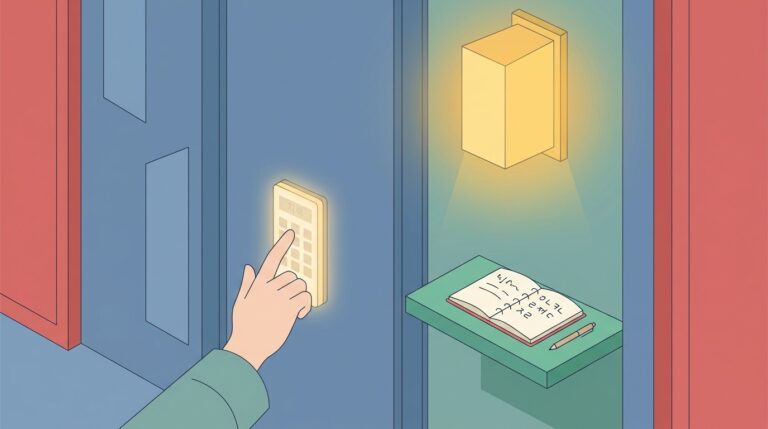
Unlock the Secret: Master the Korean Apartment Doorlock Like a Local!
안녕하세요! (An-nyeong-ha-se-yo!) Hello! I am your lead editor at Daily Hangul, your trusty Korean culture navigator.
Have you ever stood in front of a Korean apartment door, staring at a digital keypad, feeling a sudden wave of panic as a loud beep echoes through the quiet hallway? If so, you are not alone! In Korea, physical metal keys are a relic of the past. Almost every home uses a high-tech digital doorlock. In K-Dramas, you often see characters frantically pressing buttons when running away from a dramatic situation, or typing in a code to enter their best friend’s cozy studio.
Today, we will master the simple A1-level Korean phrases you need to conquer the digital doorlock, handle awkward hallway encounters, and feel right at home in Korea! Let’s dive in!
Phase 2: Key Expressions Deep Dive
1. 비밀번호 (Bimil-beonho)
- Pronunciation: bee-meel-buhn-ho (Rhymes with ‘feel-fun-go’)
- Meaning: Password / Passcode (Literally: ‘Secret Number’)
- K-Culture Moment: In K-Dramas, when a friend visits unannounced, the host might shout through the phone: ‘비밀번호 뭐야?’ (What’s the password?)
- Editor’s Insight: This word is a combination of 비밀 (secret) and 번호 (number). In daily life, Koreans almost always shorten this to 비번 (bi-beon).
- Situation Spectrum: Casual ✅ | Semi-formal ✅ | Formal ✅
- 🤔 Think About It: In your country, do you use digital doorlocks for your home, or do you still prefer physical metal keys? Why do you think Korea adopted digital locks so rapidly?
2. 눌러 주세요 (Nulleo juseyo)
- Pronunciation: nuhl-luh joo-seh-yo (Sounds like ‘null-er-ju-say-yo’)
- Meaning: Please press / Please push
- K-Culture Moment: When you arrive at a guesthouse or a friend’s apartment, they might point at the keypad and say, ‘여기 눌러 주세요’ (Please press here).
- Editor’s Insight: This comes from the verb 누르다 (to press). The ending ~주세요 makes it polite and friendly. You can use this for elevator buttons, doorbells, and phone screens too!
- Situation Spectrum: Casual ⚠️ | Semi-formal ✅ | Formal ✅
- 🤔 Think About It: How do we politely ask someone to press a button in your language? Is it one word, or a longer sentence?
3. 열렸어요 (Yeollyeosseoyo)
- Pronunciation: yuhl-lyuh-ssuh-yo (Sounds like ‘yull-yuh-saw-yo’)
- Meaning: It’s open! / It has been opened.
- K-Culture Moment: After a satisfying chirp-chirp-cheer-u sound from the electronic lock, your Korean host smiles and says: ‘들어오세요! 문 열렸어요!’ (Come in! The door is open!)
- Editor’s Insight: This is the past tense of 열리다 (to be opened). It is a joyful sound to hear after a long flight to Seoul!
- Situation Spectrum: Casual ✅ | Semi-formal ✅ | Formal ✅
- 🤔 Think About It: Korean verbs change form depending on whether an action is ongoing or completed. Hearing ‘열렸어요’ means the lock has successfully released.
Phase 3: Textbook Korean vs. Real Korean
Let’s compare what dry textbooks teach you versus how real Koreans actually talk near the doorlock.
Situation 1: Telling someone to enter the passcode
- 📖 Textbook Korean: “비밀번호를 입력하십시오.” (Please input the password.)
- Why it’s stiff: This sounds like an automated robot voice from a bank terminal!
- 🗣️ Real Korean: “비번 눌러줘.” (Press the password – Casual) / “비밀번호 눌러 주세요.” (Please press the password – Polite)
- 💡 Why it’s different: Locals prefer the short slang 비번 (bi-beon) and the soft verb 눌러주다 (to press for someone) over the clinical term ‘입력’ (input).
Situation 2: Confirming the door is unlocked
- 📖 Textbook Korean: “문이 개방되었습니다.” (The door has been opened.)
- Why it’s stiff: Sounds like an emergency exit announcement in an airport!
- 🗣️ Real Korean: “문 열렸어!” (The door is open!) / “열렸어요.” (It’s open.)
- 💡 Why it’s different: Everyday conversational Korean prioritizes active/passive simple verbs to sound warm and natural.
Phase 4: K-Culture Deep Dive & Non-verbal Manners
4-1. The ‘Nunchi’ Hand Shield (손으로 가리기)
When you are entering your passcode at the communal entrance (공동현관) or your apartment door, and someone is standing behind you, there is a polite non-verbal dance.
* The Gesture: Use your left hand to cup over the keypad like a small roof, while your right hand types the numbers.
* The Manner: This is not seen as rude or overly suspicious. In Korea, it is considered high-level manners (눈치, Nunchi) to cover the keypad so the person behind you doesn’t feel awkward or accidentally look at your private code.
4-2. The Famous ‘Doorlock Melodies’
In Korea, doorlocks don’t just ‘click’. They sing!
* When you lock the door: Ppi-rik! (삐릭!)
* When you enter the wrong password: Tti-tti-tti-tti! (띠띠띠띠! – a warning chime)
* When the door successfully unlocks: Tti-ro-ri-ra-ra! (띠로리라라! – a cheerful scale)
These sound effects are cultural staples. In K-Dramas, characters recognize who is arriving just by the rhythm of the doorlock sounds!
Phase 5: Real-life Roleplay Scenario
Setting: You have just arrived at your Airbnb in Mapo, Seoul. The host, Ji-woo, is showing you how to enter.
- Ji-woo (Host): “안녕하세요! 캐리어 무겁죠? 이쪽으로 오세요.”
- (An-nyeong-ha-se-yo! Kae-ri-eo mu-geop-jyo? I-jjok-eu-ro o-se-yo.)
- “Hello! Your suitcase is heavy, right? Come this way.”
- You: “감사합니다! 문이 예쁘네요.”
- (Gam-sa-ham-ni-da! Mun-i ye-ppeu-ne-yo.)
- “Thank you! The door is pretty.”
- Ji-woo: “도어락을 써야 해요. 자, 비밀번호를 입력해 볼까요?”
- (Do-eo-rag-eul sseo-ya hae-yo. Ja, bi-mil-beon-ho-reul im-ryeok-hae bol-kka-yo?)
- “We have to use a doorlock. Now, shall we try typing the password?”
- You: “아, 네! 어떻게 해요?”
- (A, ne! Eo-tteog-hae-yo?)
- “Ah, yes! How do I do it?”
- Ji-woo: “여기 화면을 손바닥으로 한번 터치해 보세요.”
- (Yeo-gi hwa-myeon-eul son-ba-dag-eu-ro han-beon teo-chi-hae bo-se-yo.)
- “Touch this screen once with your palm.”
- You: “아, 불빛이 켜졌어요!”
- (A, bul-bich-i kyeo-jyeos-seo-yo!)
- “Ah, the light turned on!”
- Ji-woo: “맞아요! 이제 번호를 눌러 주세요.”
- (Ma-ja-yo! I-je beon-ho-reul nul-ler ju-se-yo.)
- “Correct! Now please press the numbers.”
- You: (Presses buttons) “…그리고 별표(*)를 눌렀어요!”
- (…Geu-ri-go byeol-pyo-reul nul-leos-seo-yo!)
- “…And I pressed the star key!”
- Ji-woo: “(Chime sounds) 짜잔! 문 열렸어요. 들어가세요!”
- (Tta-jan! Mun yeol-lyeos-seo-yo. Deu-reo-ga-se-yo!)
- “Ta-da! The door is open. Go on in!”
🔀 Choose Your Adventure!
What do you do when Ji-woo asks you to enter the password, but a delivery person is walking past you in the narrow hallway?
- Choice A: Type the password quickly and loudly with one finger while staring at the delivery person.
- Feedback (Bad): Oh no! The delivery person feels incredibly awkward, and you just exposed your secret code to the whole hallway.
- Choice B: Cover the keypad with your hand gracefully while typing, and smile politely.
- Feedback (Best!): Perfect! You showed great safety awareness and mastered the local ‘Nunchi’ manner. Ji-woo is impressed!
- Choice C: Shout the password out loud to make sure the doorlock hears you.
- Feedback (Risk): Danger! Everyone in the building now knows your code. Korean doorlocks are digital, not voice-activated!
Phase 6: 10-Second Emotion Shadowing Drill
Let’s practice speaking with real-life emotions. Pay attention to the pauses (/) and try to mimic the feeling!
- [😊 Cheerful & Confident]
- “비밀번호 / 눌러 주세요!” (Bi-mil-beon-ho / nul-ler ju-se-yo!)
- “Please press / the password!”
- [🥺 Relieved & Tired]
- “와, / 드디어 / 문 열렸어요!” (Wa, / deu-di-eo / mun yeol-lyeos-seo-yo!)
- “Wow, / finally / the door is open!”
- [😮 Surprised & Curious]
- “이게 / 비밀번호예요?” (I-ge / bi-mil-beon-ho-ye-yo?)
- “Is this / the password?”
Phase 7: K-Culture Mini Dictionary
- 도어락 (Doeorak) | Digital Doorlock
- The electronic keypads installed on almost all Korean home doors.
- 공동현관 (Gongdong-hyeongwan) | Main Lobby Entrance
- The shared glass door at the ground floor of an apartment building that requires a passcode to enter.
- 비번 (Bibeon) | Passcode (Slang)
- Short for 비밀번호 (Bimil-beonho). Widely used by younger generations and in text messages.
- 초인종 (Choinjong) | Doorbell
- The button on the wall next to the door. You press this to make a “Ding-Dong” sound if you don’t know the passcode.
Phase 8: Survival Kit for Travelers
Survival Expressions TOP 3
- “비번이 뭐예요?” (Bi-beon-i mwo-yeo-yo?)
- Pro Tip: Use this to ask your Airbnb host or Korean friend for the passcode via text message.
- “안 열려요.” (An yeol-lyeo-yo.)
- Pro Tip: If the door lock is jammed or you typed the wrong code, use this to say “It won’t open.”
- “다시 눌러 주세요.” (Da-si nul-ler ju-se-yo.)
- Pro Tip: If you made a mistake typing, tell your friend: “Please press it again.”
📝 Editor’s Travel Note
When navigating to a friend’s apartment in Korea, Google Maps will not work well because of local security regulations. Be sure to download the Naver Map App or the KakaoMap App beforehand. They will guide you right to the exact building entrance (공동현관)!
(Note: App functions and interfaces are subject to update by developers.)
Phase 9: “One Step Deeper” (Reflective Essay)
In many Western countries, homes are heavily guarded with multiple deadbolts and physical keys. When foreigners first move to Korea, they are often shocked to find that even high-end luxury apartments rely solely on a 4-digit pin. This reflects Korea’s unique high-trust society and community safety. While a digital lock might feel temporary to some, to Koreans, it is a symbol of domestic convenience and communal peace of mind.
💬 Your Turn: Would you feel safe living in an apartment with only a digital keypad and no metal key? Let us know your thoughts in the comments below!
Phase 10: FAQ & Common Mistakes
Q: What should I do if the doorlock battery dies suddenly?
A: Don’t panic! Almost all Korean doorlocks have two metallic contact points on the front. You can go to any convenience store, buy a 9V rectangular battery, hold it against those metal points to jump-start the lock, and type your password!
Q: What does the star (*) key do?
A: In Korea, the star () key is usually pressed at the end of the passcode to submit it, similar to the ‘Enter’ key on a computer. Some locks require you to touch the screen first, type the code, and press ().
Q: Why does the lock make an alarm sound when I shut the door too fast?
A: The doorlock needs a second to align the automatic deadbolt. If you pull or push the door too quickly before it fully closes, it will beep angrily to let you know it isn’t locked safely.
🚨 Common Mistakes Board
- Mistake 1: Pressing the buttons with fingernails or keys.
- Correct Action: Touch gently with the pads of your fingers. Scratching the screen can damage the touch sensor!
- Mistake 2: Leaving the door open while writing down the password on your phone.
- Correct Action: Memorize the code or look it up before you reach the door so you can walk in swiftly and safely.
- Mistake 3: Forgetting to press the star (*) key.
- Correct Action: If the lock just sits there quietly after you type the code, press (*) to finish!
Phase 11: Action Missions
- 🥉 Bronze Mission: Practice saying “비밀번호 눌러 주세요” aloud 3 times in front of your room door today.
- 🥈 Silver Mission: Screenshot this post, write down “문 열렸어요!” in your notebook, and share your goal to learn Korean on social media using #DailyHangul!
- 🥇 Gold Mission: Next time you watch a K-Drama, actively listen to the background sounds of the characters coming home. Can you hear the tti-ro-ri-ra-ra doorlock chime?
Phase 12: Interactive Quiz Challenge
1. Situation Quiz
You are visiting a Korean friend’s house. They are busy cooking and yell, “비번 눌러줘!” What should you do?
* A) Press the doorbell button repeatedly.
* B) Type the passcode on the doorlock keypad.
* C) Wait outside until they open it manually.
View Answer
Correct Answer: B
“비번” is short for password, and “눌러줘” means press. Your friend wants you to type the password and come right in!
2. Fill-in-the-Blank
To politely ask someone to enter the password, you say: “비밀번호 __________.”
* A) 가 주세요 (ga-juseyo)
* B) 먹어 주세요 (meog-eo-juseyo)
* C) 눌러 주세요 (nulleo-juseyo)
View Answer
Correct Answer: C
눌러 주세요 (nulleo-juseyo) means “Please press.”
3. True or False
True or False: In Korea, covering the keypad with your hand while typing your password in front of others is considered rude and suspicious.
View Answer
Correct Answer: False
It is actually considered very polite and respectful (Nunchi) to cover the keypad so others do not feel uncomfortable watching you type.
See you in the next lesson of Daily Hangul! 다음 주에 만나요! (See you next week!)







