

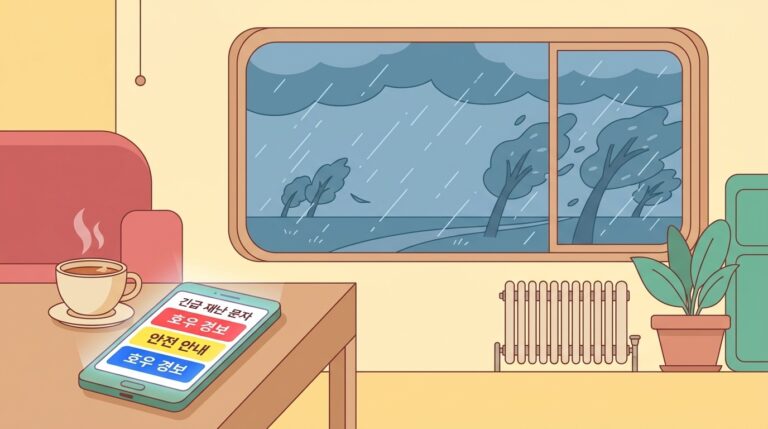
Stay Safe Indoors! Mastering Korean Typhoon News and Weather Alerts Like a Local
Phase 1: Empathy (Welcome to Daily Hangul!)
안녕하세요! Welcome back to Daily Hangul, your friendly neighborhood Korean language and culture guide. I’m your chief editor, and today we are tackling a situation that can feel incredibly daunting if you aren’t prepared: understanding Korean emergency weather broadcasts.
Imagine this: You are cozying up in your Seoul apartment, planning a weekend trip to Busan, when suddenly—BEEEEEP! Your phone screen flashes bright red with a blaring emergency alert. You tune into the news, and the anchor is speaking rapid-fire Korean with complex graphics on the screen.
One of our intermediate (B1) students, Sophie, recently shared her panic during last summer’s typhoon season. “I knew the word for ‘rain’ (비), but the news anchor was using words I’d never heard in my textbooks. I couldn’t tell if I needed to evacuate or just close my windows!”
That is a classic Korean learning pain point. Textbook Korean teaches you about “nice weather” (날씨가 좋습니다), but real life requires you to understand high-stakes safety reports. Today, we’re going to break down the essential news vocabulary and cultural nuances so that the next time a typhoon approaches, you will react with absolute confidence and safety.
Phase 2: Deep Dive into 3 Key Expressions
1. 태풍이 북상하고 있습니다 (Tae-pung-i buk-sang-ha-go is-seum-ni-da)
- Pronunciation: Tae-pung-ee buuk-sang-ha-go eet-seum-nee-da (Sounds like “tae-pung” + “book-sahng” + “ha-go” + “it-sum-ni-da”)
- Meaning: The typhoon is moving northward.
- K-Culture Moment: This is the ultimate headline phrase. You will see this text scrolling across the bottom of K-Drama broadcasts or interrupting your favorite variety shows as an emergency crawl.
- Editor’s Insight: The word 북상 (buk-sang) literally means “northward ascent” (북 = North + 상 = Up). Because typhoons heading toward the Korean Peninsula originate in the warmer southern waters, they almost always “move north” to reach Korea.
- Situation Spectrum: Casual 🚫 | Semi-formal ⚠️ | Formal ✅ (Strictly used in news reports or public safety announcements)
- 🤔 Think About It: In English, we say “the storm is coming.” In Korean, the exact geographical direction (북상) is embedded in the verb. Why do you think Korean news emphasizes physical geography so precisely?
2. 영향권에 접어들다 (Yeong-hyang-gwon-e jeob-eo-deul-da)
- Pronunciation: Yeong-hyang-gwon-eh jeob-uh-deul-da (Sounds like “yung-hyahng-gwon” + “jup-uh-deul-da”)
- Meaning: To enter the zone of influence (impact zone).
- K-Culture Moment: Weather reporters standing in raincoats on the docks of Jeju Island will shout, “제주도가 태풍 영향권에 접어들었습니다!” (Jeju Island has entered the typhoon’s zone of influence!)
- Editor’s Insight: 영향 (yeong-hyang) means “influence” and 권 (gwon) means “zone/boundary.” Together with the verb 접어들다 (jeob-eo-deul-da), which means “to enter into/step into,” it paints a vivid picture of a region crossing the physical boundary into danger.
- Situation Spectrum: Casual ⚠️ | Semi-formal ✅ | Formal ✅ (You can use this with friends to say, “We are in the rain zone now!”)
- 🤔 Think About It: How does thinking of a storm as having a “circle of influence” (영향권) change how you visualize its reach compared to just saying “it’s going to rain here”?
3. 외출을 자제해 주시기 바랍니다 (Oe-chul-eul ja-je-hae ju-si-gi ba-ram-ni-da)
- Pronunciation: Weh-chul-eul jah-jeh-hae ju-see-gee bah-rahm-nee-da
- Meaning: Please refrain from going outside.
- K-Culture Moment: Sent via SMS alerts (재난문자) to millions of citizens simultaneously when winds pick up.
- Editor’s Insight: This uses extremely polite, formal request grammar. 자제하다 (ja-je-hada) means “to exercise self-restraint/refrain.” Instead of saying “Don’t go out!” (나가지 마세요), public officials use this highly respectful phrase to encourage civic cooperation.
- Situation Spectrum: Casual 🚫 | Semi-formal ✅ | Formal ✅
- 🤔 Think About It: Korean public safety warnings rely heavily on voluntary civil cooperation rather than aggressive demands. How does this soft but firm phrasing reflect Korean social harmony?
Phase 3: Textbook Korean vs. Real-Life Korean
When heavy storms hit, native speakers rarely sound like a standard grammar textbook. Let’s look at how Koreans actually talk during typhoon season.
Situation 1: Describing the Heavy Rain
- 📖 Textbook Korean: “비가 많이 옵니다.” (It is raining a lot.)
- 🗣️ Real-Life Korean: “비가 아주 억수같이 쏟아져요.” (The rain is pouring down like a torrent/bucketloads!)
- 💡 Why the difference? 억수 (eok-su) refers to a massive, unstoppable downpour. Comparing rain to “eok-su” tells your listener that stepping outside will get them instantly soaked.
Situation 2: Checking on a Friend
- 📖 Textbook Korean: “태풍 때문에 괜찮습니까?” (Are you okay because of the typhoon?)
- 🗣️ Real-Life Korean: “태풍 오는데 별일 없으시죠?” (Nothing bad is happening with the typhoon coming, right? / Hope you’re keeping safe!)
- 💡 Why the difference? 별일 (byeol-il) means “unusual or bad event.” Asking “별일 없으시죠?” is the warmest, most natural way to check on someone’s safety and well-being during stressful times.
Phase 4: K-Culture Deep Dive & Non-verbal Manners
4-1. The “Safety-First” Digital Community
During typhoons in Korea, safety is a shared community effort. If you are chatting on KakaoTalk, it is customary to share weather updates with friends, colleagues, and family. If an elder warns you to stay indoors, the proper physical response is a deep nod of appreciation for their concern, accompanied by: “걱정해 주셔서 감사합니다. 안전하게 집에 있을게요.” (Thank you for worrying about me. I will stay safely at home.)
4-2. The “Jaenan Munja” (재난문자) Phenomenon
If you live in or travel to Korea, you will experience the sudden, synchronized screech of phones in public places during high-wind alerts. These are 재난문자 (jaenan-munja / emergency disaster alerts). In K-Dramas, you’ll often see characters look at their phones in unison. Knowing how to quickly read these alerts is essential for navigating Korean urban life during the summer months (July to September).
Phase 5: Real-Life Roleplay Scenario
- Background: Ji-won (지지원) is calling her foreign friend Alex (알렉스) to make sure he knows about the upcoming typhoon and cancels his outdoor plans.
[Scene: Ji-won calls Alex on the phone as wind starts howling outside]

지원: 알렉스 씨, 뉴스 봤어요? 지금 태풍이 북상하고 있대요.
      (Alex, did you see the news? They say a typhoon is moving north right now.)
      🎭 [걱정스러운 목소리로 / In a worried tone]

알렉스: 아, 정말요? 오늘 저녁에 한강공원 가려고 했는데 어떡하죠?
        (Oh, really? I was planning to go to Han River Park this evening, what should I do?)
        🎭 [당황하며 / Flustered]

지원: 오늘 밤부터 서울이 태풍 영향권에 접어든대요.
      (They say Seoul will enter the typhoon's zone of influence starting tonight.)
      🎭 [진지하게 설명하며 / Explaining seriously]

알렉스: 영향권이요? 비가 아주 많이 온다는 뜻인가요?
        (Zone of influence? Does that mean it will rain heavily?)
        🎭 [고개를 갸웃거리며 / Tilting head in curiosity]

지원: 네, 뉴스에서 오늘 밤에는 외출을 자제해 달라고 하더라고요.
      (Yes, the news said to refrain from going outside tonight.)
      🎭 [뉴스를 가리키는 손짓을 하며 / Gesturing towards the TV]

알렉스: 그렇군요. 그럼 오늘 약속은 취소하고 집에 있는 게 안전하겠네요.
        (I see. Then it would be safer to cancel today's plans and stay home.)
        🎭 [안도의 한숨을 쉬며 / Sighing with relief]

지원: 맞아요. 창문 꼭 닫고 배달 음식도 오늘은 안 시키는 게 좋아요.
      (Right. Make sure to close your windows tightly, and it's better not to order delivery today either.)
      🎭 [신신당부하며 / Advising earnestly]

알렉스: 알려줘서 고마워요, 지원 씨! 조심해야겠어요.
        (Thanks for letting me know, Ji-won! I should be careful.)
        🎭 [미소를 지으며 / Smiling with gratitude]
🔀 Interactive Branching Point
The storm is getting worse. What should Alex do next?
- Option A: Stay indoors, make Korean savory pancakes (부침개), and watch K-Dramas.
- Feedback (Best): Perfect choice! Koreans traditionally eat savory pancakes (부침개/전) when it rains because the sizzling sound matches the sound of pattering rain. You are perfectly safe and culturally integrated!
- Option B: Quickly run to the Han River anyway to feel the strong wind.
- Feedback (Bad): High risk! The Han River areas flood incredibly fast during typhoons. Public parks are blocked off for safety. Do not go!
- Option C: Order a warm bowl of Jjajangmyeon through a delivery app because you don’t want to cook.
- Feedback (Risk): It is highly recommended not to order delivery during severe storms to protect the safety of motorcycle delivery riders (라이더님). Many apps shut down services during extreme weather anyway.
Phase 6: 10-Second Emotion Shadowing Drill
Practice matching the exact rhythm and emotional weight of a native speaker. Pause at the slashes (/).
- 태풍이 / 북상하고 / 있대요!
- [😰 Anxious & Urgent]
- Tae-pung-i / buk-sang-ha-go / eet-dae-yo!
- 오늘 밤에는 / 외출을 / 자제해 주세요.
- [⚠️ Firm & Instructive]
- O-neul bam-e-neun / oe-chul-eul / ja-je-hae ju-se-yo.
Phase 7: K-Culture Mini Dictionary
- 재난문자 (Jaenan-munja) | Emergency Disaster Alert | Crucial warning messages pushed to mobile devices based on your GPS location during floods, heatwaves, or typhoons.
- 대비하다 (Daebi-hada) | To prepare/brace for | Used when securing loose items outside or taping windows before a heavy storm.
- 휴강 (Hyugang) | Class cancellation | University lectures that are canceled due to severe weather conditions.
- 서행 (Seohaeng) | Driving slowly | Road signs warning drivers to reduce speed to prevent hydroplaning during heavy downpours.
Phase 8: Traveler’s Survival Kit
Survival Expressions TOP 3
- “지금 지하철 정상 운행하나요?”
- Ji-geum ji-ha-cheol jeong-sang un-haeng-ha-na-yo?
- Pro Tip: Use this to ask station workers if the subway trains are running normally during heavy rains.
- “우산 어디서 살 수 있어요?”
- U-san eo-di-seo sal su is-seo-yo?
- Pro Tip: If caught in a sudden storm, head to any convenience store (GS25, CU, Seven-Eleven) to buy a sturdy umbrella.
- “날씨 때문에 예약을 취소할 수 있을까요?”
- Nal-ssi ttae-mun-e ye-yak-eul chwi-so-hal su is-seul-kka-yo?
- Pro Tip: Useful when calling hotels, KTX trains, or experiences to ask for weather-related refunds.
📝 Editor’s Travel Note
Always download the Weather Administration App or use Naver Map to check real-time subway and bus delays during storm season. If public transit stalls, booking a taxi via the Kakao T App is your safest bet, though wait times may be longer.
Phase 9: “One Step Deeper” (Cultural Insight)
In Korea, natural disasters bring out a strong sense of 우리 (Uri – “We/Our” collective consciousness). When typhoons hit, you will see a collective societal shift: delivery orders are self-regulated to protect riders, store owners help neighbors secure their entryways, and citizens actively post real-time safety updates online for strangers. It is a beautiful display of Korean civic mindfulness.
💬 Your Turn: How does your home country handle severe weather alerts? Let us know in the comments below!
Phase 10: FAQ & Common Mistakes
Q: What is the difference between 태풍 (taepung) and 비바람 (bibaram)?
A: 태풍 is the official scientific term for a typhoon (tropical cyclone). 비바람 is a descriptive word meaning “rain and wind” (비 = rain + 바람 = wind). You’ll hear “비바람이 칩니다” to describe the immediate stormy sensation outside.
Q: Why do Koreans tape tape or wet newspapers to windows during storms?
A: This is a traditional safety trick (태풍 대비 창문) to prevent glass windows from shattering under high wind pressure. Though newer apartments have reinforced windows, older buildings still practice this.
Q: What should I say to my Korean friends to wish them safety during a storm?
A: You can text them: “태풍 조심하시고 안전한 하루 보내세요!” (Be careful of the typhoon and have a safe day!)
🚨 Common Mistake Warning!
- Incorrect: “태풍을 피하세요!” (Avoid the typhoon! – sounds too dramatic, like running away from a movie monster.)
- Correct Action: Use “태풍 조심하세요” (Be careful of the typhoon) or “안전에 유의하세요” (Pay attention to your safety) for a natural, caring tone.
Phase 11: Action Mission
- 🥉 Bronze: Read the Phase 5 roleplay out loud once.
- 🥈 Silver: Write down “태풍 조심하세요” in your journal and try speaking it with a friend.
- 🥇 Gold: The next time it rains heavily, post a story on Instagram with the caption: “비가 억수같이 쏟아지네요!”
Phase 12: Interactive Quiz Challenge
Test your knowledge with these three quick questions!
1. What does “영향권” mean in weather news?
* A) Wind speed
* B) Zone of influence / Impact zone
* C) Flood warning
2. Fill in the blank: “오늘 밤에는 외출을
______해 주시기 바랍니다.”
* A) 대비 (Daebi)
* B) 자제 (Jaje)
* C) 북상 (Buksang)
3. True or False: You should order lots of food delivery during a severe typhoon to support local restaurants.
* True / False
🎉 Click to Reveal Answers & Explanations!
- Answer: B. 영향권 means “zone of influence.”
- Answer: B. 자제 (self-restraint) completes the official request “Please refrain from going outside.”
- Answer: False. It’s a respectful custom in Korea to refrain from ordering delivery during severe typhoons to protect the safety of delivery drivers.







