

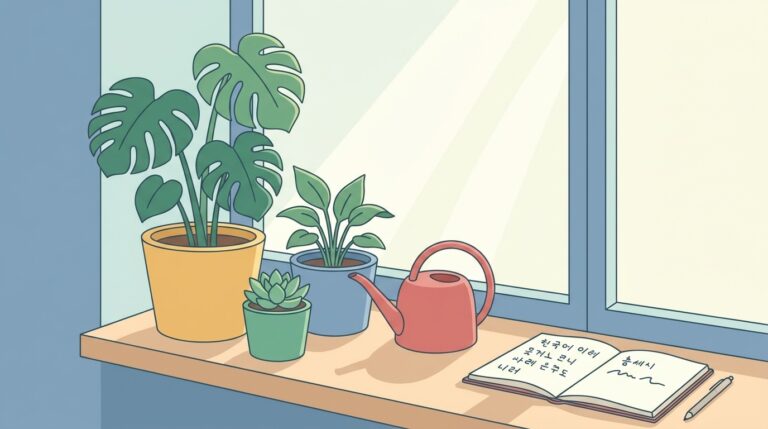
Meet Your Green Roommate: How to Talk About Plant Parenting in Korean Like a Pro
Phase 1: Empathy (스토리 몰입형 오프닝)
안녕하세요! Welcome back to another cozy corner of Daily Hangul, where we bring your Korean language skills to life through the lens of modern Korean culture. I’m your resident guide and senior editor.
Have you noticed how your social media feed has lately been painted green? If you’ve been watching K-style daily vlogs (브이로그) or looking at trendy studio apartments (원룸) in Seoul on Instagram, you’ve likely spotted Monsteras, pileas, and tiny succulents occupying pride of place on wooden desks and sunny windowsills.
In Korea, home gardening has evolved from a simple hobby into a full-blown cultural phenomenon known as 반려식물 키우기 (Companion Plant Parenting). But when you want to share this green passion with your Korean friends, simply saying “나는 식물을 좋아해요” (I like plants) feels a bit… barren, doesn’t it?
Maybe you’ve struggled to explain that your plant is droopy, or you wanted to ask if a plant needs indirect sunlight, only to find yourself searching for words in vain. Don’t worry! This guide is built based on real feedback from our B2-level learners who wanted to talk about their hobbies with more emotional depth. By the end of this article, you’ll not only master natural-sounding Korean plant vocabulary, but you’ll also understand the deep emotional connection young Koreans have with their green companions. Let’s dig in!
Phase 2: Core Expressions (핵심 표현 3선 심층 분석)
Let’s look at three highly useful, native-level terms that will immediately upgrade your conversations from “textbook-stiff” to “expert plant parent.”
1. 반려식물 (Bal-ryeo-sik-mul)
- Pronunciation: [Bahl-yuh-sheek-mool] (Rhymes with the “ul” in culture)
- Meaning: Companion Plant (Literal: Partner Plant)
- K-Culture Moment: You’ll see this word all over lifestyle television shows and modern K-dramas. When characters live alone in Seoul’s busy districts, they often introduce their “companion plant” to visitors as if introducing a pet.
- Editor’s Insight: Just as pets are called 반려동물 (bal-ryeo-dong-mul – companion animals), adding the prefix “반려” (companion/partner) to “식물” (plant) elevates its status from simple home decor to a member of the family. It implies you talk to it, worry about it, and care for it emotionally.
- Situation Spectrum: Casual (✅) | Semi-formal (✅) | Formal (✅)
- 🤔 Think About It: How does naming a plant “companion” change the way you care for it? Do you have a banryeo-singmul at home?
2. 분갈이하다 (Bun-gal-i-ha-da)
- Pronunciation: [Boon-gahl-ee-hah-dah] (Think of “boon” as in boon docks, and “gal-i” as gahl-ee)
- Meaning: To repot a plant (Literal: to change the pot)
- K-Culture Moment: Saturday mornings on Korean lifestyle vlogs often feature the aesthetic, therapeutic routine of spreading newspapers on the floor to do some “분갈이” while listening to indie lo-fi music.
- Editor’s Insight: “분” (盆) refers to a pot, and “갈이” comes from “갈다”, meaning to change or replace. Since plant parenting is all about growth, telling someone “이 화분 분갈이할 때가 됐어요” (It is time to repot this plant) shows a highly advanced grasp of practical gardening Korean.
- Situation Spectrum: Casual (✅) | Semi-formal (✅) | Formal (✅)
- 🤔 Think About It: Do you find the physical act of repotting therapeutic or just messy?
3. 물이 마르다 / 물을 주다 (Mul-i ma-reu-da / Mul-eul ju-da)
- Pronunciation: [Mool-ee mah-reuh-dah] / [Mool-eul joo-dah]
- Meaning: The soil/water dries out / To water (give water)
- K-Culture Moment: If you visit a plant shop in Yeonnam-dong or Seongsu-dong, the aesthetic care cards attached to the pots almost always say: “겉흙이 마르면 물을 듬뿍 주세요” (When the topsoil dries out, give it plenty of water).
- Editor’s Insight: Learners often translate “when the soil is dry” literally as “흙이 건조할 때”. While not incorrect, native speakers naturally use “마르다” (to dry/evaporate). Specifically, “겉흙” (geot-heulk) refers to the topsoil, and “속흙” (sok-heulk) refers to the soil inside.
- Situation Spectrum: Casual (✅) | Semi-formal (✅) | Formal (✅)
- 🤔 Think About It: Is your watering style systematic (on a scheduled day) or intuitive (checking if the soil is dry)?
Phase 3: Textbook vs. Real Korean (교과서 한국어 vs 진짜 한국어)
Let’s compare the stiff expressions found in standard curriculum books with the lively, natural language Koreans actually use.
Situation 1: Describing a plant that is losing its vitality
- 📖 교과서 한국어: 식물이 죽어가고 있어요. (The plant is dying.)
- 🗣️ 진짜 한국어: 식물이 요즘 힘이 없고 시들시들해요. (The plant has no energy lately and is drooping/wilting.)
- 💡 왜 다를까? Saying a plant is “죽어가고 있다” sounds incredibly grim and clinical. Koreans prefer using the expressive mimetic word 시들시들하다 (to be wilting slowly/drooping) or describing it as having “no strength/energy” (힘이 없다), which sounds much more affectionate and realistic for a plant that just needs a little extra love.
Situation 2: Proudly identifying yourself as a plant lover
- 📖 교과서 한국어: 저는 식물 키우는 것을 아주 좋아합니다. (I like growing plants very much.)
- 🗣️ 진짜 한국어: 저 요즘 완전 ‘식집사’ 다 됐어요! (I’ve completely become a ‘plant butler’ lately!)
- 💡 왜 다를까? While the textbook version is grammatically flawless, it lacks personality. Modern Korean pop culture uses the slang 식집사 (Sik-jip-sa)—a combination of 식물 (plant) and 집사 (butler), playfully implying that you are a humble servant catering to your plants’ every whim, much like a “cat butler” (고양이 집사).
Phase 4: K-Culture Deep-Dive & Non-Verbal Etiquette
4-1. 눈치 (Nunchi) & Plant Etiquette
If you are invited to a Korean’s home and they proudly show off their plant collection, a great way to show nunchi (tact/situational awareness) is to avoid touching the 새순 (sae-sun – new shoots/baby leaves). New leaves are highly delicate, and touching them can stun their growth. Instead, tilt your head slightly, gently support a mature leaf from underneath without squeezing, and say:
“어머, 사랑을 많이 받고 자란 게 티가 나네요!” (Oh my, it really shows that it grew up receiving a lot of love!)
4-2. The Cultural Phenomenon: 식멍 (Sik-meong)
Have you heard of “멍때리다” (meong-ttae-ri-da), which means to zone out or blankly stare into space to clear your mind? In Korea, this has turned into various relaxation trends: “불멍” (staring at a campfire) and “물멍” (staring at a fish tank). Now, stressed-out urbanites embrace 식멍 (Sik-meong) – staring blankly at green plants. It is highly praised as a mental health practice in busy cities like Seoul, where green spaces can be scarce.
Phase 5: Real-Life Roleplay (실전 롤플레이 시나리오)
Setting: A warm, sunlit boutique plant shop in Yeonnam-dong, Seoul.
Characters:
* 지우 (Ji-woo): The friendly shop owner and seasoned “식집사” who treats plants like her children.
* Sarah: An intermediate Korean learner who is struggling to keep her Monstera alive.
지우: 안녕하세요! 어서 오세요. 편하게 둘러보세요.
      (Hello! Welcome. Please feel free to look around.)

Sarah: 🎭 (조금 걱정스러운 표정으로)
       저... 사장님, 여쭤볼 게 있어서 왔는데요.
       (Um... owner, I came because I have something to ask.)

지우: 네, 어떤 것든 물어보세요! 반려식물이 아픈가요?
      (Yes, ask me anything! Is your companion plant sick?)

Sarah: 맞아요. 우리 집 몬스테라 잎이 자꾸 노랗게 변하고 시들시들해요.
       (That's right. My Monstera's leaves keep turning yellow and drooping.)

지우: 아하, 잎이 노랗게 변하는 건 대개 물을 너무 많이 주셨거나 통풍이 안 돼서 그래요. 보통 물은 어떻게 주셨어요?
      (Ah, leaves turning yellow is usually because of overwatering or poor ventilation. How have you been watering it?)

Sarah: 🎭 (멋쩍게 웃으며)
       그냥 일주일에 한 번씩 날짜 맞춰서 듬뿍 줬어요.
       (I just watered it thoroughly once a week on a set schedule.)

지우: 겉흙이 마르기 전에 물을 계속 주면 뿌리가 썩을 수 있어요. 과습이 온 것 같네요.
      (If you keep watering before the topsoil dries, the roots can rot. It seems like it's overwatered.)

Sarah: 아, 과습이군요! 그럼 이제 어떻게 해야 하나요?
       (Ah, overwatering! Then what should I do now?)

지우: 우선 당분간 물주기를 멈추시고 통풍이 잘 되는 창가에 두세요. 흙이 바짝 마를 때까지 기다려야 해요.
      (First, stop watering for a while and place it by a well-ventilated window. You must wait until the soil is completely dry.)
🔀 Interactive Choice Point
How should Sarah respond to Ji-woo’s advice to show her gratitude and intermediate Korean skills?
- Choice A: “알겠습니다. 그냥 내버려 둘게요.” (Got it. I’ll just leave it alone.)
- Choice B: “아, 통풍이 중요하군요. 알려주신 대로 창가에 두고 신경 써서 지켜볼게요. 감사합니다!” (Ah, ventilation is important. I’ll place it by the window as you said and keep a close eye on it. Thank you!)
- Choice C: “몬스테라가 죽으면 어떡하죠? 새 식물로 바꿔 주세요.” (What if the Monstera dies? Please exchange it for a new plant.)
💡 Feedback on Your Choice
- Choice A (Risk): Too blunt. It might sound like you don’t care about the plant or the owner’s warm advice.
- Choice B (Best): Perfect! It repeats the key vocabulary (통풍, 창가), shows your intention to actively care for the plant (신경 써서 지켜볼게요), and politely thanks the owner. This is true B2 level natural flow!
- Choice C (Bad): Extremely rude. It lacks empathy for the plant and sounds demanding, which violates Korean polite social norms.
Phase 6: 10-Second Emotion Shadowing (10초 감정 섀도잉 드릴)
To sound natural, you need to practice pausing and putting emotion into your words. Try reading these sentences aloud, paying attention to the / (pauses) and the emotional cues.
- [🥺 Expressing worry about a sick plant]
- “우리 집 / 반려식물이 / 요즘 시들시들해서 / 너무 걱정이에요.”
- [U-ri jip / bal-ryeo-sing-mu-ri / yo-jeum si-deul-si-deul-hae-seo / neo-mu geop-jeong-i-e-yo.]
- My companion plant is drooping lately, so I’m really worried.
- [😊 Expressing joy over a new leaf]
- “대박! / 드디어 / 귀여운 새순이 / 돋았어요!”
- [Dae-bak! / deu-di-eo / gwi-yeo-un sae-su-ni / do-dat-seo-yo!]
- No way! Finally, a cute new shoot has sprouted!
Phase 7: K-Culture Mini Dictionary (핵심 키워드 4개)
- 식집사 (Sik-jip-sa) | Plant Butler
- A trendy blend of “식물” (plant) and “집사” (butler). Used by people who dedicatedly care for their plants like treasured pets.
- 식멍 (Sik-meong) | Plant-gazing
- The act of zoning out while staring at plants to find mental peace and relieve daily stress.
- 과습 (Gwa-seup) | Overwatering
- A botanical term (excess moisture) heavily used by Korean plant lovers to describe the tragic state of root rot due to over-watering.
- 분갈이 (Bun-gal-i) | Repotting
- The process of changing a plant’s soil and moving it to a bigger pot to allow healthier root growth.
Phase 8: Traveler’s Survival Kit (여행자를 위한 생존 키트)
If you are visiting beautiful plant shops in Seoul (like those in Hannam-dong or Mapo) or visiting a botanical cafe, here are some survival phrases:
Survival Expressions
- “초보자가 키우기 쉬운 식물 추천해 주세요.”
- [Cho-bo-ja-ga ki-u-gi swi-un sing-mul chu-cheon-hae ju-se-yo.]
- Pro Tip: Use this to ask for a beginner-friendly plant recommendation.
- “이 식물은 햇빛을 많이 받아야 하나요?”
- [I sing-mu-reun haet-bi-cheul ma-ni ba-da-ya ha-na-yo?]
- Pro Tip: Ask this to know if the plant requires direct sunlight.
- “인테리어용으로 선물하기 좋은 화분이 있을까요?”
- [In-te-ri-eo-yong-eu-ro seon-mul-ha-gi jo-eun hwa-bu-ni is-seul-kka-yo?]
- Pro Tip: Perfect for when you want to buy a potted plant as a housewarming gift for a friend.
Editor’s Travel Note
When traveling in Seoul, search for “식물 카페” (Plant Cafes) or “플라워 카페” (Flower Cafes) on the 네이버 지도 (Naver Map) app. Places like Ver’s House in Yeonnam-dong offer coffee surrounded by lush interior forestry, letting you enjoy ultimate “식멍” while practicing your Korean readings!
Phase 9: “한 발 더 깊이” (Deep Dive Thought)
In a fast-paced society like South Korea, where the rate of single-person households (1인 가구) is skyrocketing, loneliness and urban burnout are common challenges. Unlike pets, companion plants don’t make noise, don’t require expensive vet bills, and grow in quiet resilience.
By treating plants as “반려” (companions), young Koreans are finding a silent but deeply rewarding emotional anchor. It’s a beautiful reflection of how language adapts to meet the psychological needs of its speakers.
💬 Your Turn: Do you talk to your plants? Do you think of them as mere decorations, or do they feel like quiet housemates? Let us know in the comments below!
Phase 10: FAQ & Common Mistakes (FAQ & 오해 방지)
Q: Can I use “반려식물” to refer to garden vegetables like green onions or lettuce?
A: Generally, no. Vegetables grown for consumption are usually referred to as “텃밭 작물” (kitchen garden crops). “반려식물” implies a long-term emotional companion that you grow for aesthetic and mental bonding, not for eating!
Q: What is the difference between “화초” (hwa-cho) and “식물” (sing-mul)?
A: “식물” is the broad biological term for all plants. “화초” (flower and grass) specifically refers to decorative, small plants and flowers kept indoors. As a plant parent, you’ll use both, but “반려식물” is the modern, warmer term.
Q: How do I say “I have a green thumb” in Korean?
A: Koreans don’t use green thumbs! Instead, they say: “저는 식물을 잘 키워요” (I grow plants well) or jokingly say, “제 손은 금손이에요” (My hand is a gold hand / talented hand).
🚨 Common Mistakes Alert (외국인 흔한 실수 TOP 3)
- Mistake 1: Calling overwatering “물을 너무 많이 줬어요” in a professional context.
- Correct Action: Use the word 과습 (gwa-seup – overwatering) to sound much more natural and precise.
- Mistake 2: Using “나무” (tree) for all indoor potted plants.
- Correct Action: Unless it is a literal indoor tree (like a Ficus), refer to them as 화분 (potted plant) or 식물 (plant).
- Mistake 3: Saying “식물이 감기에 걸렸어요” (The plant caught a cold) when it’s sick.
- Correct Action: Plants don’t catch colds! Say “식물이 시들시들해요” or “상태가 안 좋아요” (Its condition is not good).
Phase 11: Action Mission & Engagement
Are you ready to take your learning out into the wild? Complete these three missions!
- 🥉 Bronze Mission: Go to your plant (or find one online), look at it, and say: “오늘도 힘내자!” (Let’s gain strength today too!)
- 🥈 Silver Mission: Take a photo of a plant and post it on Instagram with the hashtag #반려식물 and tag us @DailyHangul with a short Korean description like “우리 집 새순이 나왔어요!”
- 🥇 Gold Mission: Next time you visit a flower market or a local Korean plant shop, use the phrase “초보자가 키우기 쉬운 식물 추천해 주세요” to strike up a conversation with the owner!
- 🎮 K-Culture Mission: Watch a modern Korean slice-of-life drama or a vlog. Try to spot if a character has a plant in their room and check if they talk to it!
Phase 12: Interactive Quiz Challenge (퀴즈 챌린지)
Test your plant-parenting Korean knowledge below!
1. Situational Judgment
Your friend’s Monstera has yellowing, soggy leaves. What is the most likely diagnosis you should tell them?
* A) 통풍 (Ventilation)
* B) 과습 (Overwatering)
* C) 분갈이 (Repotting)
Reveal Answer & Explanation
Correct Answer: B) 과습 (Overwatering)
Yellowing and soggy leaves in indoor plants are almost always a sign of root rot due to overwatering (과습). You can advise them: “과습인 것 같아요. 물주기를 멈추세요!”
2. Fill in the Blank
Complete the sentence: “요즘 회사 일 때문에 스트레스가 많았는데, 주말에 화분들을 보며 ( )을 하니까 힐링이 돼요.”
* Hint: Staring blankly at plants for stress relief.
Reveal Answer & Explanation
Correct Answer: 식멍 (Sik-meong)
“식멍” is the trendy word for zoning out/gazing at plants to de-stress. Perfect fit for the context of healing!
3. True or False
True or False: If a plant has grown too big for its current pot, you should perform “분갈이” (Bun-gal-i).
Reveal Answer & Explanation
Correct Answer: True
Yes! When a plant gets too big, its roots get crowded, making it necessary to repot (분갈이하다) into a bigger vessel.







