

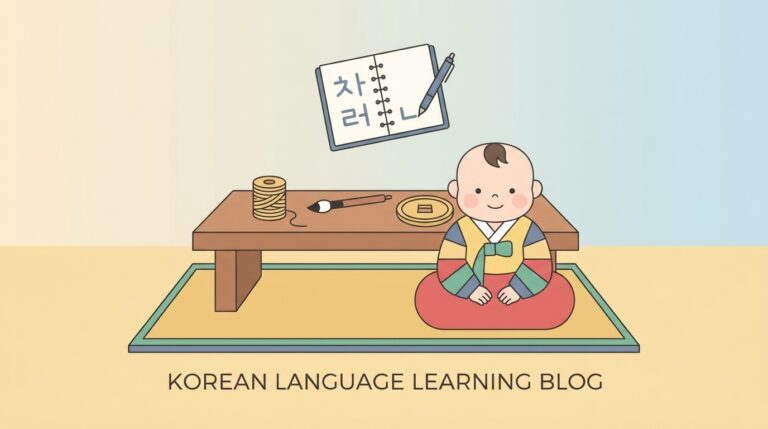
Celebrating Life’s First Major Milestone: The Magic of Korean Doljanchi and Doljabi
Phase 1: Welcome to the Ultimate Family Celebration!
안녕하세요! (Annyeonghaseyo!) I’m your lead editor and culture navigator at Daily Hangul. Have you ever scrolled through social media and seen a cute Korean baby dressed in a vibrant, royal-looking Hanbok (한복), sitting in front of a table stacked with thread, money, and mini-gavel? Or perhaps you’ve watched a K-drama where the entire family holds their breath as a toddler reaches for a stethoscope?
Welcome to Doljanchi (돌잔치)—the Korean first birthday celebration, and its absolute highlight, Doljabi (돌잡이)!
For many of my intermediate (B2) students, attending a Doljanchi for a friend’s baby is an incredibly heartwarming but slightly nerve-wracking experience. “Do I bow? What do I say to the parents? What on earth does the thread mean?” If you’ve asked these questions, you are in the right place. Today, we’ll dive deep into the beautiful linguistic nuances and cultural etiquettes of this centuries-old tradition so you can join the celebration like a true local!
Phase 2: Core Expressions Deep Dive
Let’s master three vital expressions you will hear constantly during a first birthday celebration.
1. 첫돌 (Cheot-dol)
- Pronunciation: chut-dol (sounds like the word “shut” but with a “ch” sound, followed by the English word “doll”)
- Meaning: First Birthday / First Anniversary of Birth
- K-Culture Moment: In family-centric K-dramas, you’ll often hear grandparents excitedly planning the “첫돌” months in advance, discussing whether to go traditional or modern.
- Editor’s Insight: While “생일” (saeng-il) is the general term for birthday, “첫돌” (or simply “돌”) is reserved exclusively for the monumental first birthday. In the past, due to high infant mortality rates, reaching the first year was a massive triumph of survival. Celebrating “첫돌” is a deep-seated prayer for the baby’s continuous safety.
- Situation Spectrum: Casual ✅ / Semi-formal ✅ / Formal ✅ (Perfect for any conversation about a baby’s first year!)
- 🤔 Think About It: Why does your culture celebrate the first birthday? Is there a specific milestone that holds as much historical weight as Cheot-dol does in Korea?
2. 돌잡이 (Dol-jabi)
- Pronunciation: doll-jah-bee (sounds like “doll” + “jah” as in jar + “bee” like the insect)
- Meaning: The fortune-telling grabbing game on a baby’s first birthday
- K-Culture Moment: This is the absolute peak of the Doljanchi. Guests gather around the table, taking bets on what item the baby will grab first.
- Editor’s Insight: The word comes from “돌” (first birthday) and “잡이” (grabbing/picking up, derived from the verb “잡다”). The baby is placed in front of a tray of symbolic items. Whichever item they grab first is said to predict their future career or life path.
- Situation Spectrum: Casual ✅ / Semi-formal ✅ / Formal ✅
- 🤔 Think About It: If you could place a modern object on a Doljabi table today (like a smartphone or a passport), what would it symbolize for the baby’s future?
3. 실을 잡다 (Sil-eul jap-da)
- Pronunciation: sheel-eul-jahp-dah (sounds like “sheel” + “eul” + “jahp” with a light ‘p’ hold + “dah”)
- Meaning: To grab the thread (symbolizing longevity)
- K-Culture Moment: When the baby reaches for a bundle of multi-colored or white thread, the entire room erupts into a collective, warm sigh of relief and cheers.
- Editor’s Insight: “실” (sil) means thread, and “잡다” (jap-da) means to grab. Historically, in an era of scarce medicine, living a long, healthy life (무병장수) was the ultimate blessing. Grabbing the thread is still considered one of the most traditional and cherished outcomes.
- Situation Spectrum: Casual ✅ / Semi-formal ✅ / Formal ⚠️ (Slightly colloquial, but perfectly understood in all celebration settings.)
- 🤔 Think About It: In our fast-paced digital age, why do you think Korean parents still value “long life” over “wealth” (represented by money) when their baby grabs the thread?
Phase 3: Textbook Korean vs. Real-Life Korean
Let’s compare stiff, textbook language with the living, breathing phrases you’ll actually hear at a modern Doljanchi venue.
Situation 1: Asking what the baby will choose
- 📖 Textbook Korean: “아기가 어떤 물건을 선택할 것이라고 생각합니까?” (What object do you think the baby will select?)
- 🗣️ Real-Life Korean: “아기가 뭐 잡을 것 같아요?” (What do you think the baby’s gonna grab?)
- 💡 Why is it different? The verb “선택하다” (to select/choose) is way too formal and academic for this playful moment. Real Koreans always use the active verb “잡다” (to grab) to keep the vibe energetic and lively.
Situation 2: Wishing the baby a healthy life
- 📖 Textbook Korean: “아이의 무병장수를 기원합니다.” (I pray for the child’s disease-free longevity.)
- 🗣️ Real-Life Korean: “건강하게만 자라다오!” (Just grow up healthy!)
- 💡 Why is it different? While the textbook phrase is grammatically correct, it sounds like an official speech. Parents and close guests use “-다오” (a warm, poetic imperative used by elders to children) to express a deep, affectionate wish that transcends formal grammar rules.
Phase 4: K-Culture Deep Dive & Non-verbal Manners
4-1. Read the Room: Doljanchi Etiquette
- The Clap and Cheer: When the baby is hesitating over the Doljabi tray, never make sudden, loud noises. It can scare the baby and lead to tears! Instead, lean in, make soft encouraging sounds, and clap gently.
- Handing over Cash (축의금): If you give a cash gift (highly expected), place it in a clean white envelope. Present it to the parents with both hands, with a slight head bow. Never slide it across the registration desk with one hand.
4-2. The Cultural Gavel
In K-dramas, you will often see characters joking about their career paths based on their Doljabi. For example, a lawyer character might have their old baby photos shown, with the parent proudly bragging, “He grabbed the pansabong (판사봉 – judge’s gavel) at his Doljanchi!” It represents a deeply rooted societal pride in intellectual and professional achievements.
Phase 5: Real-Life Roleplay Scenario
Setting: A beautiful banquet hall decorated with traditional screens. Ji-won (your close Korean friend) is hosting his son Min-jun’s first birthday party. Sarah (you, an intermediate learner) has just arrived.
🎭 Ji-won: (Holding a smiling baby in a tiny blue Hanbok, waving)
어라, 사라 씨! 와 주셔서 정말 감사해요!
[Eo-ra, Sa-ra ssi! Wa ju-shyeo-seo jeong-mal gam-sa-hae-yo!]
(Oh, Sarah! Thank you so much for coming!)

🎭 Sarah: (Beaming, bowing slightly)
초대해 주셔서 제가 더 감사하죠. 어머, 민준이가 한복 입으니까 진짜 천사 같네요!
[Cho-dae-hae ju-shyeo-seo je-ga deo gam-sa-ha-jyo. Eo-meo, Min-jun-i-ga han-bok ib-eu-ni-kka jin-짜 cheon-sa gat-nae-yo!]
(Thank you for inviting me. Oh my, Min-jun looks like a real angel in his Hanbok!)

🎭 Ji-won: (Laughing warmly, adjusting the baby’s silk hat)
다행히 오늘 기분이 좋아 보여요. 조금 있다가 바로 돌잡이 시작해요.
[Da-haeng-hi o-neul gi-bun-i jo-a bo-yeo-yo. Jo-geum it-da-ga ba-ro dol-ja-bi shi-jak-hae-yo.]
(Fortunately, he seems to be in a great mood today. We're starting the Doljabi in a bit.)

🎭 Sarah: (Curious, looking at the beautifully set table)
우와, 테이블에 신기한 게 많네요. 마이크도 있고 청진기도 있어요!
[U-wa, te-i-beul-e shin-gi-han ge manh-nae-yo. Ma-i-keu-do it-go cheong-jin-gi-do is-seo-yo!]
(Wow, there are so many interesting things on the table. There's a microphone and even a stethoscope!)

🎭 Ji-won: (Nodding proudly)
요즘은 직업이 다양해져서 그래요. 사라 씨는 민준이가 뭐 잡을 것 같아요?
[Yo-jeum-eun jik-eop-i da-yang-hae-jyeo-seo geu-rae-yo. Sa-ra ssi-neun Min-jun-i-ga mwo ja-beul geot gat-a-yo?]
(That's because careers are so diverse these days. Sarah, what do you think Min-jun will grab?)

🎭 Sarah: (Leaning closer, playfully whispering to the baby)
음... 돈을 잡아서 부자가 되면 좋겠지만, 저는 실을 잡고 건강하게 자랐으면 좋겠어요!
[Eum... don-eul jab-a-seo bu-ja-ga doe-myeon jo-ghet-ji-man, jeo-neun sil-eul jap-go geon-gang-ha-ge ja-rat-seu-myeon jo-ghet-seo-yo!]
(Hmm... grabbing money to become rich would be nice, but I hope he grabs the thread and grows up healthy!)

🎭 Ji-won: (Touched by the sincere wish)
정말 고마워요, 사라 씨. 자, 이제 돌잡이 시작하니까 앞쪽으로 오세요!
[Jeong-mal go-ma-wo-yo, Sa-ra ssi. Ja, i-je dol-ja-bi shi-jak-ha-ni-kka ap-jjok-eu-ro o-se-yo!]
(Thank you so much, Sarah. Alright, the Doljabi is starting now, so come up to the front!)

🎭 Sarah: (Clapping hands excitedly)
네! 민준아, 화이팅!
[Ne! Min-jun-a, hwa-i-ting!]
(Okay! Go Min-jun!)
🔀 Interactive Choice Point
During the Doljabi, Min-jun hesitates and then grabs a shiny 10,000 Won bill. What do you do?
* A) Laugh loudly, point your finger at the baby, and shout “He loves money!”
* B) Smile warmly, clap your hands with everyone, and say, “우와, 부자 되겠네!” (Wow, he’s going to be rich!)
* C) Stay completely silent and look confused because he didn’t pick the thread.
Feedback:
- Best Choice – B: Perfect! Celebrating the choice of money is highly positive in Korea as it represents financial ease and comfort. Saying “부자 되겠네!” matches the joyful mood perfectly.
- Risk Choice – A: While well-intentioned, pointing fingers at a baby or shouting too loudly can startle them and might seem slightly unrefined in a formal banquet hall.
- Bad Choice – C: Being silent might make the parents feel like you are not enjoying the party. Even if you preferred another item, join in the clapping!
Phase 6: 10-Second Emotion Shadowing Drill
Let’s practice speaking with real Korean emotions. Pay attention to the pauses (/) and the emotional cues!
- [😊 Filled with excitement and cheering]
“아이고, / 우리 민준이가 / 돈을 잡았네!”
Pronunciation: [Ai-go, / u-ri Min-jun-i-ga / don-eul ja-ban-ne!]
Meaning: “Oh my goodness, our Min-jun grabbed the money!” -
[🥺 Tearfully warm and affectionate]
“다른 건 필요 없고, / 건강하게만 / 자라다오.”
Pronunciation: [Da-reun geon pi-ryo eop-go, / geon-gang-ha-ge-man / ja-ra-da-o.]
Meaning: “Nothing else matters, just grow up healthy.”
Phase 7: K-Culture Mini Dictionary
- 돌상 (Dol-sang): The beautifully decorated ceremonial table set for the first birthday. It features seasonal fruits, traditional rice cakes (tteok), and the Doljabi tray.
- 청진기 (Cheong-jin-gi): Stethoscope. A popular modern Doljabi item. If grabbed, it predicts the baby will become a successful doctor or medical professional.
- 마이크 (Ma-i-keu): Microphone. Symbolizes becoming an entertainer, singer, or a famous modern content creator.
- 판사봉 (Pan-sa-bong): Judge’s gavel. Symbolizes entering the legal profession to become a judge or lawyer.
Phase 8: Traveler’s Survival Kit
Survival Expressions TOP 3
- “첫돌을 축하합니다!” [Cheot-dol-eul chuk-ha-ham-ni-da!]
- Pro Tip: Use this formal phrase when writing on the envelope of your cash gift.
- “돌잡이 언제 시작해요?” [Dol-ja-bi eon-je shi-jak-hae-yo?]
- Pro Tip: Use this to ask the staff or friends when the main event starts if you need to plan your food plate.
- “건강하고 밝게 자라길 바랄게!” [Geon-gang-ha-go balk-ge ja-ra-gil ba-ral-ge!]
- Pro Tip: Write this in a cute birthday card for the baby.
📝 Editor’s Travel Note
Most modern Doljanchi celebrations are held in professional buffet venues called “돌잔치 전문점”. If you are invited, make sure to use the Naver Map App to find the venue beforehand, as some are hidden inside massive multi-complex malls. If you cannot attend, it is highly polite to send a digital gold ring or gift card through KakaoTalk Gift! Note: Buffet prices and locations are subject to change depending on the season, so check the venue details on your invitation.
Phase 9: “One Step Deeper” (Cultural Reflection)
The Doljabi is a fascinating cultural mirror of South Korea’s rapid transformation. Generations ago, the table held only thread (for long life), rice/paper (for wealth), and a book/brush (for scholars). Today, you will see golf balls, computer mice, stethoscopes, and even passports.
While the objects change to reflect modern prestige and happiness, the core essence remains unchanged: a collectivist community gathering together to lay a path of blessings for a tiny, new member of society.
💬 Your Turn: If you had a Doljabi when you were a baby, what item do you think you would have grabbed? Tell me in the comments below!
Phase 10: FAQ & Mistake Prevention
Q: How much money should I put in the white envelope (축의금)?
A: Generally, if you are a casual friend or colleague, 50,000 to 10,0000 KRW is standard. If you are very close or attending with a partner, 100,000 to 150,000 KRW is highly recommended to offset the cost of the expensive buffet.
Q: Is there a dress code for attending a Doljanchi?
A: No strict dress code is enforced, but avoid wearing overly casual clothes like sweatpants or slippers. Smart casual—like a neat dress, blouse, or a clean collar shirt—is perfect.
Q: Can I buy a baby gift instead of giving cash?
A: Yes! Traditionally, Koreans gave a small 24k gold ring (돌반지) to secure the baby’s financial future. Today, high-quality baby clothes or organic skin care sets are also highly appreciated.
🚨 Common Mistakes Alert!
- Mistake: Handing cash directly to the parents’ hands without an envelope.
- Correct Action: Always buy a neat white envelope from a convenience store and put the money inside. Write your name vertically on the back-left side.
- Mistake: Making loud screaming noises to get the baby’s attention.
- Correct Action: Allow the professional host (MC) to guide the baby. Simply watch and smile gently.
- Mistake: Using extremely complex, formal business honorifics with the baby.
- Correct Action: Keep your wishes simple and filled with warm emotion like “건강하게만 자라줘!” (Just grow up healthy!).
Phase 11: Action Mission & Engagement
Let’s put this knowledge into action! Pick your level and try it today:
* 🥉 Bronze Mission: Practice pronouncing “건강하게만 자라다오!” out loud three times with your eyes closed, channeling the warmth of a loving guardian.
* 🥈 Silver Mission: Go to Instagram or YouTube, search for a cute #돌잡이 video, and leave a friendly comment in Korean: “첫돌을 축하해요! 너무 귀엽네요!”
* 🥇 Gold Mission: Ask your Korean friends or language exchange partners what item they grabbed at their Doljabi. You’ll be surprised at the funny stories they share!
Phase 12: Interactive Quiz Challenge
Test your knowledge of Korean first birthday traditions below!
1. Situational Judgment
Your Korean friend invites you to their child’s Doljanchi. You want to write a heartfelt congratulatory card. Which phrase is the most natural and warm?
* A) 생일 축하해, 일 열심히 해라! (Happy birthday, work hard!)
* B) 첫돌을 진심으로 축하하며, 건강하고 밝게 자라길 바랍니다. (Sincere congratulations on the first birthday, I hope you grow up healthy and bright.)
* C) 왜 돈을 잡지 않았어? 아쉽다! (Why didn’t you grab the money? What a pity!)
Show Answer & Explanation
Correct Answer: B
Explanation: B is highly respectful, warm, and appropriate for a card. A is too casual and weirdly tells a baby to work hard. C is highly impolite and ruins the celebratory mood!
2. Fill in the Blank
Complete the core expression: “우리 아기가 건강하게 자라길 바라는 마음에 실을 _________.”
* A) 던졌다 (threw)
* B) 잡았다 (grabbed)
* C) 버렸다 (threw away)
Show Answer & Explanation
Correct Answer: B (잡았다)
Explanation: The core action of Doljabi is “잡다” (to grab). Therefore, “실을 잡았다” means “grabbed the thread.”
3. True or False
Historically, the most important item on the Doljabi table was the computer mouse because Koreans always loved technology.
* True
* False
Show Answer & Explanation
Correct Answer: False
Explanation: Historically, thread (실) and rice (쌀) were the most important items, symbolizing longevity and abundant food, which were vital in agricultural times before modern technology existed.







