

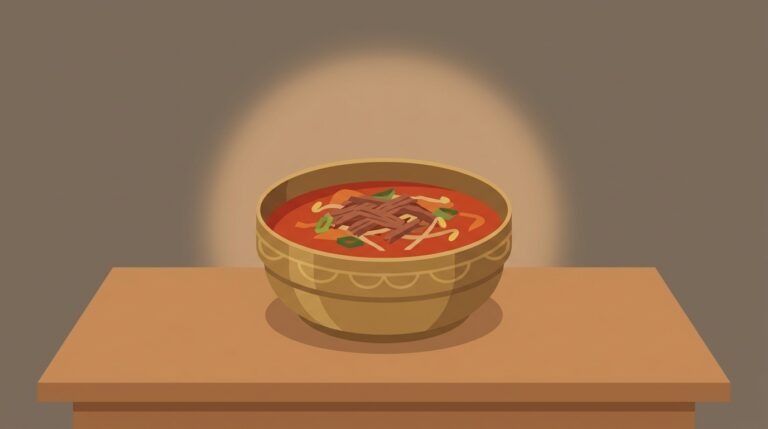
The Warm Bowl of Comfort: How to Eat Yukgaejang at a Korean Funeral Without Making a Mistake
Phase 1: Empathy (스토리 몰입형 오프닝)
안녕하세요! (An-nyeong-ha-se-yo!) Hello! It’s your friendly Daily Hangul editor here.
Imagine this: you are watching a K-Drama, and a character is sitting in a quiet, white-and-black funeral hall (장례식장 – Jang-rye-sik-jang). Instead of just weeping, they are sitting at a low table, eating a steaming, bright red bowl of spicy beef soup called Yukgaejang (육개장).
You might wonder: “Why are they eating spicy food at a funeral? Isn’t it disrespectful to eat so heartily during a time of grief?”
Many of our actual students have shared this exact worry: “I want to support my Korean friend at their family funeral, but I am terrified of doing something disrespectful at the food table!”
Take a deep breath! Eating together at a Korean funeral is actually a beautiful act of community and healing. Today, we’re going to navigate this unique K-Culture moment together. By the end of this guide, you will know exactly how to behave, what to say, and how to eat this comforting bowl of soup like a polite, culturally-savvy local.
Phase 2: Key Expressions (핵심 표현 3선 심층 분석)
Let’s learn three essential expressions you will hear or use around the funeral dining table.
1. 조금만 주세요 (Jo-geum-man ju-se-yo)
- Pronunciation: Joe-goom-mahn joo-seh-yo
- Meaning: “Please give me just a little.”
- K-Culture Moment: When entering the dining area, helpful volunteers (often neighborhood friends or family relatives) will start scoop-serving hot bowls of soup for you. If you are too sad or too full to finish a whole bowl, use this phrase.
- Editor’s Insight: Refusing food entirely at a Korean funeral can feel like rejecting the family’s hospitality. Saying “조금만 주세요” allows you to politely participate and show respect by accepting a smaller portion.
- Situation Spectrum: Casual ✅ / Semi-formal ✅ / Formal ✅
- 🤔 Think About It: In your culture, do people expect you to eat together when mourning, or do you grieve in private?
2. 건배하면 안 돼요 (Geon-bae-ha-myeon an dwae-yo)
- Pronunciation: Guhn-beh-hah-myuhn ahn dweh-yo
- Meaning: “You must not clink glasses (toast).”
- K-Culture Moment: Alcohol (usually Soju) is served at Korean funerals to help ease grief. While drinking is normal, clinking glasses and saying “Cheers!” is a huge taboo.
- Editor’s Insight: A toast (건배 – Geon-bae) is a celebratory gesture. Because a funeral is a place of mourning, you should drink quietly. If someone offers you a drink, accept it, but do not clink your glass against theirs.
- Situation Spectrum: Casual ✅ / Semi-formal ✅ / Formal ✅
- 🤔 Think About It: How do small gestures in your hometown change their meaning based on the atmosphere?
3. 잘 먹었습니다 (Jal meog-eot-seub-ni-da)
- Pronunciation: Jahl muhg-uht-seub-nee-dah
- Meaning: “I ate well / Thank you for the meal.”
- K-Culture Moment: You say this quietly to the family helpers or volunteers when you stand up to leave the dining table.
- Editor’s Insight: Even in a sad environment, thanking those who prepared the food shows excellent manners. Say this in a soft, low tone to maintain the respectful atmosphere.
- Situation Spectrum: Casual ⚠️ / Semi-formal ✅ / Formal ✅
- 🤔 Think About It: Why is saying “thank you” in a soft voice a powerful way to bring comfort to the hosts?
Phase 3: Textbook Korean vs. Real Korean (교과서 한국어 vs 진짜 한국어)
Situation 1: Offering condolences to your grieving friend
- 📖 Textbook Korean: 슬픔을 위로합니다. (Seul-peum-eul wi-ro-hap-ni-da.)
- Meaning: “I console your sadness.”
- 🗣️ Real Korean: 마음이 정말 아프시겠어요. (Ma-eum-i jeong-mal a-peu-si-get-eo-yo.)
- Meaning: “Your heart must ache so much.”
- 💡 Why the difference? The textbook expression is very stiff and grammatically distant. The real-life version feels warm, deeply empathetic, and uses simple A2-level words to express genuine comfort.
Situation 2: Asking the table servers for more side dishes
- 📖 Textbook Korean: 반찬을 더 주십시오. (Ban-chan-eul deo ju-sip-si-o.)
- Meaning: “Give me more side dishes.”
- 🗣️ Real Korean: 여기 반찬 조금만 더 주실 수 있어요? (Yeo-gi ban-chan jo-geum-man deo ju-sil su it-eo-yo?)
- Meaning: “Could I have a little more side dishes here, please?”
- 💡 Why the difference? Funerals require humble, soft, and polite speech. The textbook command sounds too demanding, whereas the real-life question is polite and humble.
Phase 4: K-Culture Deep Dive & Non-verbal Manners (비언어적 매너)
4-1. 눈치 (Nunchi) & Table Gestures
- The Two-Hand Rule: If a friend or elder pours Soju or water for you, always hold your cup with two hands.
- Keep it Low: Maintain a quiet speaking volume. It is okay to talk about fond memories of the deceased, but loud laughing or shouting is highly inappropriate.
- Slippers Matter: You will take off your shoes before entering the bowing and dining areas. Make sure you wear clean, dark-colored socks with no holes!
4-2. The Cultural Mystery: Why Yukgaejang?
- The Red Protector: In traditional Korean folklore, the bright red color of the chili oil in Yukgaejang (육개장) was believed to ward off evil spirits (귀신 – Gwi-sin) and bad luck, protecting the guests who came to mourn.
- Practical Fuel: Korean funerals traditionally last for three continuous days. Grieving families and guests spend sleepless nights. Yukgaejang is packed with beef, scallions, and spicy broth, providing much-needed energy to exhausted visitors.
Phase 5: Real-Life Roleplay Scenario (실전 롤플레이 시나리오)
Setting: You are sitting with your Korean friend, Minho, at a funeral dining hall. A bowl of hot Yukgaejang and a bottle of Soju are on the table.
- Minho: 존 씨, 많이 힘들었죠? 배고플 텐데 얼른 먹어요.
(John-ssi, ma-ni him-deul-eot-jyo? Bae-go-peul ten-de eol-reun meog-eo-yo.)
“John, it must have been a tough day. You must be hungry, eat up.” - John: 🎭 (Speaking softly and bowing head) 네, 고마워요. 잘 먹겠습니다.
(Ne, go-ma-wo-yo. Jal meog-eot-seub-ni-da.)
“Yes, thank you. I will eat well.” - Minho: 🎭 (Pouring Soju into John’s small glass) 한잔 마실래요? 마음이 좀 편해질 거예요.
(Han-jan ma-sil-rae-yo? Ma-eum-i jom pyeon-hae-jil geo-yeo-yo.)
“Would you like a drink? It might comfort your mind a bit.” - John: 🎭 (Holding the glass respectfully with two hands) 네, 고맙습니다.
(Ne, go-map-seub-ni-da.)
“Yes, thank you.” - Minho: 🎭 (Lifting his glass slightly, but not moving it forward to clink) 자, 마셔요.
(Ja, ma-syeo-yo.)
“Here, let’s drink.” - John: 🎭 (Noticing Minho keeping his glass close) 어? 건배는 안 해요?
(Eo? Geon-bae-neun an hae-yo?)
“Oh? We don’t toast?” - Minho: 아, 장례식장에서는 건배하면 안 돼요. 그냥 마시는 거예요.
(Ah, jang-rye-sik-jang-e-seo-neun geon-bae-ha-myeon an dwae-yo. Geu-nyang ma-si-neun geo-ye-yo.)
“Ah, you shouldn’t toast at a funeral. We just drink quietly.” - John: 아, 그렇군요. 몰랐어요. 조심할게요.
(Ah, geu-reoh-gun-yo. Mol-ras-eo-yo. Jo-sim-hal-ge-yo.)
“Ah, I see. I didn’t know. I’ll be careful.”
🔀 Interactive Choice!
What do you do next?
* A) Clink glasses anyway because you got excited.
* 🚫 Feedback: Oh no! Clinking glasses brings a party atmosphere, which is a major social mistake at a funeral.
* B) Put your glass down gently and take a small sip without clinking.
* ✅ Feedback: Perfect! You used your Nunchi beautifully and respected the mourning atmosphere.
* C) Refuse to drink at all because you are scared of making another mistake.
* ⚠️ Feedback: Don’t worry so much! Accepting the drink with two hands is already very polite, even if you only take a tiny sip.
Phase 6: 10-Second Emotion Shadowing Drill (10초 감정 섀도잉 드릴)
Let’s practice saying these lines with the correct cultural emotions!
- “조금만 / 주세요.”
- [🥺 Polished & Softly] (Jo-geum-man / ju-se-yo.) -> Please give me just a little.
- “건배하면 / 안 돼요.”
- [⚠️ Gentle Warning to a friend] (Geon-bae-ha-myeon / an dwae-yo.) -> You must not toast.
- “잘 / 먹었습니다.”
- [😊 Quietly Grateful] (Jal / meog-eot-seub-ni-da.) -> I ate well.
Phase 7: K-Culture Mini-Dictionary (K-Culture 미니 사전)
- 육개장 (Yukgaejang): A spicy, shredded beef soup with scallions. Served to keep funeral guests energized.
- 조의금 (Joeuigeum): Condolence money put inside a white envelope to help the family with funeral costs.
- 상주 (Sangju): The chief mourner (usually the eldest son or closest family member) who wears a black suit and armband.
- 절 (Jeol): The traditional deep bow on the floor performed twice to the portrait of the deceased.
Phase 8: Traveler’s Survival Kit (여행자를 위한 생존 키트)
Top 3 Survival Phrases:
- 어디로 가면 돼요? (Eo-di-ro ga-myeon dwae-yo?)
- “Where should I go?” (Useful when entering a large hospital funeral lobby)
- 삼가 고인의 명복을 빕니다. (Sam-ga go-in-ui myeong-bok-eul bim-ni-da.)
- “Deepest condolences for the deceased.” (The most respectful formal condolence phrase)
- 화장실이 어디예요? (Hwa-jang-sil-i eo-di-yeo-yo?)
- “Where is the restroom?”
💡 Editor’s Travel Note:
If you are attending a funeral late at night, public transport might be closed. Download the Kakao T (카카오 T) app beforehand to easily book a taxi safely to your accommodation.
Phase 9: ” 한 발 더 깊이” (Deep Thought)
In Korea, food is not just about nutrition; it is an expression of 정 (Jeong – affection and deep bond). Sharing a hot, red bowl of soup like Yukgaejang ensures that even in their darkest hours of grief, no one has to feel cold or hungry. It is a warm embrace in a bowl.
💬 Your Turn: Does your culture have a specific food served at funerals? Let us know in the comments below!
Phase 10: FAQ & Avoiding Common Mistakes
Q: Can vegetarians eat Yukgaejang?
A: Since Yukgaejang is fundamentally beef-broth based, vegetarians should avoid it. You can politely ask the volunteer helpers for plain rice (밥 – bap) and vegetable side dishes like tofu or kimchi instead.
Q: What should I wear to a Korean funeral?
A: Stick to dark colors. Black is best, but navy or dark grey is fine. Avoid flashy jewelry, bright colorful socks, and strong perfume.
Q: How much condolence money (조의금) should I give?
A: For casual friends or colleagues, 50,000 KRW is standard. For close friends, 100,000 KRW or more is polite. Always prepare clean bills and put them in a white envelope.
🚨 Common Mistakes Alert!
- Mistake 1: Showing bare feet. (Always wear clean dark socks!)
- Mistake 2: Clinking glasses when drinking Soju. (Drink quietly without touching glasses!)
- Mistake 3: Laughing loudly at the dining table. (Keep your voice soft and respectful.)
Phase 11: Action Mission (참여형 미션)
- 🥉 Bronze: Say “잘 먹었습니다” (Jal meog-eot-seub-ni-da) softly to yourself in the mirror with a gentle bow.
- 🥈 Silver: Share this blog post with a friend who loves K-Dramas so they can learn about Yukgaejang culture too!
- 🥇 Gold: Order a hot bowl of Yukgaejang at your local Korean restaurant, and practice eating it quietly without any rushing.
Phase 12: Interactive Quiz Challenge (인터랙티브 퀴즈)
1. Which of the following is highly inappropriate at a Korean funeral table?
a) Drinking Soju
b) Clinking glasses for a toast (“Cheers!”)
c) Saying “조금만 주세요”
2. Fill in the blank: “건배하면 ____ 돼요” (You must not toast).
a) 잘 (Jal)
b) 안 (An)
c) 네 (Ne)
🔍 Tap here to see the Correct Answers & Explanations!
- Answer: b) Clinking glasses for a toast is celebratory and considered highly disrespectful during mourning.
- Answer: b) “안 (An)” makes the sentence negative: “안 돼요” means “You must not / It is not allowed.”






