

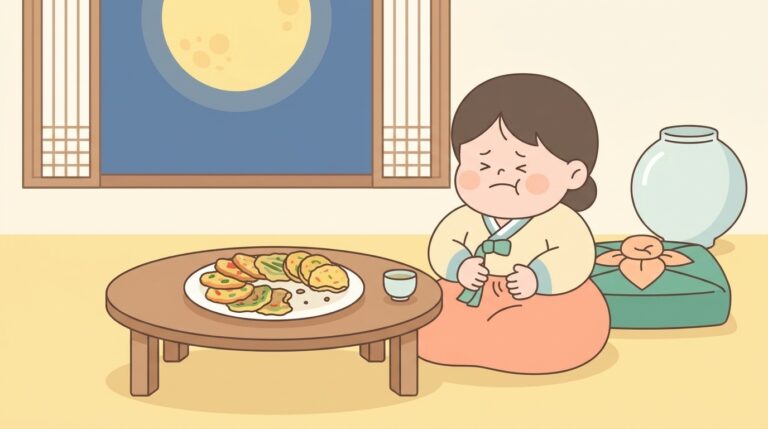
안녕하세요! (Annyeonghaseyo!) Your Korean best friend and Daily Hangul editor is here! Chuseok (추석) is finally here, which means the air is crisp, families are gathering, and—most importantly—there is an endless parade of delicious, sizzling holiday food. You sit down with a Korean family, and before you know it, your plate is piled high with savory Jeon (전 – pan-fried delicacies), succulent Galbi-jjim (갈비찜), and sweet Songpyeon (송편). It’s a feast of epic proportions!
But wait… as you politely gobble down the third plate of greasy pan-fried treats to show your appreciation, your stomach begins to send SOS signals. It feels heavy, oily, and altogether unhappy. You want to let your host or friend know you need a break or some medicine, but saying a simple “My stomach hurts” (배가 아파요) doesn’t capture that specific, heavy, ‘greasy food coma’ sensation. Today, we’re going to master the exact phrases Koreans use when they’ve had way too much holiday food, so you can navigate this common situation like a true local!
Phase 2: Core 3 Expressions Deep-Dive
1. 속이 더부룩해요. (Sogi deobureuk-haeyo.)
- Pronunciation: [Soh-ghee duh-boo-rook-hae-yo] (Think of the “duh-boo-rook” sound as the heavy, bubbling feeling of trapped gas and food in your belly).
- Meaning: My stomach feels bloated and heavy (indigestion).
- K-Culture Moment: This is the ultimate post-holiday phrase. Picture family members lounging on the living room floor after a Chuseok feast, rubbing their bellies while watching holiday specials on TV.
- Editor’s Insight: “속” means “inside” or “stomach,” and “더부룩하다” specifically describes that uncomfortable, swollen, bloated sensation when food isn’t digesting well. It’s much more descriptive than just saying you have pain.
- Situation Spectrum: Casual (속이 더부룩해 ✅) / Semi-formal (속이 더부룩해요 ✅) / Formal (속이 더부룩합니다 ⚠️)
- 🤔 Think About It: In many Western cultures, people might say “I’m stuffed.” Why do you think Korean specifically focuses on the internal state (“inside is bloated”)?
2. 배탈이 났어요. (Baetari nasseoyo.)
- Pronunciation: [Bae-tal-ee nass-uh-yo] (“Bae” is stomach, “tal” means trouble. “Nasseoyo” is the past tense of break out/happen).
- Meaning: I have an upset stomach (or diarrhea/cramps).
- K-Culture Moment: You ate too many cold fruits right after eating hot, greasy Jeon, and now you are frantically searching for an open pharmacy on a holiday.
- Editor’s Insight: “배탈” is a combination of “배” (stomach) and “탈” (trouble/malfunction). Use this when your stomach is actively cramping, or you feel like you need to run to the restroom.
- Situation Spectrum: Casual (배탈 났어 ✅) / Semi-formal (배탈이 났어요 ✅) / Formal (배탈이 났습니다 ⚠️)
- 🤔 Think About It: Has a sudden stomach bug ever ruined your travel plans? How did you communicate it?
3. 기름진 걸 많이 먹어서 속이 느끼해요. (Gireumjin geol mani meogoseo sogi neukkiraeyo.)
- Pronunciation: [Ghee-reum-jin geol mah-nee muhg-uh-suh soh-ghee neu-kkee-hae-yo] (Make the “neu-kkee” sound drag slightly to mimic the slippery, oily feeling).
- Meaning: My stomach feels greasy/nauseous because I ate too much oily food.
- K-Culture Moment: You’ve eaten too much Chuseok Jeon (전) fried in oil, and your body is screaming for some spicy Kimchi or hot soup to balance it out.
- Editor’s Insight: “느끼하다” is a fascinating word. It describes both oily/cheesy food itself and the heavy, slightly nauseated feeling you get after eating too much of it. (Bonus: You can also use it to describe a guy who uses cheesy pickup lines!)
- Situation Spectrum: Casual (속이 느끼해 ✅) / Semi-formal (속이 느끼해요 ✅) / Formal (속이 느끼합니다 ⚠️)
- 🤔 Think About It: What is your go-to food or drink when your stomach feels “느끼하다”?
Phase 3: Textbook vs. Real Korean
Situation 1: Explaining you have indigestion
- 📖 Textbook Korean: “소화가 잘 안 됩니다.” (Sohwaga jal an doemnida. – Digestion is not going well.)
- 🗣️ 진짜 Korean: “체한 것 같아요.” (Che-han geot gat-ayo. – I think I have indigestion/stomach blockage.)
- 💡 Why the difference? While “소화가 안 되다” is grammatically perfect, native Koreans almost always use the verb “체하다” (to have severe, stuck indigestion) when food feels trapped in their chest. It sounds much more natural and urgent.
Situation 2: Explaining a churning stomach
- 📖 Textbook Korean: “배가 아픕니다.” (Baega apeumnida. – My stomach hurts.)
- 🗣️ 진짜 Korean: “속이 울렁거려요.” (Sogi ulleong-georyeoyo. – My stomach is churning / I feel nauseous.)
- 💡 Why the difference? “배가 아프다” is very broad. “울렁거리다” describes the wavy, rolling sensation of nausea perfectly. It immediately lets the listener know you might throw up or need fresh air.
Phase 4: K-Culture 딥다이브 & 비언어적 매너
4-1. 눈치 (Nunchi) & Gestures
When your stomach is upset in Korea, you’ll often see people doing these distinct non-verbal actions:
1. The Hand Rub: Rubbing the stomach in slow, clockwise circles. Grandmothers often do this to children while chanting, “엄마 손은 약손, 네 배는 똥배” (Mom’s hand is a healing hand, your tummy is a cute tummy).
2. The Web Massage: Massaging the fleshy web between the thumb and index finger (called the Hapgok point, 합곡혈). Koreans firmly believe acupressure here instantly aids digestion.
4-2. Chuseok & “Jeong” (정)
Chuseok is all about sharing. Korean mothers and grandmothers express their love (정) by constantly piling food onto your plate. Refusing food can sometimes feel rude, leading many foreigners (and locals!) to overeat out of politeness. Knowing how to politely express your fullness (“잘 먹었습니다, 그런데 속이 좀 더부룩해서요…” – I ate well, but my stomach is a bit bloated…) is a crucial cultural survival skill.
Phase 5: 실전 롤플레이 시나리오
- Setting: You are visiting your Korean friend Min-jun’s (민준) family home during Chuseok. After eating a massive lunch, you are sitting on the living room floor feeling incredibly bloated.
-
Min-jun (민준): “Eugene, 전 더 먹을래? 우리 엄마가 방금 따뜻하게 다시 데웠어!”
(🎭 Holding a plate of warm Jeon, offering with a warm smile) - You (유지): “아… 고맙지만 괜찮아. 많이 먹어서 배가 정말 불러.”
(🎭 Patting your stomach, looking apologetic) - Min-jun (민준): “어라, 얼굴색이 별로 안 좋네? 괜찮아?”
(🎭 Tilting head in concern, looking closely at your face) - You (유지): “사실 기름진 걸 많이 먹어서 속이 좀 느끼하고 더부룩해.”
(🎭 Frowning slightly, rubbing stomach) - Min-jun (민준): “어이쿠, 명절 음식은 맛있지만 너무 기름지지. 체한 거 아냐?”
(🎭 Nodding understandingly, looking worried) - You (유지): “체한 것 같아. 속이 좀 울렁거려.”
(🎭 Sighing, pointing at your chest) - Min-jun (민준): “약국은 다 문 닫았을 텐데… 내가 편의점에서 소화제 사다 줄까, 아니면 손가락 딸래?”
(🎭 Pointing towards the door, then mimicking a needle prick) - You (유지): “편의점 소화제 먹을래! 고마워, 민준아.”
(🎭 Waving hands quickly to refuse the needle, smiling weakly)
🔀 인터랙티브 분기점:
What would you do in this situation?
* Option A: Ask for a carbonated drink (사이다) to wash it down.
* Option B: Agree to the traditional “finger-pricking” (손가락 따기) method.
* Option C: Say you are fine and eat one more piece of Jeon to be polite.
💡 Feedback:
- Option A (Risk): While a cold Cider (사읽다 – lemon-lime soda) feels refreshing, the sugar and carbonation can actually worsen indigestion. Better to ask for Kkaseu Hwalmyeongsu (까스활명수), a carbonated herbal digestive drink!
- Option B (Best/Traditional): If you trust Min-jun, try the finger-pricking! It sounds scary, but many Koreans swear by pricking the skin near the thumbnail to let out a tiny drop of “dark, stuck blood” (체한 피) to instantly relieve pressure.
- Option C (Bad): Never overeat to the point of sickness just to be polite. Your hosts would feel much worse if you got seriously ill!
Phase 6: 10초 감정 섀도잉 드릴
Practice these out loud with the right emotion!
1. “아… / 속이 / 너무 느끼해… [🥺 Groaning in pain, hand on stomach]”
(Ah… my stomach feels so greasy…)
2. “기름진 걸 / 많이 먹었나 봐요. [🤢 Feeling nauseous, speaking slowly]”
(I think I ate too much greasy food.)
3. “체했나 봐요. / 혹시 / 소화제 있어요? [😰 Anxious, asking for medicine]”
(I think I have indigestion. Do you happen to have digestive medicine?)
Phase 7: K-Culture 미니 사전
- 소화제 (Sohwaje) | Digestive medicine. You can buy gentle herbal or chemical digestive pills at any pharmacy or convenience store.
- 까스활명수 (Kkaseu Hwalmyeongsu) | A legendary herbal carbonated drink sold in brown bottles. It’s Korea’s absolute favorite remedy for a heavy stomach.
- 매실차 (Maesil-cha) | Fermented plum tea. A natural home remedy for digestion that tastes sweet and tart.
- 손가락 따기 (Songarak Ttagi) | A traditional folk remedy where you prick the skin just below the thumbnail with a sterile needle to relieve extreme indigestion.
Phase 8: 여행자를 위한 생존 키트
If you are traveling in Korea during Chuseok, write these down!
* “소화제 있어요?” (Sohwaje isseoyo? – Do you have digestive medicine?)
* “속이 안 좋아요.” (Sogi an joayo. – My stomach doesn’t feel good.)
* “가까운 약국이 어디예요?” (Gakkaun yakgugi eodiyeyo? – Where is the nearest pharmacy?)
Editor’s Travel Note:
During Chuseok, most neighborhood pharmacies close. Don’t panic! You can purchase basic digestive medicines like Festa (훼스타) or Bearse (베아서) at any 24-hour convenience store (CU, GS25, Seven-Eleven). If you need an open pharmacy, use the 네이버 지도 앱 (Naver Map) or KakaoMap to search for “휴일지킴이약국” (holiday-safeguard pharmacy) to find one nearby. Disclaimer: Holiday operating hours may vary, so always double-check before heading out.
Phase 9: “한 발 더 깊이” (생각 질문)
Food in Korea is never just fuel; it is a medium of care, love, and social connection. This is why the culture of “Jeong” (정) can sometimes lead to friendly force-feeding. When a Korean host constantly offers you more food, they aren’t ignoring your boundaries; they are showering you with hospitality. Understanding this cultural layer helps you navigate the holiday with grace. Instead of a flat “No,” expressing your physical state using “속이 더부룩해요” shows that you tried your best to enjoy the meal, keeping the warm connection intact.
💬 Your Turn: Have you ever experienced a “food coma” or indigestion from trying to be a polite guest in another culture? Let us know in the comments below!
Phase 10: FAQ & 오해 방지
Q: Can I buy digestive medicine at a convenience store?
A: Yes! While pharmacies offer stronger options, Korean convenience stores (의점) stock basic, effective digestive enzymes like Bearse (베아서) and Festa (훼스타) under the “Safety General Medicine” (안전상비의약셈) cabinet behind or near the counter.
Q: Why do Koreans ask me if I “che-haess-eo” (체하다) instead of asking if my stomach hurts?
A: “체하다” is a cultural medical concept referring to a state where food feels physically stuck in your digestive tract, causing cold sweats, headache, and bloating. To Koreans, this is a very specific condition distinct from a general stomach virus.
Q: What should I drink if my stomach feels greasy after Chuseok food?
A: Skip the milk or soda. Go for hot barley tea (밴리차), fermented plum tea (매실차), or a carbonated herbal drink like Kkaseu Hwalmyeongsu (까스활명수).
🚨 흔한 실수 (Common Mistakes) 경고판
- Saying “배가 아파요” (Baega apayo) for bloating: This sounds like you have sharp pain or a stomach bug. If it’s just heavy food bloating, say “속이 더부룩해요” instead.
- Drinking cold milk to soothe a greasy stomach: This will likely make your indigestion worse as dairy is hard to digest. Drink warm water or 매실차 (plum tea).
- Powering through the meal out of politeness: Don’t keep eating! Say “정말 맛있는데, 속이 안 좋아서 더 못 먹겠어요” (It’s really delicious, but my stomach isn’t well so I can’t eat more).
Phase 11: 액션 미션 & 참여 유도
- 🥉 Bronze Mission: Practice saying “속이 더부룩해요” 3 times in front of the mirror with your hand on your belly.
- 🥈 Silver Mission: Go to your favorite social media platform and write down your favorite Korean holiday food along with the phrase: “기름진 걸 많이 먹으면 속이 느끼해요!”
- 🥇 Gold Mission: Next time you eat a heavy, oily meal, message your language partner or Korean friend: “오늘 너무 많이 먹어서 속이 좀 더부룩해요!”
Phase 12: 인터랙티브 퀴즈 챌린지
Test your survival skills!
1. Which phrase means “My stomach feels bloated/heavy with indigestion”?
Answer: “속이 더부룩해요.” (Sogi deobureuk-haeyo.)
Explanation: “더부룩하다” specifically refers to the uncomfortable bloating and heavy feeling of slow digestion.
2. True or False: During Korean holidays, you can only buy digestive medicine at professional pharmacies.
Answer: False.
Explanation: You can easily find basic, effective digestive medicines at any 24-hour convenience store!
3. Fill in the blank: “기름진 음식을 많이 먹어서 속이 ______.” (My stomach feels greasy/sick because I ate too much oily food.)
Answer: 느끼해요 (neukkiraeyo)
Explanation: “느끼하다” matches the nauseous, oily feeling you get after eating greasy foods like Jeon.







