

How to Ask for Early Leave in a Korean Office (A2 Level Guide)
안녕하세요! I’m your lead editor at Daily Hangul, your friendly neighborhood guide to mastering real-life Korean culture and language.
We’ve all been there: you are sitting at your desk, but your head is throbbing, or you have an urgent personal emergency. In a Korean office, asking your boss to leave early (called 조퇴, jotoe) can feel like a high-stakes challenge, especially when navigating the unspoken rules of Korean work culture.
Don’t worry! Today, we will learn how to ask for early leave politely, naturally, and with perfect office manners. This guide is built based on real-life feedback from foreign professionals working in Seoul, so you can sound natural and respectful.
Phase 2: Three Key Expressions for Early Leave
Here are three essential expressions you can use depending on your situation.
1. 오늘 몸이 안 좋아서 먼저 들어가 보겠습니다.
- Pronunciation: Oneul mom-i an jo-aseo meonjeo deureoga bogessseumnida.
- Sound analogy: “mom-i” sounds like “mommy” but with a short “i”. “meonjeo” sounds like “mun-juh”.
- Meaning: I don’t feel well today, so I think I should head home first.
- K-Culture Moment: You often hear this in office K-Dramas like Misaeng when an employee looks pale and tries to stay polite.
- Editor’s Insight: In Korean business culture, “들어가다” (to enter) is the standard polite verb used when leaving work. You are “entering” your home!
- Situation Spectrum: Casual (⚠️), Semi-formal (✅), Formal (✅)
- 🤔 Think About It: In English, we say “I am going home.” Why do you think Koreans say “I will enter [my home] first”? How does this show respect for the shared workspace?
2. 개인 사정이 있어서 일찍 들어가 봐야 할 것 같습니다.
- Pronunciation: Gae-in sa-jeong-i isseo-seo il-jjik deureoga bwaya hal geot gatseumnida.
- Meaning: I have a personal matter, so I think I need to leave early.
- K-Culture Moment: Used when you have to visit a government office, bank, or deal with sudden family matters.
- Editor’s Insight: The phrase “~할 것 같습니다” (it seems like/I think) is a magical cushion in Korean. It softens your statement so you don’t sound too demanding.
- Situation Spectrum: Casual (⚠️), Semi-formal (✅), Formal (✅)
- 🤔 Think About It: How does softening a request with “I think I must” compare to direct requests in your home culture?
3. 병원에 가야 해서 조퇴를 해도 될까요?
- Pronunciation: Byeong-won-e gaya hae-seo jo-toe-reul hae-do doel-kka-yo?
- Meaning: I need to go to the clinic, so may I take early leave?
- K-Culture Moment: Usually said when you need to catch a doctor before the clinic closes at 6:00 PM.
- Editor’s Insight: While “병원” (byeong-won) literally translates to “hospital,” in Korea, it is commonly used for any local doctor’s office or clinic.
- Situation Spectrum: Casual (🚫), Semi-formal (✅), Formal (✅)
- 🤔 Think About It: In some cultures, telling your boss you are going to the doctor requires a detailed note. In Korea, asking directly with “조퇴” (jotoe) is very common and accepted.
Phase 3: Textbook Korean vs. Real-Life Korean
Let’s compare textbook phrases with what Koreans actually say in a modern office!
Situation 1: Asking to leave because you are sick
- 📖 Textbook: “아파서 집에 가고 싶습니다.” (Apaseo jibe gago sipseumnida. – “I am sick and I want to go home.”)
- 🗣️ Real Korean: “몸이 좀 안 좋아서 조퇴를 해야 할 것 같습니다.” (Momi jom an joaseo jotoereul haeya hal geot gatseumnida. – “I’m feeling a bit under the weather, so I think I need to take early leave.”)
- 💡 Why it matters: Saying “I want to” (~고 싶습니다) in a Korean office can sound slightly childish or self-centered. Using “몸이 안 좋다” (body is not good) and “할 것 같습니다” (it seems like) shows high respect and professionalism.
Situation 2: Leaving early for a personal errand
- 📖 Textbook: “개인적인 일로 일찍 갑니다.” (Gaeinjeogin illo iljjik gamnida. – “I am leaving early for personal business.”)
- 🗣️ Real Korean: “급한 개인 사정이 있어서 먼저 들어가 보겠습니다.” (Geuphan gaein sajeongi isseoseo meonjeo deureoga bogessseumnida. – “Something urgent came up, so I will head home first.”)
- 💡 Why it matters: Saying “I am leaving” sounds like an announcement rather than a polite notice. Framing it as “I will enter [home] first” with a soft tone is much more respectful to your team.
Phase 4: K-Culture Deep Dive & Non-Verbal Manners
4-1. The Art of Nunchi (눈치) & Gestures
Before you speak, you must practice 눈치 (nunchi – reading the room).
* Timing: Do not approach your boss when they are typing furiously, in a meeting, or looking stressed. Wait for a quiet moment.
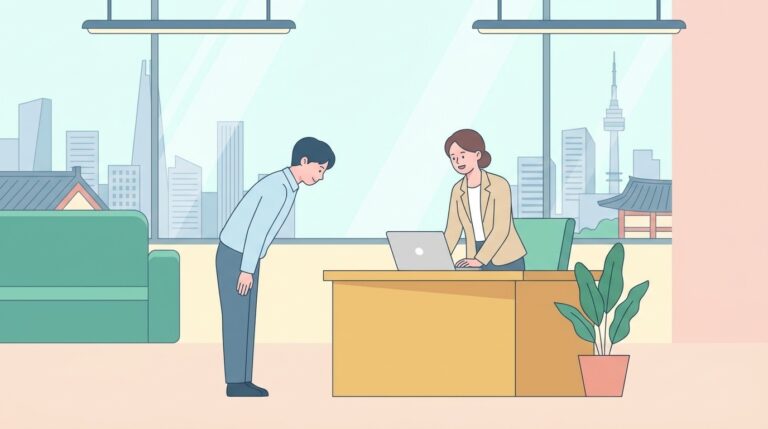
* Posture: Stand up and walk over to your boss’s desk. Do not shout across the room! Stand politely, bow slightly (about 15 degrees), and hold your hands in front of you (called 공수 자세, gongsu jase).
4-2. Workplace Respect & Titles
Never call your boss by their name! Always use their title + 님 (nim). For example:
* 부장님 (Bujang-nim – Department Manager)
* 대리님 (Daeri-nim – Assistant Manager)
Phase 5: Real-Life Roleplay Scenario
Imagine you are at your desk at a tech startup in Seoul. Your head is spinning, and you need to ask your team leader, Jimin, for early leave.
Dialogue
- You: (Approaching Jimin’s desk with a slight bow) 저… 부장님, 혹시 잠깐 시간 괜찮으세요?
(Jeo… bujang-nim, hoksi jamgkan sigan gwenchaneuseyo?)
“Excuse me… Manager, do you happen to have a moment?” -
Jimin: (Looking up from the laptop) 아, 민우 씨. 무슨 일이에요?
(Ah, Min-woo ssi. Museun irieyo?)
“Ah, Min-woo. What’s going on?” -
You: (Holding your stomach slightly) 실은 제가 오늘 아침부터 몸이 안 좋아서요.
(Sireun jega oneul achim-buteo momi an joaseoyo.)
“Actually, I haven’t been feeling well since this morning.” -
Jimin: (With a worried look) 어머, 그래요? 얼굴이 많이 안 좋아 보여요.
(Eomeo, geuraeyo? Eolguri mani an joa boyeoyo.)
“Oh, really? You look very pale.” -
You: (Politely) 네, 그래서 병원에 좀 가야 해서… 일찍 들어가 봐도 될까요?
(Ne, geuraeseo byeongwone jom gaya haeseo… iljjik deureoga bwado doelgkayo?)
“Yes, so I need to go to the doctor… would it be okay if I leave early?” -
Jimin: (Nodding warmly) 당연하죠! 오늘 할 일은 다 마무리했나요?
(Dangyeonhajyo! Oneul hal ireun da mamurihaetnayo?)
“Of course! Have you wrapped up today’s tasks?” -
You: (Relieved, bowing) 네, 급한 일은 다 끝냈습니다. 남은 건 내일 아침에 바로 처리하겠습니다. 죄송합니다.
(Ne, geuphan ireun da kkeutnaetseumnida. Nameun geon naeil achime baro cheorihagessseumnida. Joesonghamnida.)
“Yes, I finished all urgent tasks. I will handle the rest first thing tomorrow morning. I’m sorry.” -
Jimin: (Smiling gently) 미안해할 필요 전혀 없어요. 얼른 들어가서 쉬세요!
(Mianhaehal piryo jeonhyeo eopseoyo. Eolleun deureogaseo swiseyo!)
“No need to be sorry at all. Hurry home and rest!”
🔀 Interactive Choice Point
How would you answer if Jimin asked you if you finished your work, but you still have a little bit left?
- Choice A: “네, 그냥 가겠습니다.” (Ne, geunyang gagessseumnida. – “Yes, I will just go anyway.”)
- Choice B: “급한 건 끝냈고, 남은 건 내일 아침에 일찍 와서 하겠습니다.” (Geuphan geon kkeutnaetgo, nameun geon naeil achime iljjik waseo hagessseumnida. – “The urgent things are done, and I will come in early tomorrow morning to finish the rest.”)
- Choice C: “아직 안 끝났는데 아파서 못 하겠어요.” (Ajik an kkeutnatneunde apaseo mot hagessseuyo. – “It’s not finished, but I’m too sick to do it.”)
Feedback:
- Choice A (Risk): Too blunt. It looks like you don’t care about your work responsibilities.
- Choice B (Best!): Shows great responsibility. You assure your boss that you won’t let the team down even though you are leaving.
- Choice C (Bad): While honest, it sounds slightly unprofessional in a business context. Always offer a solution first!
Phase 6: 10-Second Emotion Shadowing Drill
Practice these sentences out loud, focusing on the tone markers (/ is a short pause):
[🥺 Politely & Hesitantly]
저… 부장님, / 혹시 잠깐 / 시간 괜찮으세요?
(Jeo… bu-jang-nim, / hok-si jam-gkan / si-gan gwen-chan-eu-se-yo?)-
[😔 Weak & Tired voice]
오늘 몸이 / 너무 안 좋아서 / 먼저 들어가 보겠습니다.
(Oneul mom-i / neo-mu an jo-aseo / meon-jeo deureo-ga bo-get-seum-ni-da.)
Phase 7: K-Culture Mini Dictionary
- 조퇴 (Jotoe): Early leave (leaving work or school before official hours).
- 눈치 (Nunchi): The art of reading the room and sensing others’ feelings.
- 병가 (Byeongga): Sick leave (official days off due to illness).
- 야근 (Yageun): Overtime work (working late into the night, very common in traditional offices).
Phase 8: Traveler’s Survival Kit
What if you get sick during your trip to Korea?
Survival Phrases
- 가장 가까운 약국이 어디예요? (Gajang gakkaun yakgugi eodiyeyo?)
- “Where is the nearest pharmacy?”
- 타이레놀 있어요? (Tairenol isseoyo?)
- “Do you have Tylenol?”
- 처방전 없이 살 수 있는 감기약 주세요. (Cheobangjeon eopsi sal su inneun gamgiyak juseyo.)
- “Please give me cold medicine that doesn’t need a prescription.”
📌 Editor’s Travel Note: If you are feeling unwell in Korea, download the Naver Map App to quickly locate the nearest “약국” (Pharmacy) or “내과” (Internal Medicine Clinic). Most pharmacies close around 7:00 or 8:00 PM, but you can always buy basic painkillers like Tylenol at any convenience store (GS25, CU, 7-Eleven) 24/7!
Phase 9: “One Step Deeper” (Reflective Question)
In many Western cultures, personal well-being is viewed as an individual right, and taking sick leave is straightforward. In Korea, collectivism means your absence directly impacts your teammates’ workload. Therefore, Koreans place a high value on expressing apology (죄송합니다) and offering to catch up on work (내일 처리하겠습니다), even when they are genuinely sick.
💬 Your Turn: What is the office culture like in your country when you need to leave early? Let us know in the comments below!
Phase 10: FAQ & Common Mistakes
Q: Can I use “퇴근하다” instead of “들어가다” when leaving early?
A: “퇴근하다” (toegeunhada) means leaving work at the regular designated time. Using “퇴근해 보겠습니다” when leaving early sounds like you are declaring it’s the end of your shift. Instead, use “먼저 들어가 보겠습니다” (I will head home first) to show you are leaving ahead of schedule.
Q: Do I need to provide a medical note for leaving 1-2 hours early?
A: Usually, for just 1 or 2 hours of early leave, a polite verbal request is enough. However, always check your company’s employee handbook!
Q: Can I text my boss instead of asking in person?
A: If you are already at work, always ask in person. Texting or messaging on apps like KakaoTalk while sitting just a few meters away is considered rude in Korean business culture.
🚨 Common Mistakes Warning Board
- Mistake 1: Saying “저 이제 가요” (Jeo ije gayo – “I am leaving now”).
- Correct Action: Say “먼저 들어가 보겠습니다” to remain professional.
- Mistake 2: Leaving without saying goodbye to your teammates.
- Correct Action: Bow slightly and say “먼저 들어가 보겠습니다. 수고하셨습니다” (Sugo-hasyeot-seumnida – “Thank you for your hard work”).
Phase 11: Action Missions
- 🥉 Bronze Mission: Practice saying the three key expressions out loud 5 times in front of a mirror!
- 🥈 Silver Mission: Write a mock KakaoTalk message to a teammate explaining you have to leave early in Korean in our comment section.
- 🥇 Gold Mission: Use one of these phrases next time you study or work with Korean colleagues!
- 🎮 K-Culture Mission: Watch an episode of a Korean office drama (like What’s Wrong with Secretary Kim) and try to spot how characters ask for leave or say goodbye!
Phase 12: Interactive Quiz Challenge
Test your knowledge with these quick questions!
1. Which expression is the most polite way to say “I will head home first” when leaving early?
A) 나 먼저 갈게 (Na meonjeo galge)
B) 먼저 들어가 보겠습니다 (Meonjeo deureoga bogessseumnida)
Click for Answer & Explanation
Correct Answer: B
“먼저 들어가 보겠습니다” is the formal and standard business expression. Option A is very casual and should only be used with close friends of the same age!
2. True or False: You should shout your request to leave early across the office to save time.
Click for Answer & Explanation
Correct Answer: False
Always walk over to your boss’s desk, stand politely, and speak in a low, respectful voice to respect their space and the quiet office environment.







