

Master the Art of Danggeun: Setting Up In-Person Trades in Korea like a Pro
안녕하세요! Welcome back to Daily Hangul, your premium cultural navigator. If you’ve spent more than a week in Korea, you’ve probably heard of 당근마켓 (Danggeun Market / Karrot), the country’s beloved hyper-local second-hand app.
But here’s the catch: once you find that perfect vintage vinyl or limited-edition K-Pop merch, you have to coordinate a 직거래 (jik-geo-rae – in-person trade). Where do you meet? When? How do you negotiate a time without sounding demanding, or worse, rude?
Today, we’re leveling up your B2 conversational skills with the ultimate guide to setting trade times and locations. Let’s dive in!
Phase 2: Core Expressions Deep Dive
1. 혹시 중간쯤에서 만날 수 있을까요? (Could we perhaps meet halfway?)
- Pronunciation: Hok-si jung-gan-jjeum-e-seo man-nal su is-seul-kka-yo? (Sounds like: “Hoke-shee joong-gahn-jjeum-eh-suh…”)
- Meaning: “By any chance, could we meet around the middle?”
- K-Culture Moment: You often see this in slice-of-life K-Dramas when characters try to save on shipping fees but realize they live on opposite sides of Seoul.
- Editor’s Insight: The word 혹시 (by any chance) is magic in Korean. It instantly softens any request. Adding ~쯤 (around/approximate) after 중간 (middle) shows you are flexible and not demanding a mathematically precise midpoint.
- Situation Spectrum: Casual ⚠️ | Semi-formal ✅ | Formal 🚫
- 🤔 Think About It: In many Western cultures, negotiation is highly direct. In Korea, indirect language (using “perhaps” or “around”) shows respect for the other party’s schedule. How does this compare to your hometown?
2. 평일 저녁이나 주말 아무 때나 괜찮아요. (Weekday evenings or anytime on weekends is fine with me.)
- Pronunciation: Pyeong-il jeo-nyeok-i-na ju-mal a-mu ttae-na gwen-chan-a-yo.
- Meaning: “Weekday evenings or anytime on weekends is okay.”
- K-Culture Moment: The ultimate text message sent by a polite buyer to accommodate a busy seller’s working hours.
- Editor’s Insight: 아무 때나 means “anytime.” By offering this wide window, you elevate your “manner temperature” (매너온도) on trading apps. It shows high-tier consideration for the other person’s work-life balance.
- Situation Spectrum: Casual ✅ | Semi-formal ✅ | Formal ⚠️
- 🤔 Think About It: Does offering total flexibility make you seem too eager, or is it purely polite? In Korea, it’s considered highly considerate.
3. 역 개찰구 앞으로 가도 될까요? (Would it be okay if we meet at the subway ticket gates?)
- Pronunciation: Yeok gae-chal-gu ap-eu-ro ga-do doel-kka-yo?
- Meaning: “Can I go to the station turnstiles/gates?”
- K-Culture Moment: This is the legendary 개찰구 직거래 (Turnstile Transaction). You literally swap items over the card-tapping barriers so nobody has to pay to exit the station!
- Editor’s Insight: Subway transit fees add up! Suggesting 개찰구 앞 (in front of the turnstiles) is a secret life hack. It shows you’re a savvy local who cares about saving both parties a double transit fare.
- Situation Spectrum: Casual ✅ | Semi-formal ✅ | Formal 🚫
- 🤔 Think About It: Have you ever seen a subway system where you can trade without tapping out? Korea’s immaculate station layouts make this a daily reality.
Phase 3: Textbook Korean vs. Real-Life Korean
Situation 1: Suggesting a Time
- 📖 Textbook: 몇 시에 만날까요? (Myeot si-e man-nal-kka-yo?) – “What time shall we meet?”
- 🗣️ Real Life: 편하신 시간 말씀해 주시면 맞출게요. (Pyeon-ha-sin si-gan mal-sseum-hae ju-si-myeon mat-chul-ge-yo.) – “If you tell me your preferred time, I’ll match/adjust to it.”
- 💡 Why the difference? The textbook version is too direct and forces the other person to make the first move. The real-life version uses 맞추다 (to adjust/align), which sounds incredibly polite and cooperative.
Situation 2: Suggesting a Location
- 📖 Textbook: 강남역에서 만나요. (Gang-nam-yeok-e-seo man-na-yo.) – “Let’s meet at Gangnam Station.”
- 🗣️ Real Life: 강남역 X번 출구 안쪽이 복잡하지 않고 좋을 것 같은데, 어떠세요? (Gang-nam-yeok X-beon chul-gu an-jok-i bok-jap-ha-ji ang-go jo-eul geot gat-eun-de, eo-tteo-se-yo?) – “Inside Exit X of Gangnam Station is less crowded and might be good, what do you think?”
- 💡 Why the difference? Massive transit hubs like Gangnam Station are chaotic. Specifying 안쪽 (inside) or a specific exit number, and checking if they agree (어떠세요?), saves you from wandering around for 30 minutes.
Phase 4: K-Culture Deep-Dive & Non-Verbal Manners
4-1. Nunchi & Gestures: The “Karrot” Wave
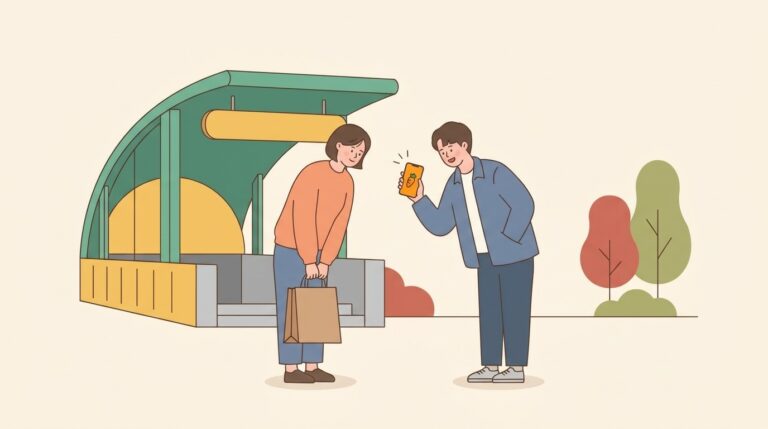
When you arrive at the designated subway exit, how do you spot your trading partner?
1. The Phone Wave: Hold up your phone screen showing the bright orange Karrot app interface.
2. The Polite Bow (목례 – Mok-rye): When eye contact is made, do a slight 15-degree head bow. Avoid intense staring; instead, offer a warm, recognizing smile.
3. Bag Presentation: Gently present the item or the cash/shopping bag with both hands (양손) as a sign of respect.
4-2. Culture Code: 매너온도 (Manner Temperature)
In Korea, trust is currency. The Karrot app features a 매너온도 (Manner Temperature) starting at 36.5°C (human body temperature). High ratings (above 40°C) are highly respected. Being punctual, using honorifics, and choosing convenient locations are the easiest ways to keep your “temperature” boiling hot!
Phase 5: Real-Life Roleplay Scenario
Characters
- 수진 (Sujin): A busy office worker selling a rare vintage cassette tape.
- Alex (You): An intermediate Korean learner buying the cassette.
수진: 안녕하세요! 카세트테이프 구매 가능할까요?
      (Hello! Is the cassette tape still available for purchase?)

Alex: 🎭 [친절하게 웃으며 메시지를 보내며] 네, 구매 가능합니다! 혹시 어디서 직거래 가능하신가요?
      (Yes, it's available! Where is a good place for an in-person trade?)

수진: 제가 퇴근 후에 강남역 근처에 있을 것 같아요.
      (I think I will be near Gangnam Station after work.)

Alex: 아, 좋습니다! 혹시 강남역 개찰구 앞으로 가도 될까요? 제가 카드를 찍고 나가지 않으려고요.
      (Ah, great! Would it be okay if we meet at the Gangnam Station turnstiles? I want to avoid tapping my transit card out.)

수진: 🎭 [공감하는 이모티콘을 보내며] 아, 좋은 생각이네요! 퇴근 시간이라 사람이 많을 텐데 괜찮으시겠어요?
      (Oh, that's a great idea! It might be crowded due to rush hour, will you be okay?)

Alex: 네, 괜찮습니다. 평일 저녁 편하신 시간 말씀해 주시면 맞출게요!
      (Yes, I am fine. Please let me know your preferred weekday evening time and I'll adjust!)

수진: 그럼 내일 저녁 7시 강남역 2호선 개찰구 앞 어떠세요?
      (Then how about tomorrow at 7 PM at the Line 2 turnstiles in Gangnam Station?)

Alex: 🎭 [엄지척 이모티콘과 함께] 네, 좋습니다! 그때 뵙겠습니다. 감사합니다!
      (Yes, sounds perfect! See you then. Thank you!)
🔀 Choose Your Adventure!
If Sujin suddenly messages you: “죄송해요, 갑자기 회식이 생겨서 못 갈 것 같아요!” (I’m sorry, a sudden company dinner came up so I don’t think I can make it!), what do you do?
- A) “그럼 거래 취소할게요.” (Then I will cancel the deal.)
- Feedback (Bad): Too abrupt. Might lower your Manner Temperature.
- B) “괜찮습니다! 그럼 주말 아무 때나 편하신 시간으로 다시 정할까요?” (No problem! Shall we reschedule for anytime on the weekend when you are free?)
- Feedback (Best): Shows incredible B2-level politeness and flexibility. Highly recommended!
- C) “회사 근처로 제가 갈까요?” (Shall I go near your company?)
- Feedback (Risk): Generous, but can seem overbearing if they are drunk at a company dinner. Better to reschedule.
Phase 6: 10-Second Emotional Shadowing Drill
Practice these with natural rhythm and pauses (/ indicates a natural pause).
-
[😊 Super Polite & Considerate]
편하신 시간 / 말씀해 주시면 / 제가 맞출게요!
(Pyeon-ha-sin si-gan / mal-sseum-hae ju-si-myeon / je-ga mat-chul-ge-yo!) -
[🥺 Apologetic but Proposing Alternative]
혹시 / 중간쯤에서 / 만날 수 있을까요?
(Hok-si / jung-gan-jjeum-e-seo / man-nal su is-seul-kka-yo?)
Phase 7: K-Culture Mini-Dictionary
- 네고 (Nego): Short for “negotiation.” Usually refers to asking for a discount. (e.g., “혹시 네고 가능한가요?”)
- 직거래 (Jik-geo-rae): Direct, in-person trade. The most common way to avoid shipping scams in Korea.
- 쿨거래 / 쿨거 (Cool-geo-rae / Cool-geo): A “cool” transaction where the buyer makes no fuss, asks no annoying questions, and pays instantly.
- 잠수 (Jam-su): Literally “diving/submerging.” It means
Frequently Asked Questions (FAQ)
Q: What does "혹시 중간쯤에서 만날 수 있을까요? (Could we perhaps meet halfway?)" mean in Korean and how do you pronounce it?
A: In Korean, "혹시 중간쯤에서 만날 수 있을까요? (Could we perhaps meet halfway?)" is pronounced [Hok-si jung-gan-jjeum-e-seo man-nal su is-seul-kka-yo? (Sounds like: "Hoke-shee joong-gahn-jjeum-eh-suh..."] and means: "By any chance, could we meet around the middle?"
Q: What does "평일 저녁이나 주말 아무 때나 괜찮아요. (Weekday evenings or anytime on weekends is fine with me.)" mean in Korean and how do you pronounce it?
A: In Korean, "평일 저녁이나 주말 아무 때나 괜찮아요. (Weekday evenings or anytime on weekends is fine with me.)" is pronounced [Pyeong-il jeo-nyeok-i-na ju-mal a-mu ttae-na gwen-chan-a-yo.] and means: "Weekday evenings or anytime on weekends is okay."
Q: What does "역 개찰구 앞으로 가도 될까요? (Would it be okay if we meet at the subway ticket gates?)" mean in Korean and how do you pronounce it?
A: In Korean, "역 개찰구 앞으로 가도 될까요? (Would it be okay if we meet at the subway ticket gates?)" is pronounced [Yeok gae-chal-gu ap-eu-ro ga-do doel-kka-yo?] and means: "Can I go to the station turnstiles/gates?"







