

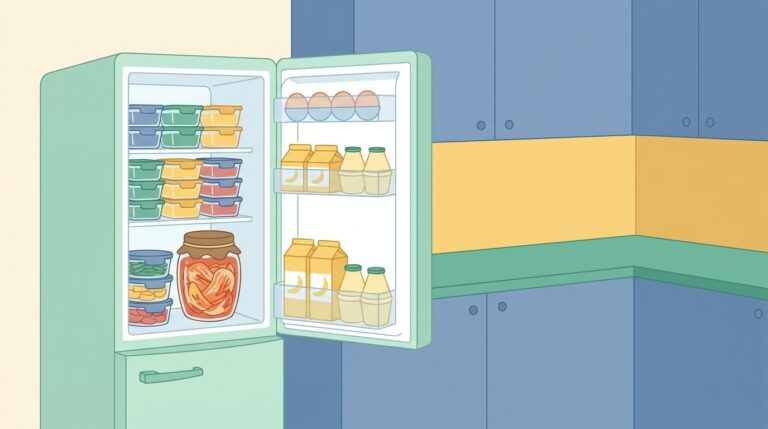
Phase 1: 공감 (Your Korean Kitchen Bestie is Here!)
안녕하세요! (An-nyeong-ha-se-yo!) I’m your Daily Hangul lead editor!
Imagine this: You just came back to your cozy Korean sharehouse after a big grocery run at E-Mart. You bought some delicious Samgak Kimbap (삼각김밥), fresh strawberries, and sweet Banana Milk (바나나맛 우유). You want to tell your Korean roommate, “Hey, can you put these in the fridge?” but you freeze. Fridge? Put inside? How do I say that?
Don’t worry! This is one of the most common stumbling blocks for A1 beginners. Today, we’re mastering “냉장고에 넣다” (putting things in the fridge). By the end of this guide, you’ll sound incredibly natural in any Korean kitchen, and your roommates will be highly impressed with your local kitchen etiquette! Let’s dive in!
Phase 2: 핵심 표현 3선 심층 분석 (3 Essential Phrases)
1. 냉장고에 넣으세요 (naeng-jang-go-e neo-eu-se-yo)
- Pronunciation: Neng-jang-go-eh nuh-uh-seh-yo (Sounds like “Neng-jang-go” + “nuh” as in “nut” + “uh-seh-yo”)
- Meaning: “Please put it in the refrigerator.”
- K-Culture Moment: You will hear this constantly in K-Dramas whenever a caring mom visits her child’s apartment, packs the fridge with homemade side dishes (반찬 – ban-chan), and says, “Make sure to put this in the fridge immediately!”
- Editor’s Insight: 냉장고 (naeng-jang-go) means “refrigerator”, -에 (e) is the location marker “in/into”, and 넣으세요 (neo-eu-se-yo) is the polite way to say “please put in”. It’s polite, friendly, and perfect for daily use.
- Situation Spectrum: Casual: ⚠️ | Semi-formal: ✅ | Formal: ✅
- 🤔 Think About It: Why is temperature so important in Korean food culture? (Hint: Fermented foods like Kimchi need precise temperatures to keep that perfect, tangy taste!)
2. 냉장고에 넣어 줘 (naeng-jang-go-e neo-eo jwo)
- Pronunciation: Neng-jang-go-eh nuh-uh jwo
- Meaning: “Put it in the fridge for me.” (Casual)
- K-Culture Moment: Two siblings arguing in a cozy K-Drama kitchen over who left the milk out on the table.
- Editor’s Insight: By replacing “-으세요” with “-어 줘” (eo jwo), you change the tone to close and casual. Only use this with close friends, roommates of the same age, or younger people!
- Situation Spectrum: Casual: ✅ | Semi-formal: 🚫 | Formal: 🚫
- 🤔 Think About It: How does dropping honorifics in Korean instantly signal that you are “best friends” with someone?
3. 이거 냉동실에 넣어요? (i-geo naeng-dong-sil-e neo-eo-yo?)
- Pronunciation: Ee-geo neng-dong-shil-eh nuh-uh-yo?
- Meaning: “Do I put this in the freezer?”
- K-Culture Moment: Unpacking groceries after buying ice cream or frozen dumplings (만두 – man-du) for a late-night snack.
- Editor’s Insight: 냉동실 (naeng-dong-sil) means “freezer”. Notice how Korean splits the fridge into 냉장실 (refrigerating room) and 냉동실 (freezing room). In daily life, we just say 냉장고 for the whole unit, but specify 냉동실 for freezing!
- Situation Spectrum: Casual: ⚠️ | Semi-formal: ✅ | Formal: 🚫
- 🤔 Think About It: Notice the word logic: “냉” (cold) + “동” (freeze) + “실” (room) = Freezer. Isn’t Korean word-building amazingly logical?
Phase 3: 교과서 한국어 vs 진짜 한국어 (Textbook vs. Real Life)
Let’s compare textbook phrases with what Koreans actually say in a real apartment!
- Situation 1: Storing leftovers
- 📖 Textbook: “식료품을 냉장실에 보관하십시오.” (Please store the food items in the refrigeration compartment.) – Too robotic!
- 🗣️ 진짜 한국어: “이거 냉장고에 넣어 놔.” (Put this away in the fridge.)
- 💡 Why it’s different: “보관하다” (to store/keep) is highly formal. Real friends use “넣어 놓다” (to put and leave it) which translates naturally to “put it away”.
- Situation 2: Asking where something goes
- 📖 Textbook: “이 제품은 동결고에 삽입해야 합니까?” (Must this product be inserted into the freezing box?) – Sounds like a chemistry lab manual!
- 🗣️ 진짜 한국어: “이거 냉동실에 넣어요?” (Do I put this in the freezer?)
- 💡 Why it’s different: “동결고” is technical jargon. Real Koreans always use “냉동실” (freezer) and “넣다” (to put in).
Phase 4: K-Culture 딥다이브 & 비언어적 매너 (Culture & Kitchen Etiquette)
4-1. Eyes on the Fridge Door! (눈치 & 제스처)
- The Double Beep Rule: Korean refrigerators often beep loudly if left open for more than 30 seconds. To show polite house manners, always make sure to close the door firmly. Koreans often use their elbow to give it a final push if their hands are full of banchan containers!
- Passing items: If an elder or a senior roommate asks you to hand them something from the fridge, always use two hands to hand over the container. It shows immense respect!
4-2. The Holy Grail of Korean Homes: The Kimchi Refrigerator (김치냉장고)
If you visit a Korean home, you might see two refrigerators in the kitchen. No, they aren’t just greedy! One of them is a dedicated Kimchi Refrigerator (김치냉장고 – kimchi-naeng-jang-go). It is designed to mimic the exact temperature of clay pots buried deep underground during winter.
* Pro Tip: Never put your soda cans or chocolate in the Kimchi fridge without asking—it’s a sacred space reserved purely for fermenting delicious Kimchi and keeping Korean fruit perfectly crisp!
Phase 5: 실전 롤플레이 시나리오 (Kitchen Roleplay)
Setting: You (Alex) and your Korean roommate, Yujin, are unpacking groceries in your Seoul apartment after a weekend shopping trip.
- Yujin: “아, 무겁다! 알렉스, 장 본 것 좀 같이 정리하자.”
(Ah, so heavy! Alex, let’s unpack the groceries together.) - Alex: “네, 제가 도울게요. 이거 만두는 어디에 넣어요?”
(Yes, I’ll help. Where do I put these dumplings?) - Yujin: “
🎭 (Points to the top freezer drawer)만두는 냉동실에 넣어 줘.”
(Put the dumplings in the freezer.) - Alex: “알겠어요. 그럼 이 바나나 우유는요?”
(Got it. What about this banana milk?) - Yujin: “
🎭 (Smiles warm-heartedly)바나나 우유는 냉장고에 넣으세요! 바로 마시게.”
(Please put the banana milk in the fridge! So we can drink it right away.)
🔀 Your Turn! Choose your reaction:
- Option A: “알겠어요! 냉장고에 넣을게요!” (Got it! I’ll put it in the fridge!)
- 👉 Best! Beautifully polite and natural. Yujin will smile!
- Option B: “냉장고에 버릴게요.” (I’ll throw it away in the fridge.)
- 👉 Bad! “버리다” means to throw away. Yujin will look shocked thinking you’re discarding the fresh milk!
- Option C: “냉동실에 넣을게요.” (I’ll put it in the freezer.)
- 👉 Risk! Frozen banana milk will turn into a rock and lose its creamy texture. Yujin might stop you!
Phase 6: 10초 감정 섀도잉 드릴 (10-Second Shadowing Drill)
Read these out loud with feeling! The slashes / indicate small natural pauses.
- “이거 / 냉장고에 / 넣어 주세요!”
- [😊 Politeness with a cute pleading tone]
- Ee-geo / neng-jang-go-eh / nuh-uh-ju-seh-yo!
- “냉동실에 / 넣어야 해요?”
- [🤔 Curious and wondering tone]
- Neng-dong-shil-eh / nuh-yah-hae-yo?
- “문 / 꼭 / 닫아 줘!”
- [⚠️ Friendly warning tone to your messy roommate]
- Mun / kkok / da-da-jwo!
Phase 7: K-Culture 미니 사전 (Mini Kitchen Dictionary)
- 냉장고 (Naeng-jang-go) | Refrigerator | The absolute heart of a Korean household.
- 냉동실 (Naeng-dong-sil) | Freezer | Where you store frozen meats, mandu, and ice cups.
- 반찬 (Ban-chan) | Side dishes | Small dishes like seasoned spinach, anchovies, or kimchi, stored in airtight containers.
- 밀폐용기 (Mil-pye-yong-gi) | Airtight Container | Often called “Lock & Lock” (락앤락) by locals. Essential for keeping fridge odors away!
Phase 8: 여행자를 위한 생존 키트 (Survival Kit for Travelers)
Survival Phrases TOP 3:
- 냉장고 어디 있어요? (Naeng-jang-go eo-di ee-seo-yo?)
- “Where is the refrigerator?” (Useful at guesthouses/Airbnbs!)
- 이거 상해요? (Ee-geo sang-hae-yo?)
- “Does this go bad?” (Ask this to know if it needs fridge storage.)
- 이거 먹어도 돼요? (Ee-geo meog-eo-do dwae-yo?)
- “Can I eat this?” (Essential when sharing a communal fridge!)
Editor’s Travel Note:
When traveling in Korea, you will love ordering food on delivery apps or shopping online! If you order fresh groceries via Market Kurly or Coupang Eats, they arrive at your doorstep in insulated bags. Remember to unpack them and 냉장고에 넣으세요 (put them in the fridge) immediately to keep them perfectly fresh!
Phase 9: “한 발 더 깊이” (Cultural Insights)
In Korean culture, the refrigerator is not just a personal appliance; it represents communal sharing. In offices, guesthouses, and homestays, you will see shared fridges filled with food labeled with love. Giving someone home-cooked side dishes (반찬 나눔 – ban-chan na-num) is a ultimate sign of affection. When someone gives you banchan, they are offering you a piece of their home!
💬 Your Turn: What is the one food item in your country’s fridge that a Korean friend might find surprising or unusual? Let me know in the comments below!
Phase 10: FAQ & 오해 방지 (FAQ & Common Mistakes)
Q: Can I use “넣다” (neo-ta) for putting clothes in a closet?
A: Yes! “넣다” means to put something inside any enclosed space. So, “옷을 옷장에 넣다” (putting clothes in the closet) is perfectly correct!
Q: What is the difference between “냉장고” and “냉동고”?
A: “냉장고” refers to the whole refrigerator unit (which contains both cooling and freezing sections). “냉동고” refers specifically to a standalone freezer machine.
Q: How do I say “Take it out” of the fridge?
A: Use “꺼내다” (kkeo-nae-da). You can say: “냉장고에서 꺼내 주세요” (Please take it out of the fridge).
🚨 Common Mistakes Alert!
- Saying “냉장고에 먹다” -> Wrong! This literally means “to eat inside the fridge.” Always use “냉장고에 넣다” (to put in).
- Leaving the door open -> Leaving a Korean fridge open causes a high-pitched alarm to ring. Always make sure you hear the soft click of the door closing!
- Confusing 냉장 (chilling) and 냉동 (freezing) -> Putting fresh milk in the 냉동실 (freezer) will ruin your breakfast. Be careful!
Phase 11: 액션 미션 (Action Missions)
- 🥉 Bronze Mission: Open your own fridge today, point at an item, and say out loud: “냉장고에 넣으세요!”
- 🥈 Silver Mission: Take a picture of your favorite snack in your fridge and share it on social media with the caption: “이거 내 냉장고에 있어!” (This is in my fridge!) and tag @DailyHangul.
- 🥇 Gold Mission: Next time you are cooking with a friend, hand them some ingredients and say confidently: “냉장고에 넣어 줘!”
Phase 12: 인터랙티브 퀴즈 챌린지 (Interactive Quiz)
Test your knowledge! Can you get 3/3?
1. Where should you store fresh ice cream?
- A) 냉장고 (Fridge compartment)
- B) 냉동실 (Freezer compartment)
2. How do you politely ask a roommate to put something in the fridge?
- A) 냉장고에 넣어 줘
- B) 냉장고에 넣으세요
3. True or False: You can put any soda cans in the Kimchi Fridge without asking.
- A) True
- B) False
👉 Click here to reveal the answers!
- 1. Correct Answer: B) 냉동실. Ice cream must be kept frozen, otherwise it melts!
- 2. Correct Answer: B) 냉장고에 넣으세요. Option A is too casual unless you are already best friends!
- 3. Correct Answer: B) False. The Kimchi Fridge is a sacred temperature-controlled space. Always ask first!







