

Secret Space in Korean Apartments: How to Use the Veranda Like a Local
안녕하세요! (Annyeonghaseyo!) Hello! I am your lead editor from Daily Hangul, your 10-year veteran local culture navigator and Korean bestie.
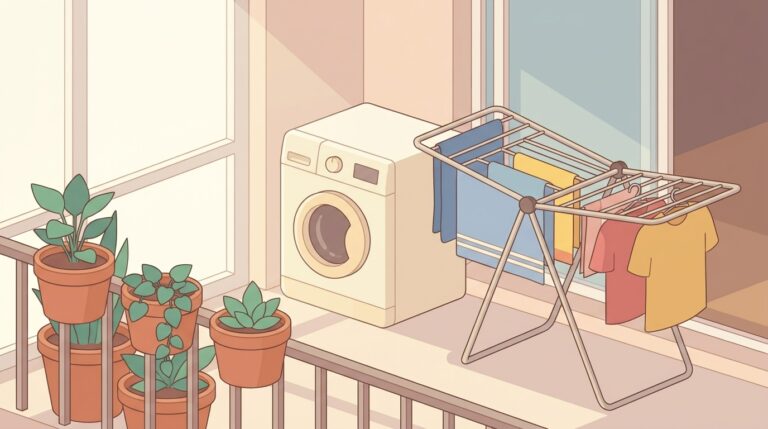
Have you ever watched a K-drama and wondered where the characters keep their washing machines, dry their clothes, or stack up their recycling bins? The answer is almost always the 베란다 (beranda – veranda)! In modern Korean apartments, this unique buffer zone between the outside world and your cozy room plays a huge role in daily life. Today, let’s unlock the secrets of this practical space using very simple A1-level Korean!
Phase 2: Core 3 Expressions
1. 베란다에 있어요. (It’s in the veranda.)
- Pronunciation: beh-rahn-dah-eh ee-ssuh-yo (Sounds like “beh-ran-da” + “eh” + “it-sir-yo”)
- Meaning: It’s in the veranda / balcony.
- K-Culture Moment: In K-dramas, when a guest asks, “Where is the washing machine?” or “Where should I put this empty box?”, the host pointing to the glass door and saying this is a classic scene.
- Editor’s Insight: The particle -에 (-eh) means “in” or “at”, and 있어요 (isseoyo) means “is” or “exists”. If you can’t find something in a Korean home, check the veranda first!
- Situation Spectrum: Casual ✅ / Semi-formal ✅ / Formal ⚠️
- 🤔 Think About It: Does your home have a dedicated balcony for household chores, or do you use a basement or laundry room?
2. 빨래 널어요. (I hang the laundry.)
- Pronunciation: pahl-lae neol-eo-yo (Sounds like “pal-lae nuhl-uh-yo”)
- Meaning: I hang the laundry (to dry).
- K-Culture Moment: Drying machines (dryers) are becoming popular, but many Koreans still love sun-drying their clothes on a ceiling-mounted or standing rack in the sunny veranda.
- Editor’s Insight: 빨래 (ppallae) means laundry, and 널어요 (neoreoyo) means to hang or spread out. It sounds friendly and warm!
- Situation Spectrum: Casual ✅ / Semi-formal ✅ / Formal ⚠️
- 🤔 Think About It: Why do you think natural sun-drying on the veranda is still preferred by many Korean families?
3. 화분 키워요. (I grow plants.)
- Pronunciation: hwah-boon kee-wuh-yo (Sounds like “hwa-boon key-war-yo”)
- Meaning: I grow potted plants.
- K-Culture Moment: Many apartment residents turn their verandas into a mini-garden, lining up cute pots of green plants or flowers.
- Editor’s Insight: 화분 (hwabun) means flowerpot, and 키워요 (kiwoyo) means to raise or grow. It shows the green-thumb lifestyle of city dwellers.
- Situation Spectrum: Casual ✅ / Semi-formal ✅ / Formal ⚠️
- 🤔 Think About It: Why is having green plants so popular for people living in tall apartment buildings?
Phase 3: Textbook Korean vs. Real Korean
Situation 1: Asking where the washing machine is
- 📖 Textbook: 세탁기는 어디에 있습니까? (se-tak-gi-neun eo-di-e it-seup-ni-ka? – Where is the washing machine?)
- 🗣️ Real Korean: 세탁기 베란다에 있어요? (se-tak-gi beh-rahn-dah-eh ee-ssuh-yo? – Is the washing machine in the veranda?)
- 💡 Why is it different? Real-life Korean often drops formal particles and endings like ‘-습니까’ in favor of simple, friendly question tones.
Situation 2: Asking someone to close the balcony door
- 📖 Textbook: 발코니 문을 닫으십시오. (bal-ko-ni mun-eul dat-eu-sip-si-o. – Please close the balcony door.)
- 🗣️ Real Korean: 베란다 문 좀 닫아줘요. (beh-rahn-dah mun jom dad-ah-jwo-yo. – Please close the veranda door.)
- 💡 Why is it different? Koreans almost always use “베란다” instead of “발코니” in conversation, and “~줘요” is the sweet, polite way to ask for a small favor.
Phase 4: K-Culture Deep-dive & Non-verbal Manners
4-1. Nunchi & Gestures: Veranda Etiquette
- Shut the Door: When the washing machine is spinning, keep the inner sliding glass door closed! This is polite “Nunchi” (social wit) to block the noisy spin cycles from disturbing the rest of the living room.
- Trash sorting: Koreans separate plastic, paper, and glass meticulously. This usually happens in the corner of the veranda. Keep it neat so guests don’t see a messy pile!
4-2. Culture Code: The “Veranda Cafe” (베란다 카페)
Recently, young Koreans love setting up a small wooden table and chairs in their veranda, lighting some fairy lights, and sipping coffee or beer while looking at the city view. It is their tiny getaway home cafe!
Phase 5: Real-Life Roleplay Scenario
Characters:
- 민준 (Minjun): Your Korean friend who is showing you his new apartment.
- 알렉스 (Alex): You, visiting a Korean apartment for the first time.
- 민준: 🎭 (Pointing to the glass door) 알렉스, 여기가 베란다예요.
(Alex, yeo-gi-ga beh-rahn-dah-yeo-yo.)
“Alex, this is the veranda.” -
알렉스: 🎭 (Looking around curiously) 와, 넓어요! 저기 세탁기 있어요?
(Wa, neolb-eo-yo! Jeo-gi se-tak-gi isseoyo?)
“Wow, it’s spacious! Is that the washing machine over there?” -
민준: 🎭 (Nodding proudly) 네, 세탁기 베란다에 있어요. 빨래도 여기서 널어요.
(Ne, se-tak-gi beh-rahn-dah-eh isseoyo. Ppal-lae-do yeo-gi-seo neol-eo-yo.)
“Yes, the washing machine is in the veranda. We dry laundry here, too.” -
알렉스: 🎭 (Pointing at green plants) 우와, 화분도 많아요!
(U-wa, hwah-boon-do manh-ah-yo!)
“Ooh, you have many flowerpots, too!” -
민준: 🎭 (Smiling) 네, 제 미니 정원이에요. 베란다 문 좀 열어볼래요?
(Ne, je mi-ni jeong-won-i-e-yo. Beh-rahn-dah mun jom yeol-eo-bol-lae-yo?)
“Yes, it’s my mini garden. Would you like to open the veranda door?”
🔀 Interactive Choice:
How do you answer Minjun?
* A. “싫어요. 베란다 추워요.” (No. The veranda is cold.)
* B. “좋아요! 베란다 문 열어요.” (Sounds good! Let’s open the veranda door.)
* C. “세탁기 돌려요?” (Are we running the washing machine?)
Feedback:
- Choice A (Risk): Too direct! While verandas can be cold in winter, saying “싫어요” (I hate it / No) sounds too harsh for an A1 level visitor.
- Choice B (Best): Fantastic! You used natural grammar to agree politely while showing interest in his lovely space.
- Choice C (Bad): Out of context. Asking about the machine suddenly when he offered to show you the view can feel a bit random.
Phase 6: 10-Second Shadowing Drill
Practice saying these out loud with natural rhythm and feeling!
세탁기는 / 베란다에 / 있어요.- [😊 Brightly & helpful]
- se-tak-gi-neun / beh-rahn-dah-eh / ee-ssuh-yo.
베란다 문 / 좀 / 닫아줘요.- [🥺 Asking gently]
- beh-rahn-dah mun / jom / dad-ah-jwo-yo.
Phase 7: K-Culture Mini Dictionary
- 베란다 (beranda): Balcony or veranda. A transitional outdoor space in apartments.
- 세탁기 (setakgi): Washing machine. Usually placed in the veranda because of water drainage systems.
- 건조대 (geonjodae): Laundry drying rack. Can be a standing rack or one attached to the ceiling.
- 분리수거 (bunrisugeo): Trash separation / Recycling. A highly organized daily ritual in Korea.
Phase 8: Travel Survival Kit
Top 3 Survival Expressions
- 문 닫아주세요. (mun dad-ah-ju-se-yo) – Please close the door. (Good for keeping cold winter drafts out of the living room!)
- 빨래 건조대 어디 있어요? (ppal-lae geon-jo-dae eo-di is-seo-yo?) – Where is the laundry drying rack?
- 추워요! (chu-wo-yo!) – It’s cold! (Uninsulated verandas can get super chilly in winter.)
💡 Editor’s Travel Note: If you are staying at an Airbnb in Korea, always check the host’s recycling guidelines. For detailed location maps and community recycling rules, you can search on the official Naver Map Web Version to find local waste drop-off zones or read localized residential guidelines!
Phase 9: Think Deeper
In many Western homes, washing machines are tucked away in a dark basement. In Korea, however, they are placed in the bright, sunny 베란다. Because Korean homes traditionally use 온돌 (ondol) floor heating, keeping wet areas like washing machines inside the main heated rooms can cause mold. Thus, the unheated veranda acts as the perfect functional buffer, balancing dry warmth indoors and ventilation outdoors. It represents a beautiful blend of traditional spatial design and modern apartment living.
💬 Your Turn: What does your balcony or backyard look like? Let us know in the comments below!
Phase 10: FAQ & Common Mistakes
Q: Is there a difference between a balcony and a veranda in Korea?
A: Architecturally yes, but in everyday language, Koreans call almost all apartment balcony spaces “베란다” (beranda). You don’t need to worry about the technical difference; just use “베란다”!
Q: Why is the washing machine always in the veranda?
A: Korean apartment verandas are built with built-in water drains on the floor. This makes it super easy to drain the washing machine water without ruining wooden indoor floors.
Q: Can I leave the veranda window open all year?
A: No! In winter, Korean pipes can freeze, causing huge trouble. You must close the windows tightly to keep the veranda above freezing temperatures.
🚨 Common Mistakes Alert!
| Mistake | What it sounds like | Correct Action |
|---|---|---|
| Saying “발코니” (balcony) in casual talk | Sounds a bit overly formal or textbook-like | Use 베란다 (beranda) instead. |
| Pronouncing it as “버랜더” (beorandeo) | English accent makes it hard for locals to understand | Pronounce clearly as 베란다 (beh-rahn-dah) with flat, even vowels. |
Phase 11: Action Mission
- Bronze: Say “베란다에 있어요” (It’s in the veranda) out loud 3 times in front of your mirror.
- Silver: Take a photo of your own balcony, washroom, or laundry space and share it on Instagram with the tag #DailyHangul_Veranda.
- Gold: The next time you watch a K-drama, try to spot the veranda glass door and say “베란다!” when you see it!
Phase 12: Interactive Quiz Challenge
1. Where is the most common place to find a washing machine in a Korean apartment?
* A) The kitchen
* B) The bedroom
* C) The veranda
👉 Click to see the answer!
Correct Answer: C) The veranda!
With built-in drainage and sun access, it’s the ultimate laundry zone in Korean homes.
2. True or False: “발코니” is more commonly used in daily spoken Korean than “베란다”.
👉 Click to see the answer!
Correct Answer: False!
Koreans almost universally refer to this space as 베란다 (beranda) in everyday speech.







