

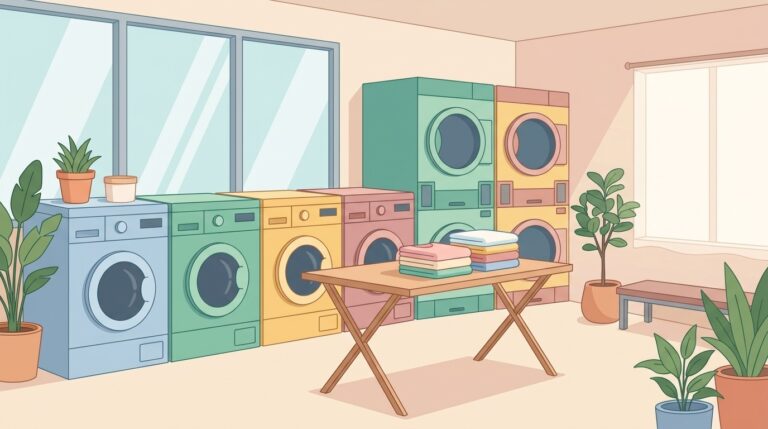
Master the Art of ‘Ppal-lae’ (빨래): Folding Laundry in a Cozy Korean Coin Laundromat
Phase 1: Empathy (Your Cozy Laundromat Guide)
안녕하세요! (An-nyeong-ha-se-yo!) Welcome back to Daily Hangul! It is your favorite editor and local guide here.
Have you ever watched a K-drama where the main characters are sitting in a warm, brightly lit coin laundromat (코인빨래방), sharing a can of sweet coffee while waiting for their clothes? There is a unique, cozy peace to Korean laundromats. But when the dryer finally goes ding! and it is time to fold your laundry at the shared table (정리대), you might feel a little lost.
How do you ask someone politely if you can use the folding table? How do you talk about finishing your chore like a real Seoulite? Don’t worry! Today, we are mastering the art of 빨래 개기 (folding laundry). Based on real questions from our global learners, this guide will help you blend in perfectly with the locals at any neighborhood laundromat. Let’s dive in!
Phase 2: Core 3 Expressions
Here are the top three expressions you absolutely need to know when handling laundry in Korea. Let’s look at them step-by-step!
1. 빨래를 개다 (ppal-lae-reul gae-da)
- Pronunciation: pahl-leh-reul geh-dah (Rhymes with “pay the”)
- Meaning: To fold laundry (Literally: Laundry + Fold)
- K-Culture Moment: You will hear this constantly in family-themed K-dramas. A mother might yell to her son, “빨래 좀 개어라!” (Fold the laundry!) while he is busy gaming in his room.
- Editor’s Insight: While the general verb for “to fold” is 접다 (jeob-da) (used for paper or wallets), Koreans use the special verb 개다 (gae-da) exclusively for clothes, blankets, and towels. Using 개다 instantly makes you sound like a native speaker!
- Situation Spectrum:
- Casual (with friends): 빨래 개자 (ppal-lae gae-ja) ✅
- Semi-formal (polite): 빨래 개요 (ppal-lae gae-yo) ✅
- Formal (business/official): 빨래를 갭니다 (ppal-lae-reul gaem-ni-da) ⚠️ (Sounds a bit too formal for home chores!)
- 🤔 Think About It: Does your language have a unique verb just for folding fabric, or do you use the same word for folding paper and clothes?
2. 다 갰어요 (da gaet-eo-yo)
- Pronunciation: dah-get-uh-yo (Sounds like “dah get oh yo”)
- Meaning: I finished folding them / They are all folded.
- K-Culture Moment: Imagine finishing a big pile of clean towels at the laundromat. You stretch your arms, look at your roommate, and say this with a proud sigh!
- Editor’s Insight: 다 (da) means “completely” or “all”. It is one of the most useful modifiers in Korean to show that a task is 100% complete.
- Situation Spectrum:
- Casual: 다 갰어 (da gaet-eo) ✅
- Semi-formal: 다 갰어요 (da gaet-eo-yo) ✅
- Formal: 다 갰습니다 (da gaet-seup-ni-da) ⚠️
3. 개는 것 좀 도와줄래? (gae-neun geot jom do-wa-jul-lae?)
- Pronunciation: geh-noon-gut jom doh-wah-jool-leh?
- Meaning: Can you help me fold this? (Casual)
- K-Culture Moment: Two roommates sitting on the floor in an apartment, folding a mountain of bed sheets together.
- Editor’s Insight: 좀 (jom) literally means “a little,” but in Korean culture, it acts as a polite cushion to make requests sound soft and natural rather than demanding.
- Situation Spectrum:
- Casual: 개는 것 좀 도와줄래? (gae-neun geot jom do-wa-jul-lae?) ✅
- Semi-formal: 개는 것 좀 도와주실래요? (gae-neun geot jom do-wa-ju-sil-lae-yo?) ✅
- Formal: 개는 것 좀 도와주시겠습니까? (gae-neun geot jom do-wa-ju-si-get-seup-ni-da-ka?) 🚫 (Too stiff for laundry!)
Phase 3: Textbook Korean vs. Real Korean
Let’s compare what you learn in classroom textbooks with how Koreans actually speak in real-life coin laundromats.
Situation 1: Suggesting to fold clothes together
- 📖 Textbook Korean: “우리 함께 세탁물을 접읍시다.” (u-ri ham-kke se-tak-mul-eul jeob-eup-si-da. – “Let us fold the laundry together.”)
- 🗣️ Real Korean: “우리 빨래 같이 갤까?” (u-ri ppal-lae gat-i gael-kka? – “Shall we fold the laundry together?”)
- 💡 Why the difference? Textbooks use the dry, formal noun 세탁물 (laundry item) and the robotic verb 접다. Real people use the warm, conversational word 빨래 and the friendly grammar -을까? (shall we?).
Situation 2: Noting that the clothes are dry and ready
- 📖 Textbook Korean: “의류 건조가 완료되었습니다.” (ui-ryu geon-jo-ga wan-ryo-doe-eot-seup-ni-da. – “Garment drying has been completed.”)
- 🗣️ Real Korean: “빨래 다 말랐다!” (ppal-lae da mal-rat-da! – “The laundry is completely dry!”)
- 💡 Why the difference? The textbook expression sounds like an automated voice from a machine. Locals simply say 다 말랐다 (completely dried) to express their excitement for warm, dry clothes.
Phase 4: K-Culture Deep Dive & Non-verbal Manners
4-1. Nunchi (눈치) at the Folding Table
When you go to a Korean coin laundromat, you will see a large table in the middle. This is the 정리대 (jeong-ri-dae – folding table). Here are the unwritten rules of Korean Nunchi (social wit):
1. Wipe before you fold: If you see any lint or dust on the table, grab a wet tissue and wipe it down. Doing this makes you look incredibly thoughtful to the next person waiting.
2. Don’t hog the space: Keep your laundry baskets (빨래 바구니) under the table or in your cart so others have room to fold.
3. Eye Contact & Smile: If someone is waiting for the table, make eye contact, nod gently, and say, “금방 끝나요” (geum-bang kkeut-na-yo – “It will be finished soon”).
4-2. The Cozy Laundromat Trend
In modern Korea, especially in cities like Seoul, single-person households are incredibly common. Because of this, coin laundromats have evolved into mini cafes! You will find free Wi-Fi, book shelves, vending machines with cold drinks, and cozy seating. Many indie musicians write songs about the warm scent of dryer sheets, and dramas like Because This Is My First Life use the laundromat as a space for intimate, honest heart-to-hearts.
Phase 5: Real-Life Roleplay Scenario
Setting: Han River Coin Laundry in Mapo-gu, Seoul. You have just taken a warm bundle of hoodies out of the dryer. Minjun, a friendly local who lives next door, is folding his t-shirts at the next table.
Characters:
* You (A2 Learner)
* Minjun (Friendly Neighbor)
Minjun: (Smiling warm) 와, 오늘 빨래 진짜 많으시네요!
        (Wa, o-neul ppal-lae jin-jja man-eu-si-ne-yo!)
        "Wow, you have a really big pile of laundry today!"

You:    🎭 (Wiping sweat with a laugh) 네, 일주일 치 빨래예요. 건조기가 정말 따뜻해요.
        (Ne, il-ju-il chi ppal-lae-yeo-yo. Geon-jo-gi-ga jeong-mal tta-tteut-hae-yo.)
        "Yes, it is a week's worth of laundry. The dryer is really warm."

Minjun: 🎭 (Nodding and pointing to the big table) 여기 정리대 같이 써요. 공간 넓어요!
        (Yeo-gi jeong-ri-dae gat-i sseo-yo. Gong-gan neolb-eo-yo!)
        "Let's use this folding table together. There is plenty of space!"

You:    (Moving your basket) 감사합니다! 혹시... 빨래 개는 것 좀 도와줄 수 있어요?
        (Gam-sa-ham-ni-da! Hok-si... ppal-lae gae-neun geot jom do-wa-jul su it-eo-yo?)
        "Thank you! By any chance... could you help me fold this?"

Minjun: (Cheerfully) 당연하죠! 수건부터 같이 갤까요?
        (Dang-yeon-ha-jyo! Su-geon-bu-teo gat-i gael-kka-yo?)
        "Of course! Shall we fold the towels first?"

You:    (Happy) 네, 좋아요! 금방 다 갰네요!
        (Ne, jo-a-yo! Geum-bang da gaet-ne-yo!)
        "Yes, great! We finished folding so fast!"
🔀 Choose Your Next Move!
- Option A: “빨래 다 갰으니까 이제 커피 마셔요!” (ppal-lae da gaet-eu-ni-kka i-je keo-pi ma-syeo-yo! – “Now that the laundry is all folded, let’s drink coffee!”)
- Option B: “고맙습니다. 근데 저는 집에 갑니다.” (go-map-seup-ni-da. geun-de jeo-neun jip-e gap-ni-da. – “Thank you. But I am going home.”)
- Option C: “도와주셔서 진짜 편해요. 다음에도 같이 해요!” (do-wa-ju-syeo-seo jin-jja pyeon-hae-yo. da-eum-e-do gat-i hae-yo! – “It was so easy thanks to your help. Let’s do it together next time too!”)
💡 Feedback on Your Choice:
- Option A (Best): Fantastic choice! Laundromat coffee is a classic Korean social bonding ritual. It is warm and super friendly!
- Option B (Bad): While polite, it is a bit too abrupt and cold after someone just helped you fold your clothes.
- Option C (Risk): Friendly, but asking to meet at the laundromat again next time can sound a little too forward for a first-time meeting in Korea!
Phase 6: 10-Second Emotion Shadowing Drill
Practice these natural conversational flows out loud! The slashes / represent natural pauses.
- [😊 Bright and excited]
“와! / 빨래가 / 진짜 / 잘 말랐어요!”
(Wa! / Ppal-lae-ga / jin-jja / jal mal-las-seo-yo!)
“Wow! / My laundry / really / dried so well!” -
[🥺 Tired but asking sweetly]
“오늘 너무 피곤한데… / 빨래 개는 것 좀 / 도와주면 안 돼?”
(O-neul neo-mu pi-gon-han-de… / ppal-lae gae-neun geot jom / do-wa-ju-myeon an dwae?)
“I am so tired today… / Could you please help / fold the laundry?”
Phase 7: K-Culture Mini Dictionary
| Word (Korean) | Romanization | English Translation | Everyday Usage Insight |
|---|---|---|---|
| 코인빨래방 | koin-ppal-lae-bang | Coin Laundromat | Also called 셀프빨래방 (self-laundromat). Most take coins or credit cards. |
| 섬유유연제 | seom-yu-yu-yeon-je | Fabric Softener | Used during the wash to make your clothes smell amazing. |
| 건조기 시트 | geon-jo-gi si-teu | Dryer Sheets | Scented sheets you toss into the dryer to prevent static. |
| 빨래대 | ppal-lae-dae | Drying Rack | A folding rack used at home to air-dry clothes. |
Phase 8: Traveler’s Survival Kit
Top 3 Survival Phrases for the Laundromat:
- “동전 교환기 어디 있어요?” (dong-jeon gyo-hwan-gi eo-di it-eo-yo?)
- Meaning: “Where is the coin changer?” (Crucial for older machines!)
- “세제는 자동으로 나와요?” (se-je-neun ja-dong-eu-ro na-wa-yo?)
- Meaning: “Does the detergent come out automatically?”
- “건조기 얼마예요?” (geon-jo-gi eol-ma-yeo-yo?)
- Meaning: “How much is the dryer?”
📌 Editor’s Travel Note:
To find the nearest cozy laundromat in Seoul, open the Naver Map App and search for 코인세탁 (coin laundry) or 빨래방 (laundromat). Note that while many modern places accept credit cards or phone payments, keeping a few 500-won coins in your pocket is a life saver!
Phase 9: “A Step Deeper” (Cultural Reflection)
In Western countries, folding laundry is often a solitary, quick chore done in a private basement or room. In Korea, however, folding laundry is traditionally a warm, communal family activity. Parents and children sit together on the warm floor (온돌), watching a evening TV show, talking about their day while neatly folding socks and shirts. It represents the quiet, domestic love that keeps a home running.
💬 Your Turn: Do you fold laundry alone in your room, or is it a shared household chore in your culture? Leave a comment below and share your story!
Phase 10: FAQ & Avoiding Mistakes
Q: Can I use the verb “접다” when folding clothes?
A: Yes, Koreans will understand you perfectly, but it sounds slightly mechanical. Using the verb 개다 specifically for fabric and clothing shows that you have a deep, natural understanding of the Korean language!
Q: How do I ask if someone is finished using a machine?
A: Simply point to the machine and politely ask: “다 끝났나요?” (da kkeut-nat-na-yo? – “Is it all finished?”).
🚨 Common Mistakes Dashboard (Don’t Do This!)
- Mistake 1: Calling laundry clothes “옷 접기” (ot jeob-gi).
- Correct Action: Say 빨래 개기 (ppal-lae gae-gi).
- Mistake 2: Putting wet clothes directly onto the folding table.
- Correct Action: Make sure clothes are 100% dry. Wet items can ruin the wooden table and leave lint everywhere.
Phase 11: Action Mission & Participation
- Bronze Medal: Say “빨래 개기” three times out loud with the correct pronunciation.
- Silver Medal: Next time you fold your clothes at home, post a picture of your neat pile on Instagram, tag
@DailyHangul, and write: “오늘 빨래 다 갰어요! 🧺” - Gold Medal: Visit a local Korean laundromat (or a Korean friend’s home) and ask them: “빨래 개는 것 좀 도와줄까?” (Shall I help you fold the laundry?)
Phase 12: Interactive Quiz Challenge
Test your skills with this quick quiz!
1. What is the most natural Korean verb for “folding laundry”?
- A) 접다 (jeob-da)
- B) 개다 (gae-da)
- C) 자르다 (ja-reu-da)
2. True or False: You should leave your laundry basket on the folding table while you wait for your clothes to wash.
- True / False
👀 Click here to reveal the answers and explanations!
- Correct Answer: B) 개다 (gae-da)
- Explanation: While ‘접다’ means to fold in general (like paper), ‘개다’ is the perfect cultural verb specifically for clothing and fabric.
- Correct Answer: False
- Explanation: To show good Nunchi (social etiquette), keep the shared folding table clear so other people can fold their warm laundry!







