

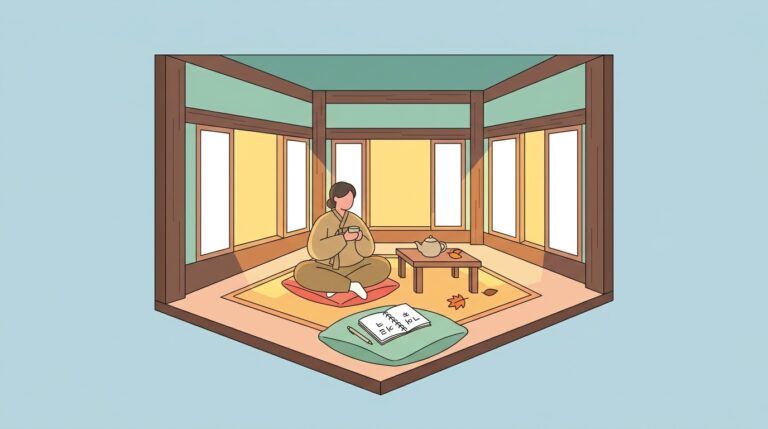
Stepping Onto Warm Earth: The Scientific Magic of Hanok’s Ondol and the Secret to Cozy Korean Comfort
안녕하세요! Welcome back to another deep-dive into the beautiful intersections of Korean language and lifestyle. I’m your Chief Editor at Daily Hangul, your cozy companion on this journey of mastering not just the words of Korea, but the soul behind them.
Have you ever watched a slice-of-life K-drama and noticed characters coming home on a freezing winter evening, only to immediately melt onto the living room floor like happy, buttered toast? Or perhaps you’ve booked a boutique 한옥 스테이 (Hanok stay) in Bukchon or Jeonju, stepped inside, and wondered why the floor felt alive with a deep, soothing warmth while the upper air remained wonderfully crisp and clean.
If you come from a culture accustomed to dry, noisy forced-air vents or clanking metal radiators, the quiet, grounding warmth of a Korean floor can feel almost supernatural. Today, we are going into the heart of traditional Korean architecture—the 한옥 (Hanok)—to explore the scientific brilliance of 온돌 (Ondol), Korea’s traditional underfloor heating system. Along the way, we’ll unpack advanced idioms and cultural behaviors that will elevate your Korean to a C1 level, turning you from a mere spectator into someone who truly understands the visceral rhythm of Korean comfort.
Phase 1: The Cold Open — Chasing the Phantom Warmth
Imagine this scenario: You’ve spent the entire afternoon walking the windy stone walls of Gyeongbokgung Palace in late November. Your toes are numb, your nose is rosy, and your energy is depleted. You finally arrive at your traditional Hanok guesthouse.
Your host welcomes you, bows, and gently reminds you: “신발은 벗고 들어오세요” (Please take off your shoes and step inside).
You slide open the wooden lattice door pasted with delicate 한지 (Hanji) paper. The moment your bare or sock-covered feet touch the smooth, dark-lacquered floor, a shockwave of deep, radiant heat travels up your spine. It doesn’t feel like a stuffy heater blowing dust into your eyes; it feels like the gentle, steady embrace of a hot stone massage.
You immediately drop your bags, lie flat on your back against the floor, and let out a long, instinctive sigh.
This isn’t just cozy; it’s a centuries-old scientific masterpiece. Traditional 온돌 (Ondol) utilizes a hearth (아궁이 – agungi) where firewood is burned to cook and heat. The smoke and hot air from this fire don’t just escape; they are funneled beneath the stone floor slabs (구들장 – gudeuljang) before exiting through a chimney on the other side. These stones store the heat and slowly release it over hours. This creates a highly efficient, vertical thermal gradient: warm feet, cool head (두한족열 – duhanjogyeol), which is considered the golden rule of holistic health in traditional Korean medicine.
Learning how to talk about this sensory experience is a vital key to bonding with Koreans. Let’s look at the expressions that bridge this physical warmth with conversational fluency.
Phase 2: Core Expressions of Thermal Comfort
To speak like a true cultural insider, you must go beyond basic adjectives like “따뜻해요” (It’s warm). Here are three advanced terms that carry rich cultural weight.
1. 등 따습고 배부르다 (Deung ttaseupgo baebureuda)
- Pronunciation: [deung ttaseup-go bae-bu-reu-da] / Sound-alike: “Deung ttah-seup-go bae-boo-roo-dah”
- Meaning: Literally “One’s back is warm and belly is full.” It represents the ultimate state of simple, worry-free contentment and physical security.
- K-Culture Moment: You will hear this in historical dramas (사극 – sageuk) when a hardworking farmer finally sits on his heated floor after a bountiful harvest, or in modern slice-of-life dramas when characters express gratitude for a cozy home.
- Editor’s Insight: This expression reflects an agrarian ancestry where winter meant survival. Having a heated floor (등 따뜻하다) and enough rice to eat (배부르다) was the highest form of luxury. Today, it’s used to describe a state of complete, peaceful satisfaction.
- Situation Spectrum:
- Casual (Friends/Family): ✅ (Perfect for expressing blissful comfort)
- Semi-formal (Colleagues): ⚠️ (Slightly colloquial, but great for casual bonding)
- Formal (Bosses/Elders): 🚫 (Too informal for structured business settings)
🤔 Think About It: Why does Korean comfort prioritize the “back” (등) over other parts of the body? Think about how Western cultures focus on sitting by the fireplace to warm their hands or face, while Koreans lie flat to heat their spine. How does your culture define physical security in a single phrase?
2. 몸을 지지다 (Momeul jijida)
- Pronunciation: [mo-meul ji-ji-da] / Sound-alike: “Moh-meul jee-jee-dah”
- Meaning: To “sear” or “toast” one’s body on a hot surface for therapeutic relief.
- K-Culture Moment: Think of an exhausted character in a family drama heading to a 찜질방 (Jjimjilbang – Korean bathhouse/sauna) or lying down on an electric heating mat (전기장판) after a grueling week of work.
- Editor’s Insight: The verb 지지다 usually means to pan-fry or griddle food. When applied to the body, it means letting the intense, deep-tissue heat of a heated floor or hot stone relax your tight muscles and aching bones. It is a highly active, therapeutic form of resting.
- Situation Spectrum:
- Casual (Friends/Family): ✅ (Very common when talking about relaxing over the weekend)
- Semi-formal (Colleagues): ✅ (Shows you understand the authentic Korean way of recovering from fatigue)
- Formal (Bosses/Elders): ⚠️ (Use with polite sentence endings: “몸을 좀 지지고 싶습니다”)
3. 아랫목 (Araetmok) vs. 윗목 (Winmok)
- Pronunciation: [a-raen-mok] / [win-mok] / Sound-alike: “Ah-raen-mok” vs “Ween-mok” (Note the nasal sound change in 아랫목 due to pronunciation rules!)
- Meaning: 아랫목 is the warmest spot on the floor closest to the furnace. 윗목 is the cooler spot furthest away.
- K-Culture Moment: In vintage or period K-Dramas, you’ll see mothers tucking their children’s brass bowls of rice under a blanket on the 아랫목 to keep them warm until the father returns home from work.
- Editor’s Insight: These words represent the social and spatial hierarchy of a Korean household. The warmest spot (아랫목) was always reserved for the family elders, honored guests, or kept as a communal heating zone. Understanding this distinction shows an elite grasp of Korean spatial culture.
- Situation Spectrum:
- Casual (Friends/Family): ✅ (Essential when staying at a guesthouse)
- Semi-formal (Colleagues): ✅ (Shows deep cultural literacy)
- Formal (Bosses/Elders): ✅ (Highly relevant when hosting or arranging seating)
Phase 3: Textbook Korean vs. Real Korean
Let’s look at how standard classroom Korean differs from what natives actually say when interacting with heated spaces.
Situation 1: Asking your Hanok host to turn up the heat
- 📖 Textbook Korean: “실내 온도를 높여 주십시오.” (Please raise the indoor temperature.)
- Why it’s unnatural: It sounds like you are reading a user manual for an industrial thermostat. It lacks human warmth.
- 🗣️ Real Korean: “사장님, 방바닥 좀 뜨끈뜨끈하게 해 주실 수 있나요?” (Owner, could you make the floor a bit nice and hot?)
- Why it works: It uses the sensory onomatopoeia 뜨끈뜨끈하다 (tteukkeun-tteukkeun-hada), which directly communicates that you want that deep underfloor heat, not just warmer air.
Situation 2: Describing how good the heated floor feels to your bones
- 📖 Textbook Korean: “바닥이 따뜻해서 피로가 풀립니다.” (Because the floor is warm, my fatigue is relieved.)
- Why it’s unnatural: While grammatically correct, it is highly clinical and lacks the visceral satisfaction of the experience.
- 🗣️ Real Korean: “아, 뜨끈한 데 누워 있으니까 뼈마디가 노곤노곤해지네요.” (Ah, lying down on this hot floor is making my bones feel so wonderfully soft and relaxed.)
- Why it works: 노곤노곤하다 (nogon-nogon-hada) is the gold standard C1-level adjective for describe that heavy, blissful, melting sensation you get when deep heat relaxes your muscles.
Phase 4: K-Culture Deep Dive & Non-verbal Manners
To navigate a Hanok and the culture of Ondol flawlessly, you need to understand the physical behaviors that accompany it.
4-1. Nunchi & Underfloor Etiquette
- The Ultimate Barefoot Rule: When visiting a Hanok, never step onto the floor with outdoor shoes. However, because Ondol floors are touched directly by hands, knees, and bodies, walking on them with sweaty bare feet can sometimes be seen as slightly impolite in formal settings. Opt for clean, neat socks (양말).
- The Elder Seat: If you enter a heated room with an elder or a boss, do not rush to sit on the warmest spot (아랫목). Guide them to it with a gentle gesture: “이쪽 아랫목이 따뜻하니 여기 앉으세요” (This spot is warm, please sit here). This subtle act of hospitality is the pinnacle of Korean 눈치 (Nunchi – situational wisdom).
- The Sofa Backrest Phenomenon: Have you ever noticed that even in modern Korean apartments equipped with luxurious sofas, many Koreans still sit on the floor and use the sofa merely as a backrest? This is a biological habit deeply ingrained by centuries of Ondol culture. The heated floor is home; the furniture is secondary.
4-2. The Science of the Mud and Stone
Traditional Hanoks are built with organic materials: wood, stone, clay, and paper. The floor is lined with layers of red clay (황토 – hwangto), which emits far-infrared radiation when heated by the Ondol system. This isn’t just a physical heating mechanism; it is a therapeutic wellness system that promotes blood circulation and relieves stress. This explains why K-Beauty and K-Wellness trends are so deeply connected to clay-based heat therapy!
Phase 5: The Interactive Roleplay — A Night at the Hanok Guesthouse
Let’s test your cultural and linguistic agility. You are staying at a traditional Hanok guesthouse in Jeonju during a cold autumn evening. You are talking to the host, a warm-hearted elderly woman (이모님 – Imonim).
Cast:
- You (The Guest): An appreciative traveler who wants to experience authentic Ondol.
- Imonim (The Host): A generous, attentive host who takes great pride in her Hanok.
The Script:
- Imonim: “아이고, 바깥 날씨가 제법 쌀쌀하죠? 얼른 들어와요.”
(Aigo, the weather outside is quite chilly, isn’t it? Come on in quickly.) -
You: “(Smile warmly, bowing slightly) 네, 이모님. 찬 바람을 오래 맞았더니 온몸이 다 으슬으슬하네요.”
(Yes, Imonim. After facing the cold wind for so long, I feel chills all over my body.) -
Imonim: “그럴 줄 알고 내가 미리 방에 군불을 때서 뜨끈뜨끈하게 만들어 놨어요.”
(I knew that, so I stoked the fire in advance to make the room nice and hot.) -
You: “(Stepping onto the floor) 와! 진짜 방바닥이 발끝부터 온몸으로 따뜻하게 차오르는 것 같아요. 이게 바로 진짜 온돌이군요!”
(Wow! The floor really feels like it is filling my whole body with warmth starting from my toes. This is real Ondol!) -
Imonim: “그럼요! 우리 집 구들장은 진짜 좋은 돌만 써서 열기가 오래 가요. 얼른 저기 아랫목에 이불 깔아놨으니 들어가서 누워요.”
(Of course! Our floor stones are made only of the best stone, so the heat lasts a long time. I laid out a futon on the Araetmok over there, so go lie down.) -
You: “아, 이 따뜻한 자리가 아랫목이군요? 정말 배려해주셔서 감사합니다. 오늘 여기서 몸 좀 푹 지져야겠어요.”
(Ah, so this warm spot is the Araetmok? Thank you so much for your thoughtfulness. I must toast my body thoroughly here today.) -
Imonim: “하하! ‘몸 지진다’는 말은 어디서 배웠대? 아주 한국 사람 다 됐네!”
(Haha! Where did you learn the phrase ‘to toast one’s body’? You’ve practically become Korean!) -
You: “(Laughing softly) 좋은 표현이니까요! 진짜 등 따습고 배부르니까 더 바랄 게 없네요.”
(Because it’s a great expression! Truly, with a warm back and a full belly, there is nothing more I could wish for.) -
Imonim: “푹 자고 나면 내일 아침에는 피로가 눈 녹듯 사라질 거예요. 필요한 거 있으면 언제든 말해요.”
(After a deep sleep, your fatigue will melt away like snow tomorrow morning. Let me know if you need anything.) -
You: “네, 이모님. 따뜻하게 챙겨주셔서 정말 감사합니다. 안녕히 주무세요.”
(Yes, Imonim. Thank you so much for taking such warm care of me. Good night.)
🔀 Decision Point!
Suppose the floor is too hot (which can happen with traditional wood-fired Ondol!). What do you say to handle this politely without offending your host?
- Option A: “방이 너무 뜨거워 타 죽을 것 같아요! 어떻게 좀 해주세요!”
- Feedback: Too aggressive and dramatic! Saying “I think I’m going to burn to death” is rude to a host who worked hard to stoke the fire.
- Option B: “이모님, 보일러 고장 난 것 같아요. 온도를 좀 낮출게요.”
- Feedback: Inaccurate! Traditional Ondol doesn’t always have a modern boiler dial you can just click down. It shows a lack of understanding of wood-fired heating.
- Option C: “이모님, 방이 아주 뜨끈뜨끈해서 좋은데, 밤새 더워질까 봐 문을 아주 살짝만 열어두고 자도 괜찮을까요?”
- Feedback: Best Choice! This praises the warmth (뜨끈뜨끈해서 좋은데) while finding a practical, polite compromise (cracking a window/door slightly) to balance the temperature.
Phase 6: 10-Second Emotion Shadowing Drill
To master the deep, sensory relief of Ondol, try shadowing this sentence with the exact physical emotion of melting into a warm floor after a long day.
“아이고, / 등 뜨뜻하니 / 잠이 솔솔 오네.”
- Romanization: [Aigo, / deung tteutteothani / jami solsol one.]
- Emotion Target:
[🥺 Tired but blissfully relieved / Voice dropping to a cozy whisper] - Intonation Guide: Drag out the “아이고” (A-i-gooo) as a sigh of relief. Put a soft, warm emphasis on “뜨뜻하니” (tteu-tteot-ha-ni) and whisper “솔솔 오네” (sol-sol o-ne) as if you are already half-asleep.
Phase 7: K-Culture Mini Dictionary
| Word | Hangul / Romanization | Definition & Real-World Use |
|---|---|---|
| 1. 구들장 | 구들장 [Gudeuljang] | The flat stone slabs placed beneath a Hanok floor to absorb and radiate heat. In conversation, it represents traditional thermal durability. |
| 2. 아랫목 | 아랫목 [Araetmok] | The warmest spot on a heated floor. Symbolizes hospitality, care, and respectful spatial hierarchy. |
| 3. 군불 | 군불 [Gunbul] | Firewood stoked in a hearth specifically for heating the floor (rather than cooking). Often used when welcoming guests in winter. |
| 4. 좌식 문화 | 좌식 문화 [Jwasik Munhwa] | Floor-sitting culture. The lifestyle of sitting, eating, and sleeping on the floor, which was made possible solely by the clean, ash-free warmth of Ondol. |
Phase 8: Traveler’s Survival Kit
Staying in a Hanok or visiting Korea in the winter? Keep these three lifesavers in your pocket!
Survival Phrases
- “보일러 온도 어디서 조절해요?”
- Romanization: [Bo-il-leo on-do eo-di-seo jo-jeol-hae-yo?]
- Pro-Tip: In modern Hanoks or apartments, underfloor heating is controlled by a small digital wall panel called a 보일러 조절기. Use this phrase to ask where it is.
- “바닥이 너무 뜨거운데 이불 하나 더 주실 수 있나요?”
- Romanization: [Ba-da-gi neo-mu tteu-geo-un-de i-bul ha-na deo ju-sil su in-na-yo?]
- Pro-Tip: If the wood-fired floor gets too hot, placing an extra thick futon (이불) beneath you acts as a thermal buffer.
- “외출 모드로 돌려놓을게요.”
- Romanization: [Oe-chul mo-deu-ro dol-ryeo-no-eul-ge-yo.]
- Pro-Tip: When leaving your room, switch the boiler controller to “외출” (Away mode) instead of turning it off. Turning off the heat completely requires immense energy to reheat the stones later!
📌 Editor’s Travel Note: If you want to experience the absolute peak of traditional Hanok and Ondol culture, I highly recommend booking an overnight stay in the Bukchon Hanok Village Reservation Page or using verified local directories. Always remember to wear warm socks, as walking on cold wooden porches (대청마루 – daecheongmaru) before stepping into the heated rooms can be chilly!
Phase 9: Deep Reflection — The Philosophy of Shared Warmth
Ondol is not merely an engineering marvel; it is an architectural philosophy that has shaped the psychology of the Korean people. Unlike Western fireplaces that heat the air and gather people in a circle facing the flame, Ondol heats the shared ground.
To share an Ondol floor is to share a foundation. Everyone sits together, eats together, and sleeps together on the same warm plane. This has fostered a deep sense of communal intimacy and equality within the home. In a world increasingly defined by individual partitions and personal screens, sitting on a warm floor forces us to look at each other at eye level. It is a physical manifestation of 정 (Jeong) — the sticky, warm feeling of deep attachment.
💬 Your Turn: Does your culture have a specific heating method or architectural space that brings family members physically closer together? Let us know in the comments below!
Phase 10: FAQ & Common Mistakes
Q: Why does the air in a traditional Hanok feel cool even when the floor is boiling hot?
A: This is intentional and scientifically brilliant! Traditional Hanoks are designed with porous natural materials that allow for ventilation, keeping the air fresh and cool while the radiant heat from the floor directly warms your body. This avoids the stuffy, dehydrating air quality of modern forced-air heating systems.
Q: Can I leave the underfloor heating (보일러) on all day?
A: Yes, but keep it at a moderate, consistent temperature. Turning a Korean floor heating system completely off and then back on actually consumes significantly more gas or electricity because it takes a long time to heat up the thick subfloor layers. Use the “외출” (away) mode when going out.
Q: Is Ondol only used in old traditional houses?
A: Absolutely not! Almost 100% of modern Korean homes, apartments, and villas use modern hydronic Ondol (hot water pipes running under the floor) instead of central forced-air heating. The scientific principle remains identical, even in a high-rise in Gangnam.
🚨 Common Mistakes Alert!
- Leaving the floor uncovered when you want it hot: If you want the floor to warm up quickly, throw a blanket or a mattress over it. The blanket traps the radiant heat, creating a warm pocket.
- Wearing thick-soled indoor slippers inside a Hanok bedroom: Slippers block the therapeutic radiant energy of the Ondol floor. Embrace the barefoot/sock experience!
- Calling the floor “뜨겁다” (tteu-geop-da) when it feels nice: If the heat is pleasant and comforting, use 뜨끈뜨끈하다 or 뜨끈하다. Reserve 뜨겁다 (hot) for when the floor is genuinely burning your skin!
Phase 11: Action Missions
- 🥉 Bronze (The Solo Mirror Challenge): Practice the shadowing drill from Phase 6 three times. Focus on dropping your voice pitch and sighing with visceral comfort on the words “아이고”.
- 🥈 Silver (The Social Connection): Take a photo of your cozy corner at home or your favorite comforting space. Post it on your social media with the caption: “오늘 하루 일과 끝! 가만히 누워있으니 등 따습고 배부르네요.” Tag us at #DailyHangul!
- 🥇 Gold (The Local Explorer): The next time you visit a Korean restaurant with floor seating (좌식), or a Hanok guesthouse, actively identify where the 아랫목 would be based on the kitchen or heat source, and offer that spot to your companion with the polite phrase: “따뜻한 아랫목에 앉으세요!”
Phase 12: Interactive Quiz Challenge
Test your C1 Korean cultural intelligence!
1. Situational Etiquette
You are entering a traditional Hanok restaurant with your Korean business partner. There is a heated floor section. Where should you sit?
* A) Take the spot closest to the door so you can leave quickly.
* B) Offer the warmest spot (아랫목) to your business partner first.
* C) Sit right in the middle of the floor to claim the central space.
2. Fill in the Blank
“이번 겨울에 시골 한옥마을에 가서 뜨끈뜨끈한 방바닥에 누워 몸을 ( ) 지지고 싶어요.”
* Hint: The verb meaning “to toast or sear the body in a hot heated room.”
3. True or False
Traditional Ondol heating warm the air first through convective air currents from high vents.
👉 Click here to reveal the Answers & Explanations!
- Answer: B
- Explanation: Offering the 아랫목 (warmest spot) to elders or guests of honor is the ultimate sign of respect and refined Nunchi in Korean dining and living etiquette.
- Answer: 푹 (followed by 지지다)
- Explanation: The full expression is 몸을 푹 지지다 (to thoroughly toast one’s body).
- Answer: False
- Explanation: Ondol heats the floor stones first, which then radiate deep, direct heat upward. The air remains relatively cool and fresh, making it a highly healthy and comfortable environment compared to high-vent air systems.
- Explanation: Ondol heats the floor stones first, which then radiate deep, direct heat upward. The air remains relatively cool and fresh, making it a highly healthy and comfortable environment compared to high-vent air systems.
We hope this deep guide warmed your soul as much as a heated Ondol floor in the middle of winter. Keep practicing, keep feeling the culture beneath the words, and we’ll see you in the next cozy lesson!
다음에 또 만나요! 안녕!






