

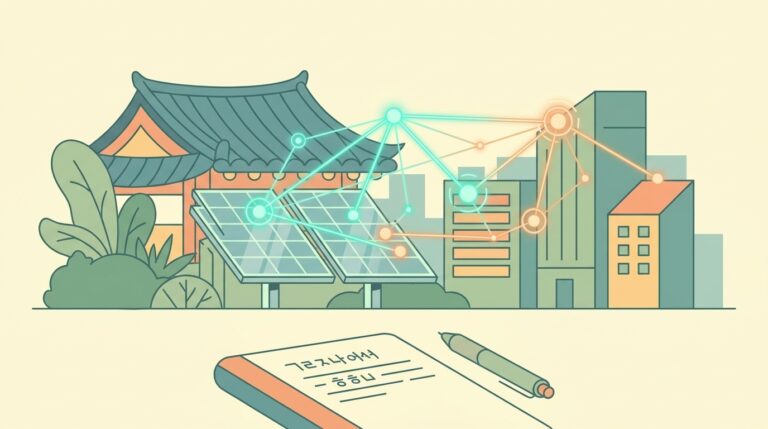
Rebuilding Seoul: Master Smart City & Urban Regeneration Korean Like a Pro
Phase 1: Empathy (스토리 몰입형 오프닝)
안녕하세요! (An-nyeong-ha-se-yo!) Your friendly neighborhood Daily Hangul Editor-in-Chief here.
Imagine this scene straight out of a premium K-Drama like Start-Up or The King: Eternal Monarch: You are standing in a sleek, glass-walled conference room overlooking the dazzling skyline of Songdo International Business District or Seoul’s Sangam Digital Media City (DMC). You have spent weeks designing an state-of-the-art smart city proposal. The presentation slides look flawless. You confidently pitch terms like “AI-driven waste management” and “Internet of Things (IoT) sensors.”
But when the Korean urban planners on the other side of the table nod politely and say, “Good, but how does this connect to our 도시 재생 (Dosi Jaesaeng – Urban Regeneration) initiative? How does it foster 상생 (Sangsaeng – Coexistence)?” your mind goes blank.
You realize that in Korea, smart cities are not just about installing high-tech gadgets in shiny new towers; they are about stitching advanced technology into the historical and cultural fabric of old neighborhoods. The gap between purely technical English jargon and the deeply community-oriented, policy-driven Korean architectural terminology is a major pain point for global experts.
Mastering these nuances will transform you from an “outsider pitching a foreign system” to a “trusted local partner who understands the soul of Korean communities.” This guide was meticulously crafted based on real-world collaborative projects between global design firms and Seoul’s Metropolitan Government. Let’s dive deep!
Phase 2: Core Expressions (핵심 표현 3선 심층 분석)
1. 도시 재생 (Dosi Jaesaeng)
- Pronunciation: [doh-shee jae-saeng] / Sound-alike guide: “Doh-she” (as in ‘she’ with a ‘d’) + “Jae-saeng” (sounds like ‘jay-sang’)
- Meaning: Urban Regeneration (Literal: City Rebirth/Re-creation)
- K-Culture Moment: Think of the trendy neighborhood of Ikseon-dong or Seongsu-dong in Seoul. Instead of bulldozing old hanoks or abandoned red-brick factories, planners preserved the structural skeletons and added modern smart-grid utilities and cafes. This is classic 도시 재생 in action.
- Editor’s Insight: Do not confuse this with 재개발 (Jae-gae-bal – Redevelopment). Redevelopment means tearing down everything and starting from scratch. 도시 재생 is a warmer, gentler term that emphasizes preserving heritage while upgrading infrastructure.
- Situation Spectrum:
- Casual/Friends: ⚠️ (Slightly academic for a casual chat, unless discussing trendy hot spots)
- Semi-formal (Business): ✅ (Perfect for conceptual pitches)
- Formal (Government Proposals): ✅ (An absolute must-use keyword)
- 🤔 Think About It: Why does Korea prioritize regeneration over redevelopment in historical pockets? How does preserving the “old” while infusing the “smart” change the way citizens interact? How does this compare to your home country’s approach?
2. 스마트 인프라 (Seumateu Inpeura)
- Pronunciation: [seu-ma-teu een-pheu-ra] / Sound-alike guide: “Suh-mah-tuh” (Smart) + “In-fra” (short for Infrastructure)
- Meaning: Smart Infrastructure
- K-Culture Moment: If you have ever stood at a Seoul smart bus shelter (스마트 쉼터) equipped with UV air sterilizers, heated benches, free Wi-Fi, and real-time digital screens showing bus locations, you have experienced 스마트 인프라 firsthand.
- Editor’s Insight: In Korean business culture, using the loanword 인프라 (Inpeura) is highly standard and preferred over the native term 기반 시설 (Giban siseol) in modern tech pitches because it sounds dynamic and forward-looking.
- Situation Spectrum:
- Casual/Friends: ⚠️
- Semi-formal (Business): ✅
- Formal (Government Proposals): ✅
- 🤔 Think About It: Notice how English loanwords like “Smart” and “Infra” are adapted into Korean. Why do you think technological terms in urban planning often utilize phonetic Koreanizations instead of pure Hanja translations?
3. 상생 협력 (Sangsaeng Hyeop-ryeok)
- Pronunciation: [sang-saeng hyeob-ryeok] / Sound-alike guide: “Sang-sang” (but with an ‘eh’ sound in the second block) + “Hyup-ryuk” (sounds like ‘yup’ with an ‘h’ + ‘ryuk’)
- Meaning: Win-Win Collaboration / Mutual Coexistence & Cooperation
- K-Culture Moment: In many K-Dramas dealing with corporate ethics, you will hear characters fight for 상생. In smart cities, it refers to high-tech companies working alongside local traditional market merchants so that technology doesn’t drive them out.
- Editor’s Insight: This is the ultimate “magic word” for Korean government projects. No smart city project will pass review if it only benefits tech conglomerates. It must show 상생 협력 with the local community.
- Situation Spectrum:
- Casual/Friends: 🚫
- Semi-formal (Business): ✅
- Formal (Government Proposals): ✅
- 🤔 Think About It: The word 상생 (Sangsaeng) consists of “mutual” (상) and “life/birth” (생). How does the linguistic choice of “living together” reflect the collective community values historically rooted in Korean society?
Phase 3: Textbook vs. Real Korean (교과서 한국어 vs 진짜 한국어)
Let’s look at how textbook learning differs from the sharp, professional language used by real-world Korean urban designers.
Situation 1: Suggesting an upgrade to a declining neighborhood
- 📖 Textbook Korean: “이 오래된 지역을 다 부수고 새로 건설합시다.” (Let’s break down this old area and build it new.)
- Why it’s awkward: Sounds incredibly aggressive, culturally insensitive, and financially reckless.
- 🗣️ Real Korean: “기존 골목길의 감성을 살리면서 스마트 인프라를 접목한 도시 재생을 제안합니다.” (I propose an urban regeneration project that integrates smart infrastructure while preserving the vibe of the existing alleyways.)
- Why it works: It demonstrates sophisticated appreciation of culture (감성 – Gamseong/vibe) and uses industry-appropriate verbs like 접목하다 (Jeommokhada – to graft/integrate).
Situation 2: Discussing the integration of public data
- 📖 Textbook Korean: “정부 데이터 컴퓨터를 우리 시스템에 연결해요.” (Connect the government data computer to our system.)
- Why it’s awkward: Sounds like a child explaining a tech project.
- 🗣️ Real Korean: “공공 데이터와 연계하여 시민 밀착형 솔루션을 도출해야 합니다.” (We must derive citizen-focused solutions by linking with public data.)
- Why it works: It uses C1-level business vocabulary such as 연계하다 (Yeon-gyehada – to link/interlock) and 밀착형 (Milchak-hyeong – tailored/highly close-fitting).
Phase 4: K-Culture Deep-Dive & Non-Verbal Manners
4-1. The Body Language of a Smart Pitch
When presenting to Korean public officials or senior architects, your body language carries as much weight as your words.
* The “Two-Handed” Slide Pointer: If you are pointing at a physical model or a map on a table, do not use a single index finger. Instead, extend your right hand with fingers closed, palm slightly up, and gently gesture toward the map while your left hand lightly touches your right forearm or is placed clean at your side. This shows immense respect.
* The Collective “Our” (우리): When pitching your firm’s design, avoid saying “내 디자인” (My design) or “제 회사” (My company). Always say “우리 스마트시티 모델” (Our smart city model) or “저희 제안서” (Our proposal). Korean professional culture values collectivism; positioning yourself as part of a collective endeavor immediately builds rapport.
4-2. The Smart City Hubs of Korea
Korea is the undisputed global playground for smart city pilots. When discussing projects, referencing real sites shows you’ve done your homework:
* Songdo (송도): Built from scratch on reclaimed land. It is the gold standard of “greenfield” smart cities, where waste is sucked directly from homes via pneumatic tubes.
* Sejong (세종): The national administrative capital, currently piloting autonomous shuttles and AI-driven healthcare services.
* Euljiro & Seongsu-dong (을지로 & 성수동): The epicenters of urban regeneration. These areas highlight how historic industrial zones transition into smart hubs without losing their grit and soul.
Phase 5: Live Roleplay Scenario (실전 롤플레이 시나리오)
Setting: A high-tech briefing room at the Seoul Metropolitan Government Office. Bright LED screens display a digital twin map of Euljiro.
Cast:
* You (Alex): Lead Urban Designer from an international smart-city consulting firm.
* Team Leader Kim (김 팀장님): A sharp, pragmatic municipal officer who values cultural heritage as much as technology.
- 김 팀장: 🎭 (Adjusts his glasses, staring at your digital rendering) 알렉스 씨, 스마트 쉼터하고 쓰레기 자동 수거 시스템 시안은 아주 좋습니다. 아주 최첨단이네요.
- [Alex, the designs for the smart shelter and automatic waste collection system are excellent. Very state-of-the-art.]
- Alex: 🎭 (Nods politely, placing hands together) 감사합니다, 팀장님. 서울시의 디지털 트윈 데이터와 연계하여 최적화했습니다.
- [Thank you, Team Leader. We optimized it by linking it with Seoul’s digital twin data.]
- 김 팀장: 🎭 (Frowns slightly, pointing to an older block on the map) 그런데 이 을지로 인쇄 골목 구역 말이에요. 여기는 60년 넘은 오래된 가게들이 밀집해 있어요. 이걸 다 밀어버리고 스마트 빌딩을 짓는 건 서울시의 도시 재생 기조와 맞지 않습니다.
- [But regarding this Euljiro printing alley zone… over here, shops over 60 years old are densely packed. Bulldozing all this to build smart buildings doesn’t fit Seoul’s urban regeneration stance.]
- Alex: 🎭 (Maintains eye contact, acknowledging the point) 네, 맞습니다. 그 부분을 깊이 고민했습니다. 그래서 저희는 전면 철거가 아닌, 기존 건물의 보존을 전제로 한 공간의 재구성을 제안합니다.
- [Yes, you are absolutely right. We contemplated that deeply. That is why we propose a reconstruction of space based on preserving the existing buildings, rather than total demolition.]
- 김 팀장: 🎭 (Leans forward, intrigued) 보존을 전제로 한다면, 구체적으로 어떤 기술이 들어갑니까?
- [If it’s based on preservation, specifically what technologies will be integrated?]
- Alex: 🎭 (Gestures elegantly with palm up toward the screen) 골목의 역사적 가치를 보존하면서, 보이지 않는 곳에 스마트 인프라를 심는 것입니다. 골목 바닥에 스마트 화재 감지 센서를 매립하고, 건물 외벽 조명은 태양광 기반 스마트 조명으로 교체할 예정입니다.
- [While preserving the historical value of the alley, we will embed smart infrastructure where it isn’t visible. We plan to embed smart fire-detection sensors in the alley ground and replace exterior building lights with solar-based smart lighting.]
- 김 팀장: 🎭 (Nods slowly) 오… 역사적 감성을 유지하면서 안전과 편의성을 극대화한다… 아주 흥미롭군요. 하지만 기존 소상공인들의 반발은 어떻게 해결할 건가요?
- [Oh… maximizing safety and convenience while maintaining the historical vibe… very interesting. But how will you handle the backlash from existing small business owners?]
- Alex: 🎭 (Confidently smiles) 저희 제안의 핵심이 바로 상생 협력입니다. 디지털 인프라 관리 플랫폼을 구축해 상인들이 무료로 사용할 수 있게 하고, 골목 특화 스마트 키오스크를 통해 골목 상권 홍보를 지원할 계획입니다.
- [The core of our proposal is indeed win-win collaboration. We plan to build a digital infrastructure management platform that merchants can use for free, and support the promotion of local commercial districts through alley-specialized smart kiosks.]
- 김 팀장: 🎭 (Smiles warmly, clapping hands once) 하하, 좋습니다! 기술과 사람이 함께 공존하는 진짜 스마트 시티의 모습이군요. 이 방향으로 다음 달 시장님 보고를 준비해 주세요.
- [Haha, excellent! This is the true image of a smart city where technology and people coexist. Please prepare the report for the Mayor next month in this direction.]
🔀 Decision Point (의사결정의 순간)
During the presentation, Team Leader Kim asks you: “이 스마트 시티 인프라의 예산이 다소 높은데, 서울시가 왜 이 금액을 투자해야 합니까?” (This smart city infrastructure budget is somewhat high; why should Seoul invest this amount?)
Which response would secure the contract?
- Option A: “최신 기술을 도입하려면 이 정도 예산은 필수적입니다. 다른 글로벌 도시들도 다 이만큼 투자합니다.”
- (Reasoning: “This much budget is essential to introduce cutting-edge tech. Other global cities invest this much too.” Rating: Bad. This sounds defensive and ignores local context.)
- Option B: “단순한 비용이 아닌, 상생 협력을 통한 장기적 사회적 가치 투자입니다. 도시 재생 비용을 대폭 절감하는 효과를 가져올 것입니다.”
- (Reasoning: “This is not a simple cost, but a long-term social value investment through win-win collaboration. It will bring the effect of significantly reducing urban regeneration costs.” Rating: Best! It links the budget to key administrative values.)
- Option C: “예산이 비싸면 스마트 조명 개수를 줄여서 가격을 맞춰 보겠습니다.”
- (Reasoning: “If the budget is expensive, we will try to match the price by reducing the number of smart lights.” Rating: Risky. It shows lack of confidence in your own engineering proposal.)
Phase 6: 10-Second Emotion Shadowing Drill (10초 감정 섀도잉 드릴)
To sound like a native professional, your tone must balance authority with humility. Practice these sentences with the indicated emotions and pauses (/).
1. [😤 Confident & Professional – Presenting a solution]
“기존 건물의 / 감성을 유지하면서 / 스마트 인프라를 / 깔아야 합니다.”
* Gi-jon geon-mul-ui / gam-seong-eul yu-ji-han-myeon-seo / seu-ma-teu een-pheu-ra-reul / kkal-a-ya hab-ni-da.
* (We must lay down smart infrastructure / while maintaining / the vibe / of the existing buildings.)
2. [🥺 Earnest & Collaborative – Emphasizing public benefit]
“시민들의 삶에 / 밀착한 / 상생 협력 모델이 / 꼭 필요합니다.”
* Si-min-deul-ui salm-e / mil-chak-han / sang-saeng hyeob-ryeok mo-del-i / kkok pyo-ryo-hab-ni-da.
* (A win-win collaboration model / tailored / to the citizens’ lives / is absolutely necessary.)
Phase 7: K-Culture Mini Dictionary (K-Culture 미니 사전)
- 환골탈태 (Hwan-gol-tal-tae – Complete Transformation): Literal translation: “Rebirth by swapping bones and changing the face.” In urban planning, it is used to describe an old, run-down neighborhood that was completely and beautifully transformed via urban regeneration.
- 상생 (Sang-saeng – Coexistence): Living and thriving together. In the business world, this is a core ESG (Environmental, Social, and Governance) value that Korean government entities strictly enforce.
- 정 (Jeong – Social Attachment/Bond): The invisible warm emotional bond that connects Koreans. Urban planners in Korea must preserve spaces where neighbors can gather and feel 정, rather than designing cold, isolated high-rise smart blocks.
- K-스마트시티 (K-Smart City): The specific brand of Korean smart city development characterized by super-fast 5G integration, centralized civic control centers (like Seoul’s TOPIS), and green technology.
Phase 8: Traveler’s Survival Kit (여행자를 위한 생존 키트)
Top 3 Expressions for Smart-City Enthusiasts:
- “이 근처에 스마트 쉼터 버스정류장이 어디에 있나요?”
- I geun-cheo-e seu-ma-teu swim-teo beo-seu-jeong-ryu-jang-i eo-di-e in-na-yo?
- (Where is the smart shelter bus stop near here?)
- “도시 재생 홍보관에 가고 싶어요.”
- Dosi jae-saeng hong-bo-gwan-e ga-go sip-eo-yo.
- (I want to go to the urban regeneration exhibition hall.)
- “공공 와이파이 비밀번호가 어떻게 되나요?”
- Gong-gong wa-i-pa-i bi-mil-beon-ho-ga eo-tteoh-ge doe-na-yo?
- (What is the public Wi-Fi password?)
📌 Editor’s Travel Note: To explore Seoul’s urban architecture like a local expert, download the official Naver Map Application on Google Play rather than relying on Google Maps, which has limited features in Korea due to national security regulations. You can search “스마트 쉼터” (Smart Shelter) directly in Naver Map to experience advanced urban infrastructure in real-time.
Phase 9: Deep Thoughts — “한 발 더 깊이”
While technology offers unprecedented convenience, it poses unique social challenges in Korea. As smart infrastructure replaces traditional physical kiosks, the elderly population face what is known as 디지털 소외 (Dijiteol So-oe – Digital Alienation). In a country that traditionally revered senior citizens, the rapid digitalization of public spaces can sometimes leave them feeling isolated. True 도시 재생 (Urban Regeneration) must bridging this digital divide, ensuring that smart cities remain spaces of warm human connection (정), rather than cold, sterile concrete grids.
💬 Your Turn: How does your home country handle the digital divide when implementing new urban technologies? Do you see a clash between heritage preservation and technological progress? Share your thoughts in the comments below!
Phase 10: FAQ & Common Mistakes
Q: What is the main difference between 도시 재생 (Dosi Jaesaeng) and 도시 개발 (Dosi Gaebal)?
A: 도시 개발 (Urban Development) generally refers to physical expansion—often clearing forests or demolishing old districts to build massive high-rises. 도시 재생 (Urban Regeneration) refers to reviving declining neighborhoods by utilizing their historical and cultural values, while inserting modern technology and utilities.
Q: Can I use the word 스마트시티 (Smart City) in casual conversations?
A: Yes, it is fully understood by most Koreans. However, in casual settings, people will usually refer to specific benefits like “스마트 정류장” (smart bus stops) or “따릉이” (Seoul’s smart public bike sharing system) rather than using the broad concept of a smart city.
Q: How do I express “IoT sensors” in professional meetings?
A: Use “IoT 센서” or “사물인터넷 센서” (Samul-inteonet senseo). Both are highly acceptable, but in business slide decks, “IoT 센서” is much more common.
🚨 Common Mistakes Alert!
- Mistake 1: Using “다 부수다” (Da busuda – to break everything down) in front of government officials.
- Correction: Use “전면 철거” (Jeon-myeon cheol-geo – total demolition) or “정비 사업” (Jeong-bi sa-eob – restructuring project) to sound professional.
- Mistake 2: Pronouncing “Smart” as a flat, English word.
- Correction: Pronounce it as four distinct syllables: 스-마-트 (Seu-ma-teu).
- Mistake 3: Assuming all high-tech solutions will be welcomed.
- Correction: Always emphasize 주민 수용성 (Ju-min su-yong-seong – resident acceptance) during pitches.
Phase 11: Action Missions (액션 미션)
- 🥉 Bronze (The Mirror Challenge): Look in the mirror and practice the 10-second shadowing drill sentence: “기존 건물의 감성을 유지하면서 스마트 인프라를 깔아야 합니다.”
- 🥈 Silver (The Network Challenge): Share an image of a beautifully preserved historic building in your city on social media and use the hashtags
#도시재생and#DailyHangulto practice writing the concept. - 🥇 Gold (The Real-World Pitch): Next time you walk past an old neighborhood or a smart bus shelter, think of how you would pitch its upgrade to a Korean developer using the phrases 스마트 인프라 and 상생 협력.
Phase 12: Interactive Quiz Challenge (인터랙티브 퀴즈 챌린지)
1. Situation Judgement
You want to propose a plan that benefits both the tech company building a smart parking system and the local residents who don’t want to lose parking spots. Which term should be the star of your pitch?
* A) 전면 철거 (Total Demolition)
* B) 상생 협력 (Win-Win Collaboration)
* C) 스마트 시티 개발 (Smart City Development)
👉 Click to see the answer and explanation!
Correct Answer: B) 상생 협력 (Win-Win Collaboration)
Explanation: Showing that a smart city project benefits both the public and local residents is key to winning municipal contracts in Korea.
2. Fill in the Blanks
“이번 프로젝트는 역사적 가치를 보존하는 ( ) 사업을 기반으로 합니다.”
(This project is based on the [ ] project that preserves historical value.)
* A) 개발 (Development)
* B) 파괴 (Destruction)
* C) 도시 재생 (Urban Regeneration)
👉 Click to see the answer and explanation!
Correct Answer: C) 도시 재생 (Urban Regeneration)
Explanation: “도시 재생” specifically targets the revitalization of declining neighborhoods while preserving their local essence and history.
3. True or False
True or False: In Korean business meetings, saying “내 디자인” (my design) is highly preferred over saying “우리 디자인” (our design).
👉 Click to see the answer and explanation!
Correct Answer: False
Explanation: Korean corporate culture is collectivist. Using 우리 (Uri – Our) shows a cooperative and humble attitude that is highly respected in professional settings.







