

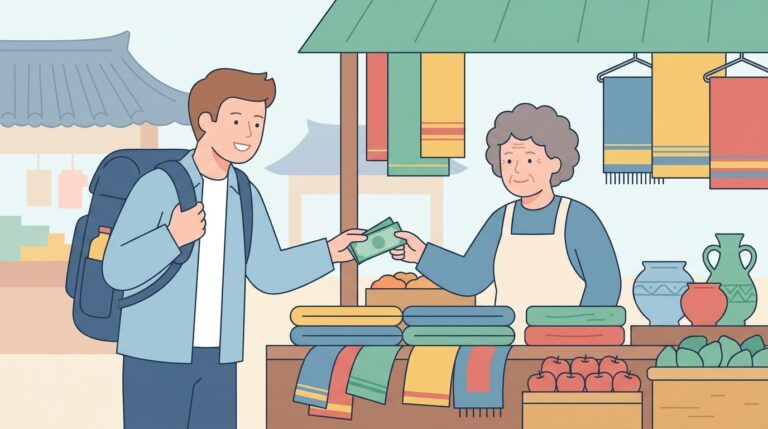
How to Bargain in Korean: Master the Art of Asking for a Discount Politely
안녕하세요! (Annyeonghaseyo!) Welcome back to Daily Hangul, your premium Korean tutoring guide and cultural navigator. I’m your chief editor and veteran tutor.
If you’ve ever walked through the vibrant, bustling alleys of Seoul’s traditional markets—like Namdaemun Market (남대문시장) or Dongdaemun (동대문)—you’ve probably seen it: the lively, dramatic, yet warm social dance of bargaining.
You see a gorgeous vintage jacket or a beautiful modern Hanbok cardigan. Your heart flutters, but the price tag makes you hesitate. In your hometown, haggling might feel confrontational or stressful. But in Korea, negotiating isn’t a battle—it’s an art form powered by relationship-building. Today, we’re going to master the magic words that will not only save your wallet but also win the hearts of Korean shop owners!
Phase 1: The ‘Jeong’ of the Deal (Why We Bargain)
Many of my students tell me, “Teacher, I wanted to ask for a discount, but I was terrified of looking rude!”
I completely understand. In many Western cultures, a price tag is a finalized contract. However, in traditional Korean markets, bargaining is actually a way of sharing 정 (Jeong)—a deep, warm social connection. When you bargain correctly, you aren’t saying, “Your product isn’t worth this much.” Instead, you are saying, “I love your shop, I love your vibe, and I want to create a friendly bond with you!”
Let’s learn how to do this like a true local, transition from textbook stiffness, and step into natural, fluent Korean.
Phase 2: 3 Essential Bargaining Expressions
Here are the top three expressions you need to know, complete with their hidden nuances and cultural weight.
1. 조금만 깎아주세요. (Please cut the price just a little.)
- Pronunciation: Jogeumman kkakkajuseyo / [Sound-alike: Joe-geum-man kkah-kkah-joo-seh-yo]
- Meaning: Literally “Please shave/peel a little off,” meaning “Could you give me a small discount?”
- K-Culture Moment: You’ve probably seen this in K-Dramas where the main lead visits a street market with their grandmother, and she uses a sweet, playful voice to lower the price of fresh ingredients.
- Editor’s Insight: The verb 깎다 (kkakta) is the same verb used for peeling fruit or shaving hair. It sounds tactile and informal. Adding 조금만 (jogeumman – just a little) softens the request, making it sound polite and humble rather than demanding.
- Situation Spectrum:
- Friends/Casual: ✅ (With sellers at flea markets)
- Semi-formal: ⚠️ (Use with caution in small boutiques)
- Formal/Business: 🚫 (Never use in department stores or corporate meetings)
- 🤔 Think About It: Why do you think Koreans use the verb “to peel” (깎다) for prices? How does this physical metaphor change how you perceive negotiating?
2. 서비스 좀 주세요! (Please give me some ‘service’!)
- Pronunciation: Seobiseu jom juseyo! / [Sound-alike: Suh-bee-seu jom joo-seh-yo!]
- Meaning: “Can I get some freebies/complimentary items?”
- K-Culture Moment: In K-Beauty shops in Myeongdong or cozy local restaurants, getting “service” (free sheet masks or an extra side dish) is the ultimate sign of a successful transaction!
- Editor’s Insight: In Korea, “service” (서비스) does not mean customer service. It refers to free gifts, extra food, or complimentary items given as a gesture of goodwill. If the seller refuses to lower the cash price, asking for “service” is a fantastic plan B!
- Situation Spectrum:
- Friends/Casual: ✅
- Semi-formal: ✅
- Formal: 🚫
3. 깎아주시면 다음에 또 올게요. (If you give me a discount, I’ll come back next time.)
- Pronunciation: Kkakkajusimyeon daeume tto olgeyo.
- Meaning: “If you discount it, I promise to become a regular customer.”
- K-Culture Moment: This is the ultimate “loyalty card” verbal contract. It shows you value relationship-building over a one-time cheap buy.
- Editor’s Insight: This phrase leverages the Korean love for long-term relationships (단골 – dangol, meaning a regular customer). Shop owners love the promise of a returning customer far more than a single quick sale.
- Situation Spectrum:
- Friends/Casual: ✅
- Semi-formal: ✅
- Formal: 🚫
Phase 3: Textbook Korean vs. Real-World Korean
Let’s look at how the textbook teaches negotiation versus how real Koreans actually talk to get results.
Scenario 1: Expressing that something is too expensive
- 📖 Textbook Korean: “이것은 너무 비쌉니다. 가격이 얼마입니까?” (This is too expensive. How much is the price?) — Too robotic, cold, and slightly hostile.
- 🗣️ Real Korean: “에이~ 사장님, 조금 비싸요! 조금만 봐주세요~” (Aw, boss, it’s a bit pricey! Please show me some mercy~)
- 💡 Why it works: Using “에이~” (a playful whimper) and “봐주세요” (literally “please look at me kindly/give me a break”) turns a cold complaint into a cute, friendly interaction.
Scenario 2: Trying to finalize a deal politely
- 📖 Textbook Korean: “가격을 할인해 주시겠습니까?” (Will you discount the price?) — Sounds like you are reading a legal document.
- 🗣️ Real Korean: “사장님, 현금으로 하면 더 깎아주실 수 있어요?” (Boss, if I pay in cash, can you discount it more?)
- 💡 Why it works: Offering to pay in cash (현금 – hyeongeum) is highly appreciated by small business owners in markets and is the easiest way to secure a 10% discount instantly.
Phase 4: K-Culture Deep Dive: The Power of ‘Sajangnim’
When bargaining, your non-verbal cues and vocabulary choices matter just as much as your pronunciation.
4-1. The Magic Word: “사장님” (Sajangnim)
In English, you might address a shop owner as “Excuse me” or “Ma’am/Sir.” In Korea, always call them 사장님 (Sajangnim), which literally means “President/CEO.”
Even if they run a tiny 2-square-meter sock stall, calling them “Sajangnim” raises their social status playfully. It builds instant rapport. If the owner is an older woman, you can also affectionately use 이모님 (Imonim – Auntie) in food stalls, but “Sajangnim” is the safest and most flattering go-to!
4-2. Non-Verbal Etiquette
- The Tilt: Tilt your head slightly to the side with a warm smile when asking for a discount. It conveys humility.
- The Two-Hand Pass: When paying with cash or your card, always hand it over using both hands. This small sign of respect makes the owner much more likely to throw in some “service”!
Phase 5: Interactive Roleplay: Dongdaemun Vintage Hunt
Imagine you are in a cozy, hidden vintage shop in Dongdaemun. The atmosphere is warm, filled with retro music. The owner, Yumi, is folded clothes behind the counter. You have found a beautiful vintage jacket with no price tag.
- Yumi (Owner): “어서 오세요! 마음에 드는 옷 있으면 편하게 입어 보세요.”
(Eoseo oseyo! Ma-eume deuneun ot isseomyeon pyeonhage ibeo boseyo.)
(🎭 Smiling warmly and gesturing to the racks: “Welcome! If there’s any clothes you like, feel free to try them on.”) -
You (Learner): “감사합니다! 사장님, 이 자켓 진짜 예쁘네요. 이거 얼마예요?”
(Gamsahamnida! Sajangnim, i jaket jinja yeppeuneyo. Igeo eolmayeyo?)
(🎭 Holding up the jacket with shining eyes: “Thank you! Boss, this jacket is really pretty. How much is this?”) -
Yumi (Owner): “아, 그거 완전 이태리 빈티지 명품이야! 원래는 8만 원인데… 학생 같아 보이니까 내가 특별히 7만 5천 원에 줄게요.”
(Ah, geugeo wanjeon itaeri binti-ji myeongpumiya! Wonraeneun pal-man woninde… haksaeng gata boinikka naega teukbyeolhi chil-man o-cheon wone julgeyo.)
(🎭 Winking slightly: “Ah, that’s a pure Italian vintage masterpiece! It’s originally 80,000 won… but you look like a student, so I’ll specially give it to you for 75,000 won.”) -
You (Learner): “와, 진짜 예쁘긴 한데… 제 예산보다 조금 비싸요.”
(Wa, jinja yeppeugin hande… je yesanboda jogeum bissayo.)
(🎭 Looking slightly downcast, touching the fabric: “Wow, it really is pretty but… it’s a bit over my budget.”) -
Yumi (Owner): “에이, 이거 가죽 질이 너무 좋아서 다른 데 가면 더 비싸게 받아!”
(Ei, igeo gajuk jiri neomu joaseo dareun de gamyeon deo bissage bada!)
(🎭 Shaking her hand side-to-side defensively: “Hey, the leather quality is so good, if you go elsewhere they’ll charge you more!”)
🔀 Decision Point: What is your next move?
- Option A: “너무 비싸요. 5만 원에 주세요.” (It’s too expensive. Give it to me for 50,000 won.)
- Option B: “사장님 인상이 너무 좋으셔서 꼭 여기서 사고 싶어요. 조금만 더 깎아주시면 안 돼요?” (Boss, you look so kind that I really want to buy it here. Could you lower the price just a little bit more?)
- Option C: “안 살래요. 안녕히 계세요.” (I won’t buy it. Goodbye.)
The Analysis:
- Best Choice: Option B! Flattering the owner’s impression (“인상이 너무 좋으셔서”) while politely asking for a small discount is the gold standard of bargaining. It melts any merchant’s heart.
- Worst Choice: Option A. Demanding a steep 30%+ discount with blunt language violates the concept of ‘Jeong’ and can make the owner feel disrespected.
Phase 6: 10-Second Shadowing Drill
Let’s practice the perfect emotional delivery. Practice saying this phrase by mimicking the emotional cues and pausing at the / marks.
“사장님~ / 진짜 마음에 드는데 / 조금만 깎아주시면 안 돼요? 🥺”
(Sajangnim~ / jinja ma-eume deuneunde / jogeumman kkakkajusimyeon an dwaeyo?)
[Emotion: 🥺 Soft, pleading, and extremely polite]
Translation: “Boss~ I really, really love this… could you possibly lower it just a tiny bit for me?”
Phase 7: K-Culture Mini Dictionary
| Word (한글) | Romanization | Real-world Context & Usage |
|---|---|---|
| 단골 | Dangol | A regular customer. Becoming a dangol in Korea unlocks secret discounts, massive portions of food, and warm chatty sessions. |
| 현금 | Hyeongeum | Cash. Carrying physical cash in traditional markets like Gwangjang or Dongdaemun is your best negotiation tool. |
| 에누리 | Enuri | A discount / bargaining. An old native Korean word for lowering the price. You’ll sometimes see signs saying “에누리 없음” (No bargaining). |
| 정 (情) | Jeong | Deep affection, attachment, and mutual bonding. This is the social glue of Korea that makes sellers want to give you freebies. |
Phase 8: Traveler’s Survival Kit
Top 3 Market Survival Phrases:
- “카드 돼요?” (Kadeu dwaeyo?) – “Do you accept cards?” (Useful to ask, but remember, cash gets better discounts!)
- “이거 서비스예요?” (Igeo seobiseuyeyo?) – “Is this a freebie/complimentary?” (Use when they slide an extra item into your bag with a smile.)
- “다음에 또 올게요!” (Daeume tto olgeyo!) – “I’ll come back next time!” (Always say this with a wave as you leave.)
📌 Editor’s Travel Note: When navigating traditional markets in Seoul, Google Maps can be highly inaccurate. Always download the Naver Map App for flawless local navigation and stall locating!
Phase 9: Think Deeper: Bargaining in a Hyper-Modern Korea
Korea is one of the most technologically advanced and cash-free societies on earth. When you walk through modern areas like Starfield COEX Mall or chic Gangnam boutiques, prices are strictly digital and non-negotiable. Yet, just a few subway stops away in traditional markets, the ancient practice of bargaining thrives.
This duality shows that while Korea embraces the future, it desperately holds onto 정 (Jeong)—the warm human contact that transactions provide. Bargaining isn’t about saving 1,000 KRW ($1 USD); it’s about the pleasant conversation and shared laughter between two strangers.
💬 Your Turn: How does bargaining work in your hometown? Is it common, or is it frowned upon? Let us know in the comments below!
Phase 10: FAQ & Common Mistakes
Q: Can I negotiate prices in places like Olive Young or Convenience Stores?
A: Absolutely not! Chain stores, convenience stores, department stores, and supermarkets have strictly fixed computerized inventory. Trying to bargain there will only confuse the young part-time staff.
Q: Is bargaining considered rude to the younger generation in Korea?
A: It depends. Younger Koreans rarely bargain because they prefer quick card transactions. However, if you are a foreign traveler visiting a flea market or a traditional market, local sellers actually enjoy the interaction and find it charming when you try in Korean!
Q: What should I do if the seller says “안 돼요” (No)?
A: Smile and pay the original price. If they say “No,” it usually means their profit margin is already razor-thin. Simply say “괜찮습니다!” (It’s okay!) and proceed with the purchase cheerfully.
🚨 Common Mistakes Alert!
- Asking for a 50% discount: This is not a tourist trap in a movie. Asking for more than 10-15% off can hurt the seller’s feelings.
- Using informal language (Banmal): Never say “깎아줘” (kkakkajwo) to an elder. Always keep the polite ending “요” (-yo).
- Not having cash ready: If you successfully bargain a “cash price” and then pull out a credit card, the deal is off!
Phase 11: Action Mission!
- 🥉 Bronze (At Home): Look in the mirror, make your best pleading eyes, and practice saying “사장님, 조금만 깎아주세요~” five times.
- 🥈 Silver (Socials): Share this post on your social media and tag your favorite travel buddy with the phrase: “우리 다음에 한국 가자!” (Let’s go to Korea next time!)
- 🥇 Gold (Real World): Visit a traditional market on your next trip to Seoul, pay in cash, use Option B from Phase 5, and get your very first real discount!
Phase 12: Interactive Quiz Challenge
Test your bargaining instincts! Click the toggles below to reveal the answers.
Q1. Which of the following is the most natural way to ask for freebies politely?
- A) 공짜로 주세요. (Give it to me for free.)
- B) 서비스 좀 주세요! (Please give me some ‘service’!)
- C) 선물 필요해요. (I need a present.)
Answer: B! “서비스” is the perfect, socially accepted Konglish term for complimentary gifts in Korea.
Q2. True or False: You can get discounts at Shinsegae Department Store by paying in cash and asking politely.
Answer: False! Large corporate department stores have strictly fixed pricing systems. Keep your bargaining skills for local street markets and vintage boutiques!
See you in the next lesson of Daily Hangul! 다음에 또 만나요! (See you next time!)







