

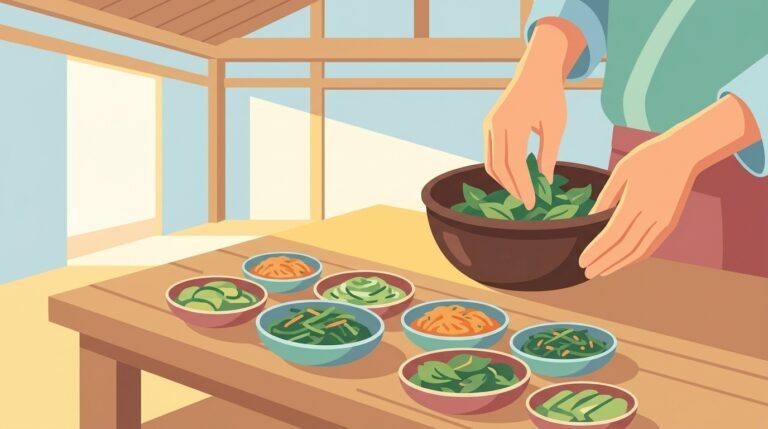
Hello, My Foodie Bestie! Welcome Back to Daily Hangul!
안녕하세요! (An-nyeong-ha-se-yo!) Your favorite local culture navigator is back. Have you ever sat down at a traditional Korean restaurant, looked at the table, and gasped?
Before your main dish even arrives, the table is magically crowded with dozens of small, colorful plates. Yes, we are talking about 반찬 (Banchan – side dishes)! Among them, the green, earthy, and aromatic seasoned vegetables—collectively called 나물 (Namul)—always steal the show.
Many of my intermediate learners tell me: “I want to recreate these healthy dishes at home, but they either turn into mush or taste like grass!”
Don’t worry! Today, we are going deep into the secret culinary science and vocabulary of Namul preparation. Mastering these expressions won’t just level up your Korean kitchen talk; it will give you a profound appreciation of Korea’s seasonal food philosophy. Let’s dig in! 🥬
Phase 2: Core Culinary Expressions Deep Dive 🍳
To understand Korean cooking, you must understand our verbs. Here are three crucial words that define the life of Namul.
1. 데치다 (Dechida)
- Pronunciation: [deh-chee-da] (Think of saying “deh-“ as in ‘dead’, followed by “chee-da”)
- Meaning: To blanch quickly in boiling water.
- K-Culture Moment: In K-Dramas, you’ll often see a mother standing over a pot of boiling water, tossing in spinach for literally 10 seconds, then immediately plunging it into ice-cold water. That’s 데치다!
- Editor’s Insight: This is the soul of Namul. We don’t over-boil vegetables until they lose their spirit. Blanching preserves the vibrant green color and the satisfying crunch (아삭아삭한 식감).
- Situation Spectrum: Casual ✅ | Semi-formal ✅ | Formal ✅
- 🤔 Think About It: In your country, do you usually boil vegetables completely, eat them raw, or is there a similar “quick-blanch” concept? How does this change the texture?
2. 조물조물 무치다 (Jomul-jomul muchida)
- Pronunciation: [jo-mool jo-mool moo-chee-da] (Mimic the sound of squeezing wet sand gently: “jo-mool”)
- Meaning: To gently hand-season and mix.
- K-Culture Moment: This expression represents the legendary 손맛 (Son-mat – hand taste). Korean grandmas rarely use tongs; they use plastic gloved (or bare) hands to massage sesame oil, garlic, and salt into the blanched greens.
- Editor’s Insight: 조물조물 is an onomatopoeia describing the light, rhythmic squeezing action. If you mix too hard, the delicate greens get bruised; if too soft, the seasoning won’t penetrate. It’s an art of gentle pressure.
- Situation Spectrum: Casual ✅ | Semi-formal ✅ | Formal ⚠️ (Use ‘무치다’ in formal recipes)
- 🤔 Think About It: Why do you think Koreans believe hands are better tools than spoons or tongs when seasoning food? What does this say about our emotional connection to cooking?
3. 숨이 죽다 (Sumi jukda)
- Pronunciation: [soo-mee jook-da]
- Meaning: Literally “the breath dies.” Figuratively, for vegetables to lose their raw stiffness, shrink in volume, and soften during cooking.
- K-Culture Moment: When cooking a mountain of fresh spinach, it looks like it won’t fit the pot. But the moment heat hits, the volume cuts by 80%. A chef would say, “숨이 죽었네.”
- Editor’s Insight: Don’t let the word “죽다” (to die) scare you! In culinary terms, when the vegetable’s 숨 (breath/rigidity) dies, it means it has reached the perfect state of tenderness to absorb delicious oils and seasonings.
- Situation Spectrum: Casual ✅ | Semi-formal ✅ | Formal 🚫 (Too colloquial for professional culinary certificates, but perfect for daily cooking!)
- 🤔 Think About It: How does your language describe the transition of vegetables from raw and bulky to cooked and compact?
Phase 3: Textbook Korean vs. Real Korean 🗣️
Let’s look at how native Koreans actually discuss the texture and seasoning of Namul compared to dry classroom phrases.
Situation 1: Describing the delicate seasoning
- 📖 Textbook Korean: “이 나물은 덜 짭니다.”
(This vegetable side dish is less salty.) - 🗣️ 진짜 Korean: “이 나물은 삼삼해서 계속 손이 가요.”
(This namul is beautifully mild and delicate, so I keep reaching for it.) - 💡 Why the difference? Intermediate learners often default to “싱겁다” (bland/under-seasoned) or “안 짜다” (not salty). But 삼삼하다 is a gorgeous, high-level culinary adjective meaning “perfectly, subtly, and healthily seasoned with a pleasant undertone.”
Situation 2: Checking the doneness of greens
- 📖 Textbook Korean: “채소가 다 익었습니까?”
(Are the vegetables fully cooked?) - 🗣️ 진짜 Korean: “나물 숨이 적당히 죽었네요.”
(The greens have wilted just the right amount.) - 💡 Why the difference? Saying “다 익다” sounds like you are boiling potatoes or cooking meat. For Namul, we care about the structural integrity of the leaf, which is why we refer to the 숨 (breath).
Phase 4: K-Culture Deep Dive & Non-verbal Manners 🇰🇷
4-1. The Body Language of Hand-Seasoning (손맛)
When watching a Korean cook prepare Namul, watch their wrists. They don’t stir roughly. They use a delicate scooping motion from bottom to top, gently releasing and grasping the greens (조물조물). Offering someone a bite directly from your gloved hand while cooking is a sign of deep affection and intimacy in Korean homes!
4-2. The Soul of Temple Food (사찰음식)
Namul is the crown jewel of Korean Temple Food, which has gained international fame. Buddhist temples practice extreme minimalism. They do not use 오신채 (Osinchae – five pungent herbs): green onions, garlic, wild chives, Korean wild chives, and asafoetida. Instead, they coax deep flavors out of wild mountain herbs (산나물) using only soybean paste (된장), soy sauce, and wild perilla oil (들기름). It teaches us that nature’s natural aroma is enough.
Phase 5: Real-life Roleplay Scenario 🎭
Setting: Yuri’s Kitchen, a cozy Hanok cooking studio in Insadong.
Characters:
* 유진 (Yujin): The warm, expert cooking instructor.
* You (The Learner): A passionate B2 learner trying to master Spinach Namul (시금치나물).
유진: 자, 시금치나물에서 가장 중요한 건 '데치기'예요. 물이 끓으면 시금치를 넣으세요.
      [Ja, sigeumchi-namureseo gajang jung-yo-han geon 'dechigi'-ye-yo. Mur-i kkeur-eumyeon sigeumchi-reul neo-heu-se-yo.]
      (Now, the most important part of Spinach Namul is 'blanching'. Once the water boils, put the spinach in.)

You: 🎭 (Anxiously watching the pot) 네, 넣었어요! 얼마나 오래 둬야 해요?
      [Ne, neo-eot-seo-yo! Ol-ma-na o-rae dwo-ya hae-yo?]
      (Yes, I put it in! How long should I leave it?)

유진: 🎭 (Lifting a chopstick) 오랫동안 삶으면 안 돼요! 숨이 살짝 죽으면 바로 건져야 해요.
      [O-raet-dong-an salm-eu-myeon an dwae-yo! Sum-i sal-jjak jug-eumyeon ba-ro geon-jyeo-ya hae-yo.]
      (Don't boil it long! The moment it wilts slightly, you must scoop it out immediately.)

You: 🎭 (Quickly rinsing the spinach in cold water) 휴, 살렸네요! 이제 양념을 넣을까요?
      [Hyu, sal-lyeot-ne-yo! I-je yang-nyeom-eul neo-eul-kka-yo?]
      (Phew, saved it! Shall we add the seasoning now?)

유진: 네, 마늘이랑 참기름을 넣고 손으로 조물조물 무쳐보세요. 손맛이 들어가야 해요!
      [Ne, maneul-i-rang cham-gi-reum-eul neo-go son-eu-ro jomul-jomul mu-chyeo-bo-se-yo. Son-mat-i deul-eo-ga-ya hae-yo!]
      (Yes, add garlic and sesame oil, and mix it gently with your hands. The 'hand-taste' has to go in!)
🔀 Choose Your Action!
- Option A: You aggressively squeeze the spinach to make sure the seasoning goes deep inside.
- Option B: You gently scoop and massage the spinach with your fingertips, ensuring the leaves don’t tear.
- Option C: You refuse to use your hands and use metal tongs to mix instead.
💡 Feedback on Your Choice:
- Best Choice – Option B: Perfect! You understood 조물조물. By keeping your touch light, the spinach retains its beautiful form and absorbs the seasoning evenly. Yujin praises your intuitive 손맛!
- Risk Choice – Option A: Oh no! You squeezed too hard. The spinach has turned into a soggy, bruised clump. The taste might be okay, but the texture is ruined. Remember, 조물조물 means gentle!
- Bad Choice – Option C: While hygienic, using cold metal tongs won’t emulsify the oils and seasonings into the warm fibers of the greens. You miss out on the magic of 손맛.
Phase 6: 10-Second Emotion Shadowing Drill 🗣️
Let’s practice speaking like a true Korean home chef. Pay attention to the pauses (/) and emotional cues!
- “나물은 / 살짝 데쳐야 / 아삭아삭해요!”
- [Namur-eun / sal-jjak de-chyeo-ya / a-sak-a-sak-hae-yo!]
- [😊 Warmly and helpfully] “You have to blanch the greens quickly to keep them crunchy!”
- “손맛이 들어가야 / 나물이 / 진짜 맛있어지죠.”
- [Son-mat-i deul-eo-ga-ya / namur-i / jin-jja ma-si-sseo-ji-jyo.]
- [😉 Confidently with a knowing smile] “Only when the ‘hand-taste’ goes in does the namul become truly delicious.”
Phase 7: K-Culture Mini Dictionary 📖
- 들기름 (Deulgireum) | Perilla Oil | A deeply aromatic, earthy seed oil highly favored over sesame oil for seasoning wild forest greens.
- 아삭아삭 (Asak-asak) | Crunchy | Onomatopoeia representing the clean, crisp bite of perfectly blanched vegetables.
- 산나물 (Sannamul) | Wild Mountain Greens | Herbs foraged from Korea’s deep mountains, carrying rich medicinal benefits and strong herbal aromas.
- 슴슴하다 / 삼삼하다 (Seum-seum-hada / Sam-sam-hada) | Mildly Delightful | Terms used to describe food that is gently seasoned, letting the natural ingredients shine without heavy salt or spice.
Phase 8: Travel Survival Kit ✈️
Survival Phrases for Banchan Lovers:
- “이 나물 이름이 뭐예요?” [I namul ireum-i mwo-yeo-yo?] – What is the name of this herb/namul?
- “이 반찬 좀 더 주실 수 있나요?” [I banchan jom deo ju-sil su in-na-yo?] – Could I please have some more of this side dish?
- “조금 덜 짜게 해주실 수 있어요?” [Jo-geum deol jja-ge hae-ju-sil su itseoyo?] – Could you make it slightly less salty?
📌 Editor’s Travel Note:
To find authentic temple food or specialized Namul restaurants in Seoul, download the Naver Map App. Search for keywords like ‘사찰음식’ (Temple Food) or ‘곤드레밥’ (Gondre Rice). Note: Restaurant menus and operating hours can change, so checking Naver reviews before traveling is highly recommended!
Phase 9: One Step Deeper (Reflections on Banchan) 💭
In Western dining, side dishes are often purchased separately. In Korea, 반찬 (Banchan) is a symbol of 정 (Jeong – affection/bonding). It is served free of charge and refilled with a smile. The effort required to forage wild greens, blanch them for mere seconds, and hand-mix them with care shows that Korean cuisine is built on patience and human warmth. It’s not fast food; it is mindful food.
💬 Your Turn: Do you have a side dish culture in your home country? How do you show hospitality through food? Let me know in the comments below!
Phase 10: FAQ & Common Mistakes 🚨
Q: Is all Namul cooked?
A: No! While many are blanched (숙채 – Sukchae), some are prepared fresh and raw (생채 – Saengchae), like fresh sweet-and-sour radish strip salad (무생채).
Q: Can I use olive oil for Namul?
A: Traditional Korean Namul relies on toasted sesame oil (참기름) or perilla oil (들기름). Olive oil has an overpowering fruitiness that clashes with the delicate forest aroma of native Korean herbs.
Q: How long does Namul stay fresh in the fridge?
A: Because they are lightly salted and hydrated, they are best eaten within 2 to 3 days. If they start releasing too much water, it’s time to turn them into 비빔밥 (Bibimbap)!
🚨 The 3 Common Mistakes of Namul Beginners:
- Mistake 1: Leaving greens in boiling water for over a minute. (Result: Mushy baby food. Fix: Limit blanching to 10-30 seconds!)
- Mistake 2: Mixing with high-tech utensils. (Result: Uneven flavor. Fix: Wash your hands and get in there to mix gently!)
- Mistake 3: Drowning the greens in soy sauce. (Result: Black, overly salty Namul. Fix: Use a pinch of coarse salt or ‘국간장’ light soy sauce to keep the green color vibrant.)
Phase 11: Action Mission & Engagement 🏆
- 🥉 Bronze Medal: Next time you cook vegetables, try quick-blanching them (데치기) and describe the process out loud in Korean!
- 🥈 Silver Medal: Take a photo of a Korean side dish you made or ordered, share it on social media, and tag us with the caption: “삼삼해서 계속 먹게 돼요!”
- 🥇 Gold Medal: Go to a Korean restaurant and confidently ask the server: “이 나물 이름이 뭐예요?” and try to identify how it was seasoned.
Phase 12: Interactive Quiz Challenge 🎮
Test your knowledge before you go!
Q1. What does it mean when a cook says “시금치 숨이 죽었다”?
- A) The spinach has gone bad and must be thrown away.
- B) The spinach has wilted and softened perfectly under heat.
- C) The spinach was not washed properly.
Q2. Fill in the blank: Korean cooks use their hands to season Namul ______________ (gently).
Q3. True or False: “삼삼하다” means the food is extremely hot and spicy.
👀 Click here to check the Answers & Explanations!
- A1: B – “숨이 죽다” refers to the vegetables losing their raw volume and becoming tender!
- A2: 조물조물 (Jomul-jomul) – The beautiful onomatopoeia for delicate hand-mixing.
- A3: False – “삼삼하다” means the dish is beautifully, mildly, and subtly seasoned, not spicy!







