

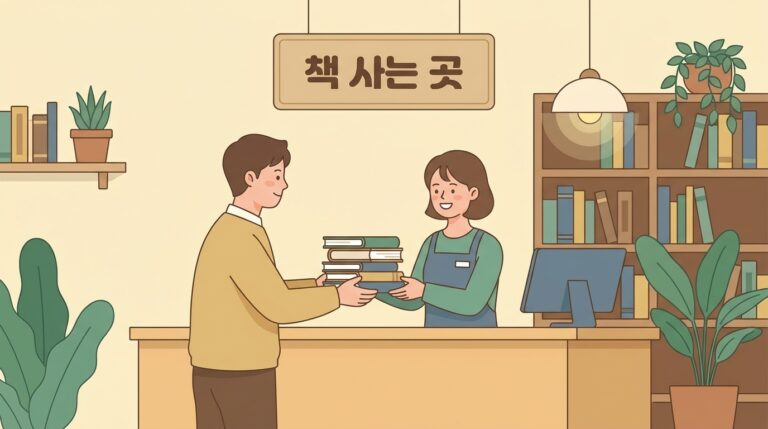
Phase 1: Empathy (공감)
안녕하세요! Welcome back to another cozy learning session with Daily Hangul. I’m your local culture guide and senior editor.
Imagine this: You’ve just finished reading a bunch of Korean novels or study guides, and your bookshelf in your Seoul studio is overflowing. You want to make some space (and extra coffee money!) by selling them at a famous Korean secondhand bookstore like Aladin (알라딘). You confidently walk in, carry your heavy bag of books to the counter, and… freeze.
“How do I ask if they take these?”
“What if they ask about the book’s condition?”
“Do I need a Korean ID?”
If your heart is racing just thinking about this, don’t worry! Today, we are going to master the exact phrases, cultural nuances, and hidden tips of selling books in Korea. By the end of this guide, you will strut into any bookstore and handle the buyback counter like a true Seoulite. Let’s dive in!
Phase 2: Key Expressions Deep Dive (핵심 표현 3선 심층 분석)
Here are the top three expressions you absolutely need when handing over your books at the counter.
1. 이 책 매입 가능한가요? (Is this book available for buyback?)
- Pronunciation: I chaek mae-ip ga-neung-han-ga-yo? (Sounds like: ee-check-may-eep-gah-nung-hahn-gah-yo)
- Meaning: “Can I sell these books here?” / “Are these eligible for buyback?”
- K-Culture Moment: You will hear this phrase constantly at the counter of used bookstores. The word 매입 (mae-ip) is a formal business term for “purchasing/buying,” which is much more professional than just saying “팔고 싶어요” (I want to sell).
- Editor’s Insight: Even if a bookstore buys used books, they won’t accept everything. They check inventory levels and book quality first. Asking this upfront saves you time!
- Situation Spectrum:
- Casual: 이 책들 팔 수 있어? (🚫 – Too informal for staff)
- Semi-formal: 이 책 매입 가능한가요? (✅ – Perfect! Polite and professional)
- Formal: 이 도서들의 매입 여부를 확인해 주시겠습니까? (⚠️ – Overly dramatic, like a business contract)
- 🤔 Think About It: Why does Korean use “매입” (purchase from the store’s perspective) instead of just “판매” (selling from your perspective) when starting the transaction?
2. 책 상태 등급이 어떻게 나왔나요? (What grade did the book’s condition get?)
- Pronunciation: Chaek sang-tae deung-geup-i eo-tteo-ke na-wat-na-yo? (Sounds like: check-sang-tay-dung-goop-ee-uh-tuh-kay-nah-waht-nah-yo)
- Meaning: “What is the condition rating of the books?”
- K-Culture Moment: Korean secondhand bookstores grade books strictly into four categories: 최상 (Excellent/Best), 상 (High/Very Good), 중 (Medium/Good), or 매입 불가 (Unsellable).
- Editor’s Insight: If there are underlines, scribbles, or folded pages, the grade drops instantly. Asking this politely helps you understand why some books might not get the price you expected.
- Situation Spectrum:
- Casual: 이거 등급이 뭐야? (🚫)
- Semi-formal: 책 상태 등급이 어떻게 나왔나요? (✅)
- Formal: 도서 등급 판정 결과를 안내해 주십시오. (⚠️)
3. 알라딘 예치금으로 적립해 주세요. (Please credit it as Aladin store points.)
- Pronunciation: Al-la-din ye-chi-geum-eu-ro jeok-rip-hae ju-se-yo. (Sounds like: al-lah-deen-yay-chee-gum-oo-ro-juck-reep-hay-joo-say-yo)
- Meaning: “Please credit the payout to my bookstore membership account.”
- K-Culture Moment: When selling books at Aladin, you can choose between getting cash (현금) or store points (예치금/포인트). Often, choosing points gives you an extra 10% to 20% bonus value!
- Editor’s Insight: If you plan on buying more books, choosing point accumulation (적립) is a smart, budget-friendly move!
- Situation Spectrum:
- Casual: 포인트로 줘. (🚫)
- Semi-formal: 예치금으로 적립해 주세요. (✅)
- Formal: 예치금 적립으로 처리 부탁드립니다. (✅)
Phase 3: Textbook Korean vs. Real Korean (교과서 한국어 vs 진짜 한국어)
Let’s compare the stiff textbook phrases with what Koreans actually say in real life.
Situation 1: Bringing a pile of books to the counter
- 📖 Textbook Korean: “저는 책을 팔기 위해 여기에 왔습니다.” (I have come here to sell books.) -> Extremely stiff and unnatural.
- 🗣️ Real Korean: “이 책들 처분하려고 하는데요, 매입 되나요?” (I’m looking to clear out/get rid of these books. Are they eligible for buyback?)
- 💡 Why the difference? Koreans use the word 처분하다 (cheo-bun-ha-da – to dispose of/clear out) when they want to declutter their home. It sounds much more natural and expresses your intent clearly.
Situation 2: Accepting that some books cannot be sold
- 📖 Textbook Korean: “괜찮습니다. 제가 다시 가져가겠습니다.” (It is fine. I will take them back.)
- 🗣️ Real Korean: “아, 이건 매입 안 되는군요. 그럼 폐기해 주세요.” (Ah, so this one can’t be bought. In that case, please discard/recycle it for me.)
- 💡 Why the difference? If a book is rejected due to damage, you don’t have to carry it back! Major bookstores offer to recycle (폐기, pye-gi) them for you for free.
Phase 4: K-Culture Deep Dive & Non-verbal Manners (K-컬처 딥다이브)
4-1. Physical Etiquette and “Nunchi” (눈치)
- The Two-Hand Rule: Always hand over your ID or membership barcode on your phone with both hands. It shows respect to the staff who are handling your pre-loved goods.
- The Waiting Game: When the staff is inspecting your books, do not hover too closely over the counter. Take one step back and wait patiently. They will call you once the scanning and grading are complete.
4-2. The Korean Used Bookstore Culture
Korean secondhand bookstores are not dusty, cramped spaces. Modern chains like Aladin (알라딘) or Yes24 are beautifully designed like trendy cafes. Koreans take immense pride in keeping their books in pristine condition. Many people read books with a cover protector to ensure they can sell them later at the “최상 (Excellent)” grade. This circular economy of reading and selling is highly integrated into daily life in Korea!
Phase 5: Real-Life Roleplay Scenario (실전 롤플레이 시나리오)
Let’s put you in the shoes of a customer at Aladin Used Bookstore in Sinchon. You are talking to Ji-won (지지원), a friendly bookstore clerk.
- Ji-won: 안녕하세요! 책 매입 도와드릴까요?
(Hello! Shall I help you with your book buyback?) - You: 네, 이 책들 처분하려고요. 매입 가능한지 봐 주시겠어요?
(Yes, I’d like to get rid of these books. Could you check if they are available for buyback?) - Ji-won (Scanning the barcodes): 네, 잠시만 기다려 주세요. 등급 조회해 드릴게요… 아, 이 소설책은 안에 낙서가 있어서 매입이 불가능해요. 어떻게 처리해 드릴까요?
(Sure, please wait a moment. I will check their grades… Ah, this novel has scribbles inside, so it’s unsellable. How would you like me to handle it?) - You (Nudging your head politely): 아, 그래요? 그럼 그 책은 그냥 여기서 폐기해 주세요.
(Oh, really? Then please just discard that book here.) - Ji-won: 알겠습니다. 나머지 세 권은 모두 ‘상’ 등급 나오셨어요. 총 만 이천 원입니다. 현금으로 드릴까요, 아니면 회원 예치금으로 적립해 드릴까요?
(Understood. The other three books got a ‘High/Good’ grade. The total is 12,000 KRW. Would you like cash, or shall I credit it to your membership points?) - You: 회원 번호로 조회해서 예치금으로 적립해 주세요!
(Please look up my membership number and credit it as points!)
🔀 Your Turn: What will you say next?
Scenario: Ji-won asks for your membership barcode to finalize the point transaction, but your phone battery suddenly died!
- Option A: “휴대폰이 꺼졌는데, 전화번호로 조회할 수 있나요?” (My phone died, can you look it up with my phone number?)
- Option B: “아니요, 그냥 현금으로 주세요.” (No, just give me cash instead.)
- Option C: “그럼 다음에 다시 올게요.” (Then I will come back next time.)
💡 Feedback:
- Best Choice (Option A): Excellent! In Korea, most memberships can easily be looked up using your registered phone number (휴대폰 번호) on a keypad at the counter.
- Safe Choice (Option B): Also great! Switching to cash is a quick and stress-free solution.
- Inefficient Choice (Option C): Oh no! Don’t carry those heavy books back home just because of a dead battery.
Phase 6: 10-Second Emotional Shadowing Drill (10초 감정 섀도잉)
Practice reading these sentences aloud, paying attention to the emotional tone and pauses (/).
- [😊 Friendly and Polite]
- “이 책들 / 처분하려고 하는데요, / 매입 가능한가요?”
- I chaek-deul / cheo-bun-ha-ryeo-go ha-neun-de-yo, / mae-ip ga-neung-han-ga-yo?
- [🥺 Disappointed but Grateful]
- “아, / 낙서 때문에 / 매입 안 되는군요. / 그럼 폐기해 주세요!”
- Ah, / nak-seo ttae-mun-e / mae-ip an doe-neun-gun-yo. / Geureom pye-gi-hae ju-se-yo!
Phase 7: K-Culture Mini Dictionary (K-컬처 미니 사전)
- 알라딘 (Aladin): The most popular secondhand bookstore chain in Korea. Famous for its clean facilities, cafes, and cute literary merchandise (굿즈).
- 매입 불가 (Mae-ip Bul-ga): “Unsellable.” A status given to books with severe damage, water stains, excessive writing, or if the store already has too many copies in stock.
- 폐기 (Pye-gi): “Disposal/Discarding.” Instead of taking rejected books back home, you can ask the bookstore to recycle them for you.
- 예치금 (Ye-chi-geum): Store credit/deposit. Saving your payout as points usually gives you a sweet extra bonus!
Phase 8: Travel Survival Kit (여행자를 위한 생존 키트)
Survival Phrases TOP 3
- “바코드 찍어봐도 될까요?” (Can I scan the barcode? – Useful if you want to use the bookstore’s self-scanner to check the price yourself.)
- “영수증은 버려주세요.” (Please throw away the receipt. – A classic phrase used in daily Korean shopping.)
- “주차 등록 가능할까요?” (Can I register my parking? – Useful if you drove to a large bookstore in a mall.)
🗺️ Editor’s Travel Note
Before carrying a suitcase of books to Aladin, download the Aladin Bookstore App (알라딘 앱) on the Google Play Store or Apple App Store. It has a built-in barcode scanner. You can scan your books at home, and the app will instantly tell you:
1) If they are buying it today, and
2) The estimated payout!
(Note: App policies and buyback rates may change without notice depending on store inventory.)
Phase 9: Deep Dive Essay – The Culture of Pristine Books (한 발 더 깊이)
In many Western countries, dog-eared pages, pencil underlinings, and worn-out spines give a secondhand book “character.” However, in Korea, the standards for secondhand books are incredibly strict. Even a tiny, neat underline with a yellow highlighter can drop a book’s value to “매입 불가” (unsellable).
This reflects the broader Korean social value of taking ultimate care of shared and personal belongings, keeping them in “as good as new” condition. When you buy or sell secondhand in Korea, there is an unspoken mutual respect: “I kept this clean for the next person, and I expect the same from you.”
💬 Your Turn: How does this compare to used bookstore cultures in your country? Let me know in the comments below!
Phase 10: FAQ & Common Mistakes (자주 묻는 질문 & 실수)
Q: Can foreigners sell books at Korean secondhand bookstores?
A: Yes! However, you will need a valid form of identification (like your Alien Registration Card – 외국인등록증) or a registered membership on their mobile app to receive cash payouts.
Q: What if my book has my name written on the first page?
A: If it’s just a name on the cover page, it might still be accepted as “상” (High) or “중” (Medium) grade. However, writing on the actual content pages instantly lowers the value or makes it unsellable.
Q: Why did the app say ‘Buyback Available’ but the store clerk rejected it?
A: The physical store’s stock levels change in real-time. If multiple people sold the same book that day, the store might stop accepting it to prevent overstocking.
🚨 Common Mistakes Alert!
- Bringing wet or wavy-paged books: Even if the book dried completely, water-damaged pages (젖은 흔적) are strictly rejected.
- Saying “이거 팔아요” too aggressively: Use “매입 가능한가요?” instead. It sounds much softer and more natural.
- Forgetting to check the publication year: Older textbooks or computer guides are rarely accepted because the information becomes outdated quickly.
Phase 11: Action Mission (액션 미션)
- 🥉 Bronze Mission: Read aloud the sentence: “이 책 매입 가능한가요?” three times with a bright smile!
- 🥈 Silver Mission: Go to a bookshelf in your room, pick a book, and write down its imaginary Korean condition grade (최상, 상, 중) in the comments.
- 🥇 Gold Mission: Visit a local Korean secondhand bookstore (or look up pictures of Aladin online) and spot the “Book Buyback Counter” (책 사는 곳 / 바이백 창구)!
Phase 12: Interactive Quiz Challenge (인터랙티브 퀴즈)
Test your knowledge with these quick questions!
1. Which grade is given to a book in perfect, almost-brand-new condition?
- A) 상 (Sang)
- B) 최상 (Choe-sang)
- C) 중 (Jung)
Reveal Answer
Correct Answer: B) 최상 (Choe-sang). ‘최’ means ‘the most/super’, so Choe-sang is ‘Excellent/Best’ condition!
2. Translate this to natural Korean: “Please credit the money to my store points.”
- A) 돈 주세요.
- B) 예치금으로 적립해 주세요.
Reveal Answer
Correct Answer: B) 예치금으로 적립해 주세요. This is the perfect, polite phrase to use at the register!







