

Glowing Skin and Sauna Secrets: Your First Korean Bathhouse Scrub Guide
Phase 1: Empathy (Welcome to the Warmest Culture Shock!)
Annyeong! 안녕하세요! Your favorite Korean bestie and Daily Hangul editor is here!
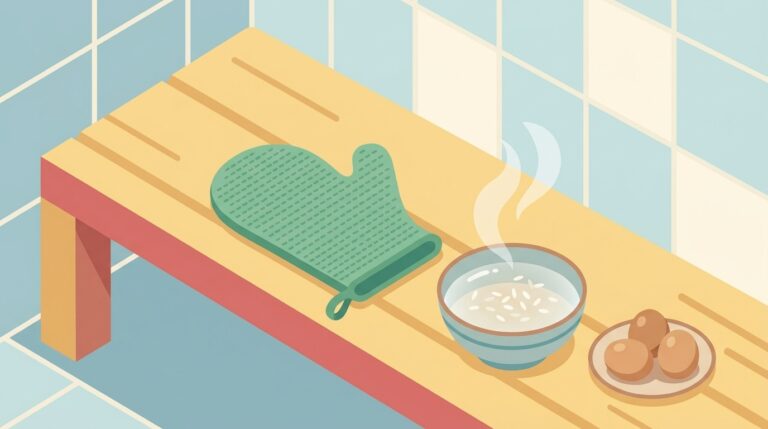
Imagine this: You walk into a cozy, steaming Korean bathhouse (목욕탕 – Mokyoktang). You see people happily chatting, soaking in hot tubs, and… vigorously scrubbing their skin with bright green mitts! You might feel a little shy or confused at first. ‘Are they hurting themselves? What is that green glove?’
Don’t worry! This is the legendary Korean exfoliating culture called ‘때 밀기’ (ttae mil-gi). It is the ultimate secret to getting baby-soft, glowing skin. Many of my global students told me they were too scared to try it at first, but once they learned the basic phrases, they fell in love with it! Today, we will learn how to talk about this refreshing experience like a real local. Put on your virtual sheep-head towel, and let’s dive in!
Phase 2: Three Core Expressions for the Ultimate Scrub
1. 때를 밀다 (ttae-reul mil-da)
- Pronunciation: Ttae-reul meel-dah (Sounds like ‘tea-rule’ + ‘meal-dah’)
- Meaning: Literally ‘to scrub away dirt/dead skin.’
- K-Culture Moment: In K-dramas, you often see family members scrubbing each other’s backs (등 밀어주기 – deung mir-eo-ju-gi) as a sign of deep affection and bonding.
- Editor’s Insight: ‘때’ (ttae) means dead skin cells. While it sounds like ‘dirt,’ in Korea, scrubbing it off is a healthy, routine self-care ritual!
- Situation Spectrum: Casual ✅ | Semi-formal ⚠️ | Formal 🚫
- 🤔 Think About It: Is there a specific ritual in your culture where people bond while doing self-care or grooming together?
2. 이태리타올 (i-tae-ri ta-ol)
- Pronunciation: Ee-tae-ree tah-ohl (Sounds like ‘Italy towel’)
- Meaning: Italy Towel (The famous abrasive green scrubbing mitt).
- K-Culture Moment: This cheap, iconic green glove is found in every single Korean household. Fun fact: It is called ‘Italy’ towel because the viscose fabric was originally imported from Italy in the 1960s!
- Editor’s Insight: It comes in different colors! Green is the standard, yellow is softer for kids, and red is the extra-strong one for pros.
- Situation Spectrum: Casual ✅ | Semi-formal ✅ | Formal ⚠️
- 🤔 Think About It: Why do you think a fabric from Italy became the most famous symbol of Korean bathhouse culture?
3. 시원하다 (si-won-ha-da)
- Pronunciation: Shee-won-hah-dah (Sounds like ‘she-one-ha-dah’)
- Meaning: Cool/Refreshing (Used for both cold wind AND burning hot baths!).
- K-Culture Moment: You will see older Korean grandpas soaking in boiling hot water, sighing deeply, and saying: ‘아, 시원하다~’ (Ah, so cool!). It refers to the physical relief of muscle tension.
- Editor’s Insight: When someone scrubs your skin hard, it might sting a little, but the feeling afterward is 100% si-won-ha-da!
- Situation Spectrum: Casual ✅ | Semi-formal ✅ | Formal ✅
- 🤔 Think About It: How does your language express the feeling of relief that is both intense and relaxing at the same time?
Phase 3: Textbook Korean vs. Real Korean
Situation 1: Talking about your weekend plans
- 📖 Textbook: 주말에 목욕을 할 것입니다. (Ju-mal-e mok-yok-eul hal geot-im-ni-da. – ‘I will take a bath on the weekend.’)
- 🗣️ Real Korean: 주말에 때 밀러 가려고요. (Ju-mal-e ttae mil-leo ga-ryeo-go-yo. – ‘I’m planning to go scrub my skin this weekend.’)
- 💡 Why the difference? ‘목욕’ is a general, formal dictionary word. Locals prefer the active, vivid expression ‘때 밀러 가다’ when visiting a public bathhouse.
Situation 2: Expressing how you feel in the hot water
- 📖 Textbook: 물이 아주 뜨겁고 좋습니다. (Mul-i a-ju tteu-geop-go jop-seum-ni-da. – ‘The water is very hot and good.’)
- 🗣️ Real Korean: 어우, 시원하다! (Eo-u, si-won-ha-da! – ‘Oh, so refreshing!’)
- 💡 Why the difference? To Koreans, ‘시원하다’ goes beyond temperature. It is an emotional and physical expression of releasing stress and body heat.
Phase 4: K-Culture Deep-dive & Non-verbal Manners
4-1. Nunchi (눈치) & Bathhouse Etiquette
- The ‘Soaking’ Rule (불리기 – bul-li-gi): You cannot scrub your skin right away! You must soak in the warm water for at least 15–20 minutes first to soften your skin. Doing it dry is painful and rude to your skin.
- Splash Control: Be careful not to splash water when washing. Koreans value a quiet, clean, and respectful atmosphere in the shared bath space.
- The Eye Contact Rule: It is polite to look away. People are naked, but everyone pretends not to see anyone. Keep your eyes to yourself!
4-2. The Golden Trio: Eggs, Sikhye, and Sheep Heads
No bathhouse visit is complete without eating! After a hard scrub, you must visit the snack bar inside the Jimjilbang.
* 맥반석 계란 (Maek-ban-seok gye-ran): Slow-baked sauna eggs that are brown and nutty.
* 식혜 (Sikhye): Sweet, ice-cold fermented rice drink served in a giant plastic cup with a straw. It is the ultimate cure for dehydration!
* 양머리 (Yang-meori): Rolling your towel into a cute ‘sheep-head’ shape to wear on your head while relaxing.
Phase 5: Real-Life Roleplay Scenario
Setting: A local bathhouse. You are standing near the professional scrubbing beds, wanting to request a service from the 세신사 (sesin-sa)—the professional skin-scrubbing auntie (often called ‘Imo’ or ‘Ajumma’).
Characters:
* You: A curious traveler with tight shoulders.
* 세신사 이모 (Sauna Auntie): A friendly, strong expert wearing black lace underwear (the official uniform of Korean scrubbers!).
- 세신사: 어서 와요! 때 밀 거예요?
(Eo-seo wa-yo! Ttae mil geo-yeo?)
🎭 (Welcoming you with a big smile, pointing at the plastic bed)
“Welcome! Are you here to get a scrub?” -
You: 네! 처음이에요. 잘 부탁드립니다.
(Ne! Cheo-eum-i-e-yo. Jal bu-tak-deu-rim-ni-da.)
🎭 (Bow slightly, feeling a bit nervous but excited)
“Yes! It is my first time. Please take care of me.” -
세신사: 걱정 마요~ 물에 몸 많이 불렸어요?
(Geok-jeong ma-yo~ mul-e mom man-i bul-ryeot-eo-yo?)
🎭 (Checking if your skin is soft enough)
“Don’t worry~ Did you soak your body in the water for a long time?” -
You: 네, 탕에서 20분 있었어요.
(Ne, tang-e-seo is-eot-eo-yo.)
🎭 (Pointing toward the hot tub)
“Yes, I was in the hot tub for 20 minutes.” -
세신사: 아주 잘했어! 여기 누워요. 아프면 말해요!
(A-ju jal-haet-eo! Yeo-gi nu-weo-yo. A-peu-myeon mal-hae-yo!)
🎭 (Patting the vinyl bed warmly)
“Great job! Lie down here. If it hurts, tell me!”
— / —
🔀 Your Turn! Choose Your Response:
- Choice A: “아파요! 살살 해주세요…” (Ah-pa-yo! Sal-sal hae-ju-se-yo…)
- Meaning: It hurts! Please do it gently…
- Feedback (BEST): Perfect! Auntie will immediately soften her touch. She knows foreigners might have sensitive skin.
- Choice B: “더 세게 해주세요!” (Deo se-ge hae-ju-se-yo!)
- Meaning: Please do it harder!
- Feedback (RISK): Wow, you are brave! But be careful—your skin might turn bright red like a lobster tomorrow!
- Choice C: (Silence and holding back tears)
- Meaning: Staying quiet while crying inside.
- Feedback (BAD): Don’t do this! Korean scrubbing is supposed to be relaxing. Always speak up if it hurts!
Phase 6: 10-Second Emotion Shadowing Drill
Practice saying these out loud with the correct feeling! The slash / means a short pause.
- [🥺 Shy and polite]
저… / 처음이라서 / 조금 부끄러워요.
(Jeo… / cheo-eum-i-ra-seo / jo-geum bu-kkeu-reo-weo-yo.)
“Um… / because it is my first time / I am a little shy.” -
[😊 Super relieved and happy]
와! / 진짜 / 시원해요!
(Wa! / jin-jja / si-won-hae-yo!)
“Wow! / It is really / refreshing!”
Phase 7: K-Culture Mini Dictionary
- 세신 (Se-sin) | Body Scrubbing Service
- The paid service where a professional scrubs your body. It usually costs around 20,000 to 35,000 KRW ($15–$25 USD).
- 탕 (Tang) | Hot Tub/Bath
- The actual hot water tubs inside the shower area. They range from warm (온탕) to boiling hot (열탕) to ice-cold (냉탕).
- 불리다 (Bul-li-da) | To Soak/Soften
- To let your skin absorb water so the dead skin cells roll off easily. Also used when soaking dry beans in cooking!
- 식혜 (Sik-hye) | Sweet Rice Punch
- A traditional beverage made from malt barley and cooked rice. The sweet taste brings your blood sugar back up after sweating.
Phase 8: Traveler’s Survival Kit
survival phrases
- “세신 하고 싶어요.” (Se-sin ha-go sip-eo-yo.)
- Translation: I want to get a professional body scrub.
- Pro Tip: Say this at the front desk or directly to the scrubbers in the back.
- “살살 해주세요.” (Sal-sal hae-ju-se-yo.)
- Translation: Please do it softly.
- Pro Tip: Use this if the Italy towel feels too scratchy!
- “수건 한 장 더 주세요.” (Su-geon han jang deo ju-se-yo.)
- Translation: Please give me one more towel.
- Pro Tip: Men usually get unlimited towels, but women are often given exactly two at the counter!
📌 Editor’s Travel Note:
Use Naver Map App to search for ‘목욕탕’ (Mokyoktang) or ‘찜질방’ (Jimjilbang) near you. Keep in mind that professional scrubbing services often only accept cash or bank transfers directly to the Auntie, so bring some 10,000 KRW bills with you!
Phase 9: “One Step Deeper” (Reflections on Naked Bonding)
In Western cultures, being naked around strangers can feel extremely uncomfortable. But in Korea, the public bathhouse is a place of absolute equality. No one cares about your body shape, your social status, or your expensive clothes—everyone is stripped down to just their humanity.
There is a special Korean word called ‘정’ (Jeong)—a deep connection and warmth. Sharing a bath and helping each other scrub hard-to-reach backs is the ultimate form of ‘Jeong.’ It is a beautiful way of saying, ‘We are all human, and we take care of each other.’
💬 Your Turn: Would you ever try a professional body scrub in Korea? Let me know in the comments below!
Phase 10: FAQ & Common Mistakes
Q: Can I wear my swimsuit inside the bath area?
A: No! Swimming suits are strictly prohibited in the hot tubs (탕). You must be completely naked. However, in the shared unisex relaxing areas (찜질방), you must wear the t-shirt and shorts provided by the counter.
Q: Do I need to bring my own soap and shampoo?
A: Most basic neighborhood bathhouses only provide bar soap. It is highly recommended to buy small travel pouches of shampoo and conditioner at the front desk for 500–1,000 KRW.
Q: Is it okay to go if I have tattoos?
A: Generally, yes! While some very traditional places might feel a bit conservative, modern Korean saunas are very welcoming to foreigners with tattoos. Just behave politely!
🚨 Common Mistakes Board
- Mistake: Jumping into the hot tub without showering first.
- Correct Action: Always wash your body thoroughly at the seated shower stations before entering any shared tubs!
- Mistake: Trying to scrub dry skin.
- Correct Action: Soak in the warm water for at least 15 minutes first.
- Mistake: Putting your long hair into the water.
- Correct Action: Tie your hair up securely before entering the tubs.
Phase 11: Action Missions for Brave Explorers
- 🥉 Bronze Mission: Tie your hair or towel into the ‘Sheep Head’ (양머리) shape at home using a bath towel!
- 🥈 Silver Mission: Go to a local Asian market, buy an green ‘Italy Towel’ (이태리타올), and try scrubbing your arms at home after a warm shower!
- 🥇 Gold Mission: Walk into a real Korean Mokyoktang, say “세신 하고 싶어요” to the desk, and experience the glorious scrub!
-
🎮 K-Culture Mission: Watch the hit Korean drama Legend of the Blue Sea or Crash Landing on You and spot the scenes where characters relax inside a sauna wearing sheep-head towels!
Phase 12: Interactive Quiz Challenge
Test your new bathhouse knowledge!
1. What should you do BEFORE getting your skin scrubbed (때 밀기)?
- A) Eat a giant bowl of spicy ramyeon.
- B) Soak in the warm water for 15-20 minutes.
- C) Apply heavy body lotion.
Click here for the Answer!
Correct Answer: B
Explanation: You must soften your skin (불리다) first so the dead skin rolls off painlessly!
2. True or False: ‘시원하다’ can mean ‘refreshing’ even when you are sitting in a steaming hot bath.
- A) True
- B) False
Click here for the Answer!
Correct Answer: A (True)
Explanation: To Koreans, ‘시원하다’ describes the feeling of body tension melting away!







