

Don’t Panic at the Trash Chute! Your Friendly Guide to Korean Apartment Recycling (Bunriseugeo)
Phase 1: Empathy (Welcome to the Neighborhood!)
안녕하세요! (An-nyeong-ha-se-yo! – Hello!) I am your friendly neighborhood Daily Hangul editor.
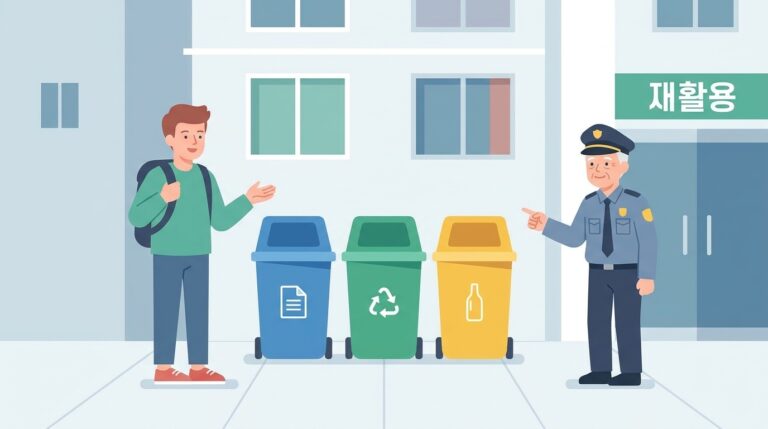
Imagine this: You’ve just moved into a beautiful high-rise Korean apartment (아파트 – a-pa-teu), just like the ones in Hospital Playlist or Our Beloved Summer. You have a bag of trash, and you walk down to the recycling zone (분리수거장 – bun-ri-su-geo-jang). Suddenly, you find yourself staring at ten different colored bins, labels entirely in Korean, and a very vigilant security guard (경비원 아저씨 – gyeong-bi-won a-jeos-si) watching your every move.
Your heart races. Where does this empty banana milk bottle go? Can this pizza box be recycled?
Don’t panic! We have all been there. Sorting trash in Korea—known as 분리수거 (bun-ri-su-geo)—is famous for being strict, but once you master a few basic A1-level Korean phrases, you will not only throw away your trash perfectly, but you will also win the warm smile and respect of your neighborhood security guard!
This guide was built with real-life feedback from foreign residents who survived their first “Recycling Sunday.” Let’s dive in!
Phase 2: 3 Key Phrases for Survival
1. 이거 어디에 버려요? (I-geo eo-di-e beo-ryeo-yo?)
- Pronunciation: [ee-guh uh-dee-eh buh-ryuh-yo?]
- Meaning: “Where do I throw this away?”
- K-Culture Moment: This is the ultimate survival phrase. You will hear neighbors or characters in slice-of-life K-dramas asking this while holding up a confusing piece of packaging.
- Editor’s Insight: This is polite, simple, and incredibly useful. Use it when holding an item you are unsure about while looking at the security guard or a neighbor.
- Situation Spectrum:
- Casual (with close friends): 이거 어디에 버려? (I-geo eo-di-e beo-ryeo?) ⚠️
- Semi-formal (neighbors/security guard): 이거 어디에 버려요? ✅
- Formal (very polite/elderly): 이것은 어디에 버려야 합니까? ⚠️ (Too stiff for daily apartment life!)
- 🤔 Think About It: In Korean, we often drop the subject (like “I” or “you”). Why do you think Korean communication relies so heavily on context? How does this change the way you interact with strangers?
2. 일반 쓰레기예요? (Il-ban sseu-re-gi-ye-yo?)
- Pronunciation: [eel-bahn sseu-reh-ghee-yeh-yo?]
- Meaning: “Is this general waste?”
- K-Culture Moment: In Korea, general waste goes into special official plastic bags (종량제 봉투 – jong-ryang-je bong-tu) purchased at local convenience stores.
- Editor’s Insight: If something cannot be recycled (like dirty plastic or used tissues), it belongs in the ‘일반 쓰레기’ (general waste). Asking this confirms if you should use your paid trash bag instead of the recycling bins.
- Situation Spectrum:
- Casual: 일반 쓰레기야? (Il-ban sseu-re-gi-ya?) ⚠️
- Semi-formal: 일반 쓰레기예요? ✅
- Formal: 일반 쓰레기입니까? ⚠️
- 🤔 Think About It: Unlike many Western countries where trash collection is funded by general property taxes, Korea charges per bag. How does “paying for your own trash weight” encourage people to recycle more?
3. 플라스틱이에요. (Peul-la-seu-tik-i-e-yo.)
- Pronunciation: [peul-lah-seu-teek-ee-eh-yo]
- Meaning: “It is plastic.”
- K-Culture Moment: You might hold up a container, and the guard might ask, “이건 뭐예요?” (I-geon mwo-yeo-yo? – What is this?). You can confidently reply with the material!
- Editor’s Insight: Since ‘plastic’ sounds almost identical to the English word, this is a super easy victory for A1 learners!
- Situation Spectrum:
- Casual: 플라스틱이야. (Peul-la-seu-tik-i-ya.) ⚠️
- Semi-formal: 플라스틱이에요. ✅
- Formal: 플라스틱입니다. ⚠️
- 🤔 Think About It: Korean has many loanwords from English (Konglish). How does recognizing Konglish words help ease your anxiety when speaking Korean for the first time?
Phase 3: Textbook Korean vs. Real Korean
Situation 1: Asking if something is recyclable
- 📖 Textbook Korean: “이것은 재활용이 가능한 물품입니까?” (Is this item capable of being recycled? – Extremely formal and robotic!)
- 🗣️ Real Korean: “이거 재활용 돼요?” (I-geo jae-hwal-yong dwae-yo? / Does this recycle?)
- 💡 Why is it different? Koreans value speed and efficiency. Turning a complex passive verb into a simple “되다” (dwae-yo – does it work/is it okay) makes you sound instantly natural.
Situation 2: Asking about food waste bags
- 📖 Textbook Korean: “음식물 쓰레기 봉투를 사용해야 합니까?” (Must I use a food waste bag?)
- 🗣️ Real Korean: “음쓰 봉투에 넣어요?” (Eum-sseu bong-tu-e neo-heo-yo? / Put in food-waste bag?)
- 💡 Why is it different? Koreans love abbreviations! ‘음식물 쓰레기’ (eum-sik-mul sseu-re-gi – food waste) is shortened to ‘음쓰’ (eum-sseu) in daily chats. Use this, and your neighbors will think you\’ve lived in Seoul for ten years!
Phase 4: K-Culture Deep Dive & Non-verbal Manners
4-1. Nunchi (눈치) & Body Language Tips
- The Power of the 45-Degree Bow: When you approach the recycling zone, always make eye contact with the security guard (경비원 아저씨) or neighbors, bow slightly, and say a warm “안녕하세요!” (An-nyeong-ha-se-yo!). This instantly establishes you as a polite and cooperative resident.
- The Golden Rule of Bunriseugeo: Never dump dirty containers! Wash plastic containers, peel off plastic labels from water bottles, and flatten cardboard boxes. Doing this shows great respect for the community. If you do this, the guard might even help you sort the rest!
4-2. K-Culture Insights
- K-Drama vs. Reality: In dramas, recycling zones are places for comedy or gossip. In reality, they are highly organized social hubs of the apartment complex. On Sunday evenings, you\’ll see stylishly dressed Koreans carrying neatly stacked boxes. It\’s a shared civic ritual!
Phase 5: Live Roleplay — Sunday Night Recycling Showdown
Setting: It is 8:00 PM on a chilly Sunday. The recycling station of “Hangul Apartments” is bustling. You are holding a cardboard box filled with plastic containers and a half-empty glass bottle of Korean plum syrup.
Cast:
* You (A helpful, learning resident)
* Mr. Kim (경비원 아저씨) (The watchful but kind-hearted security guard)
- You: (🎭 Holding the heavy box, bowing politely) 안녕하세요!
(An-nyeong-ha-se-yo! / Hello!) -
Mr. Kim: (🎭 Sweeping the floor, smiles warmly) 어서 오세요! 오늘 박스 많네요!
(Eo-seo o-se-yo! O-neul bak-seu manh-nae-yo! / Welcome! Lots of boxes today!) -
You: (🎭 Pointing at a clear plastic bottle) 네! 이거… 어디에 버려요?
(Ne! I-geo… eo-di-e beo-ryeo-yo? / Yes! This… where do I throw it away?) -
Mr. Kim: (🎭 Pointing to the blue bin) 아, 그 페트병은 라벨 떼고 저기 파란 통에 넣으세요.
(Ah, geu pe-teu-byeong-eun ra-bel tte-go jeo-gi pa-ran tong-e neo-heu-se-yo. / Oh, peel the label off that PET bottle and put it in the blue bin over there.) -
You: (🎭 Peeling the label off carefully) 아, 이렇게요?
(Ah, i-reoh-ge-yo? / Ah, like this?) -
Mr. Kim: (🎭 Nodding approvingly) 그렇지! 아주 잘하네!
(Geu-reo-chi! A-ju jal-ha-ne! / That’s it! Doing great!) -
You: (🎭 Holding up a glass bottle) 그럼 이 유리병은요?
(Geu-reom i yu-ri-byeong-eun-yo? / Then what about this glass bottle?) -
Mr. Kim: (🎭 Peeking inside) 안에 씻었어요?
(An-e ssis-eo-sseo-yo? / Did you wash the inside?) -
You: (🎭 Nodding proudly) 네, 깨끗하게요!
(Ne, kkae-kkeut-ha-ge-yo! / Yes, cleanly!) -
Mr. Kim: (🎭 Pointing to the green bin) 최고예요! 저기 초록색 통에 넣어요.
(Choe-go-ye-yo! Jeo-gi cho-rok-saek tong-e neo-heo-yo. / You’re the best! Put it in the green bin over there.)
🔀 Decision Point!
What will you say to Mr. Kim before you leave?
- Option A: “반가워요! 수고하세요!” (Nice to meet you! Work hard!)
- Option B: “감사합니다! 수고하세요!” (Thank you! Keep up the great work!)
- Option C: “안녕.” (Bye.)
🏆 Choice Analysis:
- Best Choice – Option B: “감사합니다! 수고하세요!” is perfect! It combines appreciation with a friendly acknowledgment of his hard work (수고하세요 – su-go-ha-se-yo). This will guarantee he waves at you next time.
- Awkward Choice – Option A: “반가워요” is only used when meeting someone for the first time. Using it here sounds slightly out of context.
- Bad/Rude Choice – Option C: “안녕” is casual language (반말 – ban-mal). Speaking casually to an elder is considered highly impolite in Korea!
Phase 6: 10-Second Emotion Shadowing Drill
Practice saying these lines out loud with real emotion to sound like a local!
- [🥺 Confused & Polite]
“이거 / 어디에 / 버려요?”
(I-geo / eo-di-e / beo-ryeo-yo?) -
[😊 Bright & Friendly]
“감사합니다! / 수고하세요!”
(Gam-sa-ham-ni-da! / Su-go-ha-se-yo!) -
[👍 Confident & Proud]
“네! / 다 / 씻었어요!”
(Ne! / Da / ssis-eo-sseo-yo!)
Phase 7: K-Culture Mini Dictionary
- 분리수거 (Bun-ri-su-geo): “Separate and collect.” The official term for waste recycling in Korea.
- 일반 쓰레기 (Il-ban sseu-re-gi): “General waste.” Non-recyclable trash that goes into paid official government bags.
- 음식물 쓰레기 (Eum-sik-mul sseu-re-gi): “Food waste.” Used to make animal feed or compost. Even onion skins have strict rules!
- 경비원 (Gyeong-bi-won): “Security guard.” The unsung heroes of Korean apartment complexes who keep everything running smoothly.
Phase 8: Traveler’s Survival Kit
Top 3 Survival Phrases
- “일반 쓰레기 봉투 어디 있어요?” (Il-ban sseu-re-gi bong-tu eo-di is-seo-yo?)
- Tip: Ask this at any convenience store to buy general trash bags.
- “이거 재활용 돼요?” (I-geo jae-hwal-yong dwae-yo?)
- Tip: Use this when unsure if an item can go into recycling.
- “도와주셔서 감사합니다!” (Do-wa-ju-syeo-seo gam-sa-ham-ni-da!)
- Tip: A wonderful way to thank a neighbor or guard who helped you sort.
📌 Editor’s Travel Note: To find nearby supermarkets or stores to buy trash bags, download Naver Map or KakaoMap. Unlike Google Maps, these local apps are incredibly precise in Korea.
Phase 9: Think Deeper — “One Step Closer”
Korean waste management reflects a deeply rooted sense of community responsibility. Unlike individualistic systems, Korean apartment life requires neighbors to work together to keep shared spaces clean. When you recycle correctly, you are not just throwing away trash; you are showing respect for the environment and the elderly workers who manage these facilities.
💬 Your Turn: How does your home country handle recycling? Is it as strict as Korea, or is it different? Let us know in the comments below!
Phase 10: FAQ & Common Mistakes
Q: Can I throw paper delivery food boxes (like pizza boxes) in the paper recycling?
A: Only if they are perfectly clean! If the cardboard is stained with oil or sauce, it cannot be recycled. Throw grease-stained paper into the 일반 쓰레기 (general waste).
Q: What is the most common mistake foreigners make?
A: Mixing food waste with general waste. In Korea, things like chicken bones or eggshells are general waste, while soft leftovers are food waste.
Q: Do I need to buy different bags for recycling?
A: No. Recycling is placed directly into the bins for free! You only pay for the 일반 쓰레기 (general waste) bags.
🚨 Common Mistakes Alert!
- Leaving labels on plastic bottles: Action: Always peel off plastic labels before recycling!
- Throwing away unwashed containers: Action: Rinse off any food residue with water first.
- Using normal plastic bags for general waste: Action: Always use the official 종량제 봉투 (jong-ryang-je bong-tu) purchased from convenience stores.
Phase 11: Action Missions
- 🥉 Bronze Mission: Look at a plastic bottle in your room right now. Peel the label off and say: “플라스틱이에요!”
- 🥈 Silver Mission: Practice bowing at a 45-degree angle in front of a mirror and say: “안녕하세요! 수고하세요!” with a big smile.
- 🥇 Gold Mission: Go to a Korean convenience store, buy an official trash bag, and say: “일반 쓰레기 봉투 주세요.” (Il-ban sseu-re-gi bong-tu ju-se-yo. – Please give me a general trash bag.)
🎮 K-Culture Mission: Watch any modern K-drama episode and spot a scene where characters are recycling. Note what they say!
Phase 12: Interactive Quiz Challenge
1. Which bin does a dirty, oil-stained fried chicken box go into?
- A) 종이 (Paper Recycling)
- B) 일반 쓰레기 (General Waste)
- C) 플라스틱 (Plastic Recycling)
Click to see the Answer!
Correct Answer: B) 일반 쓰레기 (General Waste)
Dirty paper cannot be recycled. Make sure to throw greasy cardboard into the general waste!
2. Fill in the blank: “이거 _______ 버려요?” (Where do I throw this away?)
- A) 언제 (When)
- B) 어디에 (Where)
- C) 누구 (Who)
Click to see the Answer!
Correct Answer: B) 어디에 (eo-di-e – Where)
“이거 어디에 버려요?” is the perfect phrase to ask for locations!
3. True or False: In Korea, you can use any plastic bag to throw away general trash.
- A) True
- B) False
Click to see the Answer!
Correct Answer: B) False
You must use official, paid municipal bags (종량제 봉투) for general waste!







