

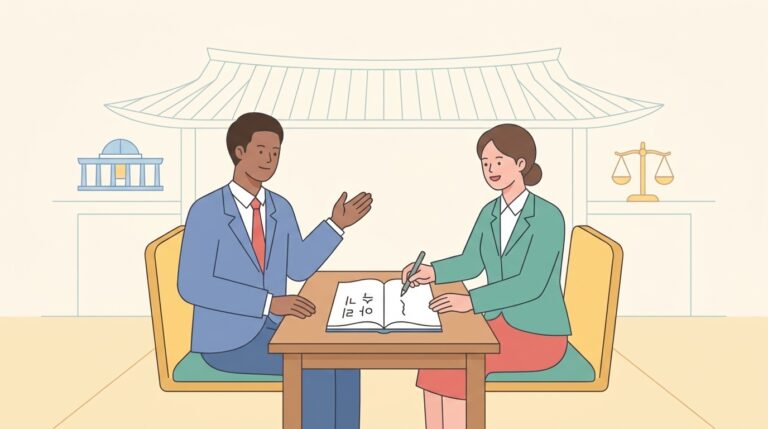
Beyond the K-Drama: How to Debate Korean Constitutional Reform Like a Local
Phase 1: Empathy (An Intellectual Night in Euljiro)
안녕하세요! Welcome back to Daily Hangul. I’m your chief editor and local cultural guide.
Imagine this: You’re sitting in a bustling, semi-hidden hanok pub in Euljiro, surrounded by the warm steam of a sizzling haemul-pajeon (해물파전 – seafood scallion pancake) and the clinking of brass cups filled with cloudy makgeolli (막걸리). You and your Korean colleagues just finished binge-watching the hit political thriller drama The Whirlwind (돌풍) or Chief of Staff (보좌관). The conversation shifts from dramatic plot twists to real-life Korean politics.
Suddenly, someone asks you:
“한국도 이제 대통령제 대신 내각제로 개헌해야 할까요?”
(Hanguk-do ije daetongnyeongje daesin naegakje-ro gaeheon-haeya halkkayo? / Do you think Korea should also revise its constitution to transition from a presidential to a parliamentary system?)
If your mind goes blank or you find yourself restricted to basic A2 phrases like “대통령 좋아요” (I like the President), you miss out on one of the most intellectually stimulating facets of Korean society. At the C2 level, discussing politics isn’t just about showing off advanced vocabulary—it’s about understanding the deep historical scars and democratic pride that shape how Koreans view power.
This guide was built from real mentoring sessions with foreign policy researchers, advanced diplomats, and K-culture enthusiasts who wanted to move past clinical textbook jargon and speak with genuine cultural depth. Let’s dive deep into the fascinating debate of Presidential System vs. Parliamentary Cabinet System in Korea!
Phase 2: C2 Political Masterclass — 3 Core Expressions
To debate Korean constitutional reform fluidly, you must master the exact terms used by editorial writers and political commentators.
1. 제왕적 대통령제 (Je-wang-jeok Dae-tong-nyeong-je)
- Pronunciation: [Je-wang-jeok Dae-tong-nyeong-je] / Sounds like: “Jay-wang-jeok Dae-tong-nyung-jay”
- Meaning: Imperial Presidency (literally, “King-like Presidential System”).
- K-Culture Moment: This term is the villain of almost every Korean political webtoon and drama. It refers to a constitutional structure where power is excessively concentrated in the executive branch, leaving the president acting more like a Joseon king than a modern democratic leader.
- Editor’s Insight: This isn’t just a political term; it’s a deep-seated cultural anxiety. Because South Korea overthrew military dictatorships in living memory, the fear of an “imperial” executive is constantly balanced against the desire for a strong, decisive leader.
- Situation Spectrum:
- Casual (with close friends): ✅ (Adds a very sophisticated, witty flavor to casual political debates)
- Semi-formal (work colleagues): ✅ (Perfect for intellectual lunch discussions)
- Formal (academic/business): ✅ (An essential term for any political analysis)
- 🤔 Think About It: Why does Korean society refer to modern presidents as “imperial”? Does your home country also grapple with the concentration of executive power, or is it balanced differently?
2. 권력 분점 (Gwon-ryeok Bun-jeom)
- Pronunciation: [Gwon-ryeok Bun-jeom] / Sounds like: “Gwon-ryuk Boon-jum”
- Meaning: Power Sharing / Division of Power.
- K-Culture Moment: In political dramas, reformist politicians often hold secret midnight meetings over high-end traditional Korean dining (hanjeongsik) to negotiate gwon-ryeok bun-jeom as a way to prevent gridlock.
- Editor’s Insight: This is the primary argument used by advocates of a parliamentary system (naegakje) or a semi-presidential system (i-won-jib-jeong-bu-je). It represents the dream of collaborative governance (hyeop-chi).
- Situation Spectrum:
- Casual: ⚠️ (Can sound slightly academic, but highly effective if the context is already political)
- Semi-formal: ✅
- Formal: ✅
- 🤔 Think About It: Is “power sharing” seen as a sign of democratic maturity or political weakness in your culture?
3. 개헌 피로감 (Gae-heon Pi-ro-gam)
- Pronunciation: [Gae-heon Pi-ro-gam] / Sounds like: “Gae-hun Pee-ro-gahm”
- Meaning: Constitutional Revision Fatigue.
- K-Culture Moment: You’ll see this phrase splashed across major news editorials (saseol) whenever politicians bring up constitutional reform right before an election, prompting citizens to roll their eyes.
- Editor’s Insight: Korea has revised its constitution nine times since 1948. When politicians bring up gae-heon (개헌), the public often suspects it’s a tactical distraction from pressing economic issues, leading to widespread civic fatigue.
- Situation Spectrum:
- Casual: ✅ (Using this will make native speakers gasp at your cultural fluency)
- Semi-formal: ✅
- Formal: ✅
- 🤔 Think About It: How many times has your country’s constitution been amended? Why do you think constitutional debates in Korea are so closely tied to the electoral cycle?
Phase 3: Textbook Korean vs. Real Korean Showcase
When debating politics, textbooks teach you sterile, academic phrasing. Real Koreans use idiom-rich, cynical, or highly pragmatic expressions to convey their skepticism or passion.
Situation 1: Discussing political instability caused by reform debates
- 📖 Textbook Korean: “내각제는 잦은 정권 교체로 인해 정치적 불안정을 초래할 수 있습니다.”
(Naegakje-neun jajeun jeonggwon gyo-che-ro inhae jeongchi-jeok buranjeong-eul chorae-hal su isseumnida.)
Translation: “A parliamentary system can bring about political instability due to frequent government changes.” - 🗣️ Real Korean: “맨날 당끼리 싸우다가 내각 해산하네 마네 하면 정국이 하루도 조용할 날이 없을 거예요.”
(Maennal dang-kkiri ssa-u-daga naegak haesanhane mane hamyeon jeongguk-i harudo joyong-hal nari eopseul geoyeyo.)
Translation: “If parties fight all day and constantly threaten to dissolve the cabinet, there won’t be a single peaceful day in politics.” - 💡 Why the Difference? Real Korean political discourse relies on vivid, colloquial scenarios (e.g., “not a single quiet day” – 하루도 조용할 날이 없다) rather than abstract nouns like “초래하다” (to bring about/cause).
Situation 2: Expressing skepticism about politicians’ motives for constitutional reform
- 📖 Textbook Korean: “정치인들의 개헌 주장은 정파적 이해관계에 따른 것입니다.”
(Jeongchi-indeul-ui gaeheon jujang-eun jeongpa-jeok ihaegwangye-e ttareun geosimnida.)
Translation: “Politicians’ advocacy for constitutional revision is based on partisan interests.” - 🗣️ Real Korean: “결국 자기네 정당 정권 잡기 좋게 판을 새로 짜겠다는 꼼수죠, 뭐.”
(Gyeolguk jagine jeongdang jeonggwon japgi joke pan-eul saero jjagetaneun kkomsu-jyo, mwo.)
Translation: “In the end, it’s just a sly trick to reshape the playing field so their own party can grab power more easily.” - 💡 Why the Difference? The use of kkomsu (꼼수 – a cheap trick / sly move) and the phrase pan-eul jjada (판을 짜다 – to set up the board / strategize) instantly localizes your language, transforming you from an academic observer into an empathetic insider.
Phase 4: K-Culture Deep-Dive & Non-verbal Manners
4-1. Nunchi & Debating Manners
- The Art of the Soft Nod: When discussing politics in Korea, maintaining nunchi (눈치 – intuitive situational reading) is critical. Koreans rarely launch into aggressive, direct disagreement. Even if you strongly disagree with a colleague’s view on the presidential system, start with:
> “그 말씀도 일리가 있네요. 하지만…” (Geu malsseum-do illiga inneyo. Hajiman… / What you say makes sense, but…) - Physical Demeanor: Avoid pointing fingers or banging on the table. Keep your hands relaxed, slightly cup your glass when someone pours you a drink, and tilt your head away slightly if you take a sip during a heavy debate. Politics can get hot, but your physical manners must remain cool.
4-2. K-Culture Code: The
Frequently Asked Questions (FAQ)
Q: What does "제왕적 대통령제 (Je-wang-jeok Dae-tong-nyeong-je)" mean in Korean and how do you pronounce it?
A: In Korean, "제왕적 대통령제 (Je-wang-jeok Dae-tong-nyeong-je)" is pronounced [Je-wang-jeok Dae-tong-nyeong-je] and means: Imperial Presidency (literally, "King-like Presidential System").
Q: What does "권력 분점 (Gwon-ryeok Bun-jeom)" mean in Korean and how do you pronounce it?
A: In Korean, "권력 분점 (Gwon-ryeok Bun-jeom)" is pronounced [Gwon-ryeok Bun-jeom] and means: Power Sharing / Division of Power.
Q: What does "개헌 피로감 (Gae-heon Pi-ro-gam)" mean in Korean and how do you pronounce it?
A: In Korean, "개헌 피로감 (Gae-heon Pi-ro-gam)" is pronounced [Gae-heon Pi-ro-gam] and means: Constitutional Revision Fatigue.







