

Master Karrot Market: How to Politely Check Item Conditions in Korean Second-Hand Trades
Phase 1: Empathy (Welcome to the World of Danggeun!)
안녕하세요! (Annyeonghaseyo!) Welcome back to your cozy Korean-learning corner. It’s your friendly senior editor from Daily Hangul, your personal cultural navigator here in Seoul.
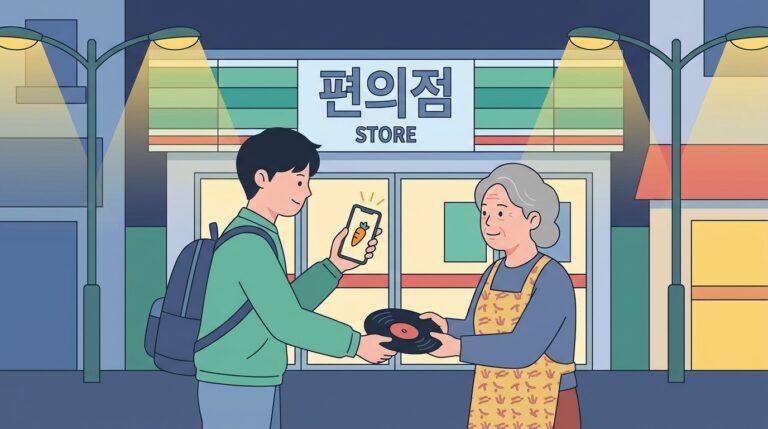
Imagine this: You are walking down a quaint alleyway in Mapo-gu, Seoul. You just spotted a listing on Korea’s beloved second-hand app, Karrot Market (당근마켓 – Danggeun Market), for that rare, limited-edition K-Drama vinyl record or a premium winter trench coat featured in your favorite show. The price is unbelievable. But wait—is that a tiny scratch on the sleeve? Is the fabric pilling?
You want to ask the seller for more details, but you hesitate. “Will I sound too demanding? Is it rude to ask for more pictures in Korea?”
In Korea, peer-to-peer trading isn’t just a transaction; it’s a polite social interaction heavily governed by 눈치 (nunchi – intuitive tact). Asking about item conditions in an overly blunt way can easily cause the seller to “ghost” you or, worse, block you. On the flip side, knowing the exact polite phrases will not only land you a pristine item but might even get you some freebies (서비스 – seobiseu) and a warm, heart-fluttering exchange with a local.
Today, we are going to dive deep into how to inspect an item’s condition like a native, ensuring your transactions are smooth, respectful, and perfectly tailored to Korean social manners. Let’s get started!
Phase 2: Deep Analysis of 3 Core Expressions
To navigate a second-hand trade smoothly, you need to master these three absolute lifesavers. Let’s look at their structure, nuances, and cultural weight.
1. 혹시 하자나 사용감 있나요? (Hoksi hajana sayonggam innayo?)
- Pronunciation: Hok-si ha-ja-na sa-yong-gam in-na-yo?
- Sound-alike guide: Think of “Hock-see” + “ha-ja-na” + “sah-yong-gahm” + “een-nah-yo?”
- Meaning: “By any chance, are there any defects or signs of use?”
- K-Culture Moment: This is the ultimate defensive spell in Korean second-hand trading. You’ll hear this used by smart buyers in almost every transaction. It’s polite, soft, and directly addresses two key elements: 하자 (haja – structural/visible defects) and 사용감 (sayonggam – signs of wear/use).
- Editor’s Insight: Starting the sentence with 혹시 (hoksi – by any chance) acts as a linguistic cushion. Without it, “하자 있나요?” sounds like an interrogation. Adding “혹시” instantly makes you sound gentle and considerate.
- Situation Spectrum:
- Casual (Friends/Close peers): ✅ (혹시 하자나 사용감 있어?)
- Semi-formal (Danggeun chat with strangers): ✅ (혹시 하자나 사용감 있나요?)
- Formal (Business/Elderly): ⚠️ (Slightly too casual; use “혹시 하자가 있거나 사용한 흔적이 있습니까?” but this is rarely needed for second-hand apps)
- 🤔 Think About It: Why does Korean rely so heavily on softeners like “혹시”? It stems from a culture that values saving face (체면 – chemyeon). Directly asking “Are there defects?” implies the seller might be hiding something. Adding “혹시” shifts the tone to a gentle inquiry.
2. 실물 사진 좀 더 볼 수 있을까요? (Silmul sajin jom deo bol su isseulkkayo?)
- Pronunciation: Sil-mul sa-jin jom deo bol su is-seul-kka-yo?
- Sound-alike guide: “Seel-mool” (actual item) + “sah-jeen” (photo) + “jom” (a little/please) + “duh” (more) + “bol soo ee-seul-kka-yo?” (could I see?)
- Meaning: “Could I see some more actual photos of the item?”
- K-Culture Moment: Often, sellers use aesthetic stock photos or screenshots from the brand’s website. To make sure you aren’t getting scammed, you need to see the 실물 (silmul – the real, physical object).
- Editor’s Insight: Notice the tiny word 좀 (jom). While it literally means “a little,” in daily Korean request patterns, it functions as “please” or “if you don’t mind.” It softens your request, making it sound like you’re trying not to inconvenience them.
- Situation Spectrum:
- Casual: ✅ (실물 사진 좀 더 볼 수 있어?)
- Semi-formal: ✅ (실물 사진 좀 더 볼 수 있을까요?)
- Formal: ✅ (실물 사진을 조금 더 확인해 볼 수 있겠습니까?)
- 🤔 Think About It: In your culture, is it common to ask for additional photos, or do people rely strictly on the posted images? In Korea, asking for physical photos is highly expected, but doing it politely with “좀” makes all the difference.
3. 혹시 미개봉 새상품인가요? (Hoksi migaebong saesangpumingayo?)
- Pronunciation: Hok-si mi-gae-bong sae-sang-pum-in-ga-yo?
- Sound-alike guide: “Hock-see” + “mee-gae-bong” (unopened) + “sae-sahng-poom” (new product) + “een-gah-yo?” (is it?)
- Meaning: “By any chance, is it an unopened, brand-new product?”
- K-Culture Moment: K-Pop fans often buy multiple albums to collect photo cards (포카 – poka), then sell the unopened albums at a discount. If you are looking for these pristine items, this phrase is your golden ticket.
- Editor’s Insight: 미개봉 (migaebong) literally translates to “unopened/sealed.” In Korea’s tech and cosmetics-dominated resale market, a “미개봉 새상품” is highly sought after because it guarantees hygiene and perfection.
- Situation Spectrum:
- Casual: ✅ (이거 미개봉 새상품이야?)
- Semi-formal: ✅ (혹시 미개봉 새상품인가요?)
- Formal: ✅ (혹시 개봉하지 않은 새 제품입니까?)
Phase 3: Textbook Korean vs. Real Korean
Many language apps teach you stiff, grammatically flawless but socially awkward sentences. Let’s look at how textbooks fail you and how real Koreans actually speak on second-hand apps.
Situation 1: Asking if there are scratches on a laptop or phone screen
- 📖 Textbook Korean: “이 기기에 상처가 있습니까?” (I gigi-e sangcheo-ga isseumnikka? / Does this device have a wound?)
- 🗣️ Real Korean: “혹시 액정에 생활 기스가 좀 있나요?” (Hoksi aekjeong-e saenghwal giseu-ga jom innayo? / By any chance, are there some light scratches from daily use on the screen?)
- 💡 Why the difference? Textbooks use “상처” (sangcheo), which usually refers to human physical wounds. On apps, Koreans use the slang-infused compound 생활 기스 (saenghwal giseu), meaning “everyday scratches” (a mix of the Korean ‘생활’ and Japanese-derived ‘기스’ for scratch), which sounds incredibly natural.
Situation 2: Asking if you can inspect the item in person during a face-to-face trade
- 📖 Textbook Korean: “제가 물건을 직접 검사해도 됩니까?” (Jega mulgeon-eul jikjeop geomsa-haedo doemnikka? / May I inspect the item directly?)
- 🗣️ Real Korean: “만났을 때 물건 상태 확인하고 구매해도 될까요?” (Mannasseul ttae mulgeon sangtae hwaginhago gumaehaedo doelkkayo? / Would it be okay if I check the item’s condition when we meet before making the purchase?)
- 💡 Why the difference? “검사” (geomsa) sounds like an official inspection or a customs check. It feels cold and untrusting. “상태 확인” (state check) sounds casual, cooperative, and standard.
Phase 4: K-Culture Deep Dive & Non-verbal Manners
4-1. Nunchi (눈치) and Non-verbal Etiquette in Face-to-Face Trades
When you meet up for a 직거래 (jikgeorae – face-to-face trade), usually outside a subway exit or a convenience store, your actions speak louder than words:
* The 3-Second Check Rule: When the seller hands you the item, do not just tuck it away immediately. It is actually considered polite to inspect it quickly in front of them while saying, “잠시만 확인할게요!” (Let me check briefly!). This prevents any post-trade misunderstandings.
* The Two-Handed Handover: Always hand over the money (or show them the bank transfer screen) and receive the item using two hands. It’s a basic sign of respect in Korea that instantly boosts your “good buyer” score.
4-2. The “Cool Georae” (쿨거래) Culture
Koreans value efficiency immensely. A 쿨거래 (cool trade) refers to a transaction where the buyer asks minimal questions, transfers the money quickly, and meets on time. If you inspect the item meticulously but do it quickly and politely, you are still considered a
Frequently Asked Questions (FAQ)
Q: What does "혹시 하자나 사용감 있나요? (Hoksi hajana sayonggam innayo?)" mean in Korean and how do you pronounce it?
A: In Korean, "혹시 하자나 사용감 있나요? (Hoksi hajana sayonggam innayo?)" is pronounced [Hok-si ha-ja-na sa-yong-gam in-na-yo?] and means: a key conversational Korean expression covered in this lesson.
Q: What does "실물 사진 좀 더 볼 수 있을까요? (Silmul sajin jom deo bol su isseulkkayo?)" mean in Korean and how do you pronounce it?
A: In Korean, "실물 사진 좀 더 볼 수 있을까요? (Silmul sajin jom deo bol su isseulkkayo?)" is pronounced [Sil-mul sa-jin jom deo bol su is-seul-kka-yo?] and means: a key conversational Korean expression covered in this lesson.
Q: What does "혹시 미개봉 새상품인가요? (Hoksi migaebong saesangpumingayo?)" mean in Korean and how do you pronounce it?
A: In Korean, "혹시 미개봉 새상품인가요? (Hoksi migaebong saesangpumingayo?)" is pronounced [Hok-si mi-gae-bong sae-sang-pum-in-ga-yo?] and means: a key conversational Korean expression covered in this lesson.







