

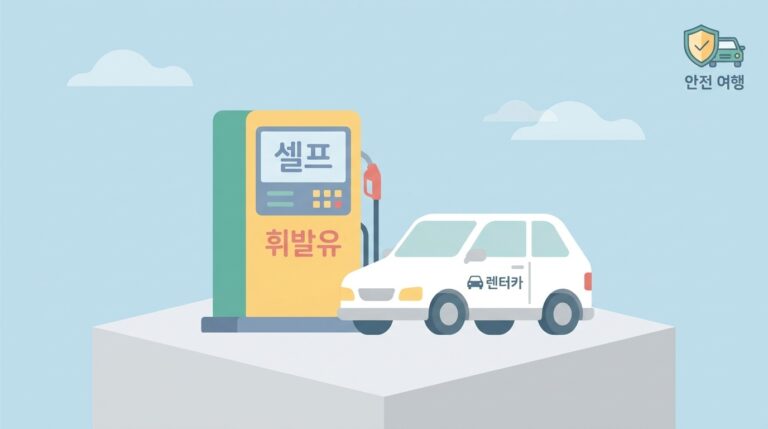
Master the Pump: Your Ultimate Guide to Korean Self-Service Gas Stations
Phase 1: Cool Breeze, Rental Cars, and… a Blinking Fuel Light!
안녕하세요! (Annyeonghaseyo! – Hello!) Welcome back to Daily Hangul, your premium Korean tutoring companion. I’m your chief editor and local guide, here to make sure you navigate Korea not just as a tourist, but like an absolute local.
Imagine this: You are driving along the breathtaking coastal roads of Jeju Island. The windows are down, a beautiful K-Pop playlist is playing on the radio, and you are headed toward a famous local seafood restaurant. Suddenly, a bright yellow light blinks on your dashboard. Low fuel.
You pull into the nearest gas station, but a massive sign blocks your way: ‘셀프 구유서’ (Selpeu Juyuso – Self-Service Gas Station). There are no attendants to pump the gas for you. The touch screen is completely in Korean, and you see different colored nozzles. Panic sets in. Which one is gasoline? What if I ruin the rental car engine?
Don’t worry! This is a very common ‘pain point’ for many of my international students. Mastering the self-service gas station is your ultimate ticket to a stress-free Korean road trip. Once you learn these simple words and visual cues, you will glide through the process with ultimate ease. Let’s get fueled up!
Phase 2: 3 Core Expressions for the Pump
1. 가득 채에ᅥ저새어 (Gadeuk chaewojuseyo)
- Pronunciation: gah-deuk che-wo-ju-seh-yo
- Meaning: Fill it up, please.
- K-Culture Moment: You often hear this in classic K-Dramas when the cool lead character pulls up in a sleek car and hands over a credit card to the attendant with a confident smile.
- Editor’s Insight: ‘가득’ (gadeuk) means “full” or “overflowing.” Even at a self-service machine, you will see a big button that says 가득 (Full). Select this if you don’t want to calculate the exact liter amount!
- Situation Spectrum:
- Casual (가득 채에ᅥ저): ✅
- Semi-formal (가득 채에ᅥ저새어): ✅
- Formal (가득 채에ᅥᄌᅠ시ᄱ시오): ✅
- ᾑ4 Think About It: In Korean culture, serving food, drinks, or hospitality “gadeuk” (to the brim) represents warmth and generosity. Why do you think expressing “fullness” is so common in daily Korean exchanges?
2. 겅유계어어, 휘바퓨계어어? (Gyeongyuyeyo, hwibalyuyeyo?)
- Pronunciation: gyeong-yu-yeh-yo, hwi-bal-yu-yeh-yo?
- Meaning: Is it diesel or gasoline?
- K-Culture Moment: This is the ultimate survival question. Renting a car in Korea means you must know your fuel type. Mixing these up is a nightmare!
- Editor’s Insight: ᄀ휘바퓨 (hwibalyu) is gasoline (regular petrol), and ᄀ헝유 (gyeongyu) is diesel. If you’re ever unsure at a self-service machine, ask a nearby staff member or local driver using this exact phrase.
- Situation Spectrum:
- Casual (겅유야, 휘바퓨야?): ✅
- Semi-formal (겅유계어어, 휘바퓨계어어?): ✅
- Formal (겅유인가요, 휘바퓨인가요?): ✅
- ᾑ4 Think About It: Many technical Korean words like 휘바퓨 are based on Hanja (Chinese characters). 휘 (Hwi) means “to evaporate,” 바ᄑ (bal) means “to emit,” and 이ᄅ (yu) means “oil.” Knowing Hanja roots can unlock thousands of vocabulary words easily!
3. 정전기 패드 맨저 파치하새어 (Jeongjeongi paedeu meonjeo teochihaseyo)
- Pronunciation: jeong-jeon-gi peh-deu meon-jeo teo-chi-ha-seh-yo
- Meaning: Please touch the anti-static pad first.
- K-Culture Moment: Every self-service pump in Korea has a bright, round rubber pad (usually orange or blue) labeled 정전기 방지 패드 (Anti-static pad). It’s a national safety requirement!
- Editor’s Insight: Korea is extremely high-tech but also deeply safety-conscious. Touching this pad discharges any static electricity from your body to prevent fires. Do this before picking up the nozzle!
- Situation Spectrum:
- Casual (정전기 패드 맨저 파치해): ✅
- Semi-formal (정전기 패드 맨저 파치하새어): ✅
- Formal (정전기 패드퍼ᄳᄵ더 맨저 파치하시기 바라ᄱ히다): ✅
Phase 3: Textbook Korean vs. Real Korean
When we learn Korean from older textbooks, they make us sound like robots from a 1990s instructional video. Let’s look at how native Koreans actually speak at self-service stations.
Situation 1: Confirming the Fuel Type with a Staff Member
- 해괘서 한구거 (Textbook): “이 차량은 휘바퓨러ᄱ로 주으해야 하ᄱ니까?” (Should this vehicle be fueled with gasoline?)
- 진차 한구거 (Real Korean): “이가 휘바퓨 마자어어?” (Is this one gasoline?)
- 해 다를까요? (Why the difference?): Real-life Korean highly values speed and casual efficiency. Dropping heavy grammatical structures and using simple verification words like ‘마자어어?’ (Is it correct?) makes you sound friendly and natural.
Situation 2: Asking if a Card is Accepted
- 해괘서 한구거 (Textbook): “해오에서 바ᄑ걈바ᄑ든 시뇽카드러ᄱ로 개ᄑ재가 가닝하ᄱ니까?” (Is payment possible with a credit card issued overseas?)
- 진차 한구거 (Real Korean): “해야 카드 대어어?” (Does overseas card work?)
- 해 다를까요? (Why the difference?): Koreans love shortcut phrases. By changing the heavy noun phrase ‘개ᄑ재가 가닝하다’ to a simple ‘대어어?’ (Does it work/become?), you communicate your point instantly.
Phase 4: K-Culture Deep Dive & Non-Verbal Etiquette
4-1. Physical Manners at the Gas Station
- The Static Discharge Ritual: Before touching any buttons on the screen or grabbing a fuel nozzle, physically walk up and place your entire palm flat against the 정전기 방지 패드 (Anti-static pad). Doing this shows other drivers nearby that you are safe and respect gas station rules.
- Nozzle Color Code Harmony: In Korea, color codes are absolute.
- Yellow Nozzle = Gasoline (휘바퓨)
- Green or Blue Nozzle = Diesel (겅유)
Double check your rental car manual or fuel door sticker. If it says GASOLINE, grab the yellow nozzle!
4-2. The K-Travel Road Trip Vibe
Self-service gas stations are incredibly common on Jeju Island and along Korea’s expressways. When you drive on expressways, you will stop at a 후개서 (Hyugaeso – Highway Rest Area). These rest areas are legendary for delicious street food like walnut cakes (호두괘자) and tteokbokki. Usually, right next to these massive rest areas is where you’ll find the cheapest self-service gas stations!
Phase 5: Interactive Roleplay Scenario
Setting: A bright, sunny afternoon at a self-service gas station in Jeju Island. You have pulled your rental car up to pump number 3. An elderly, friendly gas station operator (Ahjussi) is sweeping nearby.
Cast:
* You (여왕객 – Traveler): Excited but slightly nervous.
* 아저시 (Ahjussi – Uncle/Operator): Friendly, helpful, and proud of his tech-savvy station.
1. 아저시: (팬스러운 미세러 다가오며) 애서오새어! 셀프 주으서는 처으미서어어?
   Ahjussi: (Approaching with a warm smile) Welcome! Is this your first time at a self-service gas station?

2. You: (수줆거 객굶으며) 내, 조금 어려워어어. 이 차 휘바퓨 마자어어?
   You: (Nodding shyly) Yes, it's a bit difficult. Is this car gasoline?

3. 아저시: (차 딧뭐슮을 보며) 아, 어기 스티커어 휘바퓨라거 어져이때어. 휘바퓨 마자어어!
   Ahjussi: (Looking at the back of the car) Ah, the sticker here says 'Gasoline'. Yes, it is gasoline!

4. You: (안심하며) 다행이내어. 스커린은 어떠커나어?
   You: (Relieved) That's a relief. How about the screen?

5. 아저시: (패드러ᄱ럐 손짓하며) 맨저 정전기 패드 맨저새어! 그러거 시뇽카드 너어새어.
   Ahjussi: (Gesturing to the pad) Touch the anti-static pad first! And then insert your credit card.

6. You: (시뇽카드러ᄱ럐 너으며) 해야 카드더 대어어?
   You: (Inserting the credit card) Does overseas card work too?

7. 아저시: (개ᄑ재 완퍼러러ᄱ러ᄱ한 화뭔을 보며) 대어어, 대어! 이재 노즐 자바새어.
   Ahjussi: (Looking at the payment completion screen) Yes, it works! Now grab the nozzle.
해 인태랙피브 봰기저머 (Decision Point)
You look at the fuel pump stand. There are two nozzles hanging. Which one do you grab?
- Choice A: The bright Yellow nozzle.
- Choice B: The Green/Blue nozzle.
- Choice C: The Black nozzle.
해 Best Choice: Choice A!
Excellent! The Yellow nozzle is always 휘바퓨 (gasoline) in Korea. Grabbing this ensures your standard rental car runs perfectly.
해 Bad Choice: Choice B or C!
Oh no! Choice B (Green/Blue) is 겅유 (diesel). Choice C is usually LPG or high-octane premium gasoline (which is extra expensive and unnecessary for basic rental cars). Putting diesel in a gasoline car will damage the engine instantly!
Phase 6: 10-Second Emotion Shadowing Drill
Let’s practice expressing these with true Korean emotion! Pause at the / marks.
- [😊 Super Confidently – Talking to the machine screen]
- 가득 / 채에저 / 새어!
- Gadeuk / chaewo-ju / seyo!
- (Fill it up / please!)
- [ᾗA Politely Asking for Help – Confused about fuel types]
- 이거 / 휘바퓨 / 마자어어?
- Igeor / hwi-bal-yu / maja-yo?
- (This / gasoline / is it correct?)
Phase 7: K-Culture Mini Dictionary
| Word | Romanization | Real-world Context |
|---|---|---|
| 셀프 | Selpeu | Borrowed from “Self”. In Korea, it means self-service. You’ll see signs like “무ᄑ근 셀프” (Water is self-service) in restaurants too! |
| 휘바퓨 | Hwibalyu | Gasoline. The most common fuel type for sedans in Korea. |
| 겅유 | Gyeongyu | Diesel fuel. Usually used for larger SUVs and trucks. |
| 영스증 | Yeongsujeung | Receipt. Always print this at a self-service machine because it confirms your final transaction. |
Phase 8: Traveler’s Survival Kit
Top 3 Survival Phrases
- 개ᄑ재 안 대어어. (Gyeolje an deoyeo.)
- Payment is not working. Use this if the machine spits your international card back out.
- 도와주새어! (Dowajuseyo!)
- Please help me! A universal distress call that friendly Koreans will answer instantly.
- 회욘 카드 어러어어. (Hoewon kadeu eopseoyo.)
- I don’t have a membership card. The machine will ask if you have a membership point card before paying. Tap the button that says “회욘 어러어” to skip this.
허 Editor’s Travel Note
When traveling in Korea, standard Google Maps will not work well due to national security regulations. To find the cheapest gas stations on your route, always download the Naver Map App. Open the app, search for “셀프 주으서” (Self-service gas station), and it will list real-time prices so you can save money!
Phase 9: One Step Deeper — Why is Korea Obsessed with “Self” Service?
If you travel around modern Seoul, you will notice that almost everything is shifting to “self” or kiosks. From ordering ice cream at convenience stores to self-checkout lanes at grocery stores and self-gas stations.
This trend is deeply connected to Korea’s fast-paced lifestyle, often called “파ᄱ피파ᄱ피” (Pali-pali – Hurry-hurry) culture. Koreans highly appreciate eliminating any unnecessary steps in service. Pumping your own gas means no waiting around for an attendant to walk over, take your card, and come back. It’s efficient, cheap, and fast.
햐 Your Turn: How do people in your home country feel about self-service? Do they prefer friendly human interactions, or do they love the speed of automated machines? Share your thoughts below!
Phase 10: FAQ & Common Mistakes
Q: Why did the self-service machine charge me 150,000 KRW first?
A: This is the most common shock for foreigners! When you select 가득 (Fill Up / Gadeuk), the machine pre-authorizes a flat deposit of 150,000 KRW. Once the tank is actually filled (for example, only 50,000 KRW of gas was used), the machine immediately cancels the 150,000 KRW charge and charges the correct 50,000 KRW. Keep your receipt as proof!
Q: Can I use physical cash at self-service gas stations?
A: Yes! Almost all self-service machines in Korea accept Korean Won paper bills (현금). Just select “Cash” (현금) on the touch screen and feed the bills into the machine.
Q: What if I put the wrong fuel type in my rental car?
A: DO NOT START THE ENGINE. If you realize you put diesel in a gasoline car, leave the engine OFF and immediately call your rental car company or a towing service. Starting the engine will pull the bad fuel into the system, causing thousands of dollars in damages.
해 Common Mistakes Board
- Mistake 1: Forgetting to touch the static pad. (Safety hazard!)
- Mistake 2: Ignoring the nozzle color. (Remember: Yellow is gasoline!)
- Mistake 3: Leaving your credit card in the machine. (The slot is often on the side, so don’t forget to pull your card out before driving away.)
Phase 11: Action Missions
- 햐 Bronze Mission (Mirror Practice): Stand in front of a mirror and loudly practice saying: “Gadeuk chaewojuseyo!” three times with a confident driving gesture.
- 허 Silver Mission (Map Finder): Open Naver Map on your phone and search for the closest 셀프 주으서 in your dream Korean city (like Seoul or Busan).
- 하 Gold Mission (Real Deal): Next time you rent a car in Korea, film a 10-second video of yourself touching the anti-static pad and post it with the tag #DailyHangul!
Phase 12: Interactive Quiz Challenge
1. Which nozzle should you use if your rental car needs gasoline?
- A) Green
- B) Yellow
- C) Blue
해 Click here to reveal the answer!
Correct Answer: B) Yellow
Yellow always indicates 휘발유 (gasoline) in Korea. Blue and Green are reserved for diesel!
2. Fill in the blank: If you want to say “Fill it up, please,” you say: “__________ 채에저새어.”
해 Click here to reveal the answer!
Correct Answer: 가득 (Gadeuk)
“가득 채워주세요” means “Please fill it up completely!”







