

Why Koreans Ask Your Age in the First 5 Minutes (And How to Respond Like a Pro)
안녕하세요! (An-nyeong-ha-se-yo!) Hello there! It’s your favorite Korean culture navigator and senior editor at Daily Hangul.
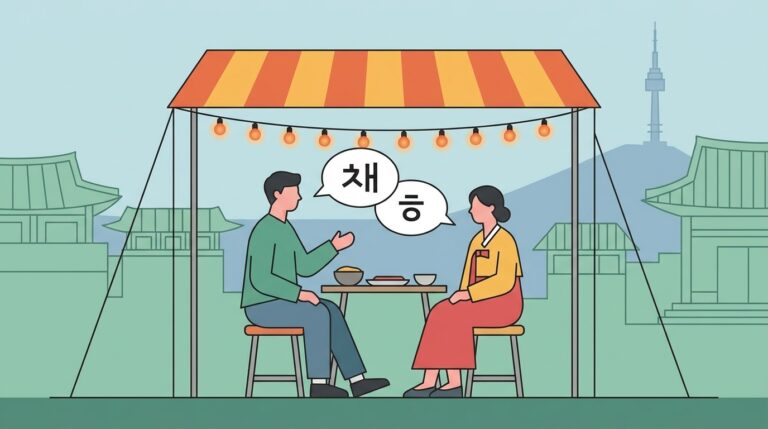
Picture this: You are sitting at a trendy pojangmacha (포장마차 – street food tent) in Euljiro, Seoul. The grilled pork belly is sizzling, and you are sharing a bottle of somaek (소맥 – beer and soju mix) with some newly introduced Korean acquaintances. The vibe is amazing, but suddenly, the person opposite you leans in and asks:
“실례지만… 혹시 몇 살이세요?” (Sil-lye-ji-man… hok-si myeot sal-i-se-yo? / “Excuse me, but how old are you by any chance?”)
If you come from a Western culture, this question might trigger an internal alarm. “Did I look tired? Is this rude? Why does my age matter right now?”
Don’t panic! In Korea, asking your age isn’t an intrusive interrogation. It is actually a warm, necessary social dance called 서열 정리 (Seo-yeol Jeong-ri – hierarchy sorting). Once Koreans know your age relative to theirs, they can choose the perfect level of politeness (존댓말 – Jondetmal vs. 반말 – Banmal), unlocking a much deeper, comfortable, and authentic connection with you.
Today, we are going to master this cultural milestone so you can handle the “Age Question” with ultimate confidence and charm!
Phase 2: Three Core Expressions for Navigating Age and Speech Levels
1. 실례지만 나이가 어떻게 되세요? (Sil-lye-ji-man na-i-ga eo-tteo-ke doe-se-yo?)
- Pronunciation: [Sil-lye-ji-man na-ee-ga uh-ttuh-keh dweh-seh-yo? / Sounds like: Sil-leh-jee-man night-gah-eo-tuh-keh-deh-seh-yo]
- Meaning: “Excuse me, but how old are you?” (Lit. “Excuse me, but how does your age become?”)
- K-Culture Moment: This is the gold standard of polite inquiry. You will hear this in K-Dramas like Because This Is My First Life when two characters meet in a shared housing situation and need to establish how to address each other.
- Editor’s Insight: Using “몇 살이에요?” (myeot sal-i-e-yo?) is okay, but using “나이가 어떻게 되세요?” is far more elegant and respectful because it uses the honorific noun “나이” (age) and the soft verb ending “되세요”.
- Situation Spectrum:
- Casual Settings (with acquaintances): ✅
- Semi-formal (colleagues at work): ✅
- Formal / Much Older Adults: ⚠️ (For elders, “연세가 어떻게 되세요?” [Yeon-se-ga eo-tteo-ke doe-se-yo?] is safer)
- 🤔 Think About It: In English, we try to avoid asking age to be polite. Why do you think Korean culture views asking age as a prerequisite for politeness?
2. 말 놓으셔도 돼요 (Mal no-eu-syeo-do dway-yo)
- Pronunciation: [Mal noh-eu-syuh-doh dweh-yo / Sounds like: Mahl-noh-she-oh-doh-deh-yo]
- Meaning: “You can lower your speech with me.” / “You can use informal language (Banmal).”
- K-Culture Moment: Imagine a sunbae (선배 – senior colleague) and hoobae (후배 – junior colleague) eating fried chicken after work. Once the tension melts, the older colleague might hesitate to use Banmal, prompting the younger one to say this line to build closer intimacy.
- Editor’s Insight: Even if you are younger, saying this to an older friend who is still speaking formally (Jondetmal) to you shows that you want to bridge the emotional distance. It is an invitation to be close friends!
- Situation Spectrum:
- Casual Settings: ✅
- Semi-formal (friendly workplace): ✅
- Formal / Strict Business: 🚫
- 🤔 Think About It: Lowering speech (말을 놓다) in Korea is compared to “putting down a heavy burden.” How does your native language express transition from formal to casual friendship?
3. 몇 년생이세요? (Myeot nyeon-saeng-i-se-yo?)
- Pronunciation: [Myut-nyun-saeng-ee-seh-yo? / Sounds like: Myut-nyun-sang-ee-seh-yo]
- Meaning: “What year were you born?”
- K-Culture Moment: Watch any K-Pop idol reality show (like Run BTS or Going Seventeen). When idols from different groups meet, they don’t ask “How old are you?” Instead, they ask “몇 년생이세요?”. If they are both born in 1997, they instantly shout “97라인! (97-line!)” and drop honorifics to become fast friends.
- Editor’s Insight: This is actually the smartest way to ask age in Korea. It avoids the confusing transition of “Korean Age” versus “International Age” by focusing solely on the birth year.
- Situation Spectrum:
- Casual Settings: ✅
- Semi-formal: ✅
- Formal / Strict Business: ⚠️
- 🤔 Think About It: In many Western countries, asking for someone’s birth year feels too specific. In Korea, why is sharing your exact birth year considered a tool for instant friendship?
Phase 3: Textbook Korean vs. Real-World Korean
When you study Korean through traditional textbooks, you often learn phrases that sound robotic or overly rigid in real life. Let’s look at how native Koreans actually handle these conversations.
Situation 1: Suggesting that you both speak comfortably
- 📖 Textbook Korean: “우리 서로 반말을 사용할까요?” (Uri seo-ro ban-mal-eul sa-yong-hal-kka-yo?) – “Shall we use informal language with each other?”
- 🗣️ Real-World Korean: “우리 말 편하게 할까요?” (Uri mal pyeon-ha-ge hal-kka-yo?) – “Shall we speak comfortably?”
- 💡 Why is it different?: Using the word “반말” (informal language) explicitly can sometimes feel a bit mechanical or blunt. Using the phrase “말을 편하게 하다” (to make speech comfortable) sounds much softer, warmer, and socially natural.
Situation 2: Confirming someone is older than you
- 📖 Textbook Korean: “당신은 저보다 나이가 많습니다.” (Dang-sin-eun jeo-bo-da na-i-ga man-seub-ni-da.) – “You have more age than me.”
- 🗣️ Real-World Korean: “저보다 형/언니이신 것 같아요!” (Jeo-bo-da hyeong/eon-ni-i-sin geot gat-ah-yo!) – “I think you are my older brother/sister!”
- 💡 Why is it different?: Koreans rarely use the word “당신” (you) in speech, as it can sound confrontational. Instead, using kinship terms like 형 (hyeong – older brother for males), 언니 (eon-ni – older sister for females), 누나 (nuna – older sister for males), or 오빠 (oppa – older brother for females) makes the relationship feel instantly warm and familial.
Phase 4: K-Culture Deep Dive & Non-Verbal Manners
4-1. The Body Language of “Seoyeol Jeong-ri”
When you are discussing age and establishing speech levels, words are only half the battle. Your body language must reflect your respect.
* The Eye Contact Shift: When asking someone older their age or when they are speaking to you in Jondetmal, keep your posture upright but slightly soften your eye contact. Staring too intensely into an elder’s eyes while discussing age can feel challenging rather than curious.
* The Two-Handed Pour: If during the conversation you discover someone is older than you, make sure to pour and receive drinks with two hands. This physical sign of respect acts as the perfect silent partner to your polite Jondetmal.
4-2. The “97-Line” Phenomenon (K-Pop Culture Code)
Have you noticed how K-Pop idols born in the same year form legendary friendship circles? In Korea, if you are born in the same year, you are automatically 친구 (Chingu – Friend). In Western terms, a “friend” can be any age. In traditional Korean culture, a true “Chingu” is someone of the exact same birth year.
Even a difference of one year (e.g., someone born in 1995 and someone born in 1996) traditionally prevents them from being “Chingu” immediately. The 1996-born must address the 1995-born with respectful titles unless they explicitly agree to “drop the speech” (말을 놓다).
Phase 5: The Euljiro Pojangmacha Roleplay
Let’s put your skills to the test. You are at an outdoor drinking spot in Seoul with Min-jun, a friendly colleague from another department who seems close in age to you.
- Your Character: Alex (26 years old, born in 1998, working in Korea)
- NPC Character: Min-jun (Warm, open-minded, loves talking about K-Drama)
[Setting: Dim orange lights under a plastic tent. The sound of cars passing and glass clinking. Steam rises from a hot bowl of fishcake soup.]
- Min-jun: (Takes a sip of water, smiles) 아, 알렉스 씨. 한국 생활은 좀 어때요? 재미있어요?
(Ah, Al-lek-seu ssi. Han-guk saeng-hwal-eun jom eo-tteo-yeo? Jae-mi-is-seo-yo?)
“Ah, Alex. How is Korean life? Is it fun?” -
You: (Nodding enthusiastically) 네! 정말 재밌어요. 특히 한국 음식이 너무 맛있어요.
(Ne! Jeong-mal jae-mit-seo-yo. Teuk-hi han-guk eom-sik-i neo-mu mat-is-seo-yo.)
“Yes! It’s really fun. Especially Korean food is so delicious.” -
Min-jun: (Laughs warmly) 다행이네요! 그런데 우리 매일 존댓말만 하니까 약간 어색한 것 같아요.
(Da-haeng-i-ne-yo! Geon-de-ri u-ri mae-il jon-daet-mal-man ha-ni-ka yak-gan eo-saek-han geot gat-ah-yo.)
“That’s a relief! By the way, since we only use honorifics every day, it feels a little formal/awkward.” -
You: (Curious, smiling) 아, 정말요? 저도 더 친해지고 싶었어요.
(Ah, jeong-mal-yo? Jeo-do deo chin-hae-ji-go sip-eot-seo-yo.)
“Oh, really? I wanted to get closer too.” -
Min-jun: (Adjusts his glasses) 맞아요. 실례지만 혹시 몇 년생이세요?
(Ma-ja-yo. Sil-lye-ji-man hok-si myeot nyeon-saeng-i-se-yo?)
“Exactly. Excuse me, but what year were you born?”
🔀 Decision Point: What do you say next?
- Option A: “저는 스물여섯 살입니다. 당신은요?” (Jeo-neun seu-mul-yeo-seot sal-im-ni-da. Dang-sin-eun-yo?)
- Option B: “저는 98년생이에요. 민준 씨는요?” (Jeo-neun gu-pal-nyeon-saeng-i-e-yo. Min-jun ssi-neun-yo?)
- Option C: “나 98년생인데! 너 몇 살이야?” (Na gu-pal-nyeon-saeng-in-de! Neo myeot sal-i-ya?)
💡 Choice Analysis:
- Best Choice: Option B! Telling your birth year in the casual-polite “-요” form (“저는 98년생이에요”) and asking “민준 씨는요?” (And you, Min-jun?) is incredibly natural, culturally fluent, and polite for B1 speakers.
- Awkward Choice: Option A. While grammatically correct, using “당신” (you) sounds like a textbook translation and feels cold or confrontational.
- Disastrous Choice: Option C. Dropping straight into Banmal (“나”, “너”, “-이야”) before Min-jun gives the green light is highly impolite and will instantly freeze the warm atmosphere.
-
You (Selecting Option B): 저는 98년생이에요. 민준 씨는요?
(Jeo-neun gu-pal-nyeon-saeng-i-e-yo. Min-jun ssi-neun-yo?)
“I was born in ’98. How about you, Min-jun?” -
Min-jun: (Claps his hands in surprise) 오! 진짜요? 저는 96년생이에요! 제가 두 살 형이네요!
(Oh! Jin-jja-yo? Jeo-neun gu-ryuk-nyeon-saeng-i-e-yo! Je-ga du sal hyeong-i-ne-yo!)
“Oh! Really? I was born in ’96! I guess I’m two years older (Hyeong)!” -
You: (Smiling respectfully) 아! 그렇군요, 형!
(Ah! Geu-reot-gun-yo, hyeong!)
“Ah! I see, Hyeong!” -
Min-jun: (Pleased, waving his hand) 이제 나이도 알았으니까 우리 말 편하게 해요! 형이라고 부르고 말 놓으세요.
(I-je na-i-do al-at-seu-ni-ka u-ri mal pyeon-ha-ge hae-yo! Hyeong-i-ra-go bu-reu-go mal noh-eu-se-yo.)
“Now that we know our ages, let’s speak comfortably! Call me Hyeong and lower your speech.”
Phase 6: 10-Second Emotional Shadowing Drill
Let’s practice speaking these with emotional authenticity. Pay attention to the pauses (/) and the mood guidance!
- [🥺 Asking politely and with a bit of cautious hesitation]
“실례지만 / 혹시 / 몇 년생이세요?”
(Sil-lye-ji-man / hok-si / myeot nyeon-saeng-i-se-yo?) -
[😊 Feeling happy and offering closer friendship]
“이제 / 우리 / 말 편하게 할까요?”
(I-je / u-ri / mal pyeon-ha-ge hal-kka-yo?)
Phase 7: K-Culture Mini Dictionary
| Word | Pronunciation | English Meaning & Cultural Context |
|---|---|---|
| 서열 정리 | Seo-yeol Jeong-ri | Hierarchy Sorting. The social process of figuring out who is older/younger or higher in status so people know how to behave. |
| 야자타임 | Ya-ja Ta-im | Yaja Time. A fun game/social event (often at company retreats) where traditional age/rank rules are reversed, and juniors can speak in Banmal to seniors. |
| 빠른 년생 | Ppa-reun Nyeon-saeng | Early Borns. People born in Jan/Feb who used to enter school early. They often cause playful debates in Korea because they span two academic years! |
| 말을 놓다 | Mal-eul No-ta | To drop honorifics. Literally “to put down speech.” Moving from formal Jondetmal to comfortable Banmal. |
Phase 8: Traveler’s Survival Kit
Even if you are traveling short-term, these 3 quick-card phrases will make you sound like an absolute local.
- Card 1: For the friendly taxi driver or restaurant owner:
- “편하게 말씀하세요!” (Pyeon-ha-ge mal-sseum-ha-se-yo!)
- Pro Tip: If an elderly shop owner is trying hard to speak formal English or awkward formal Korean to you, say this with a warm smile. They will instantly treat you like their own grandchild!
- Card 2: To show you understand Korean age dynamics:
- “혹시 저보다 언니/누나이신가요?” (Hok-si jeo-bo-da eon-ni/nu-na-i-sin-ga-yo?)
- Pro Tip: If you meet a girl who seems slightly older and you want to be polite, asking this shows great cultural tact.
- Card 3: To politely ask for clarification:
- “제가 말을 낮춰도 괜찮을까요?” (Je-ga mal-eul nat-chwo-do gwaen-chan-eul-kka-yo?)
- Pro Tip: Use this if you are older but want to make sure the younger person is comfortable with you using Banmal.
📌 Editor’s Travel Note:
When organizing a meetup with Korean friends, always check the location beforehand on the Naver Map App Download Page rather than Google Maps, which has limited walking directions in Korea. Navigating smoothly to your meeting spot is the first step of a successful “Seoyeol Jeong-ri” dinner! Note: App information is subject to developer updates.
Phase 9: One Step Deeper — The warmth behind the system
To Western minds, structured social hierarchy can feel cold or restrictive. But if you look deeper, Korean honorifics are actually built on a foundation of mutual care and protection.
In Korean society, being the “elder” (Hyeong, Nuna, Sunbae) isn’t just about enjoying respect. It comes with structural responsibilities. The older person is culturally expected to look after the younger person, listen to their worries, and—most importantly—pay for meals and drinks! Meanwhile, the younger person offers respect and assistance.
By asking your age, Koreans are not trying to box you in. They are trying to find their designated role in caring for you.
💬 Your Turn: Does your native culture have subtle ways of establishing social respect, or is it completely flat? How did you feel when someone first asked your age in Korea? Let’s chat in the comments below!
Phase 10: FAQ & Common Mistakes
Q: Can I use Banmal (informal speech) immediately if someone is the exact same age as me?
A: No, absolutely not! Even if you find out someone is your same-age “Chingu” (friend), you should always start with Jondetmal. Wait until one of you suggests, “우리 말 편하게 해요” (Let’s speak comfortably) before dropping the honorifics.
Q: What if my boss at work is younger than me?
A: Professional rank always overrides age! In a business environment, you must use Jondetmal to your boss, even if they are ten years younger than you. In casual after-hours dinners (Hoesik), you might negotiate a hybrid style of speech, but keep it professional at the office.
Q: Do Koreans still use the “Korean Age” system?
A: Yes and No. While the Korean government officially passed laws to adopt the International Age standard for legal documents, in casual social circles, Koreans still mentally group people by their birth year (몇 년생) to establish speech levels.
🚨 Common Mistakes Board:
- Using Banmal to service workers: Never use Banmal to taxi drivers, cashiers, or restaurant staff, even if they look younger than you. It is considered extremely rude.
- Using “너” (Neo – You) to older people: “너” is only for intimate friends of the same or younger age. To older people, use their title (Hyeong, Noona) or name + Ssi (e.g., Min-jun Ssi).
Phase 11: Action Missions
- 🥉 Bronze (At Home): Record yourself saying “몇 년생이세요?” on your phone three times until it sounds natural and flowing.
- 🥈 Silver (Social Media): Post a comment on our Instagram page or your personal feed using the phrase: “저는 [Your Birth Year]년생이에요!” to find same-age friends.
- 🥇 Gold (In Real Life): Next time you meet a Korean acquaintance, politely initiate the age talk using: “실례지만 나이가 어떻게 되세요?” and watch their eyes light up in surprise!
Phase 12: Interactive Quiz Challenge
1. Situation Quiz
You are meeting a new coworker who was born in 1995 (you were born in 1998). Which expression is the most appropriate?
* A) 안녕! 반가워.
* B) 안녕하세요! 저는 98년생이에요.
* C) 말 편하게 해라.
Reveal Answer & Explanation
Correct Answer: B
Even though you are coworkers, you must start with polite honorifics (Jondetmal). Informing them of your birth year politely allows them to suggest the best way to address each other.
2. Fill-in-the-Blank
“우리 말 _________ 할까요?” (Shall we speak comfortably?)
Reveal Answer & Explanation
Correct Answer: 편하게 (pyeon-ha-ge)
The full phrase is







