

Digging Deep: The Art of Korean Soil Care and Composting (흙을 살리는 비밀)
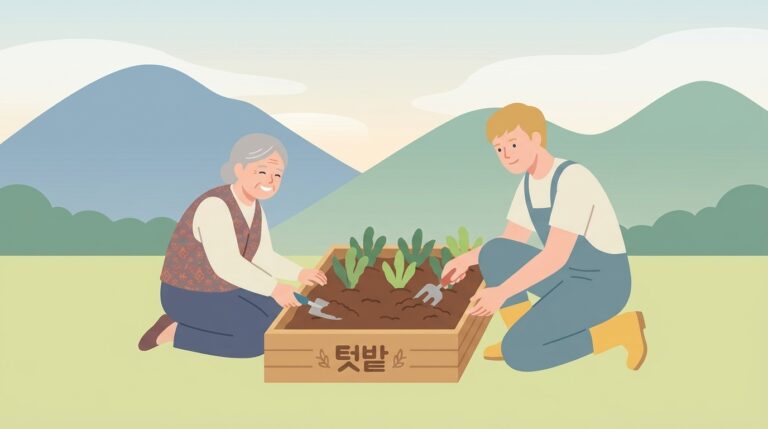
안녕하세요! Welcome back to another premium edition of Daily Hangul, where we bridge the gap between intermediate fluency and advanced cultural mastery. I’m your chief editor and resident plant-lover, here to guide you through a side of Korea that K-dramas rarely show but locals hold sacred: the deeply therapeutic, tactile world of 텃밭 (teotbat – backyard gardens), 퇴비 (toebi – compost), and soil management.
Imagine this: You’re watching the critically acclaimed movie Little Forest (리틀 포레스트), starring Kim Tae-ri. In one serene scene, she kneels in her childhood garden, sifting through dark, rich, crumbly earth. She doesn’t just call it “dirt” (흙); she treats it like a living, breathing entity. In Korea, where mountains cover 70% of the terrain, arable land is a precious gift. Soil care isn’t just a weekend hobby—it’s an ancient covenant between humans and nature.
If you’ve ever wanted to talk about sustainability, regenerative agriculture, or just share your backyard gardening journey with Korean friends without sounding like a dry academic textbook, this guide is for you. Today, we’re leveling up your C1-level Korean by exploring the rich metaphors of the earth.
Phase 2: Deep Dive into 3 Core Soil & Compost Expressions
To speak like a true native green-thumb, you must move beyond the basic “비료 (biryo – fertilizer)”. Let’s master three highly nuanced, advanced expressions.
1. 흙을 살리다 (Heulgeul sallida)
- Pronunciation: [heul-geul sal-li-da] / Sound-alike guide: “Heul-geul” flows together smoothly like ‘heel’ followed by ‘gool’, and “sal-li-da” sounds like ‘sal-lee-dah’ with a light, rolling ‘l’.
- Meaning: Literally “to bring the soil back to life”; used to describe regenerative soil management, organic composting, and restoring natural vitality to depleted earth.
- K-Culture Moment: You will hear this constantly in healing K-Dramas set in rural areas (like Hometown Cha-Cha-Cha or Our Blues). An elderly village mentor looks at a modern, chemical-laden plot of land and sighs, wanting to restore it to its natural, chemical-free state.
- Editor’s Insight: This phrase showcases the Korean animistic perspective on nature. We don’t just “fertilize” soil; we sal-li-da (save/revive) it. It implies that the soil has a soul and can grow tired or sick.
- Situation Spectrum:
- Casual: ✅
- Semi-formal: ✅
- Formal: ✅
- 🤔 Think About It: How does viewing soil as something to “revive” (살리다) rather than “exploit” change your gardening practice? In your language, do you use active verbs of saving/reviving for inanimate nature?
2. 거름을 주다 (Georeumeul juda)
- Pronunciation: [geo-reu-meul ju-da] / Sound-alike guide: ‘Geo’ sounds like the ‘g’ in ‘gorgon’, ‘reum’ rhymes with ‘zoom’, and ‘juda’ is ‘joo-dah’.
- Meaning: Literally “to feed compost/manure.” Metaphorically, it means to lay the groundwork, invest quietly, or nurture a project or relationship with patience.
- K-Culture Moment: In family dramas, a grandmother might look at her grandchild studying hard and say, “지금 공부하는 게 다 네 인생에 거름을 주는 시간이다” (Your studying now is the time of feeding compost/enriching your life).
- Editor’s Insight: While “비료” (chemical fertilizer) feels artificial, “거름” (organic compost/manure) represents slow, natural, and hard-earned nourishment. Giving “거름” means investing for the long-term harvest.
- Situation Spectrum:
- Casual: ✅
- Semi-formal: ✅
- Formal: ⚠️ (In highly formal reports, “퇴비를 시용하다” is preferred, but “거름을 주다” is widely loved in business speeches to emphasize nurturing).
- 🤔 Think About It: Koreans love organic metaphors for self-development. What has been the “거름” (compost/enrichment) of your career or language-learning journey?
3. 지력을 돋우다 (Jireogeul doduda)
- Pronunciation: [ji-ryeo-geul do-du-da] / Sound-alike guide: ‘Ji-ryeok’ starts with a soft ‘j’, ‘gool’ blends at the end, and ‘do-du-da’ sounds like ‘doh-doo-dah’.
- Meaning: To boost the natural fertility/strength of the land. Metaphorically used to describe building up one’s inner strength, stamina, or intellectual foundation.
- K-Culture Moment: Used by seasoned farmers talking about crop rotation or leaving fields fallow, and frequently borrowed by lifestyle columnists discussing mental health and taking a hiatus to “recharge your batteries.”
- Editor’s Insight: “지력” (地力) translates to “Earth Power.” It is the inherent capacity of the soil to sustain life. Raising this power requires rest and organic matter, not quick-fix chemicals.
- Situation Spectrum:
- Casual: ⚠️ (A bit literary)
- Semi-formal: ✅
- Formal: ✅
- 🤔 Think About It: In our fast-paced global culture, we often force ourselves to produce constantly. Why is the concept of “지력” (the soil’s resting and strengthening phase) so essential for long-term human productivity?
Phase 3: Textbook Korean vs. Real Korean
Let’s look at how textbooks make you sound like an instruction manual, and how real gardeners actually speak!
Situation 1: Pointing out that a garden’s soil is too hard and dry
- 📖 Textbook Korean: “이 토양은 유기물이 부족하여 매우 척박합니다.” (This soil lacks organic matter and is very barren.)
- 🗣️ Real Korean: “땅이 완전히 굳어서 힘이 다 빠졌네요. 거름 좀 넉넉히 섞어줘야겠어요.” (The ground is completely hardened and drained of its strength. We should mix in plenty of compost.)
- 💡 Why the difference? Textbooks rely on Hanja-heavy words like “유기물” (organic matter) and “척박” (barren). Real Korean gardeners treat the ground (“땅”) like a living teammate that is “tired” or “drained of strength” (힘이 빠지다).
Situation 2: Encouraging someone to rest after working hard on a project
- 📖 Textbook Korean: “지적 능력을 향상시키기 위해 휴식을 취하십시오.” (Please take a rest to improve your intellectual capacity.)
- 🗣️ Real Korean: “너무 달리기만 하면 지쳐요. 가끔은 쉬면서 지력을 돋워야죠.” (If you only run, you’ll burn out. Sometimes you need to rest and build up your inner fertility/strength.)
- 💡 Why the difference? Native speakers naturally extend agrarian metaphors to daily life. Describing rest as “building up the soil’s strength” (지력을 돋우다) sounds incredibly sophisticated, caring, and deep.
Phase 4: K-Culture Deep Dive & Non-verbal Manners
4-1. The Physicality of Korean Gardening: 쪼그려 앉기 (The Asian Squat)
If you go to a rural Korean garden, you will see a fascinating sight: seasoned grandmothers squatting perfectly flat-footed for hours, weeding and mixing compost. This is 쪼그려 앉기 (jjoguryeo anggi). To survive this, Koreans developed a genius invention: 쪼그리 (jjoguri), a tiny, donut-shaped cushion with straps that you buckle around your waist so you can sit down anywhere in the dirt.
* Body Language Tip: When working with someone elder in a garden, never stand tall leaning on your shovel while they are squatting. Lower your posture to match theirs; it is a subconscious sign of shared labor and deep respect.
4-2. The Healing Power of “텃밭” (Teotbat)
In modern Korea, despite the hyper-urbanization of Seoul, there is a massive cultural trend called 주말농장 (jumal nongjang – weekend farming). Young city dwellers rent tiny plots of land on the outskirts of Seoul to make organic compost from coffee grounds and grow their own lettuce (상추) for weekend BBQ parties. Sharing your home-composted, homegrown crops with neighbors is the ultimate expression of 정 (jeong – collective affection).
Phase 5: Live Roleplay — “The Soil Doctor of Yangpyeong”
Setting: You are visiting an organic farm in Yangpyeong (a beautiful riverside county near Seoul). You are talking with Mr. Han (한 아저씨), a warm but stern 60-year-old organic farming veteran who is passionate about natural compost.
- 한 아저씨: (🎭 Kneeling down, picking up a handful of dry, pale gray dirt) “에휴, 서울에서 온 친구들이 가꾸는 땅이라 그런가… 땅이 다 죽었네, 죽었어.”
- (Ehyu, Seoul-eseo on chingudeul-i gakku-neun ttang-ira georeon-ga… ttang-i da jugeonne, jugeot-seor.)
- (Sigh, is it because city folks have been managing this? The soil is completely dead, dead.)
-
You: (🎭 Looking closely, nodding with concern) “아저씨, 정말 그렇네요. 흙에 생기가 전혀 없어요. 어떻게 하면 이 흙을 다시 살릴 수 있을까요?”
- (Ajeossi, jeongmal geureon-ne-yo. Heul-ge saeng-gi-ga jeonhyeo eop-seo-yo. Eotteoke hamyeon i heul-geul dasi sallil su isseul-kka-yo?)
-
(You’re right, sir. The soil has no vitality at all. How can we bring this soil back to life?)
-
한 아저씨: (🎭 Smiling slightly at your genuine interest) “오호, ‘흙을 살린다’는 표현을 아네? 기특해라! 일단 저기 모퉁이에 있는 겨랑 낙엽 썩힌 것 좀 가져와 봐요.”
- (Oho, ‘heul-geul sallinda’neun pyohyeon-eul ane? Giteuk-haera! Ildan jeogi motung-e-e inneun gyeora nagyeop sseok-hin geot jom gajyeowa bwayo.)
-
(Oho, you know the phrase ‘revive the soil’? How admirable! First, bring over that mixture of rice husks and decayed leaves in the corner.)
-
You: (🎭 Walking over to pick up the bucket of dark, earthy-smelling organic compost) “아, 이게 바로 아저씨가 만드신 천연 거름이군요! 냄새가 아주 구수해요.”
- (Ah, ige baro ajeossi-ga mandeusin cheon-yeon georeum-i-gun-yo! Naemsae-ga aju gusuhayo.)
-
(Ah, this must be the natural compost you made! The smell is surprisingly earthy and rich.)
-
한 아저씨: (🎭 Laughing out loud, clapping your back) “구수하다고? 하하! 거름 냄새를 즐길 줄 알다니, 자네 진짜 농부 체질이구먼! 맞아, 이게 땅의 지력을 돋우는 비법이야.”
- (Gusuhadago? Haha! Georeum naemsae-reul jeolgil jul aldani, jane jinjja nongbu chejil-i-gumeon! Maja, ige ttang-ui jireogeul doduneun bibeop-iya.)
-
(Rich and earthy? Haha! Knowing how to appreciate the smell of compost—you’re a natural-born farmer! Exactly, this is the secret to boosting the soil’s natural strength.)
-
You: “화학 비료를 주면 금방 자랄 텐데, 왜 굳이 고생해서 이렇게 거름을 만드시는 거예요?”
- (Hwahak biryo-reul jumyeon geumbang jaral tende, wae guji gosaeng-haeseo ireoke georeumeul mandeusineun geo-ye-yo?)
-
(Using chemical fertilizers would make them grow faster, so why do you go through the trouble of making compost like this?)
-
한 아저씨: (🎭 Wiping sweat from his brow, speaking with serious pride) “화학 비료는 땅의 진액을 짜내는 거야. 잠깐은 잘 자라지. 하지만 결국 땅이 사막처럼 변해버려. 진짜 농사는 다음 세대까지 생각해서 흙을 살리는 법을 배워야 해.”
- (Hwahak biryo-neun ttang-ui jinaeg-eul jjanae-neun geoya. Jamkkan-eun jal jaraji. Hajiman gyeolguk ttang-i samak-cheoreom byeonhaebeoryeo. Jinjja nongsa-neun da-eum sedae-kkaji saenggak-haeseo heul-geul sallineun beobeul baewoya hae.)
- (Chemical fertilizers squeeze out the very essence of the soil. It grows well for a short while, but eventually, the land turns into a desert. True farming requires learning how to revive the soil, thinking of the next generation.)
🔀 Decision Point: What do you say next?
- Choice A: “맞아요, 사람도 인스턴트만 먹으면 겉만 번지르르하고 속은 골병드는 것과 같네요.” (Exactly, it’s just like how humans look fine on the outside but rot inside if they only eat instant food.)
- Choice B: “와, 너무 감동적인 이야기네요. 혹시 제 유튜브 채널에 출연해서 인터뷰 좀 해 주실 수 있나요?” (Wow, what an inspiring story. By the way, could you appear on my YouTube channel for an interview?)
- Choice C: “화학 비료가 훨씬 과학적이고 효율적인데 고집을 부리시는 것 같습니다.” (It seems like you are being stubborn when chemical fertilizers are much more scientific and efficient.)
💡 Choices Analysis:
- Best Choice: A — This beautifully links the farmer’s agricultural philosophy with a human health metaphor. It shows C1-level mastery of conversational empathy and uses native-level idioms like “겉만 번지르르하다” (shiny only on the outside) and “골병들다” (ruined on the inside).
- Risky Choice: B — While friendly, it breaks the organic connection of the moment to pivot to social media promotion, which elder Korean farmers might find slightly transactional or shallow.
- Bad Choice: C — Extremely confrontational and dismissive of the local veteran’s life-long wisdom. You will lose the farmer’s favor instantly!
Phase 6: 10-Second Emotion Shadowing Drill
Let’s practice speaking with real soul and emotion. Pause briefly at the slashes (/).
- [😊 Deeply admiring and inspired]
- “흙이 살아야 / 채소도 / 진짜 건강하게 자라는군요!”
- [Heul-gi saraya / chaeso-do / jinjja geon-gang-hage jara-neun-gunyo!]
- (The soil must be alive / for the vegetables / to grow truly healthy!)
- [😌 Playful and unbothered by the smell]
- “거름 냄새가 / 좀 독해도, / 이게 다 땅한테는 / 보약이잖아요!”
- [Georeum naemsae-ga / jom dok-haedo, / ige da ttang-hante-neun / boyag-i-janayo!]
- (Even if the compost smell / is a bit strong, / this is a herbal restorative / for the earth!)
Phase 7: K-Culture Mini Dictionary
- 1. 겨 (Gye): Rice husks. A staple ingredient in traditional Korean composting. It locks in moisture and introduces natural microbes to the soil.
- 2. 깻묵 (Kkaetmuk): Sesame oil press cake. After pressing sesame seeds for delicious sesame oil, the solid residues are used as a nitrogen-rich, premium organic fertilizer.
- 3. 부엽토 (Buyeopto): Leaf mold/humus found deep in Korean mountain forests. Gardeners collect this to introduce wild, native beneficial microbes into their home compost piles.
- 4. 친환경 (Chinhwangyeong): Eco-friendly / Pro-environment. You will see this prefix everywhere in Korean supermarkets (e.g., 친환경 채소), indicating crops grown without synthetic chemical fertilizers or pesticides.
Phase 8: Traveler’s Survival Kit (For Eco-Travelers)
Are you planning to volunteer on a Korean farm, visit an organic orchard, or join a countryside homestay (삼시세끼 – Three Meals a Day experience)? Memorize these three emergency lines!
| Korean | Romanization | English | Pro Tip |
|---|---|---|---|
| 장갑이랑 밭일 장화 좀 빌릴 수 있을까요? | Janggap-irang bat-il janghwa jom billil su isseul-kka-yo? | Can I borrow gloves and farm boots? | Essential! Korean clay soil is incredibly sticky and will ruin regular sneakers. |
| 이거 직접 만드신 퇴비예요? | Igeo jikjeop mandesin toebi-ye-yo? | Is this compost made by yourself? | This question immediately warms up any farmer’s heart. They love talking about their compost recipes! |
| 오늘 할 일은 어디서부터 시작하면 될까요? | Oneul hal il-eun eodiseobuteo sijak-hamyeon doelkka-yo? | Where should I start today’s work? | Shows initiative and eagerness to help out. |
📌 Editor’s Travel Note: If you want to locate certified eco-farms or weekend gardens near you, use the Naver Map App Webpage and search for “주말농장” (Weekend Farms) or “유기농 체험” (Organic Farming Experience). Google Maps is famously inaccurate for rural Korea, so Naver Map is your true survival tool.
Phase 9: Deep Reflection — “Jeong” (정) in the Soil
In Western gardening, soil is often managed through precise scientific calculations—measuring N-P-K (Nitrogen, Phosphorus, Potassium) ratios down to the milligram. While Korean farming incorporates modern science, there is still a pervasive philosophical belief in 정 (jeong – emotional attachment/affection) applied to land.
Old farmers believe that “식물은 주인의 발자국 소리를 듣고 자란다” (Crops grow by listening to the sound of their owner’s footsteps). This means regular, loving physical presence is more powerful than any automated watering system. When we feed our soil compost made from our own kitchen waste (like rice-wash water and sesame hulls), we are completing a local, emotional cycle of consumption and return. It’s a masterclass in living sustainably, where nothing is wasted, and everything is given time to break down, ferment, and rise again.
💬 Your Turn: How does your home country treat composting? Is it seen as a scientific chore, or is there a cultural philosophy of giving back to the earth? Let’s talk in the comments below!
Phase 10: FAQ & Common Mistakes
Q: Can I use “똥” (ttong – poop) casually when talking about manure/compost?
A: No, please avoid this! While manure is technically animal feces, using “똥” in a gardening conversation sounds very crude and childish. Always use “거름” (georeum) or “퇴비” (toebi). The only exception is if a farmer makes a joke about “닭똥 거름” (chicken manure compost), but as a learner, stick to the professional and polite words.
Q: What is the difference between 비료 (biryo) and 퇴비 (toebi)?
A: “비료” refers generally to fast-acting chemical/synthetic fertilizers. “퇴비” specifically refers to fermented, decayed organic compost (leaves, husks, manure). Mixing them up might make an organic farmer think you are using harsh chemicals on their pristine soil!
Q: Is it okay to collect dry leaves from public parks in Korea to make my own compost?
A: Generally, no. Gathering forest floor resources or public park materials in large quantities is restricted. It’s better to buy affordable, certified organic “퇴비” at local agricultural co-op stores called 농협 하나로마트 (Nonghyup Hanaro Mart).
🚨 Common Mistakes Alert!
- Mistake: Saying “흙이 더러워요” (Heul-gi deoreo-wo-yo – The dirt is dirty).
- Why it’s wrong: “더럽다” implies filth or pollution. Soil isn’t filthy; it’s natural!
- Correct Action: Say “흙이 묻었어요” (Heul-gi mudeot-seo-yo – Earth got on me).
- Mistake: Using “비료를 살포하다” in casual conversation.
- Why it’s wrong: Too clinical. Sounds like a government agricultural aircraft spraying chemicals.
- Correct Action: Say “거름을 주다” or “퇴비를 섞다”.
- Mistake: Underestimating the power of fermented rice water (쌀뜨물).
- Why it’s wrong: Throwing away rice rinse water down the sink.
- Correct Action: In Korea, fermenting rice water with EM (Effective Microorganisms) is a legendary soil activator. Pour it on your plants instead!
Phase 11: Action Missions
- 🥉 Bronze (The Mirror Challenge): Record yourself saying “지력을 돋우다” three times with your eyes closed, focusing on the rolling connection of the letters. Feel the earth power!
- 🥈 Silver (The Community Challenge): Go to your favorite social media platform and write a post about your favorite plant or garden progress using the hashtag
#DailyHanguland the phrase흙을 살리는 중(Currently reviving the soil!). - 🥇 Gold (The Reality Challenge): Go to an organic market or a local Korean mart, find the “친환경” (eco-friendly) section, and ask the vendor: “이거 친환경 거름으로만 기르신 거예요?” (Was this grown using only organic compost?).
- 🎮 K-Culture Mission: Watch the movie Little Forest (Korean version) and spot the scene where they prepare the soil for winter. Note down what materials they mix into the earth!
Phase 12: Interactive Quiz Challenge
Check your understanding of Korean soil culture with this quick quiz!
1. Situational judgment: You want to praise a Korean friend’s gorgeous, organic garden. Which sentence sounds most natural and appreciative?
- A) “비료 화학 물질이 아주 훌륭하네요.”
- B) “거름을 잘 주셔서 그런지 땅에 힘이 아주 넘치네요!”
- C) “흙의 분리배출이 잘 되었습니다.”
Reveal Answer & Explanation
Correct Answer: B!
Saying “Since you composted well, the soil is bursting with energy!” perfectly captures the native sentiment of earth being alive and powerful. A is weirdly chemical-focused, and C makes no sense (분리배출 means waste sorting!).
2. Fill in the blank: Before planting next season’s potatoes, we need to let the land rest to _______ (raise/boost the soil’s natural strength).
- “다음 농사를 위해서 잠시 땅을 쉬게 하며 지력을 (_______).”
Reveal Answer & Explanation
Correct Answer: 돋워야 해요 (or 돋우어야 합니다)
“지력을 돋우다” is the perfect combination for boosting the soil’s natural carrying capacity.
3. True or False: Traditional Korean compost often uses residues from making sesame oil (깻묵).
- True or False?
Reveal Answer & Explanation
Correct Answer: True!
“깻묵” (Sesame oil press cake) is a legendary, high-nitrogen organic nutrient loved by Korean traditional gardeners for generations.
Thank you for digging deep with Daily Hangul today! Keep nurturing your Korean language journey like a precious garden—slowly, organically, and with plenty of heart. 다음에 또 만나요! (See you next time!)







