

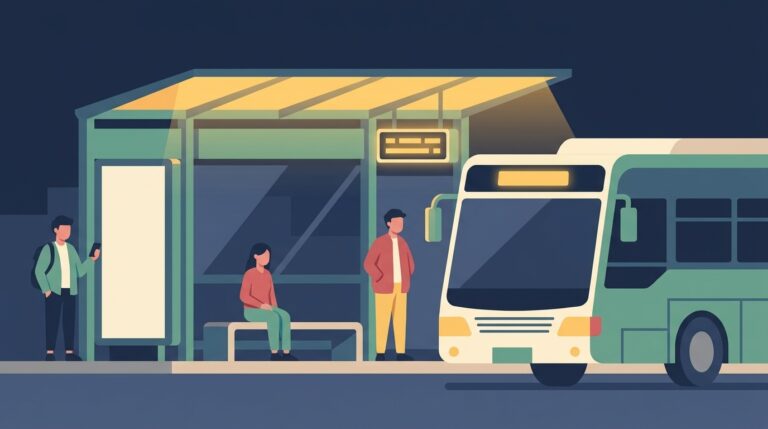
Don’t Get Lost in Seoul! How to Find a Bus Stop in Korean Like a Local
안녕하세요! (An-nyeong-ha-se-yo! – Hello!) It’s your favorite premium Korean tutor and local navigator from Daily Hangul.
Imagine this: You’ve just walked out of a cozy café in Hongdae after enjoying a warm plate of spicy tteokbokki. The night is cool, the streetlights are glowing, and you want to catch a bus back to your hotel—just like your favorite characters do in romantic K-Dramas. But as you look around, Google Maps is spinning, the streets are winding, and you can’t spot the bus stop.
Don’t panic! Finding your way in Korea is incredibly easy once you know a few magic words. Today, we’re going to learn how to ask for a bus stop in simple, A1-level Korean that will make locals smile and eagerly point you in the right direction. Let’s get you on that bus!
Phase 2: Three Magical Bus Stop Phrases
Here are the top three simple phrases you need to survive and thrive on Seoul’s streets.
1. 버스 정류장이 어디예요? (Beo-seu jeong-ryu-jang-i eo-di-ye-yo?)
- Pronunciation Guide: Bus-uh jung-ryu-jang-ee uh-dee-yeh-yo? (Sounds like: “Bus-o” + “jung-ryu-jang” + “where is it?”)
- Meaning: Where is the bus stop?
- K-Culture Moment: This is the ultimate survival line. If you get lost near a subway station or a busy market, just ask any passing local this question, and they’ll happily point you to the nearest shelter.
- Editor’s Insight: “정류장” (jeong-ryu-jang) means stop or station. Pronouncing it smoothly can be tricky for beginners. Try saying “jung-ryu” quickly as one block!
- Situation Spectrum:
- Casual (Friends): ⚠️ (A bit too polite, but okay)
- Semi-formal (Public/Strangers): ✅ (Perfect! Polite and safe)
- Formal (Business/Elderly): ✅ (Very respectful)
- 🤔 Think About It: Unlike English, which often requires “Excuse me, could you tell me…”, Korean gets straight to the point while staying extremely polite just by adding “~요” (~yo) at the end. Isn’t it wonderful how efficiency and politeness live together in one word?
2. 저기요, 명동 가는 버스 어디서 타요? (Jeo-gi-yo, Myeong-dong ga-neun beo-seu eo-di-seo ta-yo?)
- Pronunciation Guide: Jeo-gee-yo, Myeong-dong gah-neun beo-seu uh-dee-suh tah-yo?
- Meaning: Excuse me, where do I take the bus to Myeongdong?
- K-Culture Moment: You will hear “저기요” (Jeo-gi-yo / Excuse me) in almost every K-Drama episode—whether someone is calling a waiter or catching someone’s attention on the street.
- Editor’s Insight: Always start with “저기요” (Jeo-gi-yo) to politely grab attention. It literally means “Over there!” but functions as a friendly “Excuse me!”
- Situation Spectrum:
- Casual: ⚠️
- Semi-formal: ✅ (Excellent for asking strangers)
- Formal: ✅
3. 여기서 몇 번 버스 타야 돼요? (Yeo-gi-seo myeot beon beo-seu ta-ya dwae-yo?)
- Pronunciation Guide: Yuh-gee-suh myut bun beo-seu tah-yah dwae-yo?
- Meaning: Which bus number should I take from here?
- K-Culture Moment: Seoul buses are color-coded (Blue for main roads, Green for local neighborhoods, Red for express routes). This phrase helps you double-check that you aren’t hopping on the wrong color!
- Editor’s Insight: “몇 번” (myeot beon) means “which number.” This is super useful because Korean bus lines are identified by numbers.
- Situation Spectrum:
- Casual: ⚠️
- Semi-formal: ✅
- Formal: ✅
Phase 3: Textbook Korean vs. Real-World Korean
Let’s look at how textbooks teach you, versus how real Koreans actually talk on the streets.
Scenario 1: Asking for the location of the bus stop
- 📖 Textbook Korean: “버스 정류장이 어디에 위치하고 있습니까?” (Where is the bus stop situated?) – Too robotic! Nobody talks like an encyclopedia on the street.
- 🗣️ Real Korean: “버스 정류장 어디예요?” (Bus stop, where is it?) – Short, natural, and instantly understood.
- 💡 Why is it different? Koreans value speed and efficiency (the famous “Pbali-Pbali” culture). Dropping unnecessary particles makes your Korean sound much more native and relaxed.
Scenario 2: Asking if a bus goes to a landmark
- 📖 Textbook Korean: “이 버스는 남산타워로 운행합니까?” (Does this bus operate to Namsan Tower?) – Sounds like a legal contract!
- 🗣️ Real Korean: “이거 남산타워 가요?” (Does this go to Namsan Tower?) – Simple and friendly.
- 💡 Why is it different? In daily life, pointing to a bus and saying “이거… 가요?” (Does this… go?) is polite enough and highly practical.
Phase 4: K-Culture Deep Dive & Non-verbal Manners
4-1. Nunchi (눈치) & Body Language at the Bus Stop
In Korea, “눈치” (Nunchi – situational quick-wittedness) is key. When you are waiting at a bus stop, Korean bus drivers move quickly.
* The Wave: If you see your bus approaching, step slightly closer to the curb and make eye contact with the driver. A subtle nod or holding your transport card in your hand shows you are ready to board. If you stand far back looking at your phone, the bus might pass by!
* The Queue: Line up behind others naturally. Cutting in line is a big social no-no.
4-2. High-Tech Bus Stops (Smart Shelters)
If you travel to Seoul, you’ll experience “Smart Bus Shelters.” During freezing winters, the benches are heated (온열 의자 – on-yeol ui-ja)! In the summer, they blast cool air curtains. Don’t be afraid to sit down; the benches are warm and welcoming!
Phase 5: Interactive Roleplay — Finding the Stop in Hongdae
Setting: It is 9:00 PM in Hongdae. Light rain is falling. You are standing near exit 9 of Hongdae Station, trying to find the bus stop to go to Han River Park. You see Minji, a friendly-looking local holding a yellow umbrella.
Cast:
* You (Lost Traveler)
* Minji (Friendly local)
- Turn 1 (You): 저기요… 혹시 도와주실 수 있나요?
(Jeo-gi-yo… hok-si do-wa-ju-sil su in-na-yo?)
(🎭 Stage Direction: You approach politely with a warm, slightly embarrassed smile.)
“Excuse me… could you perhaps help me?” -
Turn 2 (Minji): 아, 네! 무슨 일 있으세요?
(Ah, ne! Mu-seun il is-seu-se-yo?)
(🎭 Stage Direction: Minji turns around warmly and steps closer to share her umbrella.)
“Oh, yes! Is something wrong?” -
Turn 3 (You): 버스 정류장이 어디예요? 한강공원에 가고 싶어요.
(Beo-seu jeong-ryu-jang-i eo-di-ye-yo? Han-gang-gong-won-e ga-go sip-eo-yo.)
(🎭 Stage Direction: You point to your map on your phone.)
“Where is the bus stop? I want to go to Han River Park.” -
Turn 4 (Minji): 아! 한강공원이요? 여기서 가깝고 쉬워요.
(Ah! Han-gang-gong-won-i-yo? Yeo-gi-seo ga-kkap-go swi-wo-yo.)
(🎭 Stage Direction: She smiles reassuringly.)
“Oh! Han River Park? It’s close and easy from here.” -
Turn 5 (You): 정말요? 여기서 몇 번 버스 타야 돼요?
(Jeong-mal-yo? Yeo-gi-seo myeot beon beo-seu ta-ya dwae-yo?)
(🎭 Stage Direction: Your eyes light up with hope.)
“Really? Which bus number should I take from here?” -
Turn 6 (Minji): 저기 신호등 건너편에서 730번 버스 타세요.
(Jeo-gi sin-ho-deung geon-neo-pyeon-e-seo chil-baek-sam-sip-beon beo-seu ta-se-yo.)
(🎭 Stage Direction: She points across the street to a glowing blue sign.)
“Take bus number 730 over there, across the crosswalk.” -
Turn 7 (You): 아, 저기 건너편이요? 감사합니다!
(Ah, jeo-gi geon-neo-pyeon-i-yo? Gam-sa-ham-ni-da!)
(🎭 Stage Direction: You bow slightly in gratitude.)
“Ah, across the street over there? Thank you!” -
Turn 8 (Minji): 네, 맞아요! 버스 오면 카드 꼭 찍고 타세요.
(Ne, ma-ja-yo! Beo-seu o-myeon ka-deu kkok jjik-go ta-se-yo.)
(🎭 Stage Direction: She mimics tapping a transit card.)
“Yes, correct! When the bus comes, make sure to tag your card!” -
Turn 9 (You): 네! 내릴 때도 찍어야 하죠?
(Ne! Nae-ril ttae-do jjik-eoya ha-jyo?)
“Yes! I need to tag it when getting off too, right?” -
Turn 10 (Minji): 맞아요, 그래야 환승 할인 돼요. 잘 다녀오세요!
(Ma-ja-yo, geu-rae-ya hwan-seung hal-in dwae-yo. Jal da-nyeo-o-se-yo!)
(🎭 Stage Direction: She waves happily.)
“That’s right, that’s how you get the transfer discount. Have a great trip!”
🔀 Decision Point: What would you say to Minji now?
- Choice A: “안녕!” (An-nyeong!)
- Choice B: “너무 감사합니다! 좋은 하루 보내세요!” (Neo-mu gam-sa-ham-ni-da! Jo-eun ha-ru bo-nae-se-yo!)
- Choice C: “귀찮게 해서 미안해요.” (Gwi-chan-ke hae-seo mi-an-hae-yo.)
🏆 Best Choice: Choice B
“너무 감사합니다! 좋은 하루 보내세요!” (Thank you so much! Have a nice day!) is extremely polite and warm. Using “존댓말” (honorific language) with a stranger who helped you leaves an amazing impression!
🚫 Risk Choice: Choice A
“안녕!” is casual/informal language (반말 – banmal). Even though Minji was friendly, saying “안녕” to a stranger can sound rude. Save this for close friends!
Phase 6: 10-Second Emotion Shadowing Drill
Let’s practice speaking with real Korean emotion! Pause briefly at the slashes (/).
- [🥺 Lost and asking politely]
저기요… / 버스 정류장이 / 어디예요?
(Jeo-gi-yo… / beo-seu jeong-ryu-jang-i / eo-di-ye-yo?) -
[😊 Relieved and thankful]
아! / 저기군요! / 감사합니다!
(Ah! / Jeo-gi-gun-yo! / Gam-sa-ham-ni-da!) -
[🙋♀️ Double-checking in a hurry]
이거 / 명동 / 가요?
(I-geo / Myeong-dong / ga-yo?)
Phase 7: K-Culture Mini-Dictionary
- 버스 정류장 (Beoseu jeongryujang) – Bus Stop
The physical location where buses stop. Look for the modern glass shelters with digital screens displaying real-time arrival info. - 교통카드 (Gyotong-kadeu) – Transportation Card
Cards like T-Money. You can buy and charge these at any convenience store. Essential for all public transit in Korea. - 환승 (Hwan-seung) – Transfer
The magical system where transferring between buses or subway lines within 30 minutes is absolutely free (or highly discounted)! - 정류소 안내판 (Jeongryuso annaepan) – Bus Arrival Screen
The digital board at bus stops telling you exactly how many minutes are left until your bus arrives.
Phase 8: Traveler’s Survival Kit
Top 3 Quick Phrases for Your Pocket
- 티머니 카드 충전해 주세요. (T-money ka-deu chung-jeon-hae ju-se-yo.)
👉 “Please recharge my T-money card.” (Use this at any convenience store!) - 여기 내려요! (Yeo-gi nae-ryeo-yo!)
👉 “I’m getting off here!” (Use this if the bus driver accidentally starts closing the door before you can step off). - 반대편에서 타야 돼요? (Ban-dae-pyeon-e-seo ta-ya dwae-yo?)
👉 “Do I need to take it from the opposite side?”
📌 Editor’s Travel Note: Make sure to download the Naver Map App or KakaoMap App before you arrive. Google Maps is often restricted or inaccurate for walking and transit routes in South Korea due to national security laws. Always tap your transportation card both when boarding and when exiting the bus to secure your 환승 (transfer) discount!
Phase 9: Deep Reflection — “One Step Deeper”
In western cultures, boarding a bus can be a slow, conversational process where you greet the driver and leisurely find a seat. In Korea, however, you will notice the process is extremely fast. People tap, move in quickly, and hold onto handles immediately. This stems from Korea’s post-war economic miracle era, where speed was associated with survival and progress. While it might feel intimidating at first, it is actually a display of collective consideration—not delaying the journey for the dozens of other passengers behind you.
💬 Your Turn: How does taking a bus in your hometown compare to Korea? Do people tap off? Tell us in the comments!
Phase 10: FAQ & Common Mistakes
Q: Can I pay with cash on Korean buses?
A: No, mostly. Major cities like Seoul are transitioning to completely cashless buses. It is highly recommended to purchase a 교통카드 (T-money card) at the airport or any convenience store as soon as you arrive.
Q: Do I really need to tap my card when getting off?
A: Yes! If you forget to tap off, you will be charged a penalty fare on your next ride, and you will lose any transfer discounts.
Q: What do the bus colors mean?
A: Blue buses connect distant districts along main roads. Green buses are local branch buses feeding into subways. Red buses are express buses going out to the suburbs.
🚨 Common Mistake Alert!
- Mistake 1: Waiting far away from the curb. The driver might think no one is boarding and bypass the stop. Stand visible!
- Mistake 2: Entering through the back door. Always enter through the front door and exit through the middle/back door.
Phase 11: Action Mission
- 🥉 Bronze (Home Mission): Practice saying “버스 정류장이 어디예요?” in front of a mirror three times with a friendly smile!
- 🥈 Silver (Social Mission): Take a screenshot of a Korean bus stop on Google Street View or a K-drama, and post it on your social media with the caption: “버스 정류장!”
- 🥇 Gold (Real Mission): Next time you are in Korea or a Koreatown, ask a native speaker: “저기요, 혹시 버스 정류장 어디예요?”
Phase 12: Interactive Quiz Challenge
1. Which phrase should you say to find a bus stop?
- A) 이거 가요?
- B) 버스 정류장이 어디예요?
- C) 교통카드 주세요.
2. True or False: You should enter the Korean bus through the back door.
- (True / False)
🔍 Click here for the Answers & Explanations!
- Answer: B. “버스 정류장이 어디예요?” is the direct translation and natural way to ask “Where is the bus stop?”
- Answer: False. Always board through the front door and exit through the back door!
We hope this guide makes your next Korean adventure smoother and filled with confidence! See you at the bus stop! 안녕! (An-nyeong!)







