

The Art of Slow Travel: Mastering Jeonju Hanok Village Lodging and Foodie Culture
안녕하세요! Welcome back to another masterclass with Daily Hangul. I am your senior editor and cultural navigator. Over the last decade of traversing the Korean peninsula, I have watched countless advanced learners—who can easily read Hanja-laden newspapers—utterly freeze when confronted with the localized, sensory-rich vocabulary of a traditional Hanok (한옥) guesthouse or the hyper-specific dining jargon of Jeonju.
Today, we are moving past the sterile grammar of textbook dialogues. We are diving headfirst into the soul of Jeonju (전주)—Korea’s culinary capital and a sanctuary of preserved dynastic architecture. This guide is crafted specifically for you, the advanced (C2) speaker, to help you bridge the gap between technical fluency and authentic, visceral connection with local hosts and food artisans.
Phase 2: Core Expressions Deep-Dive
To truly appreciate Jeonju, you must master the sensory and spatial adjectives that locals use to describe comfort, taste, and atmosphere. Let’s dissect three essential expressions.
1. 뜨끈뜨끈하다 (tteu-keun-tteu-keun-ha-da)
- Pronunciation: [t͈ɯk͈ɯnt͈ɯk͈ɯnhada] / Sound Analogy: Imagine the double ‘t’ as a sharp, tense release of air, followed by a warm, rolling ‘k’. It sounds like the bubbling of a heavy stone pot.
- Meaning: Comfortingly, deeply warm (physically and emotionally).
- K-Culture Moment: In healing K-Dramas, you often see characters returning from a harsh winter day to lie flat on a varnished paper floor, sighing in relief. This is the magic of Ondol (온돌), Korea’s ancient underfloor heating system.
- Editor’s Insight: Do not confuse this with “뜨겁다” (tteu-geop-da / hot). Tteugeopda is purely physical and can sometimes carry a negative connotation of burning. Tteukeun-tteukeun-hada carries an emotional weight of restorative, therapeutic heat. It is the feeling of hot soup soothing your stomach or a heated floor melting away travel fatigue.
- Situation Spectrum:
- Casual: ✅
- Semi-formal: ✅
- Formal (to elders): ✅ (e.g., “방바닥이 아주 뜨끈뜨끈해서 좋습니다.”)
- 🤔 Think About It: Why does Korean have so many duplicate-syllable sensory words (의태어/의성어)? It reflects an animistic, felt-experience approach to language where the sound mimics the physical vibration of the sensation. How does your native language phonetically represent comforting warmth?
2. 입가심하다 (ip-ga-sim-ha-da)
- Pronunciation: [ip̚k͈aɕim-hada] / Sound Analogy: “Ip” (mouth) followed by “gah-shim” (rinsing/cleansing).
- Meaning: To cleanse the palate; to have a light snack or drink to wash down a heavy meal.
- K-Culture Moment: After devouring a massive basin of Jeonju Bibimbap (전주비빔밥), locals will rarely go straight to dessert. Instead, they look for traditional Mo-ju (모주, a sweet, low-alcohol warm herbal wine) or roasted rice water (Sungnyung / 숭늉) to ip-ga-sim.
- Editor’s Insight: While Westerners think of a “palate cleanser” as a sorbet in the middle of a multi-course meal, in Korea, ip-ga-sim occurs at the very end of a meal or between distinct culinary adventures. It is both a physical transition and a conversational bridge.
- Situation Spectrum:
- Casual: ✅
- Semi-formal: ✅
- Formal: ⚠️ (Slightly colloquial; in highly formal settings, use “입을 가시다” or “디저트를 들다”)
- 🤔 Think About It: The verb “가시다” means to wash away or fade. By using ip-ga-sim, are we physically cleansing the mouth, or are we showing respect to the next taste experience? It reveals the highly ritualized nature of Korean food sequences.
3. 정취에 젖다 (jeong-chwi-e jeot-da)
- Pronunciation: [tɕʌŋtɕʰɥie tɕʌt̚t͈a] / Sound Analogy: “Jeong-chwi” (poetic atmosphere) + “e” (in/at) + “jeot-da” (to get soaked).
- Meaning: To be thoroughly steeped or soaked in the poetic mood, charm, or ambiance of a place.
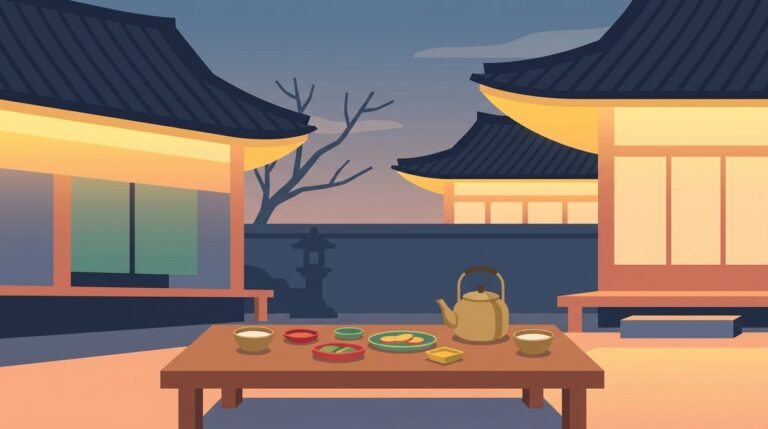
- K-Culture Moment: Walking through the winding alleys of Jeonju Hanok Village at twilight, when the soft yellow lights under the tiled eaves (giwa) begin to glow, and the smell of burning wood fills the air.
- Editor’s Insight: This is a highly sophisticated, literary expression. Instead of saying “분위기가 좋다” (The atmosphere is good), saying you are steeped in the jeong-chwi indicates a deep, emotional vulnerability to your surroundings. It is the ultimate compliment to a host’s property.
- Situation Spectrum:
- Casual: ⚠️ (Can sound overly poetic/dramatic in casual texting)
- Semi-formal: ✅
- Formal: ✅
- 🤔 Think About It: Water metaphors run deep in Korean emotions (e.g., 정(Jeong)이 넘치다 – affection overflows; 눈물에 젖다 – soaked in tears). Why do you think Korean culture conceptualizes emotional experiences as liquids that we soak in?
Phase 3: Textbook Korean vs. Real-World Korean
When booking a traditional Hanok or navigating Jeonju’s dense food alleys, standard textbook sentences can sound cold or clinically detached. Let’s look at how native speakers actually communicate.
Scenario 1: Discussing Traditional Floor Bedding
- 📖 Textbook Korean: “온돌방에서 자는 것은 조금 불편할 수 있습니다.” (Sleeping in an ondol room can be a bit uncomfortable.)
- 🗣️ Real Korean: “침대 생활만 하다가 뜨끈한 구들장에 몸 좀 지지고 싶어서 온돌방으로 했어요.” (I’m used to beds, but I really wanted to roast my body on a warm stone floor, so I chose the ondol room.)
- 💡 Why the difference? The verb 지시다 (ji-ji-da) literally means to griddle or sear, but colloquially, it refers to lying on a hot stone floor to soothe aching muscles and bones. It signals that you understand the therapeutic nature of Korean Hanok living, instantly charming your host.
Scenario 2: Expressing Food Coma / Gratitude after a Jeonju Feast
- 📖 Textbook Korean: “음식이 정말 맛있고 양이 매우 많습니다.” (The food is very delicious and the portion is huge.)
- 🗣️ Real Korean: “상다리가 부러지게 대접받고 갑니다. 정말 잘 먹었습니다.” (I am leaving after being treated to a meal that would break the table’s legs. I ate wonderfully.)
- 💡 Why the difference? 상다리가 부러지다 (Sang-da-ri-ga bu-reo-ji-da) is a classic Korean idiom for an incredibly bountiful feast. In Jeonju, where a single order of Makgeolli comes with twenty side dishes, this expression is the highest form of culinary appreciation.
Phase 4: K-Culture Deep-Dive & Non-Verbal Manners
4-1. Nunchi and Spatial Etiquette in a Hanok
Traditional Hanoks are masterfully crafted wooden structures without nails, meaning sound travels extremely well.
* The Threshold Rule (문지방): Never step on the wooden threshold (mun-ji-bang) of a Hanok door. Historically, the threshold was viewed as the boundary between the living and the ancestral spirits. Physically, stepping on it warps the wooden frame of these delicate, historic buildings.
* The Soft Footstep (발걸음 조심): Because Hanok floors are elevated wooden platforms (dae-cheong-maru), heavy stomping sounds like thunder to neighbors. Walk heel-to-toe with a soft glaze to your steps—a physical manifestation of nunchi (societal awareness).
4-2. The Jeonju Makgeolli Ritual
If you visit the famous Samcheon-dong Makgeolli Alley (삼천동 막걸리 골목), you must understand the “Kettle System.” You do not order individual dishes. Instead, you order a basic kettle (한 주전자) of Makgeolli. With every subsequent kettle you order, the host brings out a completely new wave of increasingly premium dishes (such as raw octopus, braised pork, or grilled fish) for free.
* The Pouring Etiquette: Always hold the brass kettle with two hands. When receiving, hold your small brass bowl with both hands, slightly bowing your head. To show true local integration, gently swirl the bowl to mix the sediment, and tap bowls together while maintaining eye contact with your companions.
Phase 5: Interactive Roleplay Scenario
Setting: Dusk at Gyeonggijeon Hanok Stay. The courtyard smells of damp earth and pine. The host, an elegant lady in her late 60s named Mrs. Min-gyeong, is sweeping the wooden porch.
Cast:
- Guest (You): An advanced traveler seeking the ultimate restorative stay.
- Mrs. Min-gyeong (Host): A warm but fastidious keeper of traditional Jeonju hospitality.
1. Mrs. Min-gyeong: (따뜻한 미소를 지으며) 어서 오세요. 멀리서 오시느라 고생 많으셨지요?
   [eoseo o-se-yo. meol-ri-seo o-si-neu-ra go-saeng man-eu-syeot-ji-yo?]
   (With a warm smile) Welcome. You must have had a long journey getting here.

2. Guest: (가방을 내려놓고 정중히 고개를 숙이며) 아닙니다, 사장님. 골목길 들어서면서 한옥의 정취에 벌써 정취에 젖어 피로가 싹 가시네요.
   [a-nim-ni-da, sa-jang-nim. gol-mok-gil deul-eo-seo-myeon-seo han-ok-ui jeong-chwi-e beol-seo jeong-chwi-e jeot-eo pi-ro-ga ssak ga-si-ne-yo.]
   (Putting bags down and bowing politely) Not at all, owner. Walking into the alleyway, I'm already so steeped in the charm of the Hanok that my fatigue has completely vanished.

3. Mrs. Min-gyeong: (안색이 밝아지며) 어머나, 한국어 표현이 아주 예쁘시네요. 오늘 방에 구들장 뜨끈뜨끈하게 올려놓았으니 푹 쉬시면 됩니다.
   [eo-meo-na, han-guk-eo pyo-hyeon-i a-ju ye-ppeu-si-ne-yo. o-neul bang-e gu-deul-jang tteu-keun-tteu-keun-ha-ge ol-ryeo-no-at-eu-ni puk swi-si-myeon doem-ni-da.]
   (Her face brightens) Oh my, your Korean is beautiful. I've heated up the stone floor to be nice and warm today, so you can rest comfortably.

4. Guest: (바닥을 짚어보며) 와, 정말 뜨끈한 게 제대로네요! 오늘 저녁은 근처 막걸리 골목에 가보려는데 추천해 주실 만한 곳이 있을까요?
   [wa, jeong-mal tteu-keun-han ge jae-dae-ro-ne-yo! o-neul jeon-yeok-eun geun-cheo mak-geol-ri gol-mok-e ga-bo-ryeo-neun-de chu-cheon-hae ju-sil man-han got-i is-seul-kka-yo?]
   (Feeling the floor) Wow, the warmth is absolutely perfect! I'm planning to head to the nearby Makgeolli Alley for dinner tonight. Do you have any recommendations?

5. Mrs. Min-gyeong: (손뼉을 치며) 역시 전주에 오면 막걸리지요! '용진집'이나 '옛촌막걸리'가 유명해요. 안주가 상다리가 부러지게 나올 겁니다.
   [yeok-si jeon-ju-e o-myeon mak-geol-ri-ji-yo! 'yong-jin-jip'-i-na 'yet-chon-mak-geol-ri'-ga yu-myeong-hae-yo. an-ju-ga sang-da-ri-ga bu-reo-ji-ge na-ol geom-ni-da.]
   (Clapping her hands) Ah, of course, Makgeolli is a must when in Jeonju! 'Yongjinjip' or 'Yetchon Makgeolli' are famous. The side dishes will come out so bountifully they'll break the table legs.

6. Guest: (웃으며) 듣기만 해도 군침이 도네요. 막걸리 마시고 돌아와서 이 방바닥에서 몸 지질 생각 하니까 벌써 설렙니다.
   [deut-gi-man hae-do gun-chim-i do-ne-yo. mak-geol-ri ma-si-go dol-a-wa-seo i bang-ba-dak-e-seo mom ji-jil saeng-gak ha-ni-kka beol-seo seol-rep-ni-da.]
   (Laughing) Just hearing about it makes my mouth water. Thinking about coming back after some Makgeolli to roast my body on this floor already has me excited.

7. Mrs. Min-gyeong: (흐뭇해하며) 전주 맛을 아시네! 혹시 아침식사는 어떻게 하실 건가요? 내일 아침에 해장하셔야지요?
   [jeon-ju mat-eul a-si-ne! hok-si a-chim-sik-sa-neun eo-tteoh-ge ha-sil geon-ga-yo? nae-il a-chim-e hae-jang-ha-syeo-ya-ji-yo?]
   (Proudly) You truly know the taste of Jeonju! By the way, what are your breakfast plans? You'll need to cure your hangover tomorrow morning, right?

8. Guest: (머리를 긁적이며) 네, 남부시장 현대옥에서 콩나물국밥으로 입가심할까 합니다.
   [ne, nam-bu-si-jang hyeon-dae-ok-e-seo kong-na-mul-guk-bap-eu-ro ip-ga-sim-hal-kka ham-ni-da.]
   (Scratching head) Yes, I was thinking of cleansing my palate/settling my stomach with bean sprout soup at Hyundai-ok in the Nambu Market.

9. Mrs. Min-gyeong: (엄지손가락을 치켜세우며) 세상에, 현대옥을 알다니! 수란에 국밥 국물을 몇 숟갈 넣어서 먼저 드시는 것 잊지 마세요!
   [se-sang-e, hyeon-dae-ok-eul al-da-ni! su-ran-e guk-bap guk-mul-eul myeot sut-gal neo-eoseo meon-jeo deu-si-neun geot it-ji ma-se-yo!]
   (Giving a big thumbs-up) My goodness, you know Hyundai-ok! Don't forget to pour a few spoonfuls of the soup broth into the poached egg (suran) and eat that first!

10. Guest: (미소를 지으며) 비법 전수 감사합니다, 사장님! 정취 가득한 방에서 오늘 하룻밤 잘 쉬고 갈게요.
    [bi-beop jeon-su gam-sa-ham-ni-da, sa-jang-nim! jeong-chwi ga-deuk-han bang-e-seo o-neul ha-rut-bam jal swi-go gal-ge-yo.]
    (Smiling) Thank you for passing down the secret, owner! I'll rest deeply tonight in this room filled with traditional charm.
🔀 Decision Point
How would you respond if Mrs. Min-gyeong offers you a glass of Moju (warm herbal wine) before you head out for the evening?
- A. “괜찮습니다. 술은 이따가 많이 마실 거예요.” (It’s fine. I will drink a lot of alcohol later anyway.)
- **B.
Frequently Asked Questions (FAQ)
Q: What does "뜨끈뜨끈하다 (tteu-keun-tteu-keun-ha-da)" mean in Korean and how do you pronounce it?
A: In Korean, "뜨끈뜨끈하다 (tteu-keun-tteu-keun-ha-da)" is pronounced [t͈ɯk͈ɯnt͈ɯk͈ɯnhada] and means: Comfortingly, deeply warm (physically and emotionally).
Q: What does "입가심하다 (ip-ga-sim-ha-da)" mean in Korean and how do you pronounce it?
A: In Korean, "입가심하다 (ip-ga-sim-ha-da)" is pronounced [ip̚k͈aɕim-hada] and means: To cleanse the palate; to have a light snack or drink to wash down a heavy meal.
Q: What does "정취에 젖다 (jeong-chwi-e jeot-da)" mean in Korean and how do you pronounce it?
A: In Korean, "정취에 젖다 (jeong-chwi-e jeot-da)" is pronounced [tɕʌŋtɕʰɥie tɕʌt̚t͈a] and means: To be thoroughly steeped or soaked in the poetic mood, charm, or ambiance of a place.






