

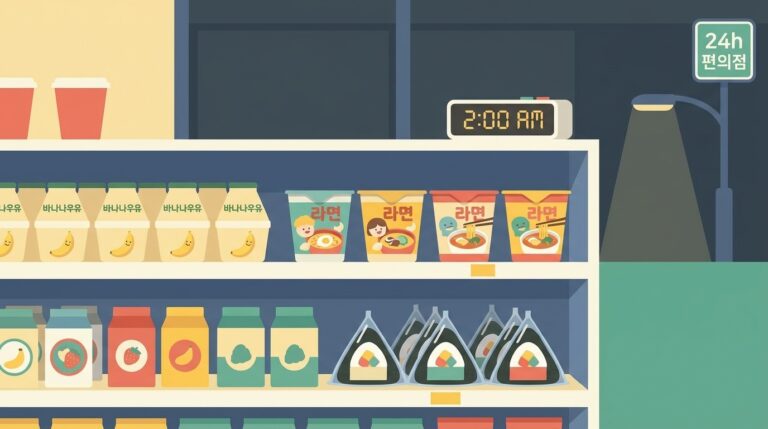
Raiding GS25 & CU: Your Beginner’s Guide to Korean Convenience Store Snacking (편의점 털기)
Phase 1: That 2 AM Craving is Real! (공감)
Imagine this: It’s 1:30 AM in Seoul. You’ve just finished a marathon of watching your favorite K-Drama, or maybe you walked 20,000 steps exploring Hongdae. Suddenly, your stomach growls. You need food, and you need it now.
In many countries, your options at this hour would be limited to a greasy drive-thru. But in Korea? You are in late-night food paradise. You step outside, and within a three-minute walk, you spot the bright, welcoming neon glow of a CU, GS25, or 7-Eleven.
Welcome to the holy grail of Korean late-night culture: 편의점 털기 (Pyeon-ui-jeom teol-gi), which literally means “robbing the convenience store”—but don’t worry, it actually just means going on an epic, guilt-free snack haul!
As a long-time Seoul resident and your personal Korean tutor, I’ve seen so many of my students freeze when they walk into a convenience store. They want to try the legendary “2+1” deals, heat up their instant ramen, or ask for chopsticks, but they get tongue-tied.
Today, we are going to fix that. By the end of this guide, you’ll walk into any Korean convenience store like an absolute local boss. Let’s dive in!
Phase 2: Core Late-Night Expressions (핵심 표현 3선)
Here are the three most powerful sentences you need for a successful late-night convenience store run.
1. 이거 2+1 이에요? (I-geo two-plus-won i-e-yo?)
- Pronunciation: [I-geo two-plus-one i-e-yo?] / Sound-alike: “Ee-guh two-plus-one ee-eh-yo?”
- Meaning: “Is this buy-two-get-one-free?”
- K-Culture Moment: You will see yellow and red tags everywhere on shelves that say 1+1 or 2+1. If you buy two, you get one absolutely free! It’s a national obsession.
- Editor’s Insight: Don’t try to translate “plus” into Korean. Koreans literally use the English words “two plus one” (투 플러스 원). It’s super easy and highly effective!
- Situation Spectrum:
- Friends (Casual): ✅
- Clerk/Semi-formal: ✅
- Formal: ✅ (Perfect for any store encounter)
- 🤔 Think About It: Why does Korea have so many multi-buy deals in convenience stores? It reflects a fast-paced, highly competitive retail culture that loves giving customers a small sense of “service” (free extras!).
2. 삼각김밥 데워야 돼요? (Sam-gak-gim-bap de-wo-ya dwae-yo?)
- Pronunciation: [Sam-gak-gim-bap de-wo-ya dwae-yo?] / Sound-alike: “Sahm-gahk-gheem-bahp day-wah-yah dway-yo?”
- Meaning: “Do I need to microwave/warm up this triangle kimbap?”
- K-Culture Moment: Triangle kimbap is the ultimate budget snack. Some flavors (like Tuna Mayo) are great cold, while others (like Jeonju Bibimbap) taste 100 times better warm.
- Editor’s Insight: The verb 데우다 (de-u-da) means to warm up food. If the clerk says “네 (Ne / Yes)”, look for the microwave station usually located in the corner of the store!
- Situation Spectrum:
- Friends (Casual): ✅
- Clerk/Semi-formal: ✅
- Formal: ⚠️ (A bit too casual for business settings, but perfectly polite for clerks)
- 🤔 Think About It: In many Western countries, store employees microwave things for you. In Korea, it is almost entirely self-service! Why do you think self-service is preferred in Korea’s quick-service culture?
3. 젓가락 챙겨주세요. (Jeot-ga-rak chaeng-gyeoh-ju-se-yo.)
- Pronunciation: [Jeot-ga-rak chaeng-gyeo-ju-se-yo.] / Sound-alike: “Chut-gah-rahk chaeng-gyuh-joo-seh-yo.”
- Meaning: “Please give me chopsticks.”
- K-Culture Moment: If you buy cup ramen (컵라면), you need utensils! Clerks used to give them automatically, but due to eco-friendly laws, you often have to ask for them now.
- Editor’s Insight: 챙겨주다 (chaeng-gyeo-ju-da) is a beautiful Korean verb that means “to take care of/pack something for someone.” It sounds much warmer than just saying “give me.”
- Situation Spectrum:
- Friends (Casual): ✅
- Clerk/Semi-formal: ✅
- Formal: ✅
- 🤔 Think About It: How does the word 챙기다 (to pack/care for) show the warm, community-focused mindset of Korean society?
Phase 3: Textbook Korean vs. Real Korean (교과서 vs. 진짜 한국어)
Let’s compare what dry textbooks teach you versus what Koreans actually say when they go to a convenience store.
Situation 1: Declining a receipt
- 📖 Textbook Korean: 영수증을 주지 마십시오. (Yeong-su-jeung-eul ju-ji ma-sip-si-o. – “Do not give me the receipt.”) -> Sounds like an angry robot in an action movie!
- 🗣️ Real Korean: 영수증은 버려주세요. (Yeong-su-jeung-eun beo-ryeo-ju-se-yo. – “Please throw away the receipt for me.”)
- 💡 Why the difference? Koreans value speed and convenience. Saying “please throw it away” is the polite, standard way to decline a receipt because the machine prints it automatically anyway.
Situation 2: Asking for a plastic bag
- 📖 Textbook Korean: 봉투를 구매하기를 원합니다. (Bong-tu-reul gu-mae-ha-gi-reul won-hap-ni-da. – “I want to purchase a bag.”) -> Too formal and stiff.
- 🗣️ Real Korean: 봉투 하나 주세요. (Bong-tu ha-na ju-se-yo. – “Please give me one bag.”)
- 💡 Why the difference? Simple, direct, and natural. Keep in mind that plastic bags cost around 100 to 200 KRW in Korea due to environmental policies!
Phase 4: K-Culture Deep Dive & Etiquette
4-1. The Art of “Nunchi” (눈치) at the Trash Station
Once you finish eating your delicious late-night snack inside the store or on the plastic tables outside, you cannot just throw everything into one bin! Korea is incredibly strict about recycling.
* The Etiquette: Look at the labels on the bins. You must separate:
– 플라스틱 (Plastic): Cups, containers.
– 일반쓰레기 (General Waste): Wooden chopsticks, napkins.
– 음식물 쓰레기 (Food Waste): Any leftover ramen soup or food scraps. (Do not throw liquid soup into the plastic bin! Pour it into the designated liquid disposal bucket/sink).
4-2. The “Mark Meal” (마크정식) Phenomenon
Korean convenience stores are not just places to buy food; they are culinary laboratories! The most famous recipe is the Mark Meal (마크정식), created by a fan of the K-Pop group GOT7’s member Mark. It mixes instant spaghetti, spicy ddeokbokki (rice cakes), string cheese, and a sausage. It went so viral that millions of Koreans eat it as their ultimate ya-sik (late-night snack)!
Phase 5: 2 AM Convenience Store Roleplay (실전 롤플레이)
Setting: It’s 2:05 AM. You and your energetic Korean friend, Min-su, are standing inside a brightly lit GS25. Outside, a gentle summer rain is falling, and the smell of hot ramen broth fills the air. You are holding a cup of spicy ramen and a triangle kimbap.
- Min-su: 아, 출출하다! 오늘 편의점 제대로 털어보자!
(Ah, chul-chul-ha-da! O-neul pyeon-ui-jeom je-dae-ro teol-eo-bo-ja!)
(🎭 Grabbing a shopping basket with a huge grin)
“Ah, I’m a bit peckish! Let’s raid this convenience store properly today!” -
You: 좋지! 삼각김밥은 이거 매운맛인데, 데워야 돼?
(Joh-ji! Sam-gak-gim-bap-eun i-geo mae-un-mat-in-de, de-wo-ya dwae?)
(🎭 Pointing to the spicy kimbap in your hand)
“Sounds great! This triangle kimbap is the spicy flavor, do I need to warm it up?” -
Min-su: 어, 그건 약간 데워야 치즈가 녹아서 훨씬 맛있어!
(Eo, geu-geon yak-gan de-wo-ya chi-zeu-ga nog-a-seo hwol-sin mas-is-eo!)
(🎭 Giving a thumbs-up)
“Yeah, you should warm that up a little so the cheese melts and makes it way better!” -
You: 오케이. 아, 저 라면은 2+1이네? 하나 더 가져올까?
(O-kei. Ah, jeo ra-myeon-eun two-plus-won-i-ne? Ha-na deo ga-jyeo-ol-kka?)
(🎭 Looking at the shelf tags)
“Okay. Oh, that ramen is buy 2 get 1 free? Should I grab one more?” -
Min-su: 당연하지! 공짜는 참으면 안 돼.
(Dang-yeon-ha-ji! Gong-짜-neun cham-eu-myeon an dwae.)
(🎭 Laughing heartily)
“Of course! You can’t say no to free stuff.”
(You walk up to the cashier to pay…)
- Cashier: 봉투 필요하세요?
(Bong-tu pil-yo-ha-se-yo?)
(🎭 Holding a plastic bag ready)
“Do you need a bag?” -
You: 네, 봉투 하나 주세요.
(Ne, bong-tu ha-na ju-se-yo.)
(🎭 Handing over your card)
“Yes, please give me one bag.” -
Cashier: 젓가락은 몇 개 드릴까요?
(Jeot-ga-rak-eun myeot gae deu-ril-kka-yo?)
(🎭 Reaching under the counter)
“How many chopsticks should I give you?” -
You: 두 개 챙겨주세요.
(Du gae chaeng-gyeo-ju-se-yo.)
(🎭 Holding up two fingers)
“Please pack two chopsticks for us.” -
Cashier: 영수증 드릴까요?
(Yeong-su-jeung deu-ril-kka-yo?)
“Would you like the receipt?”
🔀 Your Decision Point!
How will you answer the cashier’s last question?
- Option A: “아니요, 괜찮아요.” (An-i-yo, gwen-cha-na-yo. – “No, it’s okay.”)
- Best Choice! This is incredibly natural and polite. The cashier will simply throw the receipt away for you with a smile.
- Option B: “영수증은 버려주세요.” (Yeong-su-jeung-eun beo-ryeo-ju-se-yo. – “Please throw away the receipt.”)
- Excellent Choice! Very local, fast, and clear. Shows you understand the fast-paced flow of Seoul.
- Option C: “영수증을 주지 마세요!” (Yeong-su-jeung-eul ju-ji ma-se-yo! – “Don’t give me the receipt!”)
- Risky! Though grammatically correct, it sounds a bit too demanding, almost like you’re mad at the receipt itself!
Phase 6: 10-Second Emotion Shadowing Drill (감정 섀도잉)
Let’s practice speaking with real Korean emotion! Pay attention to the slash (/) marks—they tell you where to take a micro-pause for natural rhythm.
- [😊 Super excited and hungry]
- “이거 / 2+1 이에요?”
- I-geo / two-plus-won i-e-yo?
- Bounce slightly on “2+1” like you just found buried treasure!
- [🥺 Polite but casual request]
- “젓가락 / 두 개만 / 챙겨주세요.”
- Jeot-ga-rak / du gae-man / chaeng-gyeo-ju-se-yo.
- Put a soft, friendly stress on “chaeng-gyeo” to sound warm.
- [😎 Cool and fast city-dweller]
- “영수증은 / 버려주세요.”
- Yeong-su-jeung-eun / beo-ryeo-ju-se-yo.
- Say it quickly in one breath as you grab your items. Peak convenience!
Phase 7: K-Culture Mini-Dictionary (미니 사전)
| Word (Korean) | Romanization | English Translation | Real-world Context |
|---|---|---|---|
| 야식 | Ya-sik | Late-night snack | Literally “night food.” It’s an entire social culture of eating after 10 PM. |
| 편털 | Pyeon-teol | Convenience store raid | Short for 편의점 털기. Going to a store with the goal of buying a feast. |
| 꿀조합 | Kkul-joh-hap | Honey combination | An amazing food combination (like mixing cheap ramen and cheese). |
| 치맥 | Chi-maek | Chicken and Beer | The king of all ya-sik. Often ordered to a park or eaten late at night. |
Phase 8: Traveler’s Survival Kit (여행자 서바이벌 킷)
Survival Phrases TOP 3
- 화장실 어디에요? (Hwa-jang-sil eo-di-e-yo?)
- Pro Tip: Convenience stores in Korea rarely have public restrooms. If you ask, they might point you to the nearest subway station or building key!
- 뜨거운 물 어디 있어요? (Tteu-geo-un mul eo-di is-seo-yo?)
- Pro Tip: Look for the stainless steel hot water dispensers near the food prep counter to cook your cup ramen.
- 카드 돼요? (Ka-deu dwae-yo?)
- Pro Tip: Yes! Korea is almost 100% cashless. Even a 500 KRW jelly can be bought with a foreign credit card.
📌 Editor’s Travel Note:
To find the nearest 24-hour convenience store, do not use Google Maps (it doesn’t work well in Korea!). Download the Naver Map App or KakaoMap App for highly accurate, real-time walking directions.
Phase 9: Think Deeper: Why Do Koreans Love Late Night Snacks? (인문학 코너)
In many global cities, streets go quiet after 9 PM. But in Korea, the night is just starting. This vibrant midnight culture stems from the concept of Jeong (정)—the deep bond of sharing food—combined with the high-stress, hard-working lifestyle of Korean society. After a long day of work or study, sharing a simple cup of ramen or a warm triangle kimbap at a plastic convenience store table isn’t just about satisfying hunger. It’s an affordable escape, a cozy therapy session, and a way to connect with friends under the city lights.
💬 Your Turn: Does your home country have a late-night food culture? What is your favorite midnight comfort snack? Let us know in the comments below!
Phase 10: FAQ & Common Mistakes (자주 묻는 질문)
Q: Can I drink alcohol inside the convenience store?
A: Yes, but only in designated areas.
Most stores do not allow drinking alcohol inside the actual building. However, if they have plastic tables set up outside on the terrace, drinking beer or soju there is perfectly fine and is a classic Korean summer experience!
Q: What does “1+1” mean?
A: It means Buy 1 Get 1 Free!
Just bring both items to the counter, and the cashier will register the discount automatically.
Q: Do I need to bring my own shopping bag?
A: It is highly recommended!
Since 2022, Korea has banned free single-use plastic bags. You will be charged around 100~200 KRW for a paper or biodegradable bag, so bringing a small eco-bag is a great local habit.
🚨 Common Mistake Alert!
- The Mistake: Throwing leftover soup down the regular trash bin.
- The Fix: Always look for the plastic container with a strainer. Pour leftover liquid there, and throw the empty paper cup into the plastic/paper recycling bin.
Phase 11: Daily Hangul Action Missions (액션 미션)
- 🥉 Bronze Mission: Look up a picture of Korean “triangle kimbap” online and practice saying “삼각김밥 데워야 돼요?” three times in front of the mirror.
- 🥈 Silver Mission: Write down your dream Korean late-night food combo in the comments using the word 꿀조합 (kkul-joh-hap)!
- 🥇 Gold Mission: If you are in Korea, walk into a convenience store, find a 2+1 deal, and successfully ask the clerk: “이거 2+1 이에요?”
- 🎮 K-Culture Bonus Mission: Watch any K-Drama eating scene and spot whether they are using wooden chopsticks (나무젓가락) from a convenience store!
Phase 12: Interactive Quiz Challenge (퀴즈 챌린지)
1. Which expression should you say to ask for chopsticks?
- A) 영수증 주세요. (Yeong-su-jeung ju-se-yo.)
- B) 젓가락 챙겨주세요. (Jeot-ga-rak chaeng-gyeo-ju-se-yo.)
- C) 삼각김밥 데워주세요. (Sam-gak-gim-bap de-wo-ju-se-yo.)
👉 Click to see the Answer & Explanation!
Correct Answer: B!
* B means “Please pack/give me chopsticks.”
* A is asking for a receipt, and C is asking the clerk to warm up your kimbap.
2. True or False: You should throw your plastic ramen bowl with leftover soup directly into the general trash bin.
- True
- False
👉 Click to see the Answer & Explanation!
Correct Answer: False!
In Korea, you must separate the liquid soup first, put food waste in the designated food bin, and rinse/recycle the plastic cup.







