

How to Ask for Free Steamed Egg in Korea Like a Local: The Art of the “Service” Request
안녕하세요! Welcome back to Daily Hangul, your premium space for mastering not just the Korean language, but the heartbeat of Korean culture. I’m your head editor and veteran tutor.
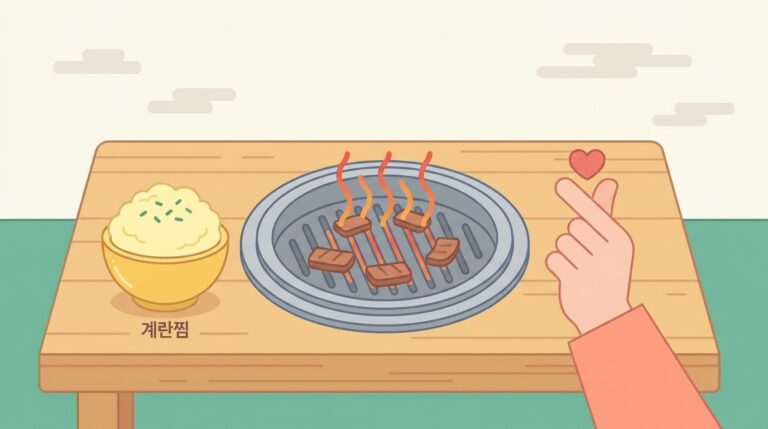
If you have ever stepped into a lively Korean BBQ joint or a spicy braised chicken (jjim) restaurant in Seoul, you know the vibe: sizzling meats, red-hot stews, and a bustling atmosphere filled with laughter. But as your tongue starts to burn from that delicious, fiery spice, your eyes wander to the next table. There it is—a steaming, golden, cloud-like dome of 계란찜 (gyeran-jjim / Korean steamed egg).
Your Korean friends whisper, “If we play our cards right, the owner might give us one for free as a ‘service’ (서비스)!”
But how do you ask for this complimentary treat without sounding rude or demanding? In Korea, begging for freebies can backfire, but asking with the right blend of charm (aegyo), politeness, and social timing (nunchi) is an art form. Today, you will learn how to unlock the ultimate Korean restaurant hack: politely requesting a complimentary gyeran-jjim like a true local.
Phase 2: Deep Dive into 3 Key Expressions
1. 혹시 계란찜 서비스로 주실 수 있나요? (Hoksi gyeran-jjim seobiseu-ro jusil su innayo?)
- Pronunciation: Hok-shee gye-ran-jjeem seo-bee-seu-ro joo-sheel soo een-na-yo?
- Meaning: “By any chance, could we get a steamed egg as a complimentary service?”
- K-Culture Moment: Picture a lively, smoke-filled dak-galbi (spicy stir-fried chicken) restaurant. You’ve ordered plenty of drinks and food, and you catch the warm eye of the owner. This phrase is the gold standard of polite requests.
- Editor’s Insight: The magic word here is 혹시 (hoksi), which means “by any chance.” Starting your sentence with hoksi instantly softens your request, making it sound tentative and highly respectful rather than demanding.
- Situation Spectrum:
- Friends & Casual settings: ✅
- Semi-formal dining (with colleagues): ✅
- Very formal restaurants (fine dining): 🚫 (In upscale places, everything is strictly billed, and asking for freebies is inappropriate.)
- 🤔 Think About It: Notice how Korean requests often use indirect phrasing like “Is it possible to…” rather than “Give me…”. How does your culture handle asking for complimentary items at restaurants?
2. 매운맛 좀 달래게 계란찜 하나만 주시면 안 될까요? (Maeunmat jom dallaege gyeran-jjim hanaman jusimyeon an doelkkayo?)
- Pronunciation: Mae-oon-mat jom dal-lae-ge gye-ran-jjeem ha-na-man joo-shee-myeon an doel-kka-yo?
- Meaning: “To soothe the spiciness a bit, could you perhaps give us just one steamed egg?”
- K-Culture Moment: You are eating extra-spicy galbi-jjim (braised short ribs). Your face is red, and tears are welling up. You look at the owner with pleading eyes.
- Editor’s Insight: The phrase 달래다 (dallaeda) means to soothe or comfort (often used for crying babies). Using it here to describe “soothing the spicy taste” shows incredible linguistic flair and will definitely make the owner smile!
- Situation Spectrum:
- Friends & Casual settings: ✅
- Semi-formal dining: ⚠️ (Use only if you have a friendly relationship with the restaurant staff.)
- Very formal restaurants: 🚫
- 🤔 Think About It: Why do you think expressing your vulnerability (admitting the food is too spicy) works so well in Korean service culture? It taps into Jeong (정), the cultural bond of warm-heartedness.
3. 사장님, 저희 계란찜 서비스는 없나요? (Sajangnim, jeohui gyeran-jjim seobiseu-neun eopnayo?)
- Pronunciation: Sa-jang-neem, jeo-hee gye-ran-jjeem seo-bee-seu-neun eop-na-yo?
- Meaning: “Boss, is there no complimentary steamed egg for us?” (Said playfully)
- K-Culture Moment: You are a regular at a local neighborhood pub (pansuljib). You’ve ordered your second round of soju and a large platter of steamed clams.
- Editor’s Insight: This is a bold, playful expression. Only use this if you have built a friendly rapport with the owner (sajangnim). It is delivered with a warm smile and a slightly teasing tone.
- Situation Spectrum:
- Friends & Casual settings: ✅ (If you are a regular)
- Semi-formal dining: ⚠️
- Very formal restaurants: 🚫
- 🤔 Think About It: Calling the restaurant owner Sajangnim (President/Boss) is a sign of respect that opens doors. How does addressing service workers by high titles affect service in your country?
Phase 3: Textbook Korean vs. Real Korean
Let’s bridge the gap between classroom Korean and the real street slang of Seoul.
Situation 1: Asking for complimentary items
- 📖 Textbook Korean: 서비스 주세요. (Seobiseu juseyo.)
- Why it’s awkward: This sounds like an direct order: “Give me free stuff.” It can sound incredibly demanding and blunt to a busy owner.
- 🗣️ Real Korean: 혹시 서비스로 계란찜 같은 거 나오나요? (Hoksi seobiseu-ro gyeran-jjim gateun geo naonayo?)
- Why it works: “By any chance, does something like steamed egg come as a service?” This shifts the question to the restaurant’s policy rather than making a personal demand. It’s polite and face-saving for both sides.
Situation 2: Expressing that the food is too spicy
- 📖 Textbook Korean: 음식이 너무 매워요. 물 주세요. (Eumsigi neomu maewoyo. Mul juseyo.)
- Why it’s awkward: It sounds like a flat complaint. While not grammatically wrong, it doesn’t build any connection with the staff.
- 🗣️ Real Korean: 와, 이거 진짜 맛있게 매우면서도 정신이 번쩍 드네요! 계란찜이랑 같이 먹으면 진짜 찰떡궁합일 것 같아요. (Wa, igeo jinjja masitge maeumyeonseodo jeongsini beonjjeok deuneyo! Gyeran-jjim-irang gachi meogeumyeon jinjja chaltteok-gung-habil geot gat-at-eoyo.)
- Why it works: “Wow, this is deliciously spicy and really wakes me up! I think it would be a perfect match with steamed egg.” Praising the food first (맛있게 매운, deliciously spicy) and then hinting at the steamed egg makes the owner want to feed you!
Phase 4: K-Culture Deep Dive & Non-verbal Manners
4-1. Nunchi and the Art of the Ask
In Korea, 눈치 (Nunchi / social intuitive ability) is everything. Before you ask for a complimentary gyeran-jjim, look around:
1. Are they busy? If the restaurant is packed and the staff are running around sweating, do not ask for freebies. It will annoy them.
2. Have you ordered enough? “Service” is a reward for being a good customer. If you only ordered one cheap dish, asking for free steamed egg is bad manners. If you’ve ordered a main dish and a few drinks, you are in the green zone!
3. Body Language: When asking, slightly tilt your head, make friendly eye contact, and hold your hands together in front of you. A warm smile goes ten times further than perfect grammar.
4-2. The Food Code: “Service” (서비스) vs. “Jeong” (정)
In Western restaurants, getting something for free usually means the kitchen made a mistake. In Korea, 서비스 (seobiseu) is a crucial tool for building customer loyalty and expressing 정 (Jeong / warm affection). When an owner gives you a free gyeran-jjim, they are saying, “I like you, thank you for coming to my shop, please come back!”
Phase 5: The Hongdae Spicy Ribs Challenge (Roleplay)
Setting: A famous, retro-style spicy braised rib (maeun galbi-jjim) restaurant in Hongdae. The air is thick with the scent of garlic and chili. K-pop from the early 2010s plays in the background.
Your Character: An intermediate-level international student dining with friends.
NPC: 이모님 (Imonim / “Auntie”, the warm but busy owner who takes pride in her spicy recipe).
- 이모님: 🎭 (Placing a boiling, red pot of braised ribs on your table with a clatter) 자, 매운 갈비찜 나왔어요! 뜨거우니까 조심해요. 우리 집 최고 매운 단계야!
- You: 우와, 색깔이 진짜 장난 아니네요! 보기만 해도 침이 고여요.
- 이모님: 🎭 (Laughing proudly, wiping her hands on her apron) 매운 거 잘 먹을 수 있을지 걱정이네. 매워서 울면 안 돼!
- You: 🎭 (Taking a small bite, eyes widening as the heat hits) 읍! 진짜 매워요! 근데 진짜 맛있게 매운맛이에요!
- 이모님: 그렇지? 우리 집 양념이 특허받은 거거든.
- You: 🎭 (Fan-flapping your mouth with your hand) 씁-하! 이모님, 혹시… 저희가 너무 매워해서 그러는데…
- 이모님: 응? 왜, 물 더 줄까?
- You: 물도 좋지만, 혹시 계란찜 하나만 서비스로 주시면 안 될까요? 이 매운 양념이랑 같이 먹으면 진짜 찰떡궁합일 것 같아서요!
- 이모님: 🎭 (Looking at your sweaty forehead, then smiling warmly) 아이고, 외국인 친구가 한국말도 싹싹하게 잘하네! 좋아, 계란찜 서비스 하나 나갑니다!
- You: 🎭 (Clapping hands together) 우와! 대박! 이모님 진짜 최고예요! 정말 감사합니다!
🔀 Decision Point: What if she was too busy to talk?
If the restaurant was packed, which option would you choose?
* A) “이모님, 저기요! 서비스 왜 안 나와요?” (Imonim, jeogiyo! Seobiseu wae an naowayo? / Auntie, over here! Why is there no freebie?)
* 🚨 Bad Choice: Extremely rude. It sounds entitled and demanding.
* B) Just order a steamed egg normally on the menu and say, “이모님, 너무 매워서 계란찜 하나만 추가해 주세요!” (Imonim, neomu maewaseo gyeran-jjim hanaman chuga-hae juseyo! / Auntie, it’s too spicy so please add one steamed egg to our order!)
* 🌟 Best Choice: Polite and respectful. Often, when you politely order and pay for a side dish because of the spice, a touched imonim might refund it or give you an extra service drink later because she appreciates your manners!
Phase 6: 10-Second Emotion Shadowing Drill
Practice saying these with the correct pause (/) and emotional tone!
- [🥺 Softly and slightly pleading]
혹시 / 너무 매워서 그러는데 / 계란찜 서비스로 / 주실 수 있나요?
(Hoksi / neomu maewaseo geureoneunde / gyeran-jjim seobiseu-ro / jusil su innayo?) -
[😊 Bright and full of energy]
우와! / 이모님 진짜 / 최고예요! / 감사합니다!
(Uwa! / Imonim jinjja / choegoyeyo! / Gamsahabnida!)
Phase 7: K-Culture Mini-Dictionary
| Word (Hangeul / Romanization) | English Meaning | Cultural Context & Usage |
|---|---|---|
| 서비스 (Seobiseu) | Complimentary / Freebie | Derived from the English “service”, but in Korea, it strictly means free food, drinks, or items given by a business to a customer. |
| 정 (Jeong) | Social bond / Affection | The invisible glue of Korean society. It’s the feeling of warm connection that makes an owner give you free food. |
| 맵부심 (Maepbusim) | Pride in eating spicy food | A portmanteau of 매운맛 (spiciness) and 자부심 (pride). Koreans love to test their maepbusim! |
| 이모님 (Imonim) | Auntie | Literally “maternal aunt”, but used affectionately to address middle-aged female staff in casual restaurants. |
Phase 8: Traveler’s Survival Kit
Survival Expressions for Spicy Situations
- 이거 덜 맵게 해 주실 수 있나요? (Igeo deol maepge hae jusil su innayo?)
- 💡 Pro Tip: “Can you make this less spicy?” Use this before ordering if you aren’t confident in your maepbusim!
- 계란찜 하나만 추가해 주세요. (Gyeran-jjim hanaman chuga-hae juseyo.)
- 💡 Pro Tip: “Please add one steamed egg to our order.” Perfect for ordering when the place is too busy for complimentary requests.
📌 Editor’s Travel Note
When navigating the bustling food alleys of Seoul, never rely on global maps. Download the Naver Map App for accurate restaurant locations and real-time reviews. Remember, tipping is not practiced in Korea. If you receive great “service” (freebies), the best way to show gratitude is to leave a glowing 5-star review on Naver Maps!
Phase 9: Deep Thoughts — “The Social Contract of the Freebie”
In many Western cultures, commerce is strictly transactional: you get exactly what you pay for. In Korea, however, a restaurant table is a shared space of communal warmth. The act of offering and requesting “service” (seobiseu) acts as a social dance. By asking politely, you are not trying to “cheap out” on the bill; rather, you are inviting the owner into a micro-friendship. This custom reflects Korea’s history of communal sharing, where food was always shared with neighbors, even in times of scarcity.
💬 Your Turn: How does restaurant hospitality work in your country? Do owners ever throw in free dishes for friendly customers? Let me know in the comments below!
Phase 10: FAQ & Common Mistakes
Q: Can I ask for “service” the very first time I visit a restaurant?
A: Yes, but keep it humble. If you have ordered a significant amount of food (like 2-3 portions of meat or a large stew) and drinks, it is completely fine to politely ask using the “Hoksi…” expressions. However, never demand it.
Q: Is it okay to ask for refills of the “service” item?
A: Generally, no. While standard side dishes (banchan) like kimchi are free and refillable, premium items like gyeran-jjim require fresh ingredients and cooking time. If you want a second one, you should order and pay for it.
Q: What should I do if they say no?
A: Smile and say, “아, 네! 괜찮습니다! 주문할게요!” (Ah, ne! Gwaenchanhseumnida! Jumun-halgeyo!) which means “Ah, yes! That’s totally fine! I will order one!”
🚨 Common Mistakes Warning Board
- Saying “공짜로 주세요” (Gongjja-ro juseyo / Give it to me for free):
- Why: “공짜” (gongjja) sounds cheap and vulgar. Always use the professional word 서비스 (seobiseu).
- Demanding service right as you sit down:
- Why: You must establish some relationship (ordering food first, praising the environment) before asking.
Phase 11: Action Missions
- 🥉 Bronze (The Mirror Challenge): Practice the expression “혹시 계란찜 서비스로 주실 수 있나요?” in front of a mirror 5 times. Focus on your facial expressions—make sure your eyes look pleading and friendly!
- 🥈 Silver (The Community Challenge): Post a picture of your favorite Korean food on Instagram or Twitter, and caption it in Korean using the phrase: “매운맛 좀 달래고 싶을 때 딱이에요!” (Perfect for when you want to soothe the spicy taste!)
- 🥇 Gold (The Real-world Mission): The next time you visit a Korean BBQ or Spicy Stew restaurant, use our Phase 5 roleplay script to ask the owner for a complimentary gyeran-jjim. Let us know if you succeeded!
Phase 12: Interactive Quiz Challenge
1. Which of the following is the most polite way to ask for a complimentary steamed egg?
- A) 계란찜 공짜로 줘요. (Gyeran-jjim gongjja-ro jwoyo.)
- B) 사장님, 혹시 계란찜 서비스로 주실 수 있나요? (Sajangnim, hoksi gyeran-jjim seobiseu-ro jusil su innayo?)
- C) 서비스로 계란찜 내놔. (Seobiseu-ro gyeran-jjim naenwha.)
2. True or False?
- Q: In Korea, it is polite to tip the waiter if they give you a free steamed egg.
🔍 Reveal Answers & Explanations
- Correct Answer: B
- Explanation: Option B uses both the respectful title Sajangnim, the polite softener hoksi, and the proper term seobiseu. Option A uses “gongjja” (cheap) and Option C is an aggressive command!
- Correct Answer: False
- Explanation: Tipping is not a part of Korean culture and can actually cause confusion. Instead, express your gratitude with a loud, friendly “감사합니다!” (Gamsahabnida!) or write a nice online review.







