

Master Your Korean Car Maintenance: How to Change Engine Oil Like a Local
안녕하세요! Welcome back to another edition of Daily Hangul, your premium guide to mastering not just the Korean language, but the vibrant, fast-paced life of South Korea. I’m your chief editor and resident cultural navigator, ready to help you drive through the streets of Seoul with confidence!
Imagine this: You’ve planned the perfect weekend getaway. You’re driving down a scenic highway toward the coastal cliffs of Gangneung or the cozy forest glamping sites of Gapyeong. Suddenly, a little yellow maintenance wrench pops up on your dashboard. Uh-oh. Your engine oil needs to be changed, or worse, your car is overdue for its regular checkup.
For many expats, entering a local Korean auto repair shop—familiarly called a 카센터 (ka-sen-teo)—can feel like entering a boss battle in a video game. Will they understand you? Will you accidentally agree to an expensive, unnecessary repair?
Don’t worry! Today, we are going to unlock the exact vocabulary, cultural nuances, and conversational scripts you need to handle a routine car inspection and engine oil change smoothly. This guide is built on real-world scenarios from our B2-level students who successfully navigated their first independent garage visits. By the end of this post, you’ll sound like an absolute pro.
Phase 2: Deep Dive into 3 Core Expressions
Let’s start with the essential tools in your verbal toolkit. These are the three high-frequency sentences you must know before pulling up to any service bay.
1. 엔진오일 교환해 주세요 (Please change the engine oil)
- Pronunciation: En-jin-o-il gyo-hwan-hae ju-se-yo
- Sound-alike Guide: “En-jean-oh-il gyoh-hwan-heh joo-seh-yo”
- Meaning: “Please change the engine oil.”
- K-Culture Moment: In slice-of-life K-Dramas, you’ll often see characters dropping their cars off at a neighborhood garage before heading to work, casually tossing this phrase to a mechanic who is wiping his hands on a greasy rag.
- Editor’s Insight: The verb 교환하다 (gyo-hwan-ha-da) specifically means “to exchange” or “to replace.” While you can technically say “엔진오일 갈아주세요” (gal-a-ju-se-yo – “please swap out the oil”), using gyo-hwan-hae ju-se-yo sounds incredibly clear, polite, and grammatically precise for a B2 speaker.
- Situation Spectrum:
- Casual (Friends): ⚠️ (Too formal for daily talk, but fine if discussing tasks)
- Semi-formal (Mechanics/Business): ✅ (Perfect balance of politeness)
- Formal (Elderly/Strict Business): ✅
- 🤔 Think About It: Notice how the object particle 을 (eul) in 엔진오일(을) is omitted in casual spoken Korean? Why do you think Korean spoken grammar prioritizes speed and efficiency over strict textbook particles?
2. 전체적으로 점검해 주세요 (Please give it a full/overall checkup)
- Pronunciation: Jeon-che-jeok-eu-ro jeom-geom-hae ju-se-yo
- Sound-alike Guide: “Jeon-cheh-jeok-uh-roh jum-gum-heh joo-seh-yo”
- Meaning: “Please inspect the car overall / run a full checkup.”
- K-Culture Moment: Perfect for the seasonal transitions! Before Korea’s freezing winter or the extremely rainy monsoon season (장마철 – jang-ma-cheol), local drivers always flock to the garage to say this to ensure their battery and tires are ready for the elements.
- Editor’s Insight: 전체적으로 (jeon-che-jeok-eu-ro) translates to “overall” or “generally,” while 점검하다 (jeom-geom-ha-da) means “to inspect” or “to check.” This phrase is a shield against unexpected breakdown charges. It politely asks the mechanic to look at everything without committing you to immediate expensive repairs.
- Situation Spectrum:
- Casual: 🚫 (Sounds overly technical)
- Semi-formal: ✅ (Highly recommended)
- Formal: ✅
- 🤔 Think About It: In your home country, is it standard practice to request a general checkup for free, or is there an automatic diagnostic fee? In Korea, a basic visual jeom-geom is often bundled as a courtesy service!
3. 소모품도 같이 확인해 주세요 (Please check the consumables/wear-and-tear parts too)
- Pronunciation: So-mo-pum-do gat-i hwa-gin-hae ju-se-yo
- Sound-alike Guide: “Soh-moh-poom-doh gah-chi hwah-ghin-heh joo-seh-yo”
- Meaning: “Please check the consumables (filters, cabin air filter, fluids) as well.”
- K-Culture Moment: With Korea’s seasonal yellow dust (황사 – hwang-sa) and fine dust (미세먼지 – mi-se-meon-ji), replacing cabin air filters—one of the key 소모품 (so-mo-pum)—is an absolute survival skill for a fresh drive.
- Editor’s Insight: 소모품 (so-mo-pum) literally means “consumable goods.” In the context of car care, this refers to brake pads, wiper blades, filters, and coolant. Adding 같이 (gat-i), which is pronounced like “gah-chi,” makes the request sound smooth and natural.
- Situation Spectrum:
- Casual: ⚠️
- Semi-formal: ✅ (Professional and smart)
- Formal: ✅
- 🤔 Think About It: The word so-mo-pum showcases Sino-Korean root words: 소모 (somo = consumption/exhaustion) + 품 (pum = product/item). Can you think of other Korean words ending in ‘품’ (e.g., 화장품 – cosmetics, 생필품 – daily necessities)?
Phase 3: Textbook Korean vs. Real Korean
When you study with standard textbooks, you often learn stiff, grammatically perfect sentences that sound remarkably unnatural in a noisy, practical environment like a Korean garage. Let’s compare the textbook versions with what real locals actually say.
Situation 1: Asking about the cost of the service
- 📖 Textbook Korean: “정비 비용이 얼마입니까?” (Jeong-bi bi-yong-i eol-ma-im-ni-ka? – “How much is the maintenance fee?”)
- 🗣️ Real Korean: “견적이 어떻게 돼요?” (Gyeon-jeok-i eo-tteo-ke dwae-yo? – “How much is the estimate? / What’s the quote?”)
- 💡 Why the difference? In real business transactions, Koreans prefer the word 견적 (gyeon-jeok – estimate/quote). Asking “어떻게 돼요?” (How does it become?) is much softer and more polite than demanding a flat price with “얼마입니까?”.
Situation 2: Asking when the car will be ready
- 📖 Textbook Korean: “언제 수리가 완료됩니까?” (Eon-je su-ri-ga wan-ryo-dem-ni-ka? – “When will the repair be completed?”)
- 🗣️ Real Korean: “얼마나 걸릴까요?” (Eol-ma-na geol-ril-kka-yo? – “How long might it take?”)
- 💡 Why the difference? Unless you are dealing with a major car crash recovery, terms like 수리 완료 (su-ri wan-ryo) sound excessively formal. “얼마나 걸릴까요?” is a warm, indirect way of asking for a time estimate, leaving room for the busy mechanic to give a realistic window.
Phase 4: Cultural Deep-Dive & Non-Verbal Manners
4-1. The Waiting Room Ritual & “Nunchi”
When you pull up to a Korean 카센터, you don’t usually stand right next to the car while the mechanic works. That can be perceived as hover-managing or showing a lack of trust. Instead, utilize your 눈치 (nunchi – intuitive situational awareness):
1. The Key Hand-off: Hand your keys over directly or leave them in the ignition if the mechanic directs you to.
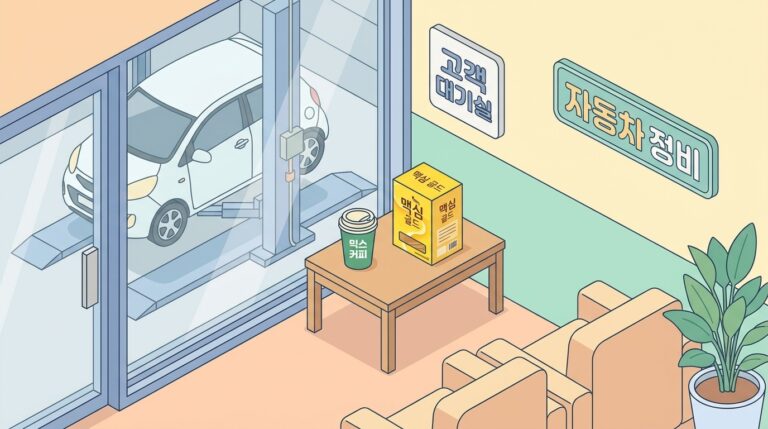
2. The Waiting Room (대기실 – dae-gi-sil): Walk into the small, glass-walled waiting room. Inside, you will almost always find a water purifier and a box of Maxim Gold Mix Coffee (맥스커피). Making yourself a sweet cup of mix coffee while watching your car on the lift through the window is the ultimate local experience.
4-2. The “Cha-bak” (차박) Culture
Korea has experienced a massive boom in 차박 (cha-bak), which is a portmanteau of 차 (cha – car) and 숙박 (suk-bak – lodging/staying overnight). It refers to car camping or sleeping in your SUV. Because cha-bak involves driving deep into remote valleys or coastal beaches, keeping your car in top shape through regular inspections is highly respected among young Koreans. If you tell your mechanic you are prepping for a cha-bak trip, they will likely double-check your tires with extra care!
Phase 5: The Interactive Roleplay Scenario
Setting: You have arrived at “Seoul Motors” (서울 정비소), a bustling local garage in Mapo-gu. The smell of fresh motor oil hangs in the air, and classic Korean ballad music plays softly from a radio. You are greeted by Kim Sajangnim (김 사장님), a friendly mechanic with thirty years of experience.
[Cast]
- You (The Smart Driver)
- Kim Sajangnim (The Veteran Mechanic)
- Turn 1
- Kim Sajangnim: (🎭 Wiping his hands with a towel and smiling warmly) 어서 오세요! 차에 무슨 문제 있으세요?
- (Eo-seo o-se-yo! Cha-e mu-seun mun-je is-seu-se-yo?)
- “Welcome! Is there some issue with the car?”
- Turn 2
- You: (🎭 Pointing politely to your car) 네, 안녕하세요. 엔진오일 교환할 때가 돼서 왔어요.
- (Ne, an-nyeong-ha-se-yo. En-jin-o-il gyo-hwan-hal ttae-ga dwae-seo wass-eo-yo.)
- “Yes, hello. I came because it’s time to change the engine oil.”
- Turn 3
- Kim Sajangnim: (🎭 Nodding while opening your hood) 아, 엔진오일이요? 마지막으로 언제 교환하셨어요?
- (Ah, en-jin-o-il-i-yo? Ma-ji-mak-eu-ro eon-je gyo-hwan-ha-syeoss-eo-yo?)
- “Ah, engine oil? When was the last time you changed it?”
- Turn 4
- You: (🎭 Thinking for a second) 한 6개월 전에 교환한 것 같아요. 한 만 킬로 정도 탔고요.
- (Han yuk-gae-wol jeon-e gyo-hwan-han geot gat-a-yo. Han man kil-lo jeong-do tass-go-yo.)
- “I think I changed it about 6 months ago. And I’ve driven about 10,000 kilometers.”
- Turn 5
- Kim Sajangnim: (🎭 Checking the oil dipstick) 맞네요, 오일 색이 많이 어두워졌어요. 교환하셔야겠네요. 혹시 다른 불편한 곳은 없으세요?
- (Man-nae-yo, o-il saek-i ma-ni eo-du-wo-jyeoss-eo-yo. Gyo-hwan-ha-syeo-ya-get-nae-yo. Hok-si da-reun bul-pyeon-han gos-eun eops-eu-se-yo?)
- “You’re right, the oil color has gotten very dark. You need a change. Any other uncomfortable issues?”
- Turn 6
- You: (🎭 Remembering your upcoming trip) 온 김에 전체적으로 한번 점검해 주세요. 다음 주에 장거리 운전을 해야 하거든요.
- (On gim-e jeon-che-jeok-eu-ro han-beon jeom-geom-hae ju-se-yo. Da-eum ju-e jang-geo-ri un-jeon-eul hae-ya heo-geun-yo.)
- “Since I’m here, please give it a full checkup. I have to do some long-distance driving next week.”
- Turn 7
- Kim Sajangnim: (🎭 Giving a reassuring thumbs-up) 아, 그러시구나! 알겠습니다. 소모품이랑 브레이크 패드도 같이 꼼꼼히 봐 드릴게요. 대기실에서 커피 한 잔 하시면서 기다려 주세요.
- (Ah, geu-reo-si-gu-na! Al-get-seub-ni-da. So-mo-pum-i-rang beu-re-i-ke pae-deu-do gat-i kkom-kkom-hi bwa deul-il-ge-yo. Dae-gi-sil-e-seo keo-pi han jan ha-si-myeon-seo gi-da-ryeo ju-se-yo.)
- “Oh, is that so! Got it. I’ll meticulously check the consumables and brake pads too. Please have a cup of coffee and wait in the waiting room.”
- Turn 8
- You: (🎭 Smiling) 감사합니다. 혹시 시간은 얼마나 걸릴까요?
- (Gam-sa-ham-ni-da. Hok-si si-gan-eun eol-ma-na geol-ril-kka-yo?)
- “Thank you. Roughly how long will it take?”
- Turn 9
- Kim Sajangnim: (🎭 Looking at his watch) 한 30분 정도 걸릴 것 같습니다.
- (Han sam-sip-bun jeong-do geol-ril geot gat-seub-ni-da.)
- “It should take about 30 minutes.”
- Turn 10 (The Climax)
- Kim Sajangnim: (🎭 Coming into the waiting room 25 minutes later) 손님, 다 됐습니다. 그런데 브레이크 오일 수분 함량이 좀 높네요. 지금 교환하시겠어요?
- (Son-nim, da dwaess-seub-ni-da. Geu-reon-de beu-re-i-ke o-il su-bun ham-ryang-i jom nop-nae-yo. Ji-geum gyo-hwan-ha-si-gess-eo-yo?)
- “Customer, it’s all done. But the moisture level in your brake fluid is a bit high. Would you like to change it now?”
🔀 Decision Point: What is your response?
- Option A: “아니요, 괜찮아요. 그냥 엔진오일만 해 주세요.” (An-i-yo, gwen-chan-a-yo. Geu-nyang en-jin-o-il-man hae ju-se-yo.)
- Option B: “아, 그래요? 교환 비용이 어떻게 되나요?” (Ah, geu-rae-yo? Gyo-hwan bi-yong-i eo-tteo-ke doe-na-yo?)
- Option C: “네, 그냥 사장님이 알아서 다 해 주세요.” (Ne, geu-nyang sa-jang-nim-i al-ah-seo da hae ju-se-yo.)
💡 Action Analysis:
- Best Choice: Option B! This shows that you are listening carefully but maintain a smart consumer boundary. Asking for the price (“교환 비용이 어떻게 되나요?”) allows you to make an informed decision without sounding rude.
- Risk Choice: Option C. Saying “알아서 다 해 주세요” (Just take care of everything as you see fit) can lead to a surprisingly high bill, as it gives the shop permission to replace parts that might still have some life in them.
- Safe & Direct: Option A. Totally fine if you are on a tight budget, but safety-wise, brake fluid moisture is crucial!
Phase 6: 10-Second Emotion Shadowing Drill
Let’s inject some real personality and natural flow into your pronunciation! Pay attention to the pauses (/) and try to mirror the emotional markers.
- [😊 Asking politely and confidently]
- “전체적으로 / 한 번 / 봐 주세요!”
- Jeon-che-jeok-eu-ro / han-beon / bwa ju-se-yo!
- “Please look over / it / overall!”
- [🥺 Softly requesting a cost estimate without sounding pushy]
- “혹시 / 견적이 / 어떻게 될까요?”
- Hok-si / gyeon-jeok-i / eo-tteo-ke doel-kka-yo?
- “By any chance, / the estimate / how might it turn out?”
- [😤 Relieved and grateful]
- “아, 다행이네요! / 신경 써 주셔서 / 정말 감사합니다!”
- Ah, da-haeng-i-ne-yo! / Sin-gyeong sseo ju-syeo-seo / jeong-mal gam-sa-ham-ni-da!
- “Oh, what a relief! / Thank you so much / for taking such good care of it!”
Phase 7: K-Culture Mini Dictionary
| Word (Korean/Romanization) | English Meaning | Cultural Context |
|---|---|---|
| 카센터 (Ka-sen-teo) | Auto Repair Shop | A perfect example of Korean “Konglish” (Car + Center). You’ll see this word on signs everywhere instead of “garage” or “mechanic shop.” |
| 단골 (Dan-gol) | Regular Patron / Customer | Being a dan-gol at a neighborhood ka-sen-teo is gold. Once they recognize your face, they often skip diagnostic fees and give honest opinions. |
| 공임비 (Gong-im-bi) | Labor Cost / Fee | Korean maintenance bills are clearly split into parts (부품비) and labor (공임비). It’s great to know this term to read invoices. |
| 서비스 (Seo-bi-seu) | Complimentary / Freebie | In Korea, “Service” means free of charge! When a mechanic refills your windshield fluid (워셔액) for free, they’ll smile and say “이건 서비스예요!” (This is a service!). |
Phase 8: Traveler’s Survival Kit
Even if you aren’t leasing a car long-term, you might rent one when traveling through romantic routes in Jeju Island or Namhae. Keep these 3 absolute emergency lines in your back pocket!
- Line 1: 타이어 공기압 좀 넣어주세요.
- Ta-i-eo gong-gi-ap jom neo-eo-ju-se-yo.
- Pro Tip: “Please add some air to my tires.” In Korea, many gas stations and garages will fill your tire air as a quick, free courtesy, especially if the tire pressure light comes on due to temperature changes.
- Line 2: 워셔액 좀 채워주세요.
- Wo-syeo-aek jom chae-wo-ju-se-yo.
- Pro Tip: “Please refill the windshield washer fluid.” Perfect to ask when you go for an oil change.
- Line 3: 차에서 이상한 소리가 나요.
- Cha-e-seo i-sang-han so-ri-ga na-yo.
- Pro Tip: “There’s a strange noise coming from the car.” Use this if you don’t know the technical term for a mechanical issue.
📌 Editor’s Travel Note:
To find reliable, high-rated local auto shops, download the Naver Map App and search for “카센터” or “자동차 정비소” near you. You can read transparent customer reviews directly in the app!
Phase 9:
Frequently Asked Questions (FAQ)
Q: What does "엔진오일 교환해 주세요 (Please change the engine oil)" mean in Korean and how do you pronounce it?
A: In Korean, "엔진오일 교환해 주세요 (Please change the engine oil)" is pronounced [En-jin-o-il gyo-hwan-hae ju-se-yo] and means: "Please change the engine oil."
Q: What does "전체적으로 점검해 주세요 (Please give it a full/overall checkup)" mean in Korean and how do you pronounce it?
A: In Korean, "전체적으로 점검해 주세요 (Please give it a full/overall checkup)" is pronounced [Jeon-che-jeok-eu-ro jeom-geom-hae ju-se-yo] and means: "Please inspect the car overall / run a full checkup."
Q: What does "소모품도 같이 확인해 주세요 (Please check the consumables/wear-and-tear parts too)" mean in Korean and how do you pronounce it?
A: In Korean, "소모품도 같이 확인해 주세요 (Please check the consumables/wear-and-tear parts too)" is pronounced [So-mo-pum-do gat-i hwa-gin-hae ju-se-yo] and means: "Please check the consumables (filters, cabin air filter, fluids) as well."







