

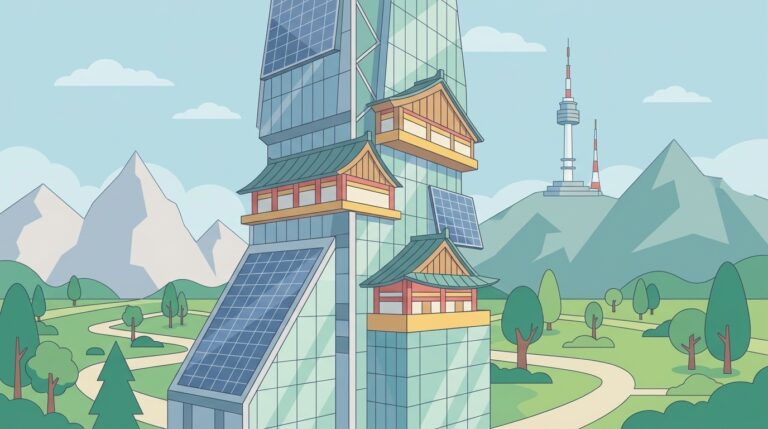
Speak Like an Eco-Architect: Master C2 Korean for Zero-Energy Buildings & Green Materials
Phase 1: Empathy (안녕하세요! Welcome to the Green Tech Revolution)
안녕하세요! (An-nyeong-ha-se-yo!) Hello, my brilliant C2-level language visionaries. It is your favorite senior editor and resident cultural navigator from Daily Hangul here!
Imagine this: You are standing in the middle of a high-tech boardroom in Songdo International Business District, the crown jewel of South Korea’s smart cities. Across the table sit elite structural engineers and green development directors from top-tier firms like Samsung C&T or Hyundai E&C. You want to pitched a cutting-edge, self-sustaining building envelope design that integrates Korean vernacular architectural concepts with modern passive house technologies.
You have the vision. You have the engineering expertise. But when you speak, do you find yourself defaulting to basic terms like “지구를 지키는 건물” (buildings that save the Earth) or “좋은 재료” (good materials)?
To command a room of Korean lead architects, you need words that carry weight, scientific precision, and cultural depth. Today, we are moving past dictionary-definition Korean. We are diving deep into the sophisticated linguistic landscape of Eco-Friendly Building Materials Development and Zero-Energy Buildings (친환경 건축 자재 개발과 제로 에너지 빌딩). This guide was meticulously crafted based on actual corporate tutoring sessions with international sustainable design consultants working right here in Seoul. Let’s elevate your Korean to a visionary level!
Phase 2: Master Class — 3 Elite Expressions Analyzed
To sound like a true industry leader, these three high-level concepts must become second nature to you. Let’s dissect them.
1. 친환경 자재의 선순환 (Chinhwangyeong jajae-ui seonsunhwan)
- Pronunciation: [tɕʰin.ɦwaŋ.ɡjʌŋ dʑa.dʑe.ɰi sʌn.sun.ɦwan] / Cheen-hwan-gyung jah-jae-wee sun-soon-hwan
- Meaning: The virtuous cycle of eco-friendly materials.
- K-Culture Moment: If you watch K-dramas featuring high-flying architects—like the hit drama Our Beloved Summer (그해 우리는)—you will notice how modern Korean design deeply respects natural flows. “선순환” (virtuous cycle) is the holy grail of modern K-engineering, contrasting with “악순환” (vicious cycle).
- Editor’s Insight: Instead of just saying “재활용” (recycling), “선순환” implies a holistic, ecological philosophy where materials are designed from the start to return to nature or be infinitely upcycled. It immediately signals that you possess a high-level system-thinking mindset.
- Situation Spectrum:
- Casual: ⚠️ (Slightly too academic for casual beer chat, but great for smart conversations!)
- Semi-formal: ✅
- Formal: ✅
- 🤔 Think About It: “선” (Seon) in this context means “good” or “virtuous” (善). Why do you think Korean technical terminology heavily relies on Hanja (Sino-Korean characters) to compress complex moral and ecological philosophies into a single, elegant word?
2. 제로 에너지 빌딩의 핵심은 기밀성입니다 (Jero eneoji bilding-ui haeksim-eun gimilseong-imnida)
- Pronunciation: [dʑe.ɾo e.nʌ.dʑi bil.diŋ.ɰi hɛk.ɕi.mɯn ɡi.mil.sʌŋ.im.ni.da] / Jeh-ro eh-nuh-jee bil-ding-wee haek-shee-mun gee-meel-sung-im-nee-dah
- Meaning: The core of Zero Energy Buildings (ZEBs) is airtightness (hermetic sealing).
- K-Culture Moment: Walk into any beautifully renovated modern Hanok (traditional Korean house) café in Samcheong-dong during the freezing Korean winter (daehan). You’ll marvel at how they kept the aesthetic wooden frames but replaced traditional paper windows with vacuum-insulated, high-airtightness glass. That perfect warmth? That is “기밀성” (gimilseong) in action.
- Editor’s Insight: While “기밀” (gimil) in everyday Korean means “top secret” or “classified,” in engineering contexts, it refers strictly to airtightness. Saying “기밀성 확보” (securing airtightness) shows you are a true technical insider.
- Situation Spectrum:
- Casual: 🚫 (Do not say this at a noraebang!)
- Semi-formal: ✅
- Formal: ✅
- 🤔 Think About It: Traditional Korean Hanoks relied on “wind paths” (바람길) for natural ventilation, whereas modern ZEBs rely on absolute airtightness combined with mechanical heat recovery. How would you explain this transition of Korean lifestyle in your own native tongue?
3. 탄소 배출을 상쇄하다 (Tanso baechul-eul sangswoehada)
- Pronunciation: [tʰan.so bɛ.tɕʰu.ɾɯl saŋ.swø.ɦa.da] / Tahn-so bae-chool-ool sahng-sweh-hah-dah
- Meaning: To offset carbon emissions.
- K-Culture Moment: With major K-Pop entertainment powerhouses (like YG, SM, and HYBE) shifting toward eco-friendly album packaging made of biodegradable materials to offset their touring carbon footprint, “탄소 상쇄” (carbon offsetting) has become a buzzword not just in engineering, but across the entire K-wave landscape.
- Editor’s Insight: The verb “상쇄하다” (to offset/counteract) is far more sophisticated than simply saying “줄이다” (to reduce). It implies an active, calculated balance of forces—a key linguistic tool for any project manager or environmental policy writer.
- Situation Spectrum:
- Casual: ⚠️
- Semi-formal: ✅
- Formal: ✅
- 🤔 Think About It: Contrast the nuance of “상쇄하다” (to offset mathematically or physically) with “비기다” (to tie/draw a game). How does using precise mathematical terms elevate your professional authority in a Korean boardroom?
Phase 3: Textbook Korean vs. Real-World Corporate Korean
When pitching sustainability in Korea, textbook-level expressions can make you sound detached from industry reality. Let’s look at how elite professionals actually frame their assertions.
Scenario 1: Proposing Self-Sufficiency Rate in a Pitch
- 📖 Textbook Korean: 이 건물은 스스로 에너지를 많이 만듭니다.
- (“This building makes a lot of energy by itself.”) – Sounds like a elementary school science project.
- 🗣️ Real-World Corporate Korean: 본 건축물은 신재생 에너지 설비를 통해 에너지 자립률 100%를 달성하도록 설계되었습니다.
- (“This building is designed to achieve 100% energy self-sufficiency through renewable energy facilities.”) – Authoritative, precise, and highly professional.
- 💡 Why the Difference? C2-level professional communication utilizes Hanja nouns like “신재생 에너지” (renewable energy) and “에너지 자립률” (energy self-sufficiency rate) to build institutional trust.
Scenario 2: Defending the Budget for Eco-Friendly Insulation
- 📖 Textbook Korean: 좋은 유리를 쓰면 나중에 돈을 아낄 수 있습니다.
- (“If we use good glass, we can save money later.”) – Way too simplistic for a high-stakes meeting.
- 🗣️ Real-World Corporate Korean: 고성능 삼중유리를 적용할 경우, 초기 투자 비용은 상승하나 장기적인 생애주기비용(LCC) 관점에서는 압도적으로 유리합니다.
- (“Applying high-performance triple glazing increases initial investment costs but is overwhelmingly advantageous from a long-term Life Cycle Cost (LCC) perspective.”)
- 💡 Why the Difference? Real Korean developers speak in terms of “생애주기비용 (LCC)” and “삼중유리” (triple glazing). It transforms a vague financial claim into a concrete engineering calculation.
Phase 4: K-Culture Deep Dive & Non-Verbal Savvy
4-1. Nunchi (눈치) and Boardroom Body Language
In Korea, sustainability discussions are rarely just about carbon metrics; they are about consensus and long-term relationships.
* The Blueprint Bow: When presenting green material certifications or blueprints to an executive or client, never slide them across the table. Always hold the document with both hands (두 손으로) and present it with a slight nod or bow.
* Read the Silences: If a Korean partner says, “검토해 보겠습니다” (We will review it), and looks down at the cost section of your green material pitch, do not push harder on the “saving the planet” narrative. Their Nunchi signal is telling you that the initial capital expenditure (CAPEX) is too high. You should immediately pivot to discussing government subsidies for Zero-Energy Buildings.
4-2. The Soul of Hanok in ZEBs: “온돌” (Ondol) and “배산임수” (Baesanimsu)
   [산 - Mountain (North)]
         🌲🌲🌲
     ┌───────────┐
     │   Hanok   │  ◀── Natural Heat & Wind Alignment
     └───────────┘
         🌊🌊🌊
     [강 - River (South)]
Modern green engineering in Korea isn’t a purely Western import. It is the evolution of 배산임수 (Baesanimsu)—the traditional architectural layout of having a mountain at the back (blocking cold winter winds) and a river in front (providing cooling summer breezes).
When modern engineers design zero-energy towers in Seoul, they model wind paths utilizing these exact geomantic principles. Furthermore, Korea’s famous 온돌 (Ondol – underfloor hydronic radiant heating) is now recognized globally as the most energy-efficient radiant floor heating system for passive residential buildings. Highlighting how your design pays homage to traditional Korean thermal engineering is a surefire way to capture the hearts of local clients!
Phase 5: Boardroom Simulation — The Green Light in Songdo
- Setting: A state-of-the-art conference room on the 33rd floor of a smart tower in Songdo. Rainfall washes over the smart glass facades.
- Your Role: Lead Sustainable Design Consultant.
- The NPC: Park Tae-su (박태수 팀장) – Meticulous, budget-conscious, but deeply passionate about making this project Korea’s first Grade 1 ZEB (Zero-Energy Building).
[System Alert: Enter the Boardroom. Keep your posture straight. Park Team Leader is reviewing the material spec sheets.]
- 박 팀장: (Frowning slightly while looking at the glass specifications) 음… 삼중유리에 고성능 단열재까지 쓰면, 초기 예산이 너무 초과되는데요? 꼭 이렇게까지 해야 합니까?
- (Eum… samjung-yuri-e goseongneung danyeoljae-kkaji sseumyeon, chogi yesan-i neomu chogadoeneundeyo? Kkok ireoke-kkaji haeya hamnikka?)
- (Hrm… if we use triple glazing and high-performance insulation, the initial budget will be exceeded too much. Do we absolutely have to go this far?)
- You: (🎭 Nodding respectfully with an empathetic smile) 팀장님 말씀대로 초기 투자 비용이 부담스러우실 수 있습니다. 하지만 이 단열재는 친환경 자재의 선순환을 염두에 두고 개발된 최신 국산 기술입니다.
- (Timjangnim malsseumdaero chogi tuja biyong-i budamseoreousil su isseumnida. Hajiman i danyeoljae-neun chinhwangyeong jajae-ui seonsunhwan-eul yeomdu-e dugo gaebal-doen choesin guksan gisul-imnida.)
- (As you mentioned, Team Leader, the initial investment cost can be burdensome. However, this insulation is a cutting-edge domestic technology developed with the virtuous cycle of eco-friendly materials in mind.)
- 박 팀장: 국산 기술이라고요? 국토교통부 녹색건축 인증(G-SEED) 가산점도 받을 수 있습니까?
- (Guksan gisur-iragoyo? Guktogyeotongbu noksaekgeonchuk injeung gasanjeom-do badeul su isseumnida?)
- (Domestic technology? Can we also receive extra points for the Ministry of Land, Infrastructure and Transport’s Green Building Certification?)
- You: (🎭 Leaning forward slightly, gesturing to the blueprint) 네, 그렇습니다. 본 자재를 적용하면 가산점뿐만 아니라 건물의 기밀성을 최고 등급으로 설계할 수 있습니다.
- (Ne, geureoseumnida. Bon jajae-reul jeogyonghamyeon gasanjeom-ppunman 아니라 geonmul-ui gimilseong-eul choego deunggeup-euro seolgyehal su isseumnida.)
- (Yes, that is correct. Applying this material not only gives extra points but also allows us to design the building’s airtightness to the highest rating.)
- 박 팀장: 기밀성이 올라가면 냉난방 부하는 확실히 줄겠군요. 하지만 건축주가 당장 내야 하는 공사비가 문제예요.
- (Gimilseong-i ollyagayeon naengnanbang buha-neun hwaksilhi julgetgunyo. Hajiman geonchukju-ga dangjang naeya haneun gongsabi-ga munjeyeo.)
- (If airtightness improves, the heating and cooling load will certainly decrease. But the immediate construction cost that the owner has to pay is the problem.)
- You: (🎭 Presenting a financial comparison chart with both hands) 그래서 제로 에너지 빌딩 지원 사업 신청서를 준비했습니다. 정부 보조금을 지원받으면 초기 공사비 차액의 80% 이상을 상쇄할 수 있습니다.
- (Geraeseo jero eneoji bilding jiwon saeop sincheongseo-reul junbihaesseumnida. Jeongbu bojogum-eul jiwonbadeumyeon chogi gongsabi chaaek-ui palsip peosenteu isang-eul sangswoehal su isseumnida.)
- (That is why I prepared the Zero Energy Building Support Project application. With government subsidies, we can offset more than 80% of the initial construction cost difference.)
- 박 팀장: (His face brightens significantly as he reviews the document) 오… 상쇄가 가능하다니 솔깃하군요. 보조금 매칭이 정말 확실한가요?
- (Oh… sangswoe-ga ganeunghadani solgithagunyo. Bojogum maeching-i jeongmal hwaksilhangayo?)
- (Oh… offsetting is possible? That is enticing. Is the subsidy matching absolutely certain?)
- You: (🎭 With absolute confidence) 네, 저희가 이미 사전 검토를 마쳤으며, 이 빌딩의 에너지 자립률 조건이면 무난히 1등급 매칭을 확보할 수 있습니다.
- (Ne, jeohui-ga imi sajeon geomto-reul macheosseumyeo, i bilding-ui eneoji jariplyul jokeon-imyeon munanni il-deunggeup maeching-eul hwakbohal su isseumnida.)
- (Yes, we have already completed the preliminary review, and with this building’s energy self-sufficiency rate conditions, we can easily secure a Grade 1 matching.)
- 박 팀장: 좋습니다! 이 기획안대로 갑시다. 역시 우리 팀 에이스다워요!
- (Choseumnida! I gihwegan-daero gapsida. Yeoksi uri tim eiseu-daweoyo!)
- (Excellent! Let’s go with this proposal. As expected of our team’s ace!)
🔀 Decision Point: Choose Your Strategy
At this point, Park Team Leader asks: “By the way, how should we handle the thermal bridging (열교 현상) at the concrete joints?”
- Option A: “그냥 대충 실리콘으로 막으면 되지 않을까요?”
- (Geunyang daechung sillikon-euro mageumeon doeji aneulkka-yo? / “Can’t we just cover it roughly with silicone?”)
- Option B: “열교 차단재(Thermal Break)를 적용하여 구조적 단열 불연속 부위를 원천 차단해야 합니다.”
- (Yeolgyo chadanjae-reul jeogyonghayeo gujojeok danyeol buryeonsok buwi-reul woncheon chadanhaeya hamnikka? / “We must apply thermal breaks to completely block structural insulation discontinuities.”)
- Option C: “그 부분은 나중에 인부들이 알아서 잘 해줄 겁니다.”
- (Geu bubun-eun najunge inbudeur-i araseo jal haejul geomnida. / “The construction workers will take care of that part themselves later.”)
💡 The Verdict:
- Best Choice: Option B! This shows absolute professional vocabulary (열교 차단재 – thermal break, 불연속 부위 – discontinuity points). It proves you aren’t just a language learner; you are a master of physical building envelopes.
- Bad/Risk Choices: Options A & C. Saying “대충” (roughly) or passing responsibility to site workers (“인부들이 알아서”) destroys professional trust instantly in Korean engineering culture, where detail is sacred.
Phase 6: 10-Second Emotion Shadowing Drill
Let’s inject passion and professional confidence into your spoken Korean. Practice these sentences using the emotional and rhythm cues below!
Drill 1: Standing your ground in a presentation
- Emotion: [😤 Confidently & Uncompromisingly]
- Sentence:
“기밀성 확보가 / 제로 에너지 빌딩의 / 핵심이자 / 타협할 수 없는 가치입니다!” - Pronunciation:
Gimilseong hwakbo-ga / jero eneoji bilding-ui / haeksim-ija / tahyeop-hal su eomneun gachi-imnida! - Translation:
Securing airtightness is the core and non-negotiable value of Zero Energy Buildings!
Drill 2: Winning over a skeptical client
- Emotion: [😊 Warmly & Persuasively]
- Sentence:
“이 친환경 자재는 / 환경뿐만 아니라 / 장기적 유지비도 / 확실하게 / 상쇄해 줍니다!” - Pronunciation:
I chinhwangyeong jajae-neun / hwangyeong-ppunman anira / janggi-jeok yujibi-do / hwaksilhage / sangswoehae jumnida! - Translation:
This eco-friendly material not only protects the environment but also definitely offsets long-term maintenance costs!
Phase 7: K-Culture Eco-Engineering Mini-Dictionary
| Word (Korean/Romanization) | English Equivalent | Contextual Professional Use |
|---|---|---|
| 배산임수 (Baesanimsu) |
Mountain back, river front | Used when discussing natural macro-site planning and orientation of smart green districts. |
| 단열재 (Danyeoljae) |
Insulation material | The most important material in passive houses; crucial when discussing R-values and thermal conductivity. |
| 신재생 에너지 (Sinjaesaeng Eneoji) |
Renewable energy | Encompasses solar PV, geothermal, and wind energy systems required for high-grade ZEB certification. |
| 에너지 자립률 (Eneoji Jariplyul) |
Energy self-sufficiency rate | The quantitative KPI evaluated by the Korean government to award zero-energy building grades (1 to 5). |
Phase 8: Traveler’s Green Engineering Survival Kit
Are you visiting an active eco-construction site or the futuristic Zero-Energy exhibition hall, Seoul Energy Dream Center (서울에너지드림센터)? Keep these 3 rescue phrases in your pocket!
Top 3 Site-Survival Phrases:
- “안전모와 안전화를 착용해야 들어갈 수 있습니까?”
- (Anjeonmo-wa anjeonhwa-reul chagyonghaeya deureogal su isseumnida?)
- Pro-tip: “Do I need to wear a hard hat and safety shoes to enter?” Always prioritize safety (안전 제일) in Korean industrial zones.
- “이 빌딩의 에너지효율등급 인증서를 보여주실 수 있나요?”
- (I bilding-ui eneoji-hyoyul-deunggeup injeungseo-reul boyeojusil su innayo?)
- Pro-tip: “Could you show me this building’s Energy Efficiency Grade certificate?” Great for site audits.
- “태양광 패널의 발전 효율은 어떻게 됩니까?”
- (Taeyanggang paeneol-ui baljeon hyoyur-eun eotteoke doemnida?)
- Pro-tip: “What is the generation efficiency of the solar panels?” Perfect ice-breaker with on-site facility engineers.
📌 Editor’s Travel Note: To locate certified zero-energy landmarks like the Seoul Energy Dream Center or green Hanoks in Eunpyeong Hanok Village, do not use Google Maps (which has restricted features in Korea due to security laws). Instead, use the Naver Map App which lists accurate green architectural points of interest and public transit options with real-time updates.
Phase 9: Deep Thoughts — “한 발 더 깊이” (Going Deeper)
In South Korea, modern urban planning exists in a perpetual, beautiful tension. On one hand, you have the cultural philosophy of Pali-Pali (빨리빨리 – Fast, Fast) which drove the rapid economic rise and built massive high-rise apartment complexes in record time. On the other hand, traditional Korean heritage is rooted in deeply sustainable slow-living, respecting the cycle of nature without leaving a trace.
Today, these two opposing forces are fusing. The South Korean government has legally mandated that all public buildings above a certain size must achieve ZEB certification, with private residential buildings following close behind. The speed of Korean construction is now being applied to build some of the world’s most sophisticated zero-energy structures.
It makes one think: Is sustainability truly about slowing down, or can high-speed innovation and technology be the ultimate savior of our ecosystem?
💬 Your Turn: How does your home country balance the speed of industrial development with the strict demands of green building certification? Let’s discuss this high-level topic in the comments below! (Feel free to try writing in Korean!)
Phase 10: FAQ & Spotting Silent Errors (FAQ Schema Optimized)
Q: Can I use “친환경” (Chinhwangyeong) for absolutely any green material in professional reports?
A: Depends. While “친환경” (eco-friendly) is widely understood, in high-level engineering papers or certification pitches, you should specify the actual certification standard. Use terms like “환경성적표지 인증 제품” (certified environmental product declaration product) or “저탄소 자재” (low-carbon materials) to sound truly academic and legally precise.
Q: What is the difference between “단열” (Danyeol) and “방열” (Bangyeol)?
A: They are polar opposites! 단열 (Insulation) prevents heat transfer (crucial for keeping a building warm or cool), whereas 방열 (Heat dissipation) is the process of releasing heat into the environment (like a computer radiator). Mixing these up in a mechanical drawing review can cause major confusion.
Q: How do I politely disagree with a senior engineer’s outdated insulation method?
A: Never say “그 방법은 틀렸습니다” (That method is wrong). Instead, frame it as a regulatory transition: “선배님 말씀도 맞지만, 최근 강화된 제로 에너지 빌딩 기밀 기준을 충족하기 위해서는 이 공법이 더 안전할 것 같습니다.” (You are correct, Senior, but to satisfy the recently tightened ZEB airtightness standards, this engineering method seems safer.)
🚨 Common Mistake Alert:
- Mistake 1: Using “그린에너지” (Green Energy) instead of “신재생 에너지” (New & Renewable Energy) in official government submittals. “신재생 에너지” is the legally defined term in Korean construction law.
- Mistake 2: Saying “공기가 안 통해요” (Air does not pass) to mean airtightness. The correct engineering term is “기밀성이 우수하다” (Airtightness is excellent).
- Mistake 3: Forgetting to bow slightly when receiving a business card (명함) from a structural engineer. Receive it with both hands, study it for 5 seconds, and place it neatly on the conference table in front of you.
Phase 11: Action Missions — Your Green Blueprint Challenge
Ready to put your C2 Korean eco-engineering skills to the test? Complete these three challenges!
- 🥉 Bronze (The Mirror Spec Pitch): Record yourself saying Drill 1 from Phase 6 with perfect professional gravity. Pay close attention to the pauses (
/). - 🥈 Silver (The ESG Share): Write a short 3-sentence post on LinkedIn or your favorite language community about the importance of 친환경 자재의 선순환 (the virtuous cycle of eco-friendly materials) utilizing at least two words from our Mini-Dictionary.
- 🥇 Gold (The On-Site Quest): Visit a modern green building or a green-certified building near you, locate its mechanical/solar installations, and describe them in a brief Korean paragraph using the term 에너지 자립률 (energy self-sufficiency rate).
Phase 12: Interactive Quiz Challenge
Test your green mettle! Select your answers and click the toggle to reveal the explanations.
1. Situational Judgment
Which phrase is best suited to convince a cost-sensitive developer to use vacuum-insulated glass?
* (A) “이게 최신 유행하는 유리라 디자인이 끝내줍니다!”
* (B) “초기 자재비는 상승하나, 기밀성 향상으로 인한 냉난방 부하 저감 효과가 뚜렷하여 생애주기비용(LCC)을 대폭 절감할 수 있습니다.”
* (C) “환경을 생각해서 그냥 이 유리를 써 주세요. 제발요.”
🔍 Reveal Best Choice & Explanation
Correct Answer: (B)
Using professional terminology like “냉난방 부하 저감” (heating/cooling load reduction) and “생애주기비용” (LCC) shows high-level engineering logic and immediate financial benefit. (A) is too casual, and (C) sounds like begging rather than professional consulting.
2. Fill in the Blanks
Fill in the missing words based on today’s lesson:
“우리 빌딩의 ( 1 )을 높이기 위해서는 벽체 연결 부위의 ( 2 ) 확보가 최우선 과제입니다.”
- Hint 1: Energy self-sufficiency rate
- Hint 2: Airtightness
🔍 Reveal Correct Words
Answers:
1. 에너지 자립률 (Eneoji jariplyul)
2. 기밀성 (Gimilseong)
Full Translation: “In order to increase our building’s energy self-sufficiency rate, securing the airtightness of the wall joints is the top priority.”
3. True or False: Culture Trivia
Traditional Korean Ondol (온돌) technology has nothing in common with modern Zero-Energy Building radiant heating systems.
* True (T) or False (F)?
🔍 Reveal Answer
Answer: False (F)
Modern highly-efficient hydronic radiant floor heating systems utilized in state-of-the-art European and Korean passive houses are direct descendants of the traditional physical layout of Ondol, which utilizes conduction and radiation to heat spaces extremely efficiently without wasting hot air.
축하합니다! (Congratulations!) You have just unlocked C2-level proficiency in Korean Eco-friendly Engineering and Green Building Design. Keep building bridges, saving energy, and speaking like the visionary you are!
See you in the next premium unit of Daily Hangul! 다음 시간에 만나요! 👋







