

Beyond the Murals: Discussing Korea’s Urban Regeneration, Gentrification, and the Soul of Seoul’s Alleyways
Phase 1: Empathy (스토리 몰입형 오프닝)
안녕하세요! Welcome back, language adventurers and urban explorers! It’s your chief editor from Daily Hangul (매일한글).
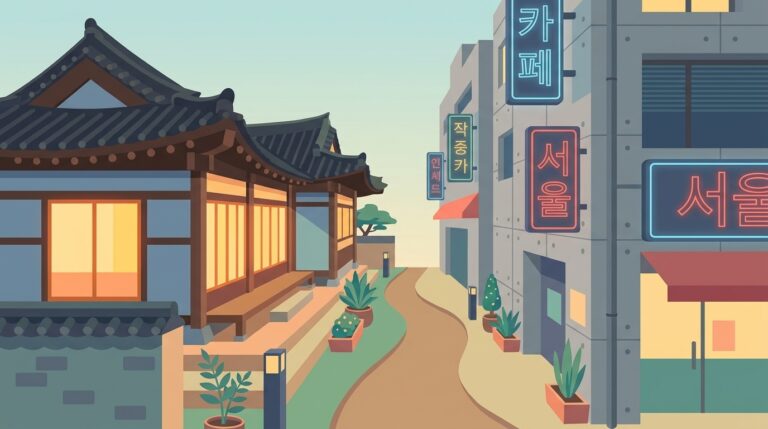
Picture this: You are walking down a narrow, labyrinthine alleyway in Euljiro (을지로). On your left, a 50-year-old metal lathe workshop screeches as sparks fly; on your right, a sleek, neon-lit natural wine bar housed in a crumbling 1960s printing press serves trendy natural wines to young Seoulites. You might have seen this aesthetic clash on Instagram or in popular K-dramas like My Mister (나의 아저씨) or Our Beloved Summer (그해 우리는).
This is the face of South Korea’s ambitious Urban Regeneration New Deal (도시 재생 뉴딜 사업). Originally conceived to breathe life into decaying neighborhoods while preserving their historical identity, this grand socio-architectural experiment has triggered heated debates across Korean society.
As a C2-level learner, you aren’t here just to order coffee; you’re here to engage in deep, nuanced discussions about society, architecture, and structural inequality. If you want to hold your own at a dinner with Korean architects, urban planners, or socially conscious friends, you need the precise vocabulary to critique this urban evolution. Today, we will unpack the triumphs and struggles of Korea’s urban landscape—moving beyond the textbook to analyze the real-world tensions of gentrification and community preservation. Let’s dive in!
Phase 2: Core Expressions Deep Dive (핵심 표현 3선 심층 분석)
1. 온고지신 (溫故知新 / 온고지신)
- Pronunciation: [on-go-ji-sin] / Sound-alike: “own-go-jee-sheen”
- Meaning: Reviewing the old and learning the new. In architectural discourse, it refers to “preservation-based modernization.”
- K-Culture Moment: This idiom is frequently invoked by architects in documentaries talking about the adaptive reuse of Hanoks in Ikseon-dong or factory-cafes in Seongsu-dong (like Onion or Daelim Changgo), showcasing how Korea merges its rapid modernization with historic textures.
- Editor’s Insight: This is a classic four-character idiom (사자성어) that elevates your speech instantly. Use it when praising projects that beautifully integrate historical structures with modern functionality.
- Situation Spectrum:
- Casual: ✅
- Semi-formal: ✅
- Formal: ✅
- 🤔 Think About It: How does your home country balance historic preservation with the demands of modern infrastructure? Why do you think Korea historically preferred “demolish-and-rebuild” (재개발) over Ongojishin?
2. 무늬만 도시 재생 (무늬만 도시 재생)
- Pronunciation: [mu-nui-man do-si jae-saeng] / Sound-alike: “moo-nee-mahn do-shee jae-saeng”
- Meaning: Urban regeneration in name only; superficial, skin-deep cosmetic makeovers.
- K-Culture Moment: Think of neighborhood revitalization projects where the government simply paints colorful murals on cracking walls of impoverished villages (like Ihwa Mural Village) without fixing the lack of parking, sewage issues, or safety hazards.
- Editor’s Insight: “무늬만” (muneeman) literally means “only the pattern/surface.” It is a biting, highly natural sarcastic expression used to criticize anything that lacks substance. It shows a highly sophisticated grasp of Korean social cynicism.
- Situation Spectrum:
- Casual: ✅
- Semi-formal: ✅
- Formal: ⚠️ (Use “실질적인 개선 없는 보여주기식 사업” in formal academic presentations)
- 🤔 Think About It: Why is superficial gentrification or “beautification” easier for local governments to implement than deep structural rehabilitation?
3. 둥지 내몰림 / 젠트리피케이션 (둥지 내몰림)
- Pronunciation: [dung-ji nae-mol-lim] / Sound-alike: “doong-jee nae-moll-leem”
- Meaning: Nest displacement; the native, pure Korean term for gentrification.
- K-Culture Moment: This is the tragic climax of many K-dramas where a beloved neighborhood diner or old bookstore is forced to close because a global franchise coffee shop is moving in due to skyrocketing commercial rents.
- Editor’s Insight: While Koreans use the loanword “젠트리피케이션” (gentrification), the National Institute of Korean Language (국립국어원) coined “둥지 내몰림” (literally, “being pushed out of one’s nest”). Using this term shows incredible linguistic empathy and deep cultural awareness of the vulnerability of local tenants.
- Situation Spectrum:
- Casual: ✅
- Semi-formal: ✅
- Formal: ✅
- 🤔 Think About It: Does the term “nest displacement” evoke a stronger emotional response than the academic term “gentrification”? How does this reflect the Korean cultural value of “Jeong” (정 – communal affection)?
Phase 3: Textbook Korean vs. Real Korean (교과서 한국어 vs. 진짜 한국어)
To sound like a true native intellectual, you must shed rigid, translation-style sentences. Observe how real Koreans express these architectural realities.
Scenario 1: Discussing a newly gentrified, heavily commercialized historic neighborhood.
- 📖 Textbook Korean: “이 지역은 많은 관광객이 방문하지만 원주민들이 떠나가고 있습니다.”
(This area is visited by many tourists, but original residents are leaving.) - 🗣️ Real Korean: “감성 카페들이 들어서면서 결국 상권만 비대해지고 원주민들은 둥지 내몰림을 당하는 악순환이 반복되고 있어요.”
(As trendy ‘aesthetic’ cafes move in, the commercial zone bloated up, repeating the vicious cycle of original residents getting pushed out of their nests.) - 💡 Why the difference? Real Korean uses sensory terms like “감성 카페” (aesthetic cafes) and metaphorical verbs like “들어설다” (to stand in/occupy) to paint a vivid picture of rapid commercialization.
Scenario 2: Critiquing a failed local government regeneration project.
- 📖 Textbook Korean: “정부의 도시 재생 사업은 효과가 별로 없었습니다.”
(The government’s urban regeneration project was not very effective.) - 🗣️ Real Korean: “주민들의 실생활 개선은 안중에도 없고, 그저 벽화나 그리고 도로 포장만 새로 한 무늬만 도시 재생에 그쳤네요.”
(Improving residents’ actual lives wasn’t even on their radar; it just ended up being ‘regeneration in name only’—doing nothing but painting murals and repaving roads.) - 💡 Why the difference? Idioms like “안중에도 없다” (not even in one’s eye line/radar) and “~에 그치다” (stopped short at / limited to) show a critical, analytical attitude essential for C2-level debates.
Phase 4: K-Culture Deep Dive & Non-Verbal Manners
4-1. Spatial Nunchi (눈치) & Alleyway Etiquette
When visiting urban regeneration areas like Changsin-dong or Mullae-dong, a highly sophisticated non-verbal cue is required: Spatial Nunchi. Many of these places are “living museums” where industrial laborers and elderly residents still reside.
* The Whispered Gaze: Avoid pointing directly at crumbling structures or taking intrusive close-up photos of active workshops without asking first.
* The Modest Step: In narrow alleys, yield the right of way to local residents or delivery motorbikes carrying steel sheets. Do not block doorways for the sake of an Instagram photo; it demonstrates an insensitive “poverty tourism” attitude that locals deeply resent.
4-2. The Dual Soul of Seoul’s Architecture
In K-dramas, architecture symbolizes socio-economic status. In Parasite, the vertical contrast between the high-altitude, glass-and-concrete villa of the Park family and the semi-basement (반지하) of the Kim family speaks volumes. The Urban Regeneration New Deal attempted to bridge this gap, but often resulted in creating highly curated, aesthetic pockets of wealth surrounded by neglected poverty. Understanding this tension will allow you to see Seoul not just as a futuristic playground, but as a complex, layered socio-spatial canvas.
Phase 5: Roleplay Scenario (실전 롤플레이 시나리오)
The Setting
A cozy, dimly lit craft beer pub in Euljiro, situated inside an old, repurposed tool shop. Rain is pattering against the corrugated steel roof.
Cast
- You (The Learner): An advanced architectural student doing a research project on Seoul’s urban landscapes.
- Min-woo (민우): A cynical but passionate 3rd-generation Euljiro metal worker who is facing eviction because his building is being sold to make way for a mega-developer.
민우: (한숨을 쉬며 맥주잔을 만지작거린다)
Min-woo: (Sighs, playing with his beer glass)
결국 우리 공장 건물도 대기업 시행사에 팔렸답니다. 이제 갈 데가 없네요.
In the end, our factory building got sold to a major developer too. Now we have nowhere to go.

유: (안타까운 표정으로)
You: (With a look of regret)
아... 정말 속상하시겠어요. 을지로의 역사가 담긴 곳인데, 이렇게 쉽게 사라지다니요.
Oh... that must be so incredibly frustrating. This place holds the history of Euljiro; I can't believe it's disappearing so easily.

민우: (허탈하게 웃으며)
Min-woo: (Laughs hollowly)
정부에서는 도시 재생 어쩌구 하면서 골목길 보존한다고 생색은 다 내더니, 결국은 건물주 배만 불려준 꼴이죠.
The government made such a big deal about urban regeneration and preserving alleyways, but in the end, it only fattened the landlords' pockets.

유: (고개를 끄덕이며)
You: (Nodding)
맞아요. 주민의 삶보다 겉포장만 중요시하는 '무늬만 도시 재생'의 전형적인 한계네요.
You're right. It's a classic limitation of 'urban regeneration in name only,' prioritizing the outer packaging over the residents' actual lives.

민우: (잔을 들이켜고)
Min-woo: (Gulping down his glass)
골목이 유명해지면 뭐 합니까? 임대료가 폭등하니까 저 같은 기술자들은 다 쫓겨나는 걸요.
What's the point of the alley becoming famous? Rents skyrocket, and technicians like me all get kicked out anyway.

유: (진지한 눈빛으로)
You: (With an earnest look)
지속 가능한 상생 대신 '둥지 내몰림'이 악순환처럼 반복되는 현실이 참 씁쓸하네요.
It's truly bitter to see this reality where 'nest displacement' repeats like a vicious cycle, instead of sustainable coexistence.

민우: (당신의 말에 공감하며)
Min-woo: (Sympathizing with your words)
외국인 학생이 우리 같은 영세 상인들 마음을 그렇게 잘 알아주니 고맙기도 하고 신기하네요.
I'm both grateful and amazed that a foreign student understands the hearts of small-scale merchants like us so well.

유: (미소를 지으며)
You: (Smiling gently)
진정한 '온고지신'은 공간만 남기는 게 아니라, 그 공간을 지켜온 사람들의 가치를 지키는 것이니까요.
Because true 'Ongojishin' isn't just about leaving the physical space behind; it's about protecting the value of the people who have kept that space alive.

민우: (맥주를 새로 주문하며)
Min-woo: (Ordering fresh beer)
말이 정말 잘 통하네요! 자, 한 잔 더 합시다!
We really speak the same language! Come on, let's have another round!
🔀 Decision Point: How do you react to Min-woo’s frustration about gentrification?
- Option A: “그래도 동네가 깨끗해지고 젊은 사람들이 많이 오니까 장기적으로는 좋은 거 아닌가요?” (But isn’t it good in the long run because the neighborhood gets clean and young people visit?)
- 🚫 Critical Feedback: This sounds highly insensitive. It minimizes the real pain of displacement and aligns with capitalistic gentrification logic, which might offend a local artisan facing eviction.
- Option B: “진짜 나쁘네요! 대기업하고 건물주들을 다 고소해야 해요!” (That’s so bad! You should sue the conglomerates and landlords!)
- ⚠️ Critical Feedback: Too radical and unrealistic. It lacks the professional, socio-economic perspective expected of a C2 speaker, reducing a complex systemic issue to a simple emotional outburst.
- Option C (Best Choice): “역사적 가치를 지닌 산업 생태계가 파괴되는 것은 단순한 미관 정비보다 훨씬 더 큰 손실이에요.” (The destruction of an industrial ecosystem that holds historical value is a much greater loss than mere aesthetic beautification.)
- ✅ Why it’s best: Extremely sophisticated, empathetic, and structurally accurate. It treats Min-woo as an equal intellectual partner and critiques the systemic issue rather than making superficial claims.
Phase 6: 10-Second Emotion Shadowing Drill (10초 감정 섀도잉 드릴)
To sound native, you must capture the cultural melancholy (한 – Han) and social critique in your tone. Practice with these emotional guideposts:
Drill 1: [😤 Bitterly analytical and critical]
- Sentence: 무늬만 / 도시 재생이지, / 결국은 / 원주민만 / 다 내쫓는 / 결과를 / 낳았네요.
- Romanization: Muneeman / dosi jaesaeng-iji, / gyeolgug-eun / wonjumin-man / da naejjokneun / gyeolgwa-reul / nahatneyo.
- Syllable Stress & Pause: Muu-nee-man [pause] do-shee jae-saeng-ee-jee, [pause] gyul-gook-eun [pause] won-joo-min-man da nae-jjok-neun gyeol-gwa-reul nah-at-neyo.
- Nuance: Critiquing cosmetic governmental policies.
Drill 2: [🥺 Nostalgic yet deeply empathetic]
- Sentence: 공간의 / 껍데기만 / 남기는 게 / 아니라, / 사람의 / 온기를 / 채우는 / 재생이 / 필요합니다.
- Romanization: Gonggan-ui / kkeopdegiman / namgigeun ge / anira, / saram-ui / ongi-reul / chaeuneun / jaesaeng-i / piryohamnida.
- Syllable Stress & Pause: Gong-gan-ui kkeop-de-gee-man [pause] nam-gee-neun-ge ah-nee-rah, [pause] sah-ram-ui ohn-gee-reul chae-oo-neun jae-saeng-ee pee-ryo-ham-nee-da.
- Nuance: Expressing your philosophical vision for human-centered architecture.
Phase 7: K-Culture Mini Dictionary (K-Culture 미니 사전)
- 1. 힙지로 (Hipjiro): A portmanteau of “Hip” and “Euljiro.” It refers to Euljiro’s transformation from a gritty manufacturing district into Seoul’s coolest retro-nightlife hub, capturing the essence of the “Newtro” trend.
- 2. 골목상권 (Golmok-sanggwon): Alleyway commercial spheres. Unlike massive shopping malls, this refers to small, localized clusters of businesses that foster unique local identities but are highly vulnerable to franchise encroachment.
- 3. 아파트 공화국 (Apartment Gonghwaguk): “The Republic of Apartments.” A satirical term used by urban scholars and critics to describe South Korea’s overwhelming landscape of uniform, high-rise residential complexes built at the expense of historical neighborhoods.
- 4. 도시 재생 뉴딜 (Doshi Jaesaeng New Deal): The massive, state-sponsored urban revitalization policy aimed at upgrading deteriorating neighborhoods without demolishing them, utilizing community-driven, local economic initiatives.
Phase 8: Traveler’s Survival Kit (여행자를 위한 생존 키트)
Even if you are an academic tourist, navigating these urban regeneration spots requires physical tools and precise language.
Survival Cards
| Korean | Romanization | English Translation | Pro-Tip |
|---|---|---|---|
| 여기 재개발 구역인가요? | Yeogi jaegaebal gu-yeok-in-gayo? | Is this area slated for redevelopment? | Ask this to local cafe owners to open up a fascinating conversation about the area’s future. |
| 사진 촬영 허락을 받을 수 있을까요? | Sajin chwaryeong heorak-eul badeul su isseulkkayo? | May I get permission to take a photo? | Essential when photographing traditional machinery workshops or private residential alleyways. |
| 이 동네의 옛모습을 볼 수 있는 곳이 어디인가요? | I dongnae-ui yen-moseup-eul bol su inneun gosi eodi-ingayo? | Where can I see how this neighborhood used to look? | Perfect for finding hidden historical archives, municipal exhibition spaces, or local museums. |
📌 Editor’s Travel Note
- Must-Have App: Do not rely on Google Maps in narrow regeneration districts; it does not map tiny alleys well. Use the KakaoMap Web Application or Naver Map Download Page to find hidden rooftop cafes tucked behind old steel mills.
- Cash is King: While Korea is almost entirely cashless, keeping some physical cash is a warm gesture when buying traditional snacks (e.g., 붕어빵 or 호떡) from the elderly street vendors who are fighting to survive in these gentrifying neighborhoods.
Phase 9: Deep Reflection — “한 발 더 깊이” (Going Deeper)
South Korea’s rapid transformation from the ashes of the Korean War to a global economic powerhouse was fueled by a philosophy of speed and efficiency: “Palli-Palli” (빨리빨리 – Fast-Fast). In architecture, this manifested as massive, sweeping redevelopments—clearing historic hillsides to raise concrete apartment blocks.
The Urban Regeneration New Deal represented a monumental philosophical paradigm shift: moving from “demolition” to “preservation.” However, the harsh laws of real estate capitalism often catch up. When a neighborhood becomes culturally attractive, property values skyrocket, and the very people who created its unique charm are priced out. This raises a profound ethical question for global citizens: Is it possible to revitalize a community without destroying its original soul?
💬 Your Turn: How does your home city handle the delicate balance between economic growth and preserving historic communities? Have you seen instances of “nest displacement” in your country? Let’s talk in the comments below!
Phase 10: FAQ & Common Mistakes (FAQ Schema Optimized)
Q: What is the main difference between ‘재개발’ (Jaegaebal) and ‘도시 재생’ (Doshi Jaesaeng)?
A: 재개발 (Redevelopment) is a total-clearance approach where old neighborhoods are completely demolished to build new skyscrapers, roads, and apartments. 도시 재생 (Urban Regeneration) seeks to preserve the existing physical structure and social fabric, improving infrastructure and painting murals while keeping local historical narratives alive.
Q: Is using ‘무늬만’ (Muneeman) considered rude in a professional architectural discussion?
A: It is not rude, but it is highly opinionated and colloquial. In an academic presentation or corporate board meeting, use more formal vocabulary like “형식적인 개선에 치우친” (biased toward cosmetic/formal improvements) or “실질적 성과가 결여된” (lacking substantial results) to maintain a professional, objective distance.
Q: Why do Koreans use ‘둥지 내몰림’ instead of just ‘젠트리피케이션’?
A: While both are understood, 둥지 내몰림 (Nest Displacement) is actively promoted by local governments and social organizations because it evokes a strong moral and emotional duty to protect vulnerable residents. It frames human displacement as losing one’s home and sanctuary, rather than just an economic shift.
🚨 Common Mistakes Alert!
- Saying “도시가 다시 태어났어요” (The city was born again) to mean regeneration: While grammatically correct, it sounds like a generic advertisement. Use “구도심의 활력을 불어넣다” (breathe vitality into the old downtown) for a native C2 academic flavor.
- Confusing ‘원주민’ (Indigenous people/Original residents) with ‘원시인’ (Primitive cavemen): A hilarious but catastrophic slip! Make sure you say 원주민 (原住民 – Original inhabitants) when talking about gentrification, not 원시인 (原始人).
- Using ‘온고지신’ for purely futuristic buildings: Ongojishin requires the coexistence of the old and the new. Do not use it to describe a brand-new, ultra-modern building like the Dongdaemun Design Plaza (DDP) unless you are discussing how its design references the historic fortress walls found during excavation.
Phase 11: Action Missions (실전 액션 미션)
🥉 Bronze Mission (Mirror Shadowing)
Record yourself saying: “개발도 좋지만, 둥지 내몰림에 대한 대책이 우선되어야 합니다.” (Development is good, but countermeasures against nest displacement must come first.) Focus on expressing a firm, socially conscious tone.
🥈 Silver Mission (Community Contribution)
Find a picture of your favorite old neighborhood in Korea (or your own country) and write a 3-sentence post on Instagram or Threads using the words 온고지신 and 도시 재생. Tag us at #DailyHangul!
🥇 Gold Mission (Local Interview)
On your next trip to a trendy spot like Euljiro, Seongsu, or Ikseon-dong, find a small local shop that has survived the transition. Politely ask the owner: “여기서 장사하신 지 얼마나 되셨어요?” (How long have you been doing business here?) and listen to their living history.
🎮 K-Culture Mission
Watch the K-Drama My Mister (나의 아저씨) or the movie Space Sweepers (승리호). Pay attention to how spatial decay, high-tech modernization, and community struggles are visually contrasted in their scenography!
Phase 12: Interactive Quiz Challenge (아코디언 퀴즈)
Test your architectural and socio-linguistic mastery below!
1. Which word best describes a situation where a local government simply repaves a sidewalk and paints beautiful murals, but does nothing to solve the neighborhood’s lack of clean water or heating?
- A) 온고지신
- B) 무늬만 도시 재생
- C) 아파트 공화국
2. Fill in the blank with the most natural advanced term:
“임대료 상승으로 인해 오랜 세월 자리를 지켜온 예술가들이 결국
_________________ 현상으로 쫓겨나고 말았다.”
* A) 빨리빨리
* B) 둥지 내몰림
* C) 재개발
3. True or False: ‘온고지신’ can be used to describe demolishing an old palace to build a bigger replica of it using concrete.
- True
- False
👀 Click here to reveal Answers & Explanations!
- Answer: B) 무늬만 도시 재생
- Explanation: Mural painting without resolving structural living conditions is the quintessential textbook definition of “cosmetic regeneration in name only.”
- Answer: B) 둥지 내몰림
- Explanation: “Nest displacement” (gentrification) is the precise socioeconomic term for artists being priced out by rising rents.
- Answer: False
- Explanation: Demolishing the historic original to build a replica is not Ongojishin (preserving the old to understand the new); it is a destruction of authenticity. True Ongojishin preserves the original physical heritage while integrating modern functionality surrounding or within it.
- Explanation: Demolishing the historic original to build a replica is not Ongojishin (preserving the old to understand the new); it is a destruction of authenticity. True Ongojishin preserves the original physical heritage while integrating modern functionality surrounding or within it.






