

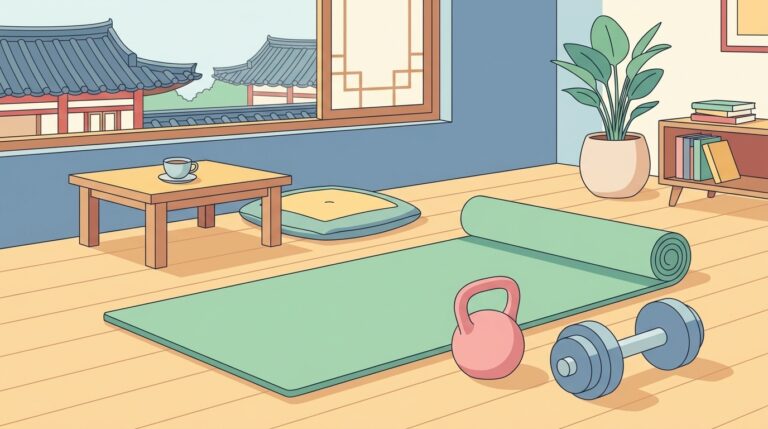
Crush Your Korean Home Workouts: Natural Slang for Dumbbell and Kettlebell Training
Phase 1: Empathy (스토리 몰입형 오프닝)
안녕하세요! (An-nyeong-ha-se-yo!) Welcome back to Daily Hangul, your premium Korean lifestyle and language guide. I’m your chief editor and senior tutor, and today we are stepping away from the traditional desk to break a sweat right in our living rooms!
Imagine this: You’re in your cozy Seoul officetel, inspired by a K-Pop idol’s intense home workout vlog. You’ve got your brand new dumbbell and kettlebell set, ready to crush a session. You put on a fitness stream by a famous Korean trainer, but suddenly you are hit with a wave of unfamiliar words. They aren’t saying “lift” or “exercise”—instead, they are shouting things like “Let’s go, Deuk-geun!” or talking about “destroying” their shoulders.
You hesitate, wondering if you are doing the exercise right or if your downstairs neighbor is about to knock on your ceiling because of the heavy kettlebell vibrations.
Don’t sweat it! Working out at home—or as locals call it, 홈트 (Hom-teu)—has its own rich, vibrant, and surprisingly psychological linguistic culture in Korea. Today, we’ll unlock the exact phrases, cultural etiquette, and colloquial slang you need to sound like a seasoned Korean fitness junkie. By the end of this guide, you’ll not only master your dumbbell and kettlebell routines but also be able to banter with your Korean gym bros like a true local!
Phase 2: 핵심 표현 3선 심층 분석 (Three Core Fitness Expressions)
Let’s dive deep into three essential expressions that will immediately elevate your Korean fitness vocabulary from classroom-level to street-smart.
1. 득근하다 (Deuk-geun-hada)
- Pronunciation: [deuk-geun-ha-da] / Sound-alike guide: “Deuk” sounds like “took” with a soft ‘d’, and “geun” rhymes with the first syllable of “gunshot”.
- Meaning: Literally “to obtain muscle,” but used as a passionate encouragement meaning “May your muscles grow!” or “Happy muscle gains!”
- K-Culture Moment: You will see this word plastered across the comment sections of fitness YouTubers like Kim Jong-kook (Gym Jong Kook) or physical trainers on Instagram. It’s the ultimate blessing shared among fitness enthusiasts.
- Editor’s Insight: This word merges the Hanja (Sino-Korean) root 득 (Deuk – to gain) and 근 (Geun – muscle). It’s incredibly trendy, representing the modern Korean obsession with aesthetic and functional strength.
- Situation Spectrum (상황 스펙트럼):
- Friends & Gym Buddies (Casual): ✅
- Gym Personal Trainer (Semi-formal): ✅ (Very friendly and polite if you add -세요)
- Workplace Boss (Formal): 🚫 (Too casual and slang-like for business meetings)
- 🤔 Think About It (스스로 생각해보기): Why do you think modern Koreans prefer creating new Sino-Korean blend words like “득근” (Deuk-geun) over simply borrowing the English word “gains”? How does this reflect the linguistic efficiency of the Korean language?
2. 홈트 (Hom-teu)
- Pronunciation: [hom-teu] / Sound-alike guide: “Hom” like the English “home”, and “teu” like the first syllable of “telephone” but ending with a soft, short ‘u’ sound.
- Meaning: Home Training (Home Workout).
- K-Culture Moment: During the pandemic, “홈트” became a national phenomenon. Celebrities on shows like I Live Alone (나 혼자 산다) frequently showcase their high-end “홈트” setups, complete with aesthetic dumbbells and kettlebells.
- Editor’s Insight: Koreans love portmanteaus. “홈트레이닝” (Home training) is simply too long for daily conversations. If you say “집에서 운동해요” (I work out at home), it sounds a bit textbook. Saying “홈트해요” (I do Hom-teu) immediately makes you sound natural.
- Situation Spectrum (상황 스펙트럼):
- Friends & Gym Buddies (Casual): ✅
- Gym Personal Trainer (Semi-formal): ✅
- Workplace Boss (Formal): ⚠️ (Use “재택 운동” or “집에서의 개인 운동” in highly formal contexts, but 홈트 is widely understood)
3. 조지다 (Jojida) [Handle with Care!]
- Pronunciation: [jo-ji-da] / Sound-alike guide: “Jo” as in “jog”, “ji” as in “jeep”, “da” as in “dot”.
- Meaning: Literally “to beat up” or “to ruin,” but in fitness jargon, it translates to “to destroy/demolish a muscle group” (e.g., “destroying shoulders” with dumbbells).
- K-Culture Moment: You’ll hear fit Korean friends say “오늘 하체 조진다” (I’m destroying my lower body today). It shows a passionate, raw commitment to pushing physical limits.
- Editor’s Insight: Caution! This is a strong slang word. Outside the gym, it can sound quite aggressive or vulgar. However, within the fitness community, it is used with humorous affection to describe a highly effective, muscle-burning workout.
- Situation Spectrum (상황 스펙트럼):
- Close Gym Buddies (Casual): ✅ (Very natural and funny)
- Gym Personal Trainer (Semi-formal): 🚫 (Too informal unless you are extremely close)
- Workplace Boss (Formal): 🚫 (Absolutely do not use!)
Phase 3: 교과서 한국어 vs 진짜 한국어 (Real Korean Showcase)
Let’s compare the stiff sentences you learn in traditional grammar books with the vibrant phrases actual Koreans use when lifting weights at home.
Situation 1: Explaining your shoulder routine with dumbbells
- 📖 Textbook Korean: 아령을 사용하여 어깨 근육을 강화하고 있습니다.
- Translation: I am strengthening my shoulder muscles using dumbbells.
- 🗣️ 진짜 한국어: 덤벨로 어깨 조지는 중이에요.
- Translation: I’m currently destroying my shoulders with dumbbells.
- 💡 Why the difference? The textbook uses “아령” (a older word for dumbbell) and formal grammar. Modern Koreans almost exclusively use “덤벨” (dumbbell) in active fitness contexts, and “조지는 중” adds a highly realistic, hard-working vibe.
Situation 2: Discussing your home kettlebell workout
- 📖 Textbook Korean: 집에서 케틀벨을 흔드는 운동을 했습니다.
- Translation: I did the exercise of swinging a kettlebell at home.
- 🗣️ 진짜 한국어: 오늘 케틀벨 스윙으로 홈트 제대로 했어요.
- Translation: I did a proper home workout with kettlebell swings today.
- 💡 Why the difference? Translating “swinging a kettlebell” literally sounds robotic. Real Koreans use the loanword “케틀벨 스윙” (kettlebell swing) and combine it with “홈트” and the intensive adverb “제대로” (properly/intensely) to show they had a high-quality session.
Phase 4: K-Culture 딥다이브 & 비언어적 매너 (Cultural Nuances)
4-1. 눈치 (Nunchi) and the Silent Home Workout Etiquette
In Korea, home training is not just about physical effort; it is a test of your 눈치 (Nunchi – situational quick-wittedness). Most Koreans live in high-rise apartments (아파트) or multi-unit villas where sound travel is incredibly efficient. This introduces the concept of 층간소음 (Cheung-gan-so-eum – inter-floor noise).
- The Dumbbell/Kettlebell Manners: Dropping a 16kg kettlebell onto a bare wooden floor is practically a declaration of war against your downstairs neighbor. To maintain social harmony, you must use a thick 홈트 매트 (workout mat). When setting down your dumbbells, you must lower them with extreme control. This is actually a great eccentric training method—so you can think of neighborly politeness as a way to gain more muscle!
4-2. The “Body Profile” (바디프로필) Phenomenon
In K-Culture, staying fit is often tied to the highly popular trend of shooting a 바디프로필 (Body Profile). Young Koreans train intensely for months, often using home equipment to supplement gym workouts, to capture professionally photographed, highly aesthetic shots of their peak physical condition. It is a major milestone of 자기관리 (Ja-gi-gwan-ri – self-management), a highly valued social trait in modern Korea.
Phase 5: 게이머가 된 듯한 실전 롤플레이 시나리오 (Interactive Roleplay)
Scenario: You are at your apartment in Seoul. Your fitness-conscious Korean friend, Min-ho (민호), has come over to check out your new home gym setup. He brought his favorite competition kettlebell to show you.
- Cast:
- You (C1 Korean Learner): Passionate about lifting weights, trying to show off your natural fitness slang.
- Min-ho (민호): A friendly gym fanatic who loves “득근” and takes home training very seriously.
The Dialogue
- 민호: 우와, 집 진짜 깔끔하다! 근데 이 덤벨이랑 케틀벨은 새로 산 거야?
- [Min-ho: Wow, your place is so clean! By the way, are this dumbbell and kettlebell newly bought?]
- You: 🎭 (Proudly pointing at the gear) 응, 맞어! 이번에 당근마켓에서 상태 좋은 걸로 득템했지. 요즘 홈트에 꽂혔거든.
- [You: Yep, that’s right! I scored them in great condition on Karrot Market recently. I’m really into Hom-teu these days.]
- 민호: 대박! 당근마켓에서 이걸 구했다고? 진짜 잘 샀다. 케틀벨 몇 킬로짜리야?
- [Min-ho: Awesome! You got this on Karrot Market? What a steal. How many kilograms is the kettlebell?]
- You: 🎭 (Picking up the kettlebell effortlessly) 이거 16킬로짜리야. 너도 한번 들어볼래?
- [You: This is a 16kg one. Do you want to try lifting it?]
- 민호: 🎭 (Taking the kettlebell and swinging it smoothly) 와, 그립감 장난 아니다! 이걸로 케틀벨 스윙하면 어깨랑 둔근 바로 조지겠는데?
- [Min-ho: Wow, the grip is no joke! If you do kettlebell swings with this, you’ll destroy your shoulders and glutes instantly, right?]
- You: 🎭 (Laughing) 그치? 어제도 그걸로 홈트 하다가 지옥을 맛봤어. 오늘 같이 조져볼래?
- [You: Right? I tasted hell doing Hom-teu with that yesterday too. Want to destroy our muscles together today?]
- 민호: 좋지! 근데 아래층에서 올라오는 거 아냐? 층간소음 조심해야 해.
- [Min-ho: Sounds great! But won’t the downstairs neighbor come up? We have to watch out for inter-floor noise.]
- You: 🎭 (Winking and pointing down) 걱정 마! 내가 6센티짜리 두꺼운 홈트 매트 깔아놨거든. 살살 내려놓으면 절대 안 들려.
- [You: Don’t worry! I laid down a thick 6cm workout mat. If we put them down gently, they’ll never hear it.]
- 민호: 역시 준비성이 철저하네! 자, 그럼 덤벨 프레스부터 3세트 갈까? 마지막 랩은 드롭 세트로!
- [Min-ho: As expected, you are thoroughly prepared! Alright, shall we start with 3 sets of dumbbell presses? Drop set for the last rep!]
- You: 🎭 (Tightening your grip on the dumbbells) 당연하지! 오늘 제대로 득근하고 치맥 먹으러 가자!
- [You: Absolutely! Let’s get a proper muscle pump today and go grab chicken and beer!]
🔀 Decision Point (의사결정 분기점)
Min-ho suddenly challenges you to do 50 consecutive kettlebell swings to finish the session. How do you respond?
- Option A: “죄송하지만 제 어깨 관절이 아픕니다.” (Textbook, excessively formal, kills the energetic workout vibe.)
- Option B: “50개? 오케이, 오늘 내 근육 다 조져보자! 대신 근손실 오면 네가 책임져!” (Excellent! Fun, casual, uses fitness slang naturally, shows deep rapport.)
- Option C: “안돼요, 아래층 사람이 화낼 거예요.” (A bit flat, misses the chance to use gym slang, though practical.)
-
Best Choice: Option B. It matches Min-ho’s high-energy fitness vibe perfectly while teasing him about the ultimate gym fear: 근손실 (muscle loss).
Phase 6: 10초 감정 섀도잉 드릴 (Interactive Shadowing Drill)
To sound truly natural, you need to match the rhythmic pacing and emotion of Korean gym enthusiasts. Practice these three distinct vibes!
- [😊 High Energy & Encouraging]
- “오늘도/ 득근합시다!/ 파이팅!”
- Pronunciation: [O-neul-do/ deuk-geun-hap-si-da!/ Pa-i-ting!]
- Meaning: Let’s gain muscle today as well! Fighting!
- [🤫 Quietly Alert / Warning Your Gym Buddy]
- “층간소음 때문에/ 덤벨은/ 살살 내려놓으세요.”
- Pronunciation: [Cheung-gan-so-eum ttae-mun-e/ deom-bel-eun/ sal-sal nae-ryeo-no-eu-se-yo.]
- Meaning: Because of inter-floor noise, please set the dumbbells down gently.
- [😩 Exasperated yet Fully Satisfied]
- “아…/ 오늘/ 어깨/ 제대로 조졌다…”
- Pronunciation: [Ah…/ o-neul/ eo-kkae/ je-dae-ro joj-eot-da…]
- Meaning: Ah… I absolutely demolished my shoulders today…
Phase 7: K-Culture 미니 사전 (4 Key Lifestyle Keywords)
| Word (한글 + Romanization) | English Translation | Cultural Context & Usage |
|---|---|---|
| 오운완 (O-un-wan) | Today’s Workout Completed | The absolute king of social media hashtags (#오운완) used when posting a mirror selfie after working out. |
| 근손실 (Geun-son-sil) | Muscle Loss / Catabolism | The ultimate humorous fear of any Korean fitness enthusiast. Missed a meal? “Ah, 근손실 is coming!” |
| 헬린이 (Hel-rin-i) | Gym Beginner | A portmanteau of “Health” (헬스) and “Child” (어린이 – Eorini). Used self-deprecatingly by beginners. |
| 근수저 (Geun-su-jeo) | Muscle Spoon (Genetically Fit) | A playful twist on the class system metaphor “Gold Spoon” (금수저). Refers to someone born with naturally great athletic genetics. |
Phase 8: 여행자를 위한 생존 키트 (Traveler’s Survival Kit)
Even if you are only staying in Korea for a short month, you can keep up your fitness routine using these quick hacks!
Survival Phrases for the Traveling Lifter
- “이 근처에 일일권 끊을 수 있는 헬스장 있나요?”
- [I geun-cheo-e il-il-gwon kkeun-eul su in-neun hel-seu-jang in-na-yo?]
- Pro Tip: “Is there a gym nearby where I can buy a 1-day pass?” Perfect when your Airbnb doesn’t have home equipment.
- “덤벨 제자리에 놓아주세요.”
- [Deom-bel je-ja-ri-e no-ah-ju-se-yo.]
- Pro Tip: “Please return dumbbells to their designated spot.” A common gym sign you will see.
📌 Editor’s Travel Note
If you want to buy high-quality, cheap dumbbells or kettlebells while in Korea, do not buy them brand new. Download the Karrot Market (당근마켓) App to buy second-hand gear from locals in your neighborhood. It’s safe, extremely fast, and you can practice your Korean chatting skills while picking up your kettlebell!
Phase 9: 깊이 있는 생각 질문 — “한 발 더 깊이” (Deep Cultural Reflection)
In Korea, the obsession with fitness, home training, and body profiles runs deeper than simple physical wellness. It is fundamentally tied to the societal demand for 자기관리 (Ja-gi-gwan-ri – self-management). In a fast-paced, highly competitive society, how you manage your body is often viewed as a direct reflection of your mental discipline, work ethic, and respect for others. While this drives a highly active and healthy lifestyle culture, it also places immense aesthetic pressure on younger generations.
💬 Your Turn: How does your home country view the relationship between physical fitness and personal character? Is there a similar emphasis on visible self-management, or is working out seen as purely personal leisure? Let us know in the comments below!
Phase 10: FAQ & 오해 방지 (FAQ Schema Optimized)
Q: Can I use the word “조지다” to my physical trainer (PT) to show my dedication?
A: Generally, no. While it is funny, “조지다” is still considered low-level slang. If you want to say you want to work hard to your trainer, say “오늘 하체 하얗게 불태우고 싶습니다!” (I want to burn my lower body white hot today!) instead.
Q: Is there a linguistic difference between “아령” (Ah-ryeong) and “덤벨” (Deom-bel)?
A: Strictly speaking, they mean the same thing. However, “아령” feels like an older, traditional term (often associated with grandma’s light plastic walking weights), while “덤벨” is the modern, trendy loanword used in weightlifting and modern fitness contexts.
Q: Can I practice kettlebell swings in a Hanok (traditional wooden guesthouse)?
A: Absolutely not. Hanok floors are made of delicate wood and traditional paper structures. Heavy kettlebell movements or dropping dumbbells will easily cause damage and massive structural vibration. Save your swings for modern, concrete-built apartments with thick mats!
🚨 Fitness Slang Mistakes to Avoid:
- Calling the gym a “Gym”: In Korea, a fitness club is almost exclusively called 헬스장 (Hel-seu-jang), and working out there is 헬스 (Hel-seu). Saying “체육관” (Che-yuk-gwan) makes it sound like a school gymnasium.
- Shouting “득근” to strangers: While it’s friendly, keep it to social media comments or close friends. Shouting it at a random person at the local park gym might make them run away!
Phase 11: 액션 미션 및 참여 유도 (Action Missions)
Are you ready to apply what you learned today? Let’s take on the Daily Hangul Home Gym Challenge!
- 🥉 Bronze (방구석 챌린지): Record yourself saying “오늘도 득근합시다!” with a passionate fist pump. Check your pronunciation of “Deuk-geun”!
- 🥈 Silver (네트워크 챌린지): Take a photo of your dumbbell or kettlebell setup at home and post it on social media with the hashtag #오운완 and #홈트.
- 🥇 Gold (현실 챌린지): Chat with a Korean friend or trainer and casually drop the phrase: “오늘 하체 운동 제대로 조졌어요.” (I completely destroyed my lower body routine today) and watch their surprised, delighted reaction!
Phase 12: 인터랙티브 퀴즈 챌린지 (Interactive Quiz)
Test your knowledge of Korean fitness culture and slang!
1. What is the most appropriate hashtag to use on Instagram after finishing a heavy home kettlebell workout?
a) #아령운동
b) #오운완
c) #체육시간
2. Fill in the blank:
“덤벨을 내려놓을 때는 _________ 소리가 나지 않게 살살 내려놓아야 해요.”
Hint: It refers to inter-floor noise in Korean apartments.
3. True or False:
“득근” (Deuk-geun) is a word that has been used in classic Korean literature for hundreds of years.
🔍 Click here to check the answers and explanations!
- Answer: b) #오운완 (Today’s Workout Completed). It is the absolute trendiest tag for fitness achievements in Korea.
- Answer: 층간소음 (Cheung-gan-so-eum). Living in harmony with neighbors is a core Korean value!
- Answer: False. “득근” is modern internet slang created by fusing Sino-Korean characters to mimic traditional idioms, highlighting the dynamic evolution of the Korean language!
See you in the next lesson! Until then, stay safe, lift smart, and 오늘도 득근하세요!






