

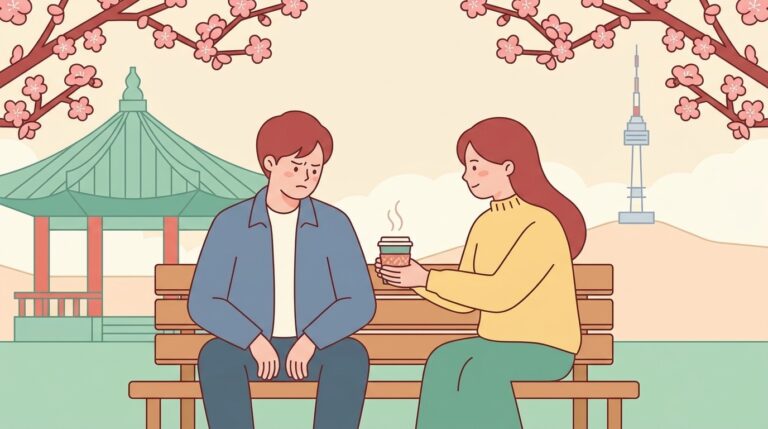
When Panic Strikes in Seoul: How to Say ‘Calm Down’ in Korean Like a True Friend
안녕하세요! (An-nyeong-ha-se-yo!) Welcome back to Daily Hangul. I’m your lead editor and your friendly neighborhood Korean tutor.
We’ve all been there: You’re at a bustling Han River park, enjoying the sunset, when your friend suddenly gasps. They can’t find their phone, or maybe they just realized they lost their concert ticket to see their favorite K-Pop group! Their eyes go wide, their breathing speeds up, and panic sets in.
You want to help. You want to tell them to take a deep breath and relax. But in that high-stress moment, your mind goes blank. How do you say ‘Hey, calm down’ or ‘It’s going to be okay’ in natural, warm Korean without sounding like a cold textbook?
Today, we are going to learn how to soothe anxious situations and calm someone down using real, everyday Korean. These aren’t just vocabulary words; they are linguistic warm blankets that will make your Korean friends go, ‘Wow, you really understand me.’
1. The Core 3: Comforting Expressions to Calm Anyone Down
Here are the three most essential expressions you need to know when someone around you is panicking.
① 진정하세요 (Jin-jeong-ha-se-yo)
- Pronunciation: Jin-jeong-hah-seh-yo (Sounds like: ‘Jean-jung-hah-seh-yo’)
- Meaning: Please calm down / Take it easy.
- K-Culture Moment: You’ve definitely seen this in K-Dramas! Think of the scene where a character gets dramatic news at a company office, and their coworker gently holds their arm, saying, ‘Jin-jeong-ha-se-yo.’
- Editor’s Insight: This comes from the hanja word ‘진정’ (jin-jeong), which means ‘suppressing excitement or agitation’ and bringing things back to a peaceful state. The ‘-하세요’ ending makes it polite and safe for almost any situation.
- Situation Spectrum:
- Friends & Casual: ⚠️ (Use ‘진정해’ Jin-jeong-hae instead!)
- Coworkers & Semi-formal: ✅
- Bosses & Elders: ✅
- 🤔 Think About It: In Korean culture, keeping the harmony (평화) of a group is highly valued. When you say Jin-jeong-ha-se-yo, you aren’t just telling them to stop crying or yelling; you are gently inviting them back into a shared state of peace.
② 괜찮아요 (Gwen-chan-a-yo)
- Pronunciation: Gwen-chahn-ah-yo (Sounds like: ‘Gwen’ Stefani + ‘chahn’ + ‘ah-yo’)
- Meaning: It’s okay / No worries / Everything will be fine.
- K-Culture Moment: Think of that iconic healing K-Drama scene where the lead character is having a rough day, and their best friend buys them a sweet banana milk (바나나맛 우유) and says, ‘Gwen-chan-a-yo.’
- Editor’s Insight: This is the ultimate Korean survival phrase. It doesn’t just mean ‘I am okay.’ When said with a soft, falling intonation, it acts as a magical spell that reassures the other person that the world is not ending.
- Situation Spectrum:
- Friends & Casual: ✅ (Drop the ‘-yo’ to say ‘괜찮아’)
- Coworkers & Semi-formal: ✅
- Bosses & Elders: ✅
③ 천천히 말해보세요 (Cheon-cheon-hi mal-hae-bo-se-yo)
- Pronunciation: Chuhn-chuhn-hee mahl-heh-boh-seh-yo
- Meaning: Please take your time and tell me / Speak slowly.
- K-Culture Moment: Anxious international fans during a K-Pop video call fansign (팬싸인회) often panic because of the 60-second timer. Idols love to look them in the eyes and say, ‘Cheon-cheon-hi mal-hae-bo-se-yo.’
- Editor’s Insight: ‘천천히’ means ‘slowly’ and ‘말해보세요’ means ‘try talking.’ This expression is beautiful because it gives the panicking person permission to slow down time.
- Situation Spectrum:
- Friends & Casual: ⚠️ (Say ‘천천히 말해봐’ Cheon-cheon-hi mal-hae-bwa)
- Coworkers & Semi-formal: ✅
- Bosses & Elders: ✅
2. Textbook Korean vs. Real-Life Korean
When we study from old-school textbooks, we often learn sentences that are grammatically perfect but sound incredibly stiff—almost like a robot from a 1980s sci-fi film!
Situation 1: Your friend spilled coffee on their laptop.
- 📖 Textbook Korean: “흥분을 가라앉히십시오.” (Heung-bun-eul ga-ra-an-hi-sip-si-o – ‘Please subside your excitement.’)
- 🗣️ Real Korean: “워워, 진정해!” (Wo-wo, jin-jeong-hae! – ‘Whoa, whoa, calm down!’)
- 💡 Why is it different? Koreans love efficiency and rhythm. Saying ‘Wo-wo’ (just like ‘whoa, whoa’ in English) instantly breaks the tension and sounds incredibly friendly!
Situation 2: Your coworker made a small mistake on a presentation.
- 📖 Textbook Korean: “염려하지 마십시오.” (Yeom-ryeo-ha-ji map-si-o – ‘Do not worry.’)
- 🗣️ Real Korean: “별일 아니에요. 괜찮아요!” (Byeol-il a-ni-e-yo. Gwen-chan-a-yo! – ‘It’s no big deal. It’s okay!’)
- 💡 Why is it different? Yeom-ryeo is a very heavy, literary word for ‘worry.’ Using ‘Byeol-il a-ni-e-yo’ (literally: ‘It is not a special event’) minimizes the problem and makes your coworker feel instantly relieved.
3. K-Culture Deep Dive: The Art of ‘Nunchi’ and Body Language
Calming someone down in Korea isn’t just about the words you speak; it is heavily tied to Nunchi (눈치)—the Korean art of reading the room and sensing other people’s emotions.
4-1. Soft Body Language
In Western cultures, when someone is panicking, you might give them a loud, energetic ‘Come on, you got this!’ or a big shoulder shake. In Korea, a gentler, softer touch is appreciated.
* The Soft Nod: Nod your head slowly while listening to them. This shows ‘공감’ (gong-gam / empathy).
* The Open Palms: Keep your hands visible and open. It communicates that you are ready to help.
* Avoiding Eye-Staring: Don’t stare too intensely, as it can feel confrontational. Instead, keep a soft, warm gaze.
4-2. The Healing Power of Food & Drinks
If a Korean friend is highly stressed, the ultimate cultural remedy is offering them something sweet or soothing.
In dramas, you’ll often see characters say, ‘달달한 것 좀 먹어’ (Eat something sweet) or offering a hot cup of honey tea (꿀차). When someone is angry or panicking, giving them something sweet is seen as the fastest way to physically calm their nervous system!
4. Playable Roleplay: The Lost Phone Emergency!
Let’s put your new skills to the test. Imagine you and your Korean friend, Min-jun, are in Hongdae (홍대). You are heading to a K-Pop concert, but right outside the subway station, Min-jun starts frantically patting his pockets.
- Setting: The crowded exit of Hongdae Subway Station. Neon signs flashing, street music playing.
- Your Role: The calm, supportive friend.
- NPC: Min-jun (A panicked K-Pop fan).
Min-jun: (🎭 Patting his pockets frantically, eyes wide)
어떡해! 핸드폰이 없어! 어떡하지?
(Eo-tteok-hae! Haen-deu-pon-i eop-seo! Eo-tteok-ha-ji?)
"Oh no! My phone is gone! What do I do?"

You: (🎭 Putting a gentle hand on his shoulder)
민준아, 워워! 진정해.
(Min-jun-a, wo-wo! Jin-jeong-hae.)
"Min-jun, whoa, whoa! Calm down."

Min-jun: (🎭 Breathing fast, checking his bag again)
티켓도 핸드폰 안에 있단 말이야! 우리 못 들어가면 어떡해?
(Ti-ket-do haen-deu-pon an-e it-dan mal-i-ya! U-ri mot deul-eo-ga-myeon eo-tteok-hae?)
"The concert ticket is inside the phone! What if we can't get in?"

You: (🎭 Speaking in a slow, comforting voice)
괜찮아, 괜찮아. 방법이 있을 거야.
(Gwen-chan-a, gwen-chan-a. Bang-beop-i is-seul geo-ya.)
"It's okay, it's okay. There will be a way."

Min-jun: (🎭 Shaking his head, nearly crying)
아까 편의점에서 흘렸나? 아니면 지하철?
(A-kka pyeon-ui-jeom-eseo heul-ryeon-na? A-ni-myeon ji-ha-cheol?)
"Did I drop it at the convenience store earlier? Or the subway?"
🔀 Decision Point: What do you say next?
- Choice A: “빨리 말해봐!” (Ppal-li mal-hae-bwa! – ‘Hurry up and tell me!’)
- Choice B: “천천히 생각해보자. 마지막으로 핸드폰 쓴 게 언제야?” (Cheon-cheon-hi saeng-gak-hae-bo-ja. Ma-ji-mak-eu-ro haen-deu-pon sseun ge eon-je-ya? – ‘Let’s think slowly. When was the last time you used your phone?’)
- Choice C: “핸드폰 잃어버리다니 바보야?” (Haen-deu-pon il-eo-beo-ri-da-ni ba-bo-ya? – ‘Are you a fool for losing your phone?’)
💡 Analysis of Choices:
- Best Choice: B! Asking them to think ‘천천히’ (slowly) redirect’s their brain from panic to logic. It shows you are acting as their anchor.
- Bad/Risk Choice: A. Telling someone who is panicking to ‘Hurry up’ will only make their blood pressure spike!
- Avoid Choice: C. Calling them a ‘바보’ (fool) in a real emergency will destroy the friendship instantly, even if you mean it as a joke!
5. The 10-Second Emotional Shadowing Drill
To make these phrases feel natural, you must practice with the correct emotion. Try speaking these sentences out loud, pausing at the / marks, and focusing on the designated mood!
- [🥺 Softly and reassuringly]
괜찮아요, / 다 잘 될 거예요.
(Gwen-chan-a-yo, / da jal doel geo-yeo-yo.)
“It’s okay, / everything will turn out fine.” -
[🧘 Calmly and slowly]
숨을 깊이 / 쉬어 보세요. / 쓰읍, 후우.
(Sum-eul gip-i / swi-eo bo-se-yo. / Sseu-eup, hoo-oo.)
“Try to / breathe deeply. / Inhale, exhale.” -
[🤝 Firmly and reliably]
제가 도울게요. / 걱정하지 마세요.
(Je-ga do-ul-ge-yo. / Geok-jeong-ha-ji ma-se-yo.)
“I will help you. / Please do not worry.”
6. K-Culture Mini Dictionary
Here are 4 cultural terms that will help you understand the comforting psychology of Korean speakers:
| Word | Pronunciation | English Meaning | Cultural Context |
|---|---|---|---|
| 진정 (Jin-jeong) | Jin-jeong | Calming / Settling down | Used to describe restoring balance to wild emotions or physical symptoms. |
| 워워 (Wo-wo) | Wo-wo | Whoa, whoa | Adopted from horse-riding commands, now used playfully to calm excited friends. |
| 괜찮아 (Gwen-chan-a) | Gwen-chan-a | It’s alright | A warm word that builds a safe space, emphasizing that mistakes are normal. |
| 토닥토닥 (To-dak-to-dak) | To-dak-to-dak | Pat-pat | Onomatopoeia for gently patting someone’s back to comfort them. |
7. Traveler’s Survival Kit: Emergency Edition
If you find yourself in a real, tough spot in Korea, keep these three phrases in your back pocket:
- 도와주세요! (Do-wa-ju-se-yo!)
- Meaning: Help me, please!
- Pro Tip: Use this loudly if you are in physical danger or need immediate local assistance.
- 괜찮으세요? (Gwen-chan-eu-se-yo?)
- Meaning: Are you okay?
- Pro Tip: Use this if you see someone slip on rainy streets or drop their bags.
- 천천히 말씀해 주세요. (Cheon-cheon-hi mal-sseum-hae ju-se-yo.)
- Meaning: Please speak slowly for me.
- Pro Tip: Excellent for when a taxi driver or clerk is speaking too fast for your A2 Korean level.
📌 Editor’s Travel Note:
If you are lost or experiencing an emergency in Korea, download the Naver Map App for accurate offline route-finding, and save the emergency numbers: 112 for Police and 119 for Medical Emergencies. They often have English-speaking translators available!
8. One Step Deeper: The Korean Spirit of ‘Jeong’ (정)
Have you ever wondered why Koreans are so quick to offer help, tissues, or sweet snacks when they see someone crying or stressed? It comes down to Jeong (정).
Jeong is a beautiful Korean concept that translates to ‘collective affection, attachment, and shared feeling.’ In Korea, people rarely view themselves as completely isolated individuals. When a classmate or even a stranger is panicking, Koreans feel a subconscious pull of Jeong to step in and share that burden. By learning how to say ‘진정하세요’ or ‘괜찮아요’, you are stepping into this warm circle of mutual support.
💬 Your Turn: How do people in your country calm someone down? Do you offer food, a hug, or just space? Let me know in the comments below!
9. FAQ & Avoiding Common Mistakes
Q: Can I use “진정해” (Jin-jeong-hae) to an older person or my boss?
A: No! Dropping the polite ending to say ‘Jin-jeong-hae’ to an elder or a boss is highly rude. It sounds like you are ordering them around. Always use the polite form: “진정하세요” (Jin-jeong-ha-se-yo).
Q: Does “괜찮아요” mean yes or no?
A: It depends! If someone offers you more food and you say ‘괜찮아요’, it usually means ‘No, thank you (I am fine).’ But if you make a mistake and someone says ‘괜찮아요’, it means ‘Don’t worry about it.’ Pay attention to the smile and the gentle head shake!
Q: Is there a gesture that goes with “괜찮아”?
A: Yes! Koreans often wave their hand slightly from side to side in front of their chest while saying ‘괜찮아’ to visually show ‘No problem/Don’t sweat it.’
🚨 Top 3 Mistakes to Avoid:
- Saying “야! 진정해!” (Ya! Jin-jeong-hae!) to strangers. (Ya means ‘Hey!’ and is strictly for very close friends. Using it on strangers sounds aggressive.)
- Telling someone “울지 마세요” (Ul-ji ma-se-yo / Don’t cry) too quickly. Sometimes, letting them cry is healthier. Instead, say ‘괜찮아요, 마음껏 우세요’ (It’s okay, cry as much as you need).
- Using robotic translator apps for emotion. Translators often spit out stiff military phrasing like ‘안정을 취하십시오’. Stick to our simple, warm phrases instead!
10. Your Three-Step Action Mission!
Let’s move from reading to doing! Complete these steps this week:
- 🥉 Bronze (The Mirror Challenge): Look in the mirror and practice saying “괜찮아요, 천천히 말해봐요” with your warmest, friendliest smile.
- 🥈 Silver (The Social Challenge): Post a comforting comment in Korean on a friend’s or favorite idol’s social media post using “오늘도 힘내세요! 다 괜찮을 거예요!” (Find strength today! Everything will be fine!).
- 🥇 Gold (The Live Challenge): The next time a classmate or coworker looks stressed, walk over, offer them a sweet snack, and say: “피곤하죠? 이거 먹고 진정해요.” (Tired, right? Eat this and relax.)
11. Interactive Quiz Challenge
Test your A2 Korean skills below! Click the toggle to check your answers.
Q1. Your close friend is panicking about an exam that starts in 5 minutes. Which phrase is the most natural and friendly to use?
- A) 진정하십시오 (Jin-jeong-hap-si-o)
- B) 야, 괜찮아! 걱정하지 마. (Ya, gwen-chan-a! Geok-jeong-ha-ji ma.)
- C) 염려를 멈추세요. (Yeom-ryeo-reul meom-chu-se-yo.)
🔍 Click here to see the Answer & Explanation!
- Correct Answer: B!
- Explanation: Since they are a close friend, using casual language (반말 / ban-mal) like ‘야, 괜찮아! 걱정하지 마’ is the warmest and most natural choice. Option A is too formal, and Option C sounds like a machine translation!
Q2. True or False: You should always shake a Korean person’s shoulders energetically to help them calm down.
- A) True
- B) False
🔍 Click here to see the Answer & Explanation!
- Correct Answer: B (False)!
- Explanation: Gentle, non-intrusive body language and soft verbal comfort (such as offering sweet tea) are much more appreciated in Korean culture than intense physical shaking.
Keep practicing, stay warm, and remember: 괜찮아요, 다 잘 될 거예요! (It’s okay, everything will be just fine!) See you in the next lesson of Daily Hangul!







