

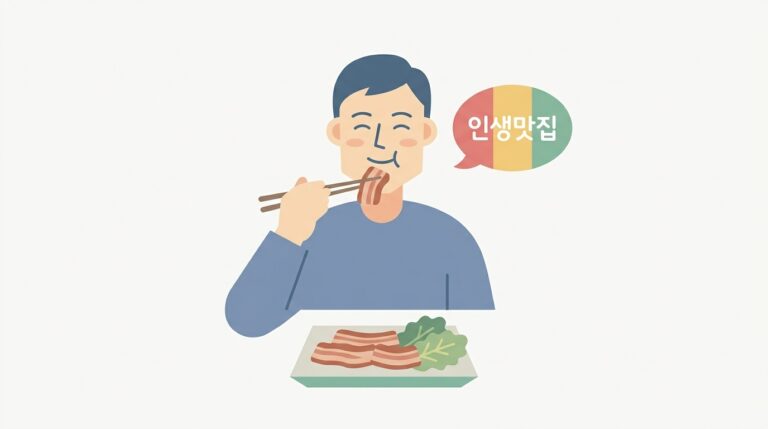
Stop Saying Just “Masisseoyo”! How to Rave About Korean Food Like a True Local
안녕하세요! (Annyeonghaseyo!) It’s your favorite Korean tutor and local culture navigator from Daily Hangul.
Imagine this: You are sitting in a cozy, steam-filled restaurant in a hidden alley of Euljiro, Seoul. You grill a piece of perfectly marbled Samgyeopsal (pork belly), dip it in sesame oil, and take a bite. Your tastebuds instantly explode with savory goodness. You want to express this culinary ecstasy to your Korean friends sitting across from you.
But the only word that comes to your mind is a flat, polite, textbook-style: “맛있어요 (Masisseoyo – It is delicious).”
While polite, it completely fails to capture the sheer joy of your food-induced spiritual awakening! In Korea, eating is a passionate, shared experience. When we find the meal of our lives, we don’t just eat—we rave, we complain about how good it is, and we get dramatically excited.
Today, we are going to upgrade your B1 Korean from “polite tourist” to “passionate local gourmet.” Let’s learn how to throw a proper Korean food tantrum (in the best way possible)!
Phase 2: Deep-Dive into 3 Core “Food Rave” Expressions
1. 인생 맛집 (Insaeng Mat-jib)
- Pronunciation: [In-saeng mat-jip] / Sound-alike: “In-sang-mat-jeep”
- Meaning: Literally “Life Restaurant” -> The absolute best restaurant of my entire life.
- K-Culture Moment: You will hear this constantly in Korean food vlogs, K-Dramas where office workers escape for comfort food, and lifestyle Instagram captions.
- Editor’s Insight: Koreans love prefixing the word 인생 (Insaeng – Life) to nouns when something is the absolute best they’ve experienced (e.g., 인생 영화 – life movie, 인생 샷 – life photo). Calling a place an Insaeng Mat-jib is the ultimate compliment you can pay to a chef.
- Situation Spectrum:
- Casual (Friends): ✅ (Absolutely perfect)
- Semi-formal (Co-workers): ✅ (Shows great enthusiasm)
- Formal (Bosses/Elders): ⚠️ (Use “인생 맛집입니다” to make it polite)
- 🤔 Think About It: Why do you think Korean culture connects the concept of “life” (insaeng) so closely to a single meal? In your culture, what word do you use to describe a meal that changes your perspective?
2. 맛 미쳤다 (Mat Mi-cheot-da)
- Pronunciation: [Mat mi-cheot-da] / Sound-alike: “Mat me-chut-dah”
- Meaning: Literally “The taste is crazy” -> This flavor is insane!
- K-Culture Moment: Picture a K-Pop idol on a variety show taking a bite of spicy rice cakes (Tteokbokki) and widening their eyes in disbelief before uttering this phrase.
- Editor’s Insight: While “미쳤다” (crazy/insane) can sound intense, when applied to food, it carries 100% positive energy. It implies that the flavor is so good it defies logical explanation.
- Situation Spectrum:
- Casual (Friends): ✅ (Extremely natural)
- Semi-formal (Co-workers): ⚠️ (Only if you are close)
- Formal (Bosses/Elders): 🚫 (Too informal/slangy)
- 🤔 Think About It: English speakers often say “This is crazy good.” Notice how both cultures use the concept of temporary madness or loss of sanity to express peak culinary pleasure!
3. 미간이 찌푸려지는 맛 (Migan-i jji-pu-ryeo-ji-neun mat)
- Pronunciation: [Mi-gan-i jji-pu-ryeo-ji-neun mat] / Sound-alike: “Mee-gan-ee jee-poo-ryuh-jee-neun mat”
- Meaning: “A taste that makes your brow furrow.”
- K-Culture Moment: In food reality shows, hosts don’t smile when they eat something legendary; they look almost angry or in pain, furrowing their eyebrows because the taste is overwhelmingly rich.
- Editor’s Insight: This refers to the universal human reaction of furrowing one’s eyebrows when experiencing an intense sensation. In Korea, this is called 진실의 미간 (Jinsil-ui migan – The eyebrow furrow of truth). If you smile, it’s just good. If you look angry, it’s legendary.
- Situation Spectrum:
- Casual (Friends): ✅
- Semi-formal (Co-workers): ✅
- Formal (Bosses/Elders): ✅
- 🤔 Think About It: How does your culture view showing non-verbal, dramatic facial expressions while eating with others? Is looking “intense” or “angry” considered polite or strange?
Phase 3: Textbook Korean vs. Real Korean Showcase
Let’s compare what the classroom taught you versus what will actually make local Koreans smile and high-five you.
Situation 1: Giving feedback to your friend about the stew
- 📖 Textbook Korean: “이 찌개는 정말 맛이 좋습니다.” (This stew’s taste is very good.)
- 🗣️ Real Korean: “와, 국물 대박이다!” (Wow, this broth is epic/amazing!)
- 💡 Why it’s different: Textbook Korean focuses on complete, formal syntactic structures. Real Korean relies heavily on exclamation words like 대박 (Daebak – epic/jackpot) and conversational shortcuts to match the high emotional state of eating.
Situation 2: Describing a restaurant you discovered yesterday
- 📖 Textbook Korean: “제가 어제 아주 유명하고 맛있는 식당을 찾았습니다.” (Yesterday, I found a very famous and delicious restaurant.)
- 🗣️ Real Korean: “어제 제 인생 맛집 찾았잖아요!” (You know what? I found my life restaurant yesterday!)
- 💡 Why it’s different: Adding “-잖아(요)” at the end invites the listener into your excitement, creating an instant bond over shared food memories.
Phase 4: K-Culture Deep-Dive & Non-Verbal Manners
4-1. The Art of “The Furrow” and “Table Slapping”
In Western dining etiquette, quiet satisfaction is often praised. In Korea, silence can sometimes mean you don’t like the food! To truly show you’re having a food-induced spiritual experience, embrace these non-verbal cues:
1. The Head Shake: Take a bite, close your eyes, and slowly shake your head side-to-side as if saying, “I cannot believe this exists.”
2. The Table Slap: Slap the table lightly (just once or twice) with an open palm when the taste hits your palate. It shows the flavor is so powerful you need a physical outlet!
4-2. Sharing is Caring (정 – Jeong)
Korean food culture is deeply communal. Many dishes, like Dak-galbi (spicy stir-fried chicken) or Kimchi-jjigae (kimchi stew), are served in a single large pot. When you find an insaeng mat-jib, the ultimate local etiquette is to immediately scoop the best, prime cut of meat or the perfect spoonful of broth and place it in your friend’s bowl, saying: “이것 좀 먹어봐! (Try this!)” This gesture of sharing is the physical manifestation of Jeong (affectionate attachment).
Phase 5: The Hongdae BBQ Battle: A Live Roleplay
Setting: You and your Korean classmate, Minji, are sitting inside a smoky, high-energy Korean BBQ house in Hongdae. Music is blasting, glasses are clinking, and the meat is sizzling.
- Cast:
- You (B1 Korean Learner): Hungry, passionate, and ready to use local slang.
- Minji (Your Korean Friend): Energetic local foodie who loves showing off her favorite food spots.
The Dialogue
- Minji: (🎭 Proudly pointing at the sizzling pork belly) 여기 삼겹살 진짜 맛있어. 먹어봐!
(Yeogi samgyeopsal jinjja masisseo. Meogeobwa! / This pork belly is seriously good here. Try it!) - You: (🎭 Taking a piece, dipping it in salt, and eating it) 음… (🎭 closing eyes dramatically)
(Eum… / Mmm…) - Minji: (🎭 Leaning in with anticipation) 어때? 맛있어?
(Eotteo? Masisseo? / How is it? Delicious?) - You: (🎭 Furrowing your eyebrows and looking almost upset) 민지야, 이거 진짜… 맛 미쳤다!
(Minji-ya, igeo jinjja… mat mi-cheot-da! / Minji, this is seriously… the taste is crazy!) - Minji: (🎭 Clapping her hands in delight) 그치! 내가 여기 진짜 맛있다고 했잖아!
(Geuchi! Naega yeogi jinjja masissdago haetjana! / Right! I told you this place was seriously good!) - You: (🎭 Nodding vigorously) 응, 여기 그냥 맛집이 아니라 내 인생 맛집이야.
(Eung, yeogi geunyang mat-jip-i anira nae insaeng mat-jip-iya. / Yeah, this isn’t just a good restaurant, it’s the life restaurant of my life.) - Minji: (🎭 Laughing out loud) 대박! 인생 맛집까지 나왔어? 소주 한잔해야겠네!
(Daebak! Insaeng mat-jip-kkaji nawasseo? Soju han-jan-haeyageonne! / Epic! Did “life restaurant” just come out? We must have a shot of Soju then!) - You: (🎭 Pouring Soju for Minji with two hands) 완전 찬성! 이 찌개도 국물 맛이 진짜 깊다.
(Wanjeon chanseong! I jjigae-do gungmul mat-i jinjja gipda. / Total agreement! Even this stew’s broth flavor is so deep.) - Minji: (🎭 Clinking glasses) 짠! 많이 먹어!
(Jjan! Mani meogeo! / Cheers! Eat a lot!) - You: (🎭 Smiling warmly) 응! 오늘 다이어트는 포기했어!
(Eung! Oneul daieoteu-neun pogi-haesseo! / Yeah! I gave up on my diet today!)
🔀 Decision Point: Minji offers you the last piece of roasted garlic.
What do you say to show true appreciation and intermediate conversational skill?
- Option A: “감사합니다.” (Gamsahamnida / Thank you.)
- Analysis: Too formal and robotic for a cozy BBQ outing. It might cool down the fun atmosphere.
- Option B: “우와, 민지 감동이야! 너 최고!” (Uwa, Minji gamdong-iya! Neo choego! / Wow, Minji, I’m touched! You’re the best!)
- Analysis: Best Choice! Shows emotion, friendly intimacy, and uses natural conversational grammar.
- Option C: “안 먹어요.” (An meogeoyo / I won’t eat it.)
- Analysis: Too blunt and can feel rejecting, even if you are full.
Phase 6: 10-Second Emotional Shadowing Drill
To sound like a native speaker, you must mimic the exact rhythm and rise-and-fall of emotional delivery. Practice these out loud!
- [😊 Bursting with Excitement]
- “와… / 여기 진짜 / 인생 맛집이에요!”
- (Wa… / yeo-gi jinjja / in-saeng mat-jip-i-e-yo!)
- Pause after “와” to let the suspense build!
- [😤 Fierce and Overwhelmed with Flavor]
- “하… / 맛 미쳤다, / 진짜로!”
- (Ha… / mat mi-cheot-da, / jin-jja-ro!)
- Exhale strongly on “하” like you’ve been defeated by how good it is.
Phase 7: K-Culture Mini Dictionary
- 이모님 (Imonim)
- Translation: Auntie (respectful term for middle-aged female restaurant owners or staff).
- Usage: Use this to friendly summon staff in traditional diners instead of saying “저기요” (Jeogiyo – Excuse me). It instantly gets you bigger portions!
- 진실의 미간 (Jinsil-ui migan)
- Translation: The Brow Furrow of Truth.
- Usage: The uncontrollable physical reaction of frowning your forehead when tasting something insanely delicious.
- 웨이팅 (Waiting)
- Translation: Waiting line / Queue.
- Usage: “여기 웨이팅 너무 길어” (The waiting line here is too long). A hallmark of a true mat-jib.
- 먹방 (Mukbang)
- Translation: Eating show.
- Usage: A globalized word combining “eating” (먹는 – meokneun) and “broadcast” (방송 – bangsong).
Phase 8: Traveler’s Survival Kit
Survival Phrases for Foodies
- “여기 뭐가 제일 잘 나가요?”
- Pronunciation: Yeogi mwo-ga je-il jal na-ga-yo?
- Meaning: What is your most popular dish here? (Use this to avoid ordering mistakes).
- “덜 맵게 해주실 수 있어요?”
- Pronunciation: Deol maep-ge hae-ju-sil su iss-eo-yo?
- Meaning: Can you make it less spicy, please?
- “계산서 좀 주시겠어요?”
- Pronunciation: Gye-san-seo jom ju-si-gess-eo-yo?
- Meaning: May I have the bill, please?
📌 Editor’s Travel Note: When navigating Seoul’s food scene, Google Maps often lacks local data. For finding real local mat-jibs and reserving tables, download the Naver Map App and check the booking status on Catch Table Korea. Note that tipping is absolutely not expected in Korean restaurants; trying to tip might actually cause confusion!
Phase 9: Deep Reflection — “Taste and the Language of Excess”
Have you noticed how Korean food culture frequently uses extreme or negative-sounding vocabulary to express supreme joy? Phrases like “맛있어 죽겠다” (It’s delicious to the point of death) or “맛 미쳤다” (The taste is crazy) are prime examples.
This reflects a communal trait of Korean emotional expression: high-intensity sharing. Historically, meals were rare moments of absolute indulgence with family and neighbors after hard agricultural labor. Expressing satisfaction required highly passionate vocabulary to show proper gratitude to the host and nature. When you use these expressions, you aren’t just saying the food is good; you are honoring the chef’s labor and sharing high-octane joy with your companions.
💬 Your Turn: How does your language express extreme satisfaction with food? Do you use words of “danger” or “insanity” too? Tell us in the comments below!
Phase 10: FAQ & Avoiding Misunderstandings
Q: Can I use “맛 미쳤다” to a restaurant owner directly?
A: No, it’s risky. While the owner might understand you mean well, using slang containing the root word for “crazy” (미치다) directly to an elder is considered impolite. Instead, say to the owner: “너무 맛있어요! 인생 맛집이에요!” (It’s so delicious! It’s the life restaurant of my life!)
Q: I want to say the soup is “refreshing,” but it’s boiling hot. Why do Koreans say “시원하다” (cool/refreshing) for hot soup?
A: It’s a cultural feeling! In Korea, when hot, savory broth clears your throat, chest, and sinuses (especially after a night of drinking), the physical relief is felt as “시원하다” (cool/refreshing). Do not worry; you are using the word correctly!
🚨 Foodie’s Common Mistakes Warning Board
- Calling every place “맛집” (Mat-jib): If you call a mediocre convenience store burger a “맛집,” Koreans will lose trust in your recommendations. Reserve it for places that actually make you close your eyes.
- Forgetting to say “잘 먹었습니다” (I ate well) to the chef/staff: It’s the ultimate sign of respect when leaving a restaurant.
Phase 11: Action Missions
- 🥉 Bronze (At Home): Look in the mirror, take an imaginary bite of your favorite food, furrow your eyebrows, and practice saying: “와, 맛 미쳤다!” out loud 3 times with real emotion.
- 🥈 Silver (Social Network): Post a picture of your favorite meal on Instagram or Twitter, and caption it with: “오늘의 #인생맛집 발견! 😋”
- 🥇 Gold (In the Real World): The next time you visit a Korean restaurant, look at the owner when paying and confidently tell them: “정말 인생 맛집이에요. 잘 먹었습니다!” Watch their face light up!
Phase 12: Interactive Quiz Challenge
1. Which expression uses “the eyebrow furrow of truth” to show food is genuinely incredible?
- A) 미소가 끊이지 않는 맛 (A smile-never-ends taste)
- B) 미간이 찌푸려지는 맛 (A brow-furrowing taste)
- C) 눈물이 흐르는 맛 (A tear-dropping taste)
Reveal Answer & Explanation
Correct Answer: B
In Korea, “진실의 미간” (the brow furrow of truth) is the ultimate physical proof of a delicious meal. Smiling (A) is nice, but furrowing your brow means the flavor is overwhelmingly deep!
2. Fill in the blank: “여기 갈비탕 진짜
______! 국물이 장난 아니에요.”
* A) 대박 (Daebak)
* B) 미안 (Mian)
* C) 안녕 (Annyeong)
Reveal Answer & Explanation
Correct Answer: A
“대박” (Daebak) means epic/amazing. It is the perfect natural exclamation to pair with delicious food.
“, 200,







