

Unlock the Lobby: How to Buzz into a Korean Apartment Like a Local
안녕하세요! (An-nyeong-ha-se-yo!) Hello! I am your friendly Daily Hangul editor. Today, we are going to solve a very common, slightly stressful mystery for travelers and expats in Korea: The Korean Apartment Common Entrance (공동 현관 – Gong-dong hyeon-gwan).
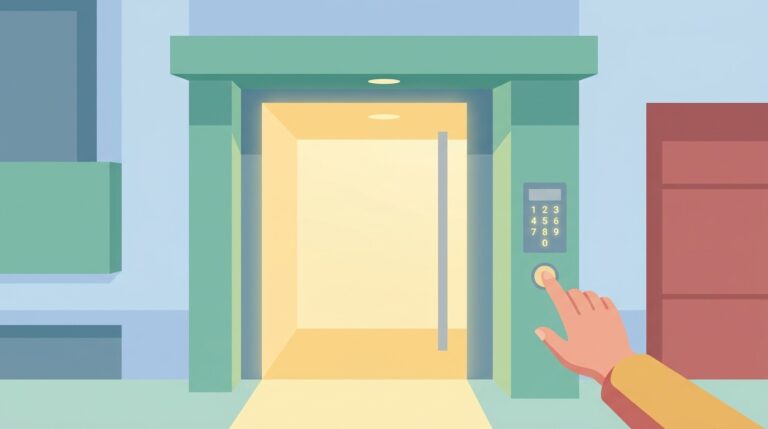
Imagine you just arrived in Seoul. You are carrying a heavy suitcase, or maybe you are holding a box of hot Korean fried chicken. You reach your friend’s beautiful apartment building. You see a huge glass door, but it is locked. There is a high-tech keypad glowing at you.
What do you do? Do you knock? Do you wait in the cold? Don’t worry! Today, you will learn how to speak through the intercom and buzz into any Korean apartment like a true local.
Phase 2: 3 Core Expressions You Must Know
1. 몇 호예요? (Myeot ho-ye-yo?)
- Pronunciation: Myeot ho-ye-yo? (Sounds like: “Myut ho-yeh-yo?”)
- Meaning: What room/apartment number is it?
- K-Culture Moment: You hear this when delivery riders arrive in K-dramas, or when the main characters visit each other’s homes.
- Editor’s Insight: In Korea, “호” (ho) means room or unit number. Always know this number before you arrive!
- Situation Spectrum:
- Friends/Casual: ✅
- Semi-formal: ✅
- Formal: ✅
- — Think About It: Why does Korean have different words for floor (층 – cheung) and room (호 – ho)? It helps make addresses super precise!
2. 문 열어 주세요 (Mun yeol-eo ju-se-yo)
- Pronunciation: Mun yeol-eo ju-se-yo (Sounds like: “Moon yul-uh joo-seh-yo”)
- Meaning: Please open the door.
- K-Culture Moment: Standing outside a friend’s lobby on a rainy day, speaking into the interphone.
- Editor’s Insight: Use this polite phrase when your friend answers the intercom speaker.
- Situation Spectrum:
- Friends/Casual: ☀라 (You can say “문 열어줘” – Mun yeol-eo-jwo to close friends)
- Semi-formal: ✅
- Formal: ✅
- — Think About It: Korean culture values safety and privacy, which is why almost every apartment building lobby is locked 24/7.
3. 비밀번호 뭐예요? (Bi-mil-beon-ho mwo-ye-yo?)
- Pronunciation: Bi-mil-beon-ho mwo-ye-yo? (Sounds like: “Bee-meel-bun-ho mwo-yeh-yo?”)
- Meaning: What is the passcode?
- K-Culture Moment: Walking home with friends after a late-night convenience store run.
- Editor’s Insight: Koreans love short words! They often shorten “비밀번호” (bi-mil-beon-ho) to just “비번” (bi-beon).
- Situation Spectrum:
- Friends/Casual: ✅
- Semi-formal: ✅
- Formal: ☀라 (A bit too direct for a boss; ask for permission first)
- — Think About It: Sharing a home passcode in Korea is a sign of deep trust and closeness.
Phase 3: Textbook Korean vs. Real Korean
Let’s see how school Korean differs from what Koreans actually say at the door!
Scenario 1: Buzzing your friend from the entrance
- 바 Textbook Korean: 공동 현관문을 열어주십시오. (Gong-dong hyeon-gwan-mun-eul yeol-eo-ju-sip-si-o. – “Please open the common entrance door.” – Very robotic!)
- ᄉ Real Korean: 저 왔어요! 문 좀 열어주세요~ (Jeo wass-eo-yo! Mun jom yeol-eo-ju-se-yo~ – “I am here! Please open the door~”)
- ᄃ Why it’s different: Adding “저 왔어요” (I’m here) and the soft word “좀” (jom – please/a bit) makes you sound warm and friendly.
Scenario 2: Asking for the door code
- 바 Textbook Korean: 공동 현관 비밀번호가 무엇입니까? (Gong-dong hyeon-gwan bi-mil-beon-ho-ga mu-eot-im-ni-ka? – “What is the passcode?” – Too formal!)
- ᄉ Real Korean: 현관 비번 뭐예요? (Hyeon-gwan bi-beon mwo-ye-yo? – “What is the door passcode?”)
- ᄃ Why it’s different: It’s faster and fits the quick-paced “Palli-Palli” (빨리빨리 – fast, fast) culture of Korea.
Phase 4: K-Culture Deep Dive & Non-verbal Manners
4-1. Nunchi (눈치) and Body Language
If you arrive at the apartment lobby and someone else is opening the door with their key, do not slide in silently like a ghost! That might scare them. Use your Nunchi (situational awareness). Make brief eye contact, give a polite, small nod (목례 – mok-rye), and walk in at a respectful distance. This shows you are a polite resident or visitor.
4-2. K-Travel Survival Fact
If you book an Airbnb in Korea, the host will likely send you a message with the door instructions. It might look like this: “종 + 1234 + 호출”. This means: Press the Bell button (종), type 1234, then press the Call button (호출).
Phase 5: Roleplay Scenario: Buzzing Minjun’s Apartment
The Setting: It is a cool evening in Seoul. You are standing outside a tall apartment building holding hot chicken. The lobby door is shut. You look at the intercom screen.
Characters: You and your Korean friend, Minjun.
- Minjun (Inside home): (ᄀ Speaking through the intercom) 여보세요? 누구세요? (Yeo-bo-se-yo? Nu-gu-se-yo? / “Hello? Who is it?”)
- You (At the door): (ᄀ Leaning toward the speaker) 민준 씨, 저예요! (Min-jun ssi, jeo-yeo-yo! / “Minjun, it’s me!”)
- Minjun: (ᄀ Happy voice) 아! 왔어요? 몇 호에 전화했어요? (Ah! Wass-eo-yo? Myeot ho-e jeon-hwa-haess-eo-yo? / “Oh! You’re here? Which room did you call?”)
- You: (ᄀ Checking the keypad) 1004호예요! 맞아요? (Cheon-sa-ho-ye-yo! Maj-a-yo? / “Room 1004! Is that right?”)
- Minjun: (ᄀ Giggling) 네, 맞아요. 배 안 고파요? (Ne, maj-a-yo. Bae an go-pa-yo? / “Yes, correct. Aren’t you hungry?”)
- You: (ᄀ Patting your stomach) 배고파요! 치킨 샀어요. (Bae-go-pa-yo! Chi-kin sass-eo-yo. / “I’m hungry! I bought chicken.”)
- Minjun: (ᄀ Excited) 와, 최고! 문 열어 줄게요. (Wa, choe-go! Mun yeol-eo jul-ge-yo. / “Wow, the best! I will open the door for you.”)
- You: (ᄀ Smiling) 네, 문 열어 주세요. (Ne, mun yeol-eo ju-se-yo. / “Yes, please open the door.”)
- Minjun: (ᄀ Pressing the button) 지금 열려요! 엘리베이터 타세요. (Ji-geum yeol-lyeo-yo! El-li-be-i-teo ta-se-yo. / “Opening now! Take the elevator.”)
- You: (ᄀ Hearing the door click open) 감사합니다! 바로 올라갈게요. (Gam-sa-ham-ni-da! Ba-ro ol-la-gal-ge-yo. / “Thank you! I will go up right away.”)
허 Decision Point!
You walk up to the keypad, but the screen is completely black and dark. What do you do?
* A) Knock loudly on the glass door.
* B) Press random buttons as hard as you can.
* C) Gently touch the screen to wake it up, or press the “Bell/Call” button first.
Best Choice is C! Korean keypads use sleep mode to save energy. Just tap the screen or press a button to wake it up before typing the numbers!
Phase 6: 10-Second Emotion Shadowing Drill
Try saying these with real feelings! The slash / is where you should pause briefly.
- [😊 Excitedly]
저 / 왔어요! / 문 좀 / 열어주세요~
(Jeo / wass-eo-yo! / Mun jom / yeol-eo-ju-se-yo~)
“I’m here! Door please~” -
[🥺 Needing Help]
비밀번호 / 뭐예요? / 알려주세요.
(Bi-mil-beon-ho / mwo-ye-yo? / Al-lyeo-ju-se-yo.)
“What is the passcode? Please tell me.”
Phase 7: K-Culture Mini Dictionary
- 공동 현관 (Gong-dong hyeon-gwan): Common Entrance. The shared main lobby door of a building.
- 인터폰 (In-teo-pon): Interphone. The wall intercom system used to call apartments.
- 비밀번호 (Bi-mil-beon-ho): Passcode. Often shortened to 비번 (bi-beon) in daily life.
- 경비실 (Gyeong-bi-sil): Security Office. Where the building guard helper (경비 아저씨) stays.
Phase 8: Traveler’s Survival Kit
Top 3 Survival Phrases
- 문이 안 열려요. (Mun-i an yeol-lyeo-yo.) -> “The door won’t open.” (Pro Tip: Try pressing ‘*’ or ‘#’ after the code!)
- 몇 호예요? (Myeot ho-ye-yo?) -> “What room is it?”
- 경비실 어디예요? (Gyeong-bi-sil eo-di-ye-yo?) -> “Where is the security office?”
ᄑ Editor’s Travel Note: To find your way around large Korean apartment complex gates easily, download the Naver Map App. It is much more accurate than Google Maps in Korea!
Phase 9: Deep Think — “A Step Closer”
Korean apartments are like giant vertical villages. The locked common entrance represents a physical boundary between the busy street and a safe private home. Sharing this code with someone means you trust them deeply.
ᄃ Your Turn: How do people enter apartment buildings in your home country? Do you use codes, keys, or security guards? Tell us in the comments below!
Phase 10: FAQ & Mistakes
Q: Do I need to press ‘#’ or ‘*’ after typing the passcode?
A: Yes, usually! Most Korean lobby doors require you to type the passcode followed by the hash key (#) or star key (*). Look closely at the small text on the screen!
Q: What if I dial the wrong room by mistake?
A: No worries! Just press the 취소 (Chwi-so – Cancel) button and try again.
Q: Can I follow a resident inside without buzzing?
A: Yes, but keep your distance. Give them a friendly little nod so they know you are a harmless visitor.
ᄅ Common Mistakes Warning Board
- Pressing too hard: Touch screens are sensitive. A light tap is enough!
- Saying just “Open”: Always say “저 왔어요” (It’s me / I’m here) first so your friend knows who you are.
- Panicking: If you get stuck, look for the 경비실 (Security office) nearby for help.
Phase 11: Action Missions
- ᄇ Bronze Mission: Practice saying “문 열어 주세요” out loud 5 times in front of your mirror!
- ᄉ Silver Mission: Text a friend or write in your notebook: “현관 비번 뭐예요?”
- ᄀ Gold Mission: Next time you visit a Korean building, look at the intercom screen and identify the words 호출 (Call) and 취소 (Cancel)!
Phase 12: Interactive Quiz Challenge
Q1. What is the short, casual word for “passcode” in Korean?
ᄒ Reveal Answer
비번 (bi-beon)! It is the short form of 비밀번호 (bi-mil-beon-ho).
Q2. Fill in the blank: “문 ___ 주세요” (Please open the door).
ᄒ Reveal Answer
열어 (yeol-eo)! The full phrase is “문 열어 주세요”.
Q3. True or False: You should knock loudly on the lobby glass if the screen is black.
ᄒ Reveal Answer
False! Just touch the screen gently to wake it up from sleep mode.







