

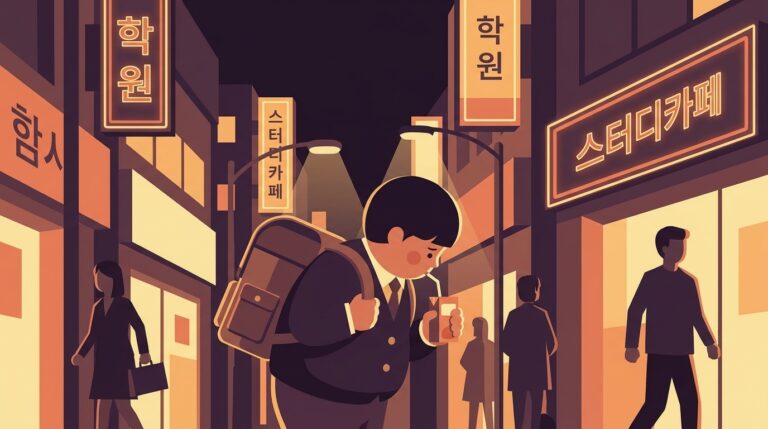
Surviving the Study Jungle: Inside Korea’s Intense ‘Hagwon’ Culture
안녕하세요! (An-nyeong-ha-se-yo!) Hello there! I’m your resident chief editor at Daily Hangul, your cozy Korean guide and friend.
Have you ever watched K-dramas like Crash Course in Romance (일타 스캔들) or Sky Castle (SKY 캐슬) and wondered: Is Korean school life really that intense? Why are there crowds of students in school uniforms walking the streets of Seoul at 10 PM with massive backpacks?
If you have Korean friends, colleagues, or neighbors, you’ve probably heard them talk about their kids’ busy schedules, or maybe you’ve tried to schedule a playdate only to be told, “My child has no time because of academy classes.”
In this guide, we are diving deep into the fascinating, heartwarming, and sometimes jaw-dropping world of Korea’s education fever (교육열 – Gyo-yuk-yeol). You will learn the actual vocabulary Koreans use to describe this lifestyle, see how it shapes modern Korean relationships, and discover how to talk about it like a true local!
Phase 2: Core Expressions Deep-Dive
To truly understand this phenomenon, you need to know these three essential expressions.
1. 학원 뺑뺑이 (Hagwon Ppeng-ppeng-i)
- Pronunciation: [ha-gwon ppeng-ppeng-i] / Sound-alike: “hah-gwon pehng-pehng-ee” (with a bouncy ‘p’)
- Meaning: “Hagwon round-tripping” or spinning through private academies.
- K-Culture Moment: Picture a mother in a suburban coffee shop, looking at her planner, saying, “I have to send my 8-year-old to English, math, and swimming today.” This relay of private tutoring is called ppeng-ppeng-i (spinning around).
- Editor’s Insight: The word ppeng-ppeng-i comes from the sound of something spinning repeatedly. It carries a mix of pity for the exhausted kids and a sense of social obligation felt by parents.
- Situation Spectrum:
- Friends & Casual: ✅ (Extremely common when chatting about parenting or childhood)
- Semi-formal: ⚠️ (Can be used with close coworkers who have kids)
- Formal: 🚫 (Use ‘사교육’ instead in formal reports or articles)
- 🤔 Think About It: In many Western countries, after-school time is for free play. In Korea, it is often structured learning. Why do you think Korean parents feel so much pressure to keep their children spinning in this loop?
2. 대치동 키즈 (Daechi-dong Kids)
- Pronunciation: [dae-chi-dong ki-jeu] / Sound-alike: “deh-chee-dong kee-jeu”
- Meaning: Children raised in Daechi-dong (the mecca of Korean private education) under strict academic regimens.
- K-Culture Moment: In K-dramas, these are the students who sleep only four hours a night, carry color-coded planners, and have parents who queue up at 5 AM just to register them for a famous star teacher’s class.
- Editor’s Insight: Calling someone a “Daechi-dong Kid” implies they are highly educated, extremely disciplined, but perhaps missed out on a carefree childhood. It’s a badge of honor and a symbol of academic pressure.
- Situation Spectrum:
- Friends & Casual: ✅
- Semi-formal: ✅
- Formal: ⚠️ (Can be used metaphorically in social commentary)
- 🤔 Think About It: Does your country have a specific neighborhood or town that represents the extreme peak of academic competition, similar to Seoul’s Daechi-dong?
3. 사교육 (Sa-gyo-yuk)
- Pronunciation: [sa-gyo-yuk] / Sound-alike: “sah-gyoh-yook”
- Meaning: Private education (as opposed to public school education, 공교육 – gong-gyo-yuk).
- K-Culture Moment: News anchors discussing the record-breaking household spending on private math academies and tutoring services.
- Editor’s Insight: This is the formal, objective term for the private education industry. If you want to sound intellectual or discuss social issues on a deeper level, this is your go-to word.
- Situation Spectrum:
- Friends & Casual: ✅
- Semi-formal: ✅
- Formal: ✅
- 🤔 Think About It: How does private tutoring function in your home country? Is it a luxury for the rich, or a common necessity like in Korea?
Phase 3: Textbook Korean vs. Real Korean
Let’s bridge the gap between classroom Korean and actual Korean street talk.
Situation 1: Describing a child who studies very hard
- 📖 Textbook Korean: “아이가 공부를 아주 열심히 해요.” (The child studies very diligently.)
- 🗣️ Real Korean: “우리 애 학원 뺑뺑이 돌리느라 정신없어요.” (I’m losing my mind running my kid through hagwon round-trips.)
- 💡 Why is it different?: While the textbook version is grammatically perfect, the real-world phrase shows the parental struggle and busy reality, making you sound much more empathetic and natural.
Situation 2: Complaining about how expensive education is
- 📖 Textbook Korean: “교육비가 너무 비쌉니다.” (Education expenses are very expensive.)
- 🗣️ Real Korean: “학원비 때문에 등골이 휘어요!” (My spine is bending because of hagwon fees!)
- 💡 Why is it different?: The idiom 등골이 휘다 (deung-gol-i hwi-da / back-breaking, literally ‘spine-bending’) is a classic Korean hyperbolic expression used to describe heavy financial burdens.
Phase 4: K-Culture Deep Dive & Non-verbal Manners
4-1. Read the Room: The “Nunchi” of Academics
In Korea, asking a parent “Where does your child go to school/hagwon?” can be a sensitive topic (민감한 질문).
* The Body Language of Sighs: When Korean parents discuss education, they often sigh deeply while saying “어휴, 다들 하니까 어쩔 수 없죠” (Sigh, everyone does it, so we have no choice). To show empathy, tilt your head slightly, nod slowly, and make a soft clicking sound with your tongue (ts-ts) to acknowledge their burden.
* Keep it humble: If your child does well, never boast openly. It’s considered good manners to say, “아니에요, 겨우 따라가고 있어요” (No, they are barely catching up).
4-2. The K-Drama Reality Check
In Sky Castle, families ruin lives to get their kids into Seoul National University (SNU). While this is an extreme dramatization, the pressure is very real. Daechi-dong hagwon streets are literally jammed with parental cars at exactly 10 PM (the legal curfew for hagwon operating hours in Seoul) to pick up their children. If you visit Seoul, walking past Daechi Station or Mapo Station at 10 PM will feel like walking out of a concert venue!
Phase 5: Interactive Roleplay Scenario
Scenario: You are having coffee with your Korean coworker, Ji-young, in a cafe in Mapo, Seoul. It is 4 PM on a Thursday.
Cast
- You (The Learner): An open-minded foreign colleague curious about Korean parenting.
- Ji-young (Coworker): A busy working mom with an 8-year-old son, Min-jun.
Dialogue
- Ji-young: (Checking her phone anxiously) 아휴, 민준이 벌써 미술 학원 끝날 시간이네. (Sigh, it’s already time for Min-jun to finish art academy.)
- You: 미술 학원요? 초등학교 1학년인데 벌써 학원에 다녀요? (Art academy? He is in first grade, and he already goes to academies?)
- Ji-young: (Laughs weakly) 아이고, 미술은 시작일 뿐이에요. 그거 끝나면 태권도 가고, 저녁에는 영어 학원 가요. (Oh, art is just the beginning. After that, he goes to Taekwondo, and in the evening, English academy.)
- You: 와, 하루에 학원을 몇 개나 가요? (Wow, how many academies does he go to in a day?)
- Ji-young: 하루에 보통 서너 개는 가죠. (Usually three or four a day.)
- You: (Surprised) 서너 개요? 피곤하지 않을까요? (Three or four? Won’t he be tired?)
- Ji-young: 피곤해하죠. 그래도 남들 다 하는데 안 하면 우리 애만 뒤처질까 봐 불안해요. (He is tired. But if we don’t do it while everyone else does, I’m scared our kid will fall behind.)
- You: (Nodding understandingly) 한국의 교육열이 정말 대단하네요. (Korea’s education fever is truly incredible.)
- Ji-young: 맞아요. 진짜 ‘학원 뺑뺑이’ 돌리느라 저도, 애도 매일 지쳐요. (Exactly. Running him through ‘hagwon round-trips’ makes both him and me exhausted every day.)
- You: 학원비도 만만치 않겠어요. (The academy fees must not be easy either.)
- Ji-young: 등골이 휩니다, 정말! (My spine is bending, seriously!)
🔀 Decision Point: How will you comfort Ji-young?
Choose your response:
- A. “학원 다 그만두게 하세요. 아이가 불쌍해요.” (Make him quit all academies. I feel sorry for the kid.)
- B. “지영 씨도, 민준이도 정말 고생이 많네요. 힘내세요!” (You and Min-jun are both working so hard. Hang in there!)
- C. “돈을 아주 많이 버셔야겠어요!” (You must have to earn a lot of money!)
💡 Feedback:
- Best Choice: B. It acknowledges the struggle of both the parent and the child without judging their lifestyle choice. Showing warm empathy (공감) is the best social glue in Korea.
- Risky Choice: A. This sounds too preachy or judgmental. Korean parents already feel guilty about sending kids to many academies; telling them to stop ignores the heavy societal pressure they face.
- Awkward Choice: C. Talking too directly about money can make the situation awkward, even if it is a realistic concern.
Phase 6: 10-Second Emotion Shadowing Drill
Let’s practice speaking with real Korean emotion! Focus on the pauses (marked by /) and the emotional tones.
- [🥺 Empathetic & Soft]
- “우리 애 / 학원 뺑뺑이 돌리느라 / 지쳤어요.”
- U-ri ae / ha-gwon ppeng-ppeng-i dol-li-neu-ra / ji-cheot-seo-yo.
- (Our kid is exhausted from being spun through academies.)
- [😤 Playfully Complaining & Hyperbolic]
- “학원비 때문에 / 정말 / 등골이 휘어요!”
- Ha-gwon-bi ttae-mu-ne / jeong-mal / deung-gol-i hwi-eo-yo!
- (Because of academy fees, my back is literally breaking!)
Phase 7: K-Culture Mini Dictionary
- 야자 (Yaja – Short for 야간자율학습): Night self-study in high schools. Usually runs until 9 or 10 PM.
- 일타강사 (Ilta-gangsa): Star instructors who earn millions of dollars. They are the “superstars” of the hagwon world.
- 대치동 (Daechi-dong): A wealthy neighborhood in southern Seoul, famous for having thousands of hagwons packed into a tiny area.
- 선행학습 (Seonhaeng-hakseup): Pre-emptive learning. Studying curriculum ahead of your actual grade level (e.g., learning middle school algebra in elementary school).
Phase 8: Traveler’s Survival Kit
If you are exploring Seoul and want to navigate or understand the busy street scenes, use these tools:
- Survival Phrase 1: “이 근처에 서점이 어디 있어요?” (Where is a bookstore near here?) – Useful when you want to look at the massive workbook sections in Korea.
- Survival Phrase 2: “여기 아이들이 많이 가는 카페가 어디예요?” (Where is a cafe kids go to often?) – Usually, you’ll find them at convenience stores or study cafes (스터디카페).
- Survival Phrase 3: “늦은 시간인데 버스가 아직 다녀요?” (It’s late, is the bus still running?) – Crucial if you find yourself stuck at 10 PM near academy zones.
📌 Editor’s Travel Note: To see this culture live, take the subway to Daechi Station (Line 3) around 9:45 PM on a weekday. Use Naver Map to find local cafes near Daechi-dong. Grab a drink and watch the organized chaos as thousands of parents wait for their children. It’s a side of Seoul you won’t find in normal travel brochures!
Phase 9: Deep Reflection — “Going Deeper”
Korea’s education system is often praised globally for its high test scores and literacy rates. However, the internal reality is a complex web of cultural values. Confucian heritage emphasizes that education is the ultimate path to self-improvement and social status. This belief, combined with rapid post-war economic development, turned education into a high-stakes competition. While it produces highly skilled professionals, it also places heavy emotional and financial weight on modern families.
💬 Your Turn: How does your home country handle after-school education? Do kids have free time, or are they busy with structured activities? Share your thoughts in the comments below!
Phase 10: FAQ & Common Mistakes
Q: Are all hagwons purely academic?
A: No. There are athletic hagwons (태권도 – Taekwondo), musical hagwons (피아노 – Piano), art hagwons (미술 – Art), and even chess or coding hagwons. For younger elementary kids, many parents use these non-academic hagwons as a form of reliable childcare while they work.
Q: Why don’t they just play outside?
A: Neighborhood dynamics play a part. Because so many kids are at hagwons, there are often no children left on the playground (놀이터) to play with! Thus, parents send kids to hagwons just so they can socialize with friends.
Q: Is it rude to ask a coworker how their child is doing in school?
A: It depends. It is okay to ask general questions like “How is your child adjusting to school?” (학교 생활 잘해요?). However, asking for specific grades, test scores, or which level class they are in at an English academy can be seen as overly intrusive.
🚨 Common Mistakes Warning Board:
- Using “학원” to refer to regular public schools: Always use 학교 (Hak-gyo) for formal public schools and 학원 (Hagwon) for private, paid academies.
- Thinking “공부” only happens at school: In Korea, when someone says “공부해요,” they might mean studying independently at a study cafe or attending a specialized exam prep institute.
- Saying “수고하셨습니다” to a teacher as a parent: It is better to use “감사합니다” (Thank you) or “선생님 덕분입니다” (It’s thanks to you). “수고하셨습니다” can sometimes sound like a boss praising an employee.
Phase 11: Action Mission
- 🥉 Bronze: Record yourself saying “학원 뺑뺑이” with the bouncy double-p sound.
- 🥈 Silver: Use the phrase “우리 애 학원 뺑뺑이 돌려요” in a sentence on your social media, or write a practice diary entry about it.
- 🥇 Gold: Find a scene in a K-drama where students are studying late, and identify if they are in a 독서실 (reading room), 스터디카페 (study cafe), or 학원 (academy).
Phase 12: Interactive Quiz Challenge
1. Situational Judgment
You meet your Korean friend, Min-ji, whose son looks very tired carrying a huge backpack. What is the most natural, empathetic thing to say?
* A) 공부가 인생의 전부는 아니에요! (Study isn’t everything in life!)
* B) 와, 정말 힘들겠다. 맛있는 거 많이 사주세요. (Wow, it must be so hard. Buy him lots of yummy food.)
* C) 공부 안 하면 나중에 고생해요. (If he doesn’t study, he will struggle later.)
👉 Click to see the answer & explanation!
Correct Answer: B
Korean parents appreciate it when you show warmth and offer practical comfort (like eating delicious food to recover energy) rather than offering uninvited life advice (A or C).
2. Fill in the Blank
“우리 아이는 하루에 학원을 네 개나 다녀요. 완전 [ ] 돌고 있어요.”
* A) 뺑소니 (Hit and run)
* B) 뺑뺑이 (Round-trips/Spinning)
* C) 빙글빙글 (Round and round – simple adverb)
👉 Click to see the answer!
Correct Answer: B
‘학원 뺑뺑이’ is the set slang expression for hopping between private academies.
Thank you for reading, and keep shining bright on your Korean language journey! 다음에 또 만나요! (See you next time!)







