

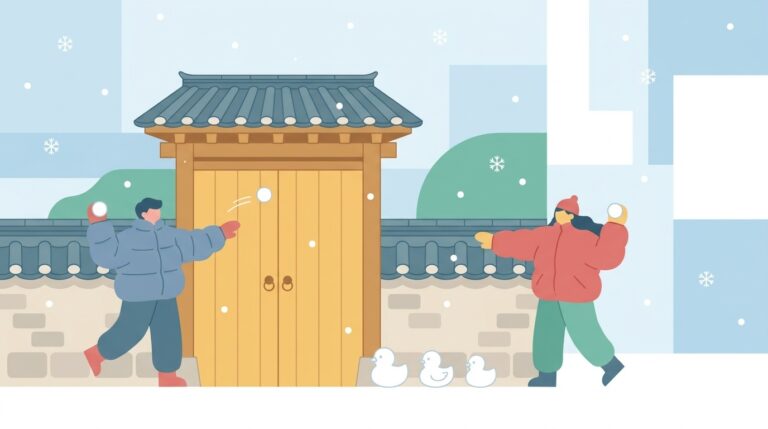
Master Korean Winter Fun: How to Have a Snowball Fight Like a K-Drama Star
안녕하세요! (An-nyeong-ha-se-yo!) Your friendly neighborhood Korean editor from Daily Hangul here! ❄️
Have you ever watched a romantic winter K-Drama and wished you could instantly teleport into that magical, powdery snow scene? You know the one: the soft instrumental music swells, the lead characters lock eyes under a streetlamp, and suddenly—splat!—a playful snowball fight begins.
But here is the catch. If you go to Korea in the winter and ask a local friend to do a “눈싸움” (nun-ssaup), you might find yourselves standing in a freezing park staring intensely into each other’s eyes without blinking, rather than throwing snow!
Why? Because in Korean, “눈” (nun) means both snow and eye. Thus, “눈싸움” can mean a snowball fight OR a staring contest!
Don’t worry. Today, we are going to learn exactly how to navigate this fun linguistic twist, master real-life winter phrases, and discover the viral winter trend that even BTS’s RM couldn’t resist. Grab your warmest puffer jacket, and let’s dive in!
Phase 2: 3 Essential Korean Winter Expressions
To make sure you don’t end up in an awkward staring contest (unless you want to!), let’s master these three high-frequency phrases for A2 beginners.
1. 우리 눈싸움 하자! (U-ri nun-ssaup ha-ja!)
- Pronunciation: Oo-ree noon-ssowp ha-ja!
- Meaning: Let’s have a snowball fight! (Informal)
- K-Culture Moment: This is the ultimate line used in playful romantic comedy scenes, where characters throw soft snow at each other while laughing in slow motion.
- Editor’s Insight: To clarify you want a snow fight and not an eye-staring match, you can physically point to the snow on the ground while saying this with an excited smile.
- Situation Spectrum:
- Friends & Close peers: ✅
- Coworkers (Semi-formal): ⚠️ Use “우리 눈싸움 해요!” (U-ri nun-ssaup hae-yo!)
- Bosses & Elders (Formal): 🚫 Probably too playful for a corporate setting!
- 🤔 Think About It: Why do you think Korean uses the same word “눈” (nun) for both “snow” and “eyes”? Can you think of any words in your native language that have two totally different meanings based on context?
2. 눈사람 만들자! (Nun-sa-ram man-deul-ja!)
- Pronunciation: Noon-sa-ram man-deul-ja!
- Meaning: Let’s make a snowman!
- K-Culture Moment: Unlike Western snowmen with three large segments, Korean snowmen are traditionally made of just two round balls—one head and one body.
- Editor’s Insight: “사람” (sa-ram) means “person.” So, “눈사람” literally translates to “Snow Person.” It is gender-neutral and cute!
- Situation Spectrum:
- Friends & Close peers: ✅
- Coworkers (Semi-formal): ✅ Use “눈사람 만들까요?” (Nun-sa-ram man-deul-kka-yo? – Shall we make a snowman?)
- Bosses & Elders (Formal): ⚠️
3. 눈오리 집게 있어? (Nun-o-ri jip-ge is-seo?)
- Pronunciation: Noon-oh-ree jeep-ge eet-suh?
- Meaning: Do you have a snow duck clip?
- K-Culture Moment: If you walk through Seoul in winter, you will see armies of tiny snow ducks lined up on walls. This viral sensation exploded when K-Pop stars like RM of BTS made “DTS” (Duck BTS) and posted them online.
- Editor’s Insight: A “눈오리 집게” is a plastic mold shaped like a duck. You scoop up snow, press it, and instantly make a perfect snow duck. Asking a friend if they have one instantly makes you look like a trendy local!
- Situation Spectrum:
- Friends & Close peers: ✅
- Coworkers (Semi-formal): ✅
- Bosses & Elders (Formal): ⚠️
Phase 3: Textbook Korean vs. Real-World Korean
Textbooks often teach polite, grammatically complete sentences that sound a bit robotic during an active snow day. Let’s look at how Koreans actually talk when playing in the snow.
Situation 1: Spotting the first snow of the year
- 📖 Textbook: 오늘 첫눈이 내립니다. (O-neul cheot-nun-i nae-rim-ni-da.) – “Today, the first snow falls.”
- 🗣️ Real Korean: 대박, 첫눈 온다! (Dae-bak, cheot-nun on-da!) – “Oh my gosh, it’s the first snow!”
- 💡 Why the difference? Real-world Korean relies heavily on short, emotional exclamations like “대박” (dae-bak – awesome/no way) to show genuine excitement.
Situation 2: Getting hit unexpectedly by a snowball
- 📖 Textbook: 저는 머리에 눈뭉치를 맞았습니다. (Jeo-neun meo-ri-e nun-mung-chi-reul ma-jat-seum-ni-da.) – “I was struck on the head by a snowball.”
- 🗣️ Real Korean: 아, 맞았어! 두고 봐! (Ah, ma-jat-seo! Du-go bwa!) – “Ow, I got hit! Just you wait!”
- 💡 Why the difference? “두고 봐” (du-go bwa) literally means “leave it and see,” but it translates to “You’ll pay for this!” or “Just wait till I get you back!” in a highly playful, competitive way.
Phase 4: K-Culture Deep Dive & Non-Verbal Etiquette
4-1. “Nunchi” (눈치) in the Snow
Playing in the snow is all about sharing joy, but you need Nunchi (tact/situational awareness).
* Never pack ice: Korean snow is often light and powdery, but sometimes it gets icy. Packing ice into snowballs is considered bad manners and dangerous. Keep it light!
* Aim for the jacket, not the face: Keep the snowballs directed at the thick padding of your friend’s winter coat (패딩 – pae-ding).
4-2. The Romantic Legend of First Snow (첫눈)
In Korea, the first snow of winter (첫눈 – cheot-nun) is highly romanticized. There is a popular belief that if you confess your love to someone during the first snow, or if you are together when it starts falling, your love will last forever. This is why you see so many confessions in K-Dramas happening precisely when the first snowflake touches the ground!
Phase 5: Interactive Snow Day Roleplay
The Setting: You are walking through a beautifully lit park near Sinchon, Seoul. The snow is falling softly. Your close Korean friend, Minjun, looks at you with a mischievous grin.
- Minjun (민준): (🎭 Rubbing his gloved hands together) 와, 오늘 진짜 춥다! 그치? (Wa, o-neul jin-jja chup-da! Geu-chi? / Wow, it’s really cold today! Right?)
- You: 응, 맞아. 근데 눈이 진짜 예뻐! (Eung, ma-ja. Geun-de nun-i jin-jja ye-ppeo! / Yeah, correct. But the snow is really pretty!)
- Minjun (민준): (🎭 Bends down and scoops up a handful of snow) 우리… 눈싸움 할래? (U-ri… nun-ssaup hal-rae? / Shall we… have a snowball fight?)
🔀 Decision Point! How do you respond?
- Option A: “싫어요, 손이 너무 추워요.” (Sil-heo-yo, son-i neo-mu chu-wo-yo. / I don’t want to, my hands are too cold.)
- Option B: “좋아! 두고 봐!” (Jo-ha! Du-go bwa! / Sounds good! Just you wait!)
- Option C: “눈사람이 더 좋습니다.” (Nun-sa-ram-i deo jop-seum-ni-da. / A snowman is better. Formally)
💡 Feedback:
- Best Choice: Option B! It matches Minjun’s playful tone perfectly using casual, high-energy language (“좋아! 두고 봐!”).
- Risk Choice: Option A. While honest, using “싫어요” (formal/polite rejection) with a close friend can sound a bit cold and dry. To say your hands are cold casually, try “나 손 시려!” (Na son si-ryeo!).
- Awkward Choice: Option C. This is grammatically correct but way too formal (“습니다” style) for a fun moment in the snow with a friend!
Phase 6: 10-Second Emotion Shadowing Drill
Let’s practice speaking with real Korean emotion! Use the slashes / as natural breathing pauses.
- [😊 Exciting & Playful]
- “와! / 진짜 많이 / 온다!”
- Wa! / Jin-jja ma-ni / on-da!
- (Wow! / It’s really / snowing a lot!)
- [🥺 Playful & Whining]
- “아! / 진짜 / 아프잖아!”
- Ah! / Jin-jja / a-peu-ja-na!
- (Ow! / That actually / hurt! Playfully accusing)
- [😤 Playfully Competitive]
- “너 / 거기 서! / 복수할 거야!”
- Neo / geo-gi seo! / Bok-su-hal geo-ya!
- (You! / Stand right there! / I will get revenge!)
Phase 7: Korean Winter Mini-Dictionary
| Word | Pronunciation | English | Real-world Context |
|---|---|---|---|
| 롱패딩 (Long-pae-ding) | Long-pae-ding | Long puffer coat | The unofficial winter uniform of South Korea. Essential for surviving Seoul’s freezing wind! |
| 붕어빵 (Bung-eo-ppang) | Boong-uh-ppang | Fish-shaped pastry | A warm, sweet winter street food filled with red bean or custard. Perfect to eat after a snowball fight! |
| 손난로 (Son-nal-ro) | Son-nal-lo | Hand warmer | Small heat packs you keep in your pockets to thaw out your frozen fingers. |
| 눈오리 (Nun-o-ri) | Noon-oh-ree | Snow duck | Cute duck-shaped snow figures made with a plastic press tool. |
| Disclaimer: Street vendor prices for winter snacks like Bung-eo-ppang may vary by neighborhood. |
Phase 8: Traveler’s Survival Kit
Top 3 Survival Phrases in the Snow ❄️
- 길이 너무 미끄러워요. (Gil-i neo-mu mi-kkeu-reo-wo-yo.)
- Meaning: The road/sidewalk is very slippery.
- Pro Tip: Use this to warn your friends when walking downhill on icy Seoul streets.
- 따뜻한 어묵 국물 마실래요? (Tta-tteut-han eo-muk guk-mul ma-sil-rae-yo?)
- Meaning: Do you want to drink some warm fishcake broth?
- Pro Tip: If you go to a street food cart (포장마차), you can get free warm soup when you buy delicious food.
- 택시가 진짜 안 잡혀요. (Taek-si-ga jin-jja an ja-phyeo-yo.)
- Meaning: It is really hard to catch a taxi.
- Pro Tip: During heavy snow, taxis are hard to find. We highly recommend using the Naver Map App to find subway routes instead of waiting outside.
Phase 9: A Step Deeper—The Romanticism of Coldness
In many Western cultures, heavy snow is seen as an inconvenient commute delay. However, in Korean society, snow holds a beautiful nostalgic value. It brings people together to share sweet street foods like Hoppang (steamed buns) and hot chocolate. It is a time for shared warmth in a fast-paced urban world.
💬 Your Turn: How does your hometown react to the first snow of the year? Do you have snowball fights, or do you prefer staying warm inside? Let us know in the comments below!
Phase 10: FAQ & Avoiding Common Mistakes
Q: Can I use “눈싸움” (nun-ssaup) in a professional setting?
A: Depends. If you are close with your coworkers, you can playfully say, “눈싸움 할까요?” (Shall we have a snowball fight?). However, avoid saying it to your boss unless they suggest it first!
Q: What is the most common mistake foreigners make?
A: Using “눈싸움 하자” with an elder or a stranger. Always use the polite polite form “눈싸움 해요” (nun-ssau-mhae-yo) if you aren’t close friends yet!
🚨 Common Mistakes Warning Board
- Incorrect: “눈을 던지세요!” (Nun-eul deon-ji-se-yo!) -> Sounds like “Throw your eyes!”
- Correct: “눈뭉치 던져!” (Nun-mung-chi deon-jyeo!) -> “Throw the snowball!”
Phase 11: Daily Hangul Action Missions!
- 🥉 Bronze: Record yourself saying “대박, 첫눈 온다!” with pure excitement on your phone.
- 🥈 Silver: Write a post on your social media with a picture of snow and write the caption: “우리 눈싸움 하자!”
- 🥇 Gold: Find a Korean friend (or language exchange partner) and ask them: “한국에서 눈오리 집게 사봤어요?” (Have you ever bought a snow duck clip in Korea?)
Phase 12: Interactive Quiz Challenge
1. What does “눈싸움” mean in Korean?
- A) Only a snowball fight
- B) Only a staring contest
- C) Both a snowball fight and a staring contest
👉 Click to see the Answer!
Answer: C
Because “눈” means both snow and eye, “눈싸움” can playfully refer to both activities!
2. Fill in the blank: Let’s make a snowman! = “_______ 만들자!”
👉 Click to see the Answer!
Answer: 눈사람 (Nun-sa-ram)
Literally translated as “Snow Person.”







