

Master the Secret Code of Extreme Korean Honorifics: Lexical Shifting
Phase 1: The High-Stakes Dinner (A Warm Welcome)
안녕하세요! (An-nyeong-ha-se-yo!) Welcome back to Daily Hangul. I’m your chief editor and resident cultural navigator.
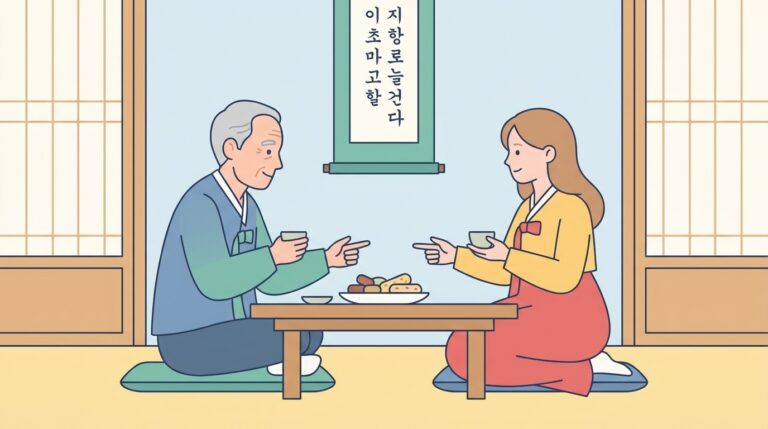
Imagine this: You are invited to a premium Hanjeongsik (한정식 – traditional Korean course meal) restaurant in Samcheong-dong. Sitting across from you is your partner’s stern, traditional grandfather, or perhaps the CEO of the Korean company you’ve been pitching to for months. The atmosphere is quiet, the scent of pine needles fills the room, and the pressure is palpable.
You want to ask if they have eaten. You confidently say:
“할아버지, 밥 먹었어요?” (Grandfather, did you eat rice?)
Suddenly, a micro-freeze ripples across the room. While grammatically correct, using basic honorific endings like -요 (-yo) with standard nouns like 밥 (bap – food/rice) and 먹다 (meok-da – to eat) in front of an elder feels like wearing jeans to a state dinner. To truly speak Korean with nuance and gain their ultimate respect (and maybe a nod of deep admiration), you must master the art of Lexical Shifting—changing the actual words themselves when speaking to or about someone of highly elevated status.
In this guide, we are going to dive deep into these high-honorific lexical shifts. By the end, you won’t just avoid awkward silences; you’ll charm the room like a native. Let’s elevate your Korean to the B2 elite level!
Phase 2: Deep Dive into 3 Elite Lexical Shifts
1. From 밥 (Bap) & 먹다 (Meok-da) to 진지 (Jin-ji) & 잡수시다 / 드시다 (Jap-su-si-da / Deu-si-da)
- Pronunciation:
- 진지: [Jin-ji] / Sounds like “jean-g” (as in jeep, but ending with a soft ‘ee’ sound).
- 잡수시다: [Jap-su-si-da] / Sounds like “Job-soo-she-dah”.
- 드시다: [Deu-si-da] / Sounds like “Deu-she-dah” (with a flat ‘eu’ sound, similar to the ‘u’ in ‘put’).
- Meaning:
- Literal: Rice & to eat.
- Real-world Nuance: Sacred sustenance & to partake gracefully.
- K-Culture Moment: You will hear this constantly in historical dramas (사극 – sageuk) when the royal kitchen court ladies serve the King, or in modern K-Dramas when a well-mannered daughter-in-law addresses the family patriarch.
- Editor’s Insight: 잡수시다 carries a classic, deeply traditional tone of respect, whereas 드시다 is modern, sleek, and widely used in both upscale business and family settings.
- Situation Spectrum:
- Friends / Casual: 🚫 (Using 진지 with friends sounds hilarious and overly dramatic, like acting in a theater play!)
- Workplace / Semi-formal: ⚠️ (Use 식사 [sik-sa] & 드시다 for bosses unless they are of grandfatherly age).
- Seniors / Grandparents: ✅ (The ultimate gold standard of respect).
- 🤔 Think About It: Why does Korean have a completely different word for ‘food’ when talking to elders? It stems from a history where securing food was the ultimate form of welfare. Asking if an elder had eaten 진지 was a sincere, elevated inquiry about their health and survival.
2. From 집 (Jip) to 댁 (Daek)
- Pronunciation: [Daek] / Sounds like “deck” but with a sharper, non-aspirated ‘d’ sound.
- Meaning:
- Literal: House.
- Real-world Nuance: Residence / Honorable Estate.
- K-Culture Moment: When characters in dramas visit a wealthy family’s estate (think Penthouse or Sky Castle), they refer to the residence as “회장님 댁” (The Chairman’s Residence).
- Editor’s Insight: Never use 댁 to refer to your own home! If someone asks “Where do you live?”, replying with “My 댁 is in Seoul” will sound incredibly arrogant. 댁 is exclusively used to elevate the other person’s home.
- Situation Spectrum:
- Friends / Casual: 🚫
- Workplace / Semi-formal: ✅ (Highly recommended when discussing clients’ or executives’ homes).
- Seniors / Grandparents: ✅
- 🤔 Think About It: By elevating someone’s physical living space, you are linguistically honoring their family line and their legacy. How does your native language elevate someone’s personal domain?
3. From 나이 (Na-i) & 아프다 (A-peu-da) to 연세 (Yeon-se) & 편찮으시다 (Pyeon-chan-eu-si-da)
- Pronunciation:
- 연세: [Yeon-se] / Sounds like “yawn-say”.
- 편찮으시다: [Pyeon-chan-eu-si-da] / Sounds like “pyeon-chahn-eu-she-dah”.
- Meaning:
- Literal: Age & to be sick.
- Real-world Nuance: Accumulation of years & to feel uncomfortable/unwell.
- K-Culture Moment: In K-Pop fandoms, when fans talk respectfully about legendary, pioneering artists of the older generation, they use 연세 instead of 나이 to honor their career longevity and wisdom.
- Editor’s Insight: 아프다 is physical pain. 편찮으시다 literally means “not comfortable” (편치 않다). It softens the harsh reality of sickness for an elder, showing incredible emotional delicacy.
- Situation Spectrum:
- Friends / Casual: 🚫
- Workplace / Semi-formal: ⚠️ (Only use 연세 for clients or executives who are visibly much older, roughly 60+).
- Seniors / Grandparents: ✅
- 🤔 Think About It: Euphemisms in honorifics show empathy. By saying someone is 편찮으시다 instead of 아프다, you protect their dignity in front of others. How important is verbal softening in your culture?
Phase 3: Textbook Korean vs. Real Korean
Let’s compare what you find in basic apps versus what actually commands respect in the real world.
Scenario 1: Asking if the CEO has arrived home safely
- 📖 Textbook Korean: “사장님, 집에 도착했어요?” (Sajangnim, jibe dochakaesseoyo? – CEO, did you arrive at the house?)
- 🗣️ Real Korean: “사장님, 댁에 무사히 도착하셨습니까?” (Sajangnim, daege musahi dochakhasyeossseumnikka? – CEO, did you arrive safely at your honorable residence?)
- 💡 Why the shift?: Replacing 집 with 댁 instantly elevates the business communication. Adding 무사히 (safely) shows genuine care for their well-being, displaying professional maturity.
Scenario 2: Expressing concern for a teacher’s health
- 📖 Textbook Korean: “선생님, 아파요?” (Seonseangnim, apayo? – Teacher, are you sick?)
- 🗣️ Real Korean: “선생님, 혹시 어디 편찮으신 데 있으세요?” (Seonseangnim, hoksi eodi pyeonchanheusin de isseuseoyo? – Teacher, is there by any chance an area where you feel unwell?)
- 💡 Why the shift?: Asking “Are you sick?” directly can feel intrusive and overly blunt. 편찮으시다 turns a potentially sensitive medical question into a beautiful, polite inquiry.
Phase 4: K-Culture Deep Dive & Non-Verbal Manners
4-1. Physical Honorifics: The Two-Hand Rule & The Head Turn
Linguistic respect in Korea is only 50% of the equation; the other 50% is visual.
* The Gift & Beverage Pass: When serving a drink or handing over a business card to an elder, always use both hands. Your left hand should lightly support your right forearm or wrist, and your head should be slightly bowed.
* The Drink Turn: If you are having a formal meal that includes alcohol, never drink directly facing an elder. Turn your upper body slightly to the side (usually away from the most senior person) and cover your glass with your left hand while sipping.
4-2. The “K-Drama Dinners” vs. Reality
In dramas, you often see young protagonists talking casually to old chairmen to show they have “spunk” or “backbone.” Do not try this in real life! In Korean society, using flawless honorific vocabulary is considered the baseline of intelligence and education. Speaking with flawless lexical shifts marks you as a highly sophisticated, high-value individual.
Phase 5: Roleplay: Dinner at Grandfather’s House
Setting: A serene, traditional wooden Hanok house in Bukchon Hanok Village. The scent of roasted barley tea fills the warm room. You are sitting on a silk floor cushion opposite Grandfather (할아버지), who is looking at you with a curious but stern expression.
Dialogue (10 Turns)
- 할아버지: “어서 오게. 한국어 공부를 아주 열심히 한다고 들었네.”
(Grandfather: Welcome. I heard you are studying Korean very hard.) - You (🎭 Bowing slightly): “안녕하세요, 어르신. 만나 뵙게 되어 영광입니다.”
(You: Hello, esteemed elder. It is an honor to meet you.) - 할아버지: “허허, 예의가 아주 바르군. 이쪽으로 와서 편히 앉게.”
(Grandfather: Haha, you have excellent manners. Come here and sit comfortably.) - You (🎭 Gently placing your hands on your knees): “네, 감사합니다. 댁이 정말 아름답고 고풍스럽습니다.”
(You: Yes, thank you. Your honorable residence is truly beautiful and elegant.) - 할아버지: “내 평생 가꾼 곳이라네. 시장하지 않은가? 곧 저녁이 나올 걸세.”
(Grandfather: It’s a place I’ve taken care of my whole life. Aren’t you hungry? Dinner will be out soon.) - You (🎭 Expressing polite anticipation): “네, 조금 배가 고픕니다. 할아버지, 혹시 오늘 진지는 잡수셨습니까?”
(You: Yes, I am a bit hungry. Grandfather, have you by any chance eaten your honorable meal today?) - 할아버지 (🎭 Surprised and highly impressed): “허허! 내 진지까지 걱정해 주는가? 아직이네, 자네와 함께 먹으려고 기다렸지.”
(Grandfather: Oh! You are even worrying about my meal? Not yet, I was waiting to eat with you.) - You (🎭 Smiling warmly): “기다려 주셔서 감사드립니다. 맛있게 먹겠습니다.”
(You: Thank you for waiting for me. I will eat well.) - 할아버지: “요즘 몸은 어떤가? 외국 타향살이가 쉽지 않을 텐데.”
(Grandfather: How is your health lately? Living in a foreign country must not be easy.) - You: “네, 저는 아주 건강합니다! 할아버지께서도 편찮으신 곳 없이 늘 건강하시기를 바랍니다.”
(You: Yes, I am very healthy! I hope you too remain healthy without any discomfort.)
🔀 Decision Point: Grandfather offers you the first portion of the main dish
What do you do?
* Choice A: Say “감사합니다!” and immediately grab your chopsticks and dig in.
* Choice B: Wait, bow slightly, use both hands to receive the plate, and say “할아버지, 먼저 드십시오.”
* Choice C: Decline politely, saying “괜찮습니다, 저는 많이 못 먹습니다.”
💡 Choices Breakdown:
- Best Choice: Choice B! Waiting for the eldest person to pick up their utensils first is the ultimate sign of respect. Saying “먼저 드십시오” (Please eat first) proves you understand Korean table etiquette.
- Risk Choice: Choice A. Though you said thank you, starting to eat before the elder is considered highly impolite in traditional settings.
- Bad Choice: Choice C. Rejecting food prepared for you can easily be misinterpreted as rejecting their hospitality.
Phase 6: 10-Second Emotion Shadowing Drill
Practice these lines with the correct emotional delivery to sound authentic and respectful!
- [😊 Warm & Deeply Respectful]
할아버지 / 진지 / 잡수셨어요?
(Hal-abeoji / jin-ji / jap-su-syeoss-eo-yo?)
Practice tip: Pause slightly after “할아버지” to show a rhythmic tempo. -
[🥺 Softly Concerned]
어디 / 편찮으신 데 / 있으세요?
(Eodi / pyeon-chan-eu-sin de / is-seu-se-yo?)
Practice tip: Lower the tone of your voice slightly to show warmth and genuine worry. -
[💼 Polite Professionalism]
부장님 / 댁에 / 가시는 길입니까?
(Bujangnim / daek-e / ga-si-neun gil-im-ni-ka?)
Practice tip: Pronounce “댁에” clearly to emphasize your respect for their home.
Phase 7: K-Culture Mini Dictionary
| Word (Korean/Romanization) | English Equivalent | Practical Context & Meaning |
|---|---|---|
| 효도 (Hyo-do) | Filial Piety | The cultural foundation of Korean respect. It’s the duty and love children show to protect and care for their parents and elders. |
| 어르신 (Eo-reu-sin) | Esteemed Elder | A highly respectful term to address an elderly person whose name you do not know. It sounds much more polite than “할아버지” (Grandfather) for strangers. |
| 성함 (Seong-ham) | Honorable Name | The shift for “이름” (i-reum). Used when asking for a senior’s name. (e.g., “성함이 어떻게 되십니까?”) |
| 연세 (Yeon-se) | Honorable Age | The shift for “나이” (na-i). Used to ask or mention the age of seniors to maintain their dignity. |
Phase 8: Traveler’s Survival Kit (High Honorific Edition)
Even if you’re just traveling, these three phrases are your magic key to unlocking the kindest hospitality from elderly store owners or grandparents you meet along the way!
Survival Cards
- “성함이 어떻게 되세요?”
- Romanization: Seong-ham-i eo-tteo-ke doe-se-yo?
- Pro Tip: Use this instead of “이름이 뭐예요?” when asking for the name of a guesthouse owner, taxi driver, or elderly person. It makes a stunning first impression.
- “먼저 드십시오.”
- Romanization: Meon-jeo deu-sip-si-o.
- Pro Tip: At a table with older acquaintances, say this before touching your chopsticks. They will be absolutely charmed!
- “어르신, 길 좀 여쭤봐도 되겠습니까?”
- Romanization: Eo-reu-sin, gil jom yeo-jjeo-bwa-do doe-gess-seum-ni-ka?
- Pro Tip: When lost, use this to ask an elder for directions. It translates to: “Esteemed elder, may I ask you for directions?”
📌 Editor’s Travel Note: When navigating historic sites in Korea, apps like Google Maps often do not work well. I highly recommend using the Naver Map App or KakaoMap App for precise, up-to-date directions.
Phase 9: Deep Reflection
Linguistic structural changes like 밥 becoming 진지 or 집 becoming 댁 reflect the collectivist, relational nature of Korean society. In the Western linguistic mindset, “I” remain “I,” and a “house” remains a “house,” regardless of who owns it.
In Korean, however, words morph depending on the relational space between you and the listener. Your language bends to create harmony and elevate others. It is not about submission; it is a linguistic handshake that creates a safe, respectful, and balanced community.
💬 Your Turn: How does your native language or culture show respect to elders? Do you change specific words, or is it mostly done through tone and body language? Let us know in the comments below! We love reading your cultural stories.
Phase 10: FAQ & Common Mistakes
Q: Can I use “진지” and “댁” when talking about my own grandparents to a stranger?
A: Yes, but with a catch! If you are talking about your own grandfather to someone who is higher in status than your grandfather (like your company’s CEO), you actually downplay your family. But in normal conversations, it is standard to use 댁 and 진지 when referring to your own elderly relatives to show them respect.
Q: Is “밥” always rude to use with older people?
A: Not necessarily, but context matters. Saying “밥 먹었어요?” to a close boss in their 30s or 40s is usually fine. However, if they are elderly (60+), or if the setting is highly formal, switching to “식사” (sik-sa – meal) or “진지” (jin-ji) is much safer and highly appreciated.
Q: Can I say “제가 진지를 먹었습니다” (I ate the honorable meal)?
A: Absolutely not! This is one of the most common mistakes intermediate learners make. You can never use extreme honorific lexical words to refer to yourself. Saying this is like saying “I, the supreme ruler, have dined.”
🚨 The “Common Mistakes” Warning Board
- Mistake: Elevating yourself (e.g., “저의 댁은 서울입니다.”) -> Correction: Use “저희 집은 서울입니다.”
- Mistake: Using basic verbs with honorific nouns (e.g., “할아버지, 진지 먹어.”) -> Correction: Match the verb shift too: “할아버지, 진지 잡수세요.”
- Mistake: Overusing high honorifics with young coworkers -> Correction: Keep it to standard
-요endings to avoid looking sarcastic or stiff.
Phase 11: Daily Hangul Action Missions
- 🥉 Bronze (The Mirror Challenge): Record yourself saying “할아버지, 편찮으신 곳은 없으세요?” with a warm, caring facial expression. Listen to your tone!
- 🥈 Silver (The K-Drama Treasure Hunt): Watch a family-oriented K-Drama. Listen closely for when a character says “댁” or “진지.” Write down who said it and to whom.
- 🥇 Gold (The Local Hero Mission): The next time you visit a traditional Korean market or restaurant run by an older grandmother (할머니), ask politely: “할머니, 성함이 어떻게 되세요?” or use “먼저 드십시오” if sharing a space. Watch their face light up!
Phase 12: Interactive Quiz Challenge
Test your intermediate honorific intuition!
1. Which sentence is the most natural and respectful way to ask a senior boss if they are sick?
- A) 부장님, 아파요?
- B) 부장님, 편찮으십니까?
- C) 부장님, 아프십니까?
🔍 Reveal Answer & Explanation
Correct Answer: B!
“편찮으십니까” uses the lexical shift verb “편찮으시다” along with the formal ending “-십니까”. Option A is too casual, and Option C uses “아프다” which is too direct and unrefined for a senior boss.
2. Fill in the blank: “우리 사장님 _____에 한 번 놀러 가고 싶어요.”
- A) 집
- B) 댁
- C) 집구석
🔍 Reveal Answer & Explanation
Correct Answer: B!
Since you are referring to your CEO’s house, you must elevate it using the lexical shift “댁”. (By the way, “집구석” in Option C is a slang term for a messy home—never use it in polite company!)
3. True or False: It is polite to say “할아버지, 밥 잡수셨어요?”
- A) True
- B) False
🔍 Reveal Answer & Explanation
Correct Answer: B (False)!
While “잡수셨어요” is correct, you should not pair the high-honorific verb with the standard noun “밥”. To be fully polite, pair it with “진지” -> “진지 잡수셨어요?” or “식사 하셨어요?”. Consistency in level is key!
Keep practicing, and remember: Every lexical shift you master is a bridge of respect built between cultures. Until next time, 행복한 한글 공부 하세요! (Happy Korean learning!)







