

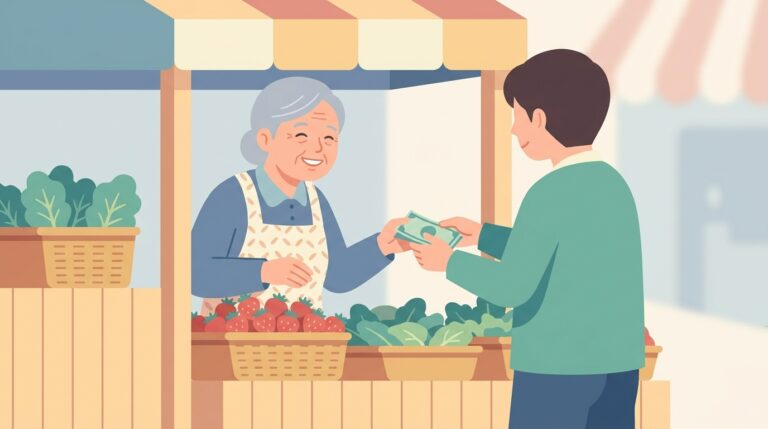
Master the Art of Chatting with Korean Market Vendors Like a Local!
안녕하세요! (Annyeonghaseyo!) It’s your favorite Daily Hangul editor and local culture guide!
Imagine this: You are walking down the vibrant, bustling alleys of Mangwon Market (망원시장) in Seoul. Your senses are overloaded in the best way possible. The rich, savory aroma of freshly fried Jeon (전 – Korean pancakes) fills the air, and you see mountains of bright red, glossy Ttteokbokki (떡볶이) bubbling away.
Suddenly, a warm, energetic elderly lady locks eyes with you, waves a spatula, and shouts: “총각/아가씨, 와서 맛보고 가!” (Chonggak/Agassi, waseo matbogo ga! – Young man/lady, come have a taste!)
Your heart does a little flip. You want to try it, but you’re terrified of saying the wrong thing. Do I sound too robotic? Will I sound impolite if I ask for a discount?
Don’t panic! Today, we are going to learn how to speak real, human Korean with traditional market merchants. By the end of this guide, you won’t just get your food—you’ll get a warm smile, a friendly chat, and maybe even some free extra food (known as Deom / 덤)! Let’s dive in! 🌟
Phase 2: Deep Dive into 3 Core Market Expressions
Here are the absolute game-changers for any traditional market visit. Master these three, and you will instantly transform from a clueless tourist into a beloved regular.
1. 이모, 이거 얼마예요? (Imo, igeo eolmayeyo?)
- Pronunciation: [ee-moh, ee-guh eol-mah-yeh-yo?]
- Sound-alike: “Ee-mo, ee-guh all-mah-yay-yo?”
- Meaning: “Auntie, how much is this?”
- K-Culture Moment: In K-Dramas like Our Blues or Reply 1988, you’ll notice people rarely call female market vendors “Sajangnim” (사장님 – President/Boss). Instead, they use 이모 (Imo), which literally means “maternal aunt.” It immediately melts the ice and creates a warm, family-like bond.
- Editor’s Insight: Calling a female merchant “Imo” is a magic cheat code. It shows you understand Korean social intimacy. However, only use it if the vendor looks at least 15–20 years older than you. If she looks close to your age, stick to Sajangnim (사장님) to avoid accidentally offending her!
- Situation Spectrum:
- Casual (Friends/Strangers in casual settings): ✅ (Perfect for traditional markets)
- Semi-formal (Coworkers): 🚫 (Too informal)
- Formal (Bosses/Elders in formal settings): 🚫
- 🤔 Think About It: Why does Korean culture use family terms (like Imo for aunt, or Eonni/Oppa for older sister/brother) for complete strangers? What does this tell us about how Koreans view community and social connections?
2. 조금만 깎아주세요! (Jogeumman kkakkajuseyo!)
- Pronunciation: [jo-geum-mahn kkah-kkah-joo-seh-yo]
- Sound-alike: “Joe-gum-mahn kah-kah-joo-say-yo”
- Meaning: “Please give me a small discount!” (Literally: “Just cut [the price] a little bit!”)
- K-Culture Moment: Think of those fun variety shows where K-pop idols visit traditional markets and do cute dances (aegyo) to get a cheaper price on fresh fruit or street snacks.
- Editor’s Insight: Bargaining in Korea is not a battle; it’s a playful game of tug-of-war. Never demand a lower price aggressively. Instead, say this phrase with a big, bright smile and a playful, pleading tone.
- Situation Spectrum:
- Casual (Traditional Markets): ✅
- Semi-formal (Department Stores/Malls): 🚫 (Fixed prices apply here!)
- Formal: 🚫
- 🤔 Think About It: In many Western cultures, bargaining is seen as stressful or rude. Why do you think traditional Korean markets treat haggling as an interactive, friendly form of communication?
3. 이모, 덤 좀 주세요! (Imo, deom jom juseyo!)
- Pronunciation: [ee-moh, deom jom joo-seh-yo]
- Sound-alike: “Ee-mo, dum jom joo-say-yo”
- Meaning: “Auntie, please give me some extra goodies!”
- K-Culture Moment: When characters in dramas buy ingredients to make food for their neighbors, the market vendor always throws in a couple of extra green onions or an extra piece of fish for free.
- Editor’s Insight: 덤 (Deom) is a beautiful Korean concept. It refers to free extra things given out of pure affection and generosity (Jeong / 정). Asking for Deom is often much more successful (and fun!) than asking for a cash discount.
- Situation Spectrum:
- Casual (Traditional Markets / Street Stalls): ✅
- Semi-formal (Supermarkets/Franchises): 🚫
- Formal: 🚫
- 🤔 Think About It: Deom is closely linked to the Korean concept of 정 (Jeong)—a warm feeling of attachment. How does your country’s culture show “extra kindness” during a purchase?
Phase 3: Textbook Korean vs. Real Korean
Traditional markets run on fast-paced, high-energy spoken Korean. Let’s look at how textbooks fail you, and what locals actually say!
Situation 1: Asking for the price of fruit
- 📖 Textbook Korean: “이 사과의 가격은 얼마입니까?” (I sagwa-ui gagyeog-eun eolmainikka? – What is the price of this apple?)
- 🗣️ Real Korean: “이모, 이 사과 얼마예요?” (Imo, i sagwa eolmayeyo? – Auntie, how much for this apple?)
- 💡 Why the difference? Textbook Korean is grammatically perfect but incredibly stiff. In a bustling market, brevity and warmth are key. Dropping unnecessary particles like 의 (ui) makes you sound natural and approachable.
Situation 2: Paying and saying goodbye
- 📖 Textbook Korean: “감사합니다. 안녕히 계십시오.” (Gamsahabnida. Annyeonghi gyesipsio. – Thank you. Goodbye.)
- 🗣️ Real Korean: “많이 파세요!” (Mani paseyo! – Sell a lot! / Prosper!)
- 💡 Why the difference? Wishing a merchant to “sell a lot” is the ultimate polite and warm blessing in Korean business culture. It shows you genuinely care about their success, leaving them with a huge smile!
Phase 4: K-Culture Deep Dive & Non-verbal Manners
To truly connect with Korean market vendors, you need to understand the unspoken rules of etiquette.
4-1. The Body Language of “Jeong” (정)
- Two-Hand Rule: Whenever you hand over your cash, credit card, or receive your shopping bag, always use two hands. You don’t have to bow deeply, but a slight nod of the head while using both hands shows immense respect.
- Eye Contact & Smiling: Don’t look down at your feet! Make warm eye contact, smile, and nod actively as they speak. Even if you don’t understand everything they say, active listening goes a long way.
4-2. The “Survival” Reality of Korean Markets
If you plan to visit spots like Tongin Market (통인시장), where you can buy lunch using traditional brass coins, or Gwangjang Market (광장시장), keep this in mind:
* Cash is King: While almost everywhere in Korea accepts credit cards, traditional market vendors (especially elderly ones selling small street snacks) greatly appreciate cash (현금 – hyeongeum). Carrying a few 1,000 KRW and 5,000 KRW bills in your pocket will make transactions incredibly smooth!
Phase 5: Interactive Roleplay Scenario
Let’s play a game! You are standing in front of a warm pancake (Jeon) stall. Let’s see if you can charm the vendor and get some extra food!
🎭 Cast:
- You (A2 Korean Learner): Hungry, excited, and ready to use real Korean.
- Halmoni (할머니 – Sweet Grandma Vendor): Energetic, loud, and incredibly warm-hearted.
- Halmoni: (Gesturing to a freshly fried mung bean pancake) “아가씨, 총각! 뜨끈뜨끈한 빈대떡 먹고 가! 진짜 맛있어!”
(Agassi, chonggak! Ddeukeun-ddeukeun-han bindaetteok meokgo ga! Jinja masisseo! – Lady, young man! Come eat some piping hot mung bean pancakes! It’s delicious!) - You: (Smiling warmly and pointing at the pancakes) “우와, 맛있겠어요! 이모, 이거 얼마예요?”
(Uwa, masitgesseoyo! Imo, igeo eolmayeyo? – Wow, looks delicious! Auntie, how much is this?) - Halmoni: “한 장에 오천 원! 세 장 사면 만 이천 원에 줄게!”
(Han jang-e o-cheon won! Se jang samyeon man i-cheon won-e julge! – 5,000 won for one! If you buy three, I’ll give them to you for 12,000 won!) - You: “아, 그래요? 그럼 두 장만 주세요.”
(Ah, geuraeyo? Georeom du jang-man juseyo. – Oh, really? Then please give me just two.) - Halmoni: (Quickly packing the hot pancakes into a box) “그래, 여기! 더 필요한 건 없고?”
(Geurae, yeogi! Deo piryohan geon eopgo? – Okay, here! Do you need anything else?)
🔀 Decision Point!
What will you say to get a friendly extra or discount? Choose your path:
- Option A: “이모, 너무 비싸요. 깎아주세요!” (Imo, neomu bissayo. Kkakkajuseyo! – Auntie, it’s too expensive. Give me a discount!)
- Option B: “이모, 너무 맛있어 보여요! 서비스나 덤 좀 주세요~!” (Imo, neomu masisseo boyeoyo! Seobiseuna deom jom juseyo~! – Auntie, it looks so delicious! Please give me some service or extras~!)
- Option C: “이것의 가격을 더 낮출 수 있습니까?” (Igeoseui gagyeogeul deo natchul su itseumnika? – Is it possible to lower the price of this?)
💡 Choice Analysis:
- Best Choice: Option B! Asking for “service” (서비스) or “deom” (덤) with a compliment (“it looks so delicious!”) is the golden key. It targets the vendor’s pride in her food and her generous spirit.
- Risky Choice: Option A. Saying “it’s too expensive” (neomu bissayo) can sound slightly rude to an older vendor who worked hard to cook the food.
- Awkward Choice: Option C. This sounds like a formal business contract negotiation! It will ruin the cozy market vibe instantly.
Phase 6: 10-Second Emotion Shadowing Drill
Let’s practice speaking with real Korean emotion! Use the emotion guides and pause at the slashes (/).
- [😊 Bright & Friendly]
- “이모! / 이거 / 얼마예요?”
- Imo! / Igeo / eolmayeyo?
- [🥺 Playful & Cute]
- “이모~! / 조금만 / 깎아주세요! / 네?”
- Imo~! / Jogeumman / kkakkajuseyo! / Ne?
- [💖 Warm & Grateful]
- “감사합니다! / 많이 / 파세요!”
- Gamsahabnida! / Mani / paseyo!
Phase 7: K-Culture Mini Dictionary
| Word (Korean/Romanization) | Meaning | Cultural Context |
|---|---|---|
| 이모 (Imo) | Auntie | A friendly title used for middle-aged female shopkeepers to build instant intimacy. |
| 정 (Jeong) | Warm feeling of attachment | The invisible emotional bond of affection, sharing, and kindness that connects Korean people. |
| 덤 (Deom) | Free extras | Extra goods given out of generosity without expecting payment. A physical representation of Jeong. |
| 서비스 (Seobiseu) | “Service” (Freebie) | The English loanword Koreans use daily to describe free extra dishes, drinks, or items in restaurants and markets. |
Phase 8: Traveler’s Survival Kit
📌 Survival Card TOP 3
- 카드 돼요? (Kadeu dwaeyo?)
- Do you accept credit cards?
- Pro Tip: Useful at modern market stalls, but keep cash ready just in case!
- 이거 매워요? (Igo maewoyo?)
- Is this spicy?
- Pro Tip: Crucial if you are trying street food like Tteokbokki or Dakgangjeong (sweet crispy chicken).
- 여기서 먹을게요. (Yeogiseo meogeulgeyo.)
- I will eat here.
- Pro Tip: Say this if the stall has tiny plastic stools nearby where you can sit and eat fresh food immediately.
📌 Editor’s Travel Note
Before heading out, download the Naver Map App for Android or the Naver Map App for iOS. Unlike Google Maps, Naver Map is incredibly precise in Korea and will guide you to the exact entrance of traditional markets!
Phase 9: One Step Deeper — Cultural Reflection
In our hyper-connected, digital world, self-checkout kiosks and robot servers are replacing human contact. But in Korean traditional markets, the human connection is still very much alive.
When a market vendor gives you a little extra piece of food (Deom), they aren’t trying to optimize business metrics. They are expressing 정 (Jeong)—a unique Korean form of social love and mutual care. By learning to speak to merchants with respect and warmth, you are participating in a beautiful, centuries-old tradition of human interaction.
💬 Your Turn: How do merchants in your hometown show kindness or build relationships with customers? Do you have a concept similar to Deom or Jeong? Share your stories in the comments below!
Phase 10: FAQ & Common Mistakes
Q: Can I use “Imo” (이모) to male vendors?
A: No! Imo specifically means maternal aunt. For male vendors, use 사장님 (Sajangnim – Boss) or 삼촌 (Samchon – Uncle). Sajangnim is always the safest and most polite option for men of all ages!
Q: Is bargaining acceptable at every market stall?
A: It depends. If you are buying cheap street food (like a 3,000 KRW snack) or if prices are clearly printed on labels, do not ask for a discount. Bargaining is usually reserved for buying fruits, vegetables, or clothes in bulk.
Q: What is the biggest mistake foreigners make at markets?
A: Calling a senior lady 아줌마 (Ajumma). While it means “middle-aged woman,” it can sometimes carry a slightly negative, unflattering nuance. Stick to 이모 (Imo) or 사장님 (Sajangnim) to make them feel respected and happy!
Phase 11: Action Missions
- 🥉 Bronze (At-Home Challenge): Record yourself saying “이모, 조금만 깎아주세요!” (Imo, jogeumman kkakkajuseyo!) using the shadow drill emotional markers.
- 🥈 Silver (Social Challenge): Post a picture of your favorite Korean street food on Instagram or Twitter, and caption it with: “이거 얼마예요?” (How much is this?) and tag #DailyHangul!
- 🥇 Gold (Real-Life Challenge): Visit your nearest local Korean market or Korean grocery store. Buy some fresh ingredients, hand over the cash using both hands, and say: “많이 파세요!” (Mani paseyo!)
Phase 12: Interactive Quiz Challenge
1. Which term is the safest and most polite to use when calling a female market vendor who is clearly older than you?
- A) 아줌마 (Ajumma)
- B) 이모 (Imo)
- C) 할머니 (Halmoni)
👉 Click to reveal the Answer & Explanation
Answer: B) 이모 (Imo)
Explanation: While “Ajumma” is technically correct, it can sound cold. “Imo” (Auntie) is warm, polite, and guarantees a friendly reaction. Only use “Halmoni” (Grandma) if the vendor is very elderly.
2. Fill in the blank: To wish a merchant prosperity as you leave, you should say: “많이 ______!”
👉 Click to reveal the Answer & Explanation
Answer: 파세요 (paseyo)
Whole sentence: 많이 파세요! (Mani paseyo! – Please sell a lot!)
3. True or False: You should always use both hands when handing over your card or money in Korea.
👉 Click to reveal the Answer & Explanation
Answer: TRUE!
Explanation: Using both hands is a fundamental sign of respect in Korean culture, showing that you value the person you are interacting with.







