

Shopping for Children’s Day in Korea: Your Ultimate Survival Guide
안녕하세요! (Annyeonghaseyo!) Hello! I am your lead editor at Daily Hangul, your trusty Korean friend and guide.
Imagine this: It is early May in Seoul. The weather is perfect, cherry blossoms have given way to lush green leaves, and the city is buzzing with excitement. You walk into a giant mart like E-Mart or Lotte Mart, and it is packed with parents, grandparents, aunts, and uncles. Everyone is looking for the perfect toy.
Why? Because May 5th is Children’s Day (어린이날 – Eorininal) in Korea! It is a massive national holiday where children receive presents, eat delicious food, and spend the day at amusement parks like Everland or Lotte World.
If you have Korean friends with kids, nieces, nephews, or are simply traveling in Korea during this beautiful family season, you might find yourself wanting to buy a gift. But how do you ask for recommendations, check what is popular, or get it beautifully wrapped without getting overwhelmed? Don’t worry! Today, we will learn the absolute best, natural A2-level Korean phrases to conquer the toy store like a local.
Phase 2: Core 3 Expressions for Holiday Shopping
Here are three magic expressions that will make any toy store clerk instantly smile and help you find exactly what you need.
1. 이거 요즘 인기 많아요? (Igeo yojeum ingi manayo?)
- Pronunciation: [ee-geo yo-jeum een-gee ma-nah-yo?]
- Meaning: “Is this popular these days?”
- K-Culture Moment: In K-Dramas, you often see sweet aunts or uncles standing helplessly in front of a wall of toys, completely confused by modern kids’ trends. Asking this question instantly gets you the “it-item” of the season!
- Editor’s Insight: Korean children’s trends change incredibly fast. What was popular last month might be old news today. Use this phrase to get the freshest recommendations!
- Situation Spectrum:
- Friends/Casual: 이거 요즘 인기 많아? (Igeo yojeum ingi mana?) ✅
- Store Clerks (Semi-formal): 이거 요즘 인기 많아요? (Igeo yojeum ingi manayo?) ✅
- Formal/Elders: 이것이 요즘 인기가 많습니까? (Igeosi yojeum ingiga manseumnikka?) ⚠️ (Too formal for a toy store!)
- 🤔 Think About It: Why does “popularity” (인기) matter so much in Korean trends? Think about how collective tastes shape shopping in your own country.
2. 추천해 주세요. (Chucheonhae juseyo.)
- Pronunciation: [choo-cheon-hae joo-seh-yo]
- Meaning: “Please recommend something.”
- K-Culture Moment: When shopping at a traditional market or a modern department store, asking for a recommendation shows you trust the shopkeeper’s expertise.
- Editor’s Insight: If you don’t know what age group a toy is for, you can combine this: “몇 살용 추천해 주세요?” (Myeot sal-yong chucheonhae juseyo? – “Please recommend something for [X] years old.”)
- Situation Spectrum:
- Friends/Casual: 추천해 줘. (Chucheonhae jwo.) ✅
- Store Clerks (Semi-formal): 추천해 주세요. (Chucheonhae juseyo.) ✅
- Formal: 추천해 주시겠습니까? (Chucheonhae jusigesseumnikka?) ⚠️ (Slightly stiff, but polite)
3. 선물 포장해 주세요. (Seonmul pojanghae juseyo.)
- Pronunciation: [seon-mool po-jang-hae joo-seh-yo]
- Meaning: “Please wrap it as a gift.”
- K-Culture Moment: Presentation is everything in Korea. Gift wrapping (선물 포장) is often treated like an art form, especially during holidays.
- Editor’s Insight: Many department stores and large toy shops offer free or cheap wrapping services during the holiday season. Always ask for this to make your gift look extra special!
- Situation Spectrum:
- Friends/Casual: 선물 포장해 줘. (Seonmul pojanghae jwo.) 🚫 (Do not use with store staff!)
- Store Clerks (Semi-formal): 선물 포장해 주세요. (Seonmul pojanghae juseyo.) ✅
- Formal: 선물 포장 부탁드립니다. (Seonmul pojang butakdeurimnida.) ✅ (Very polite and elegant)
Phase 3: Textbook Korean vs. Real Korean
Let’s compare textbook phrases with how real Koreans actually speak in toy stores.
Situation 1: Asking about the target age
- 📖 Textbook: “이것은 몇 세의 어린이가 사용합니까?” (For which age children is this used?)
- 🗣️ Real Korean: “이거 몇 살용이에요?” (What age is this for?)
- 💡 Why the difference?: The textbook version is grammatically correct but sounds like an instruction manual. Real Koreans use the friendly, conversational “몇 살용” (myeot sal-yong) to ask about age ranges.
Situation 2: Asking if there is a discount event
- 📖 Textbook: “할인 혜택이 적용됩니까?” (Is a discount benefit applied?)
- 🗣️ Real Korean: “이거 할인해요?” (Is this on sale?) or “이거 세일해요?” (Is this on sale?)
- 💡 Why the difference?: Koreans love efficiency and use the English-derived word “세일” (seil – sale) or the simple verb “할인하다” (harinhada) in daily conversations.
Phase 4: K-Culture Deep Dive & Non-verbal Manners
4-1. The Art of the Two-Handed Handover
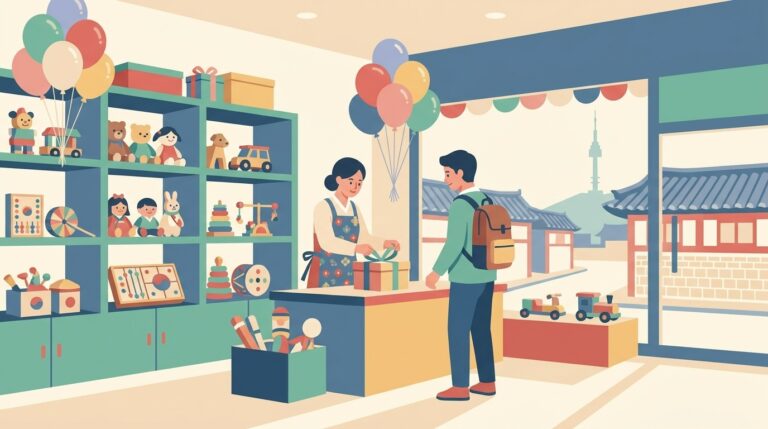
When you pay for the toy or receive the wrapped gift from the clerk, always use two hands. Handing over your card or taking your shopping bag with only one hand can be seen as slightly impolite in Korea. A gentle nod of your head with a warm “감사합니다” (Gamsahabnida) completes the perfect polite interaction!
4-2. The “Ten Pockets” (텐 포켓) Trend
In modern Korea, birth rates are low, meaning a single child often receives undivided attention and gifts from many family members. Koreans call this the “Ten Pockets” phenomenon—referring to the pockets of parents, two sets of grandparents, aunts, uncles, and family friends all opening up to buy gifts for one beloved child. This is why toy stores during Children’s Day are wonderfully busy and filled with high-quality, premium items!
Phase 5: Interactive Roleplay Scenario
Setting: You are inside a bustling toy store in Seoul on May 4th, the eve of Children’s Day. Colorful balloons hang from the ceiling, and cheerful children’s music is playing.
Cast:
* You (A kind foreigner looking for a gift for a friend’s 6-year-old child)
* Minji (A busy but enthusiastic toy store employee)
- Minji (Clerk): 어서 오세요! 어떤 것 찾으세요?
(Eoseo oseyo! Eotteon geot chajuseyo?)
(🎭 Smiling warmly and gesturing toward the shelves)
(Welcome! What are you looking for?) -
You: 안녕하세요! 어린이날 선물을 사고 싶어요.
(Annyeonghaseyo! Eorininal seonmureul sago sipeoyo.)
(🎭 Looking slightly lost but smiling)
(Hello! I want to buy a Children’s Day gift.) -
Minji (Clerk): 아, 어린이날 선물이요! 아이가 몇 살이에요?
(Ah, eorininal seonmuriyo! Aiga myeot sarieyo?)
(Oh, a Children’s Day gift! How old is the child?) -
You: 여섯 살이에요. 요즘 어떤 게 인기 많아요?
(Yeoseot sarieyo. Yojeum eotteon ge ingi manayo?)
(They are six years old. What is popular these days?) -
Minji (Clerk): 여섯 살이면 이 캐릭터 장난감이 요즘 제일 인기 많아요!
(Yeoseot sarieon i kaerikteo jangnangami yojeum jeil ingi manayo!)
(🎭 Pointing to a cute colorful character toy)
(If they are six, this character toy is the most popular these days!) -
You: 우와, 진짜 귀엽네요. 이거 추천해 주세요!
(Uwa, jinja gwiyeopneyo. Igeo chucheonhae juseyo!)
(Wow, it’s really cute. Please recommend this one!) -
Minji (Clerk): 네, 탁월한 선택이세요! 계산 도와드릴게요.
(Ne, tagworhan seontegiseoyo! Gyesan dowadeurilgeyo.)
(Yes, excellent choice! I will help you with the payment.) -
You: 네, 그리고 혹시… 선물 포장도 돼요?
(Ne, geurigo hoksi… seonmul pojangdo dwayo?)
(Yes, and by any chance… is gift wrapping possible?) -
Minji (Clerk): 네, 선물 포장 가능합니다! 잠시만 기다려 주세요.
(Ne, seonmul pojang ganeunghabnida! Jamsiman gidaryeo juseyo.)
(Yes, gift wrapping is possible! Please wait a moment.) -
You: 감사합니다!
(Gamsahabnida!)
(🎭 Bowing slightly and handing over the payment card with both hands)
(Thank you!)
🔀 Decision Point: What do you say if you want a discount?
Imagine the toy is a bit expensive. What is the most natural way to ask if there are deals?
- Choice A: “깎아 주세요!” (Kakka juseyo!) -> “Give me a discount!” (A bit too direct/aggressive for a modern toy store, better left for traditional open-air markets!)
- Choice B: “이거 혹시 할인 카드 있어요?” (Igeo hoksi harin kadeu isseoyo?) -> “Do you have any discount card promotions for this?” (Excellent! Very smart way to ask for bank card discounts in big marts.) ✅
- Choice C: “돈이 없어요.” (Doni eopseoyo.) -> “I have no money.” (A funny joke, but might make the clerk feel awkward!)
Phase 6: 10-Second Emotional Shadowing Drill
Practice these sentences with real emotion! Follow the pauses (/) and try to mimic the emotional tones.
- [😊 Excited and bright]
“이거 / 요즘 / 인기 / 진짜 많아요?”
(Igeo / yojeum / ingi / jinja manayo?)
(Is this really popular these days?) -
[🥺 Polite and hopeful]
“선물 / 포장도 / 같이 / 해주세요!”
(Seonmul / pojangdo / gachi / hae-juseyo!)
(Please do the gift wrapping together as well!)
Phase 7: K-Culture Mini Dictionary
| Word (Korean + Romanization) | English Meaning | Cultural Context & Usage |
|---|---|---|
| 어린이날 (Eorininal) | Children’s Day | May 5th. A beautiful spring day where children are celebrated as the future of the nation. |
| 조카 (Joka) | Nephew / Niece | Koreans love their nieces and nephews deeply, often calling themselves “Joka-Babo” (조카 바보 – fool for their nephew/niece). |
| 장난감 (Jangnangam) | Toy | Literally translates to “play tool.” Essential vocabulary for any toy store adventure. |
| 포장 (Pojang) | Wrapping / Packaging | Can mean food takeout or gift wrapping depending on the verb that follows! |
Phase 8: Traveler’s Survival Kit
Top 3 Survival Phrases
- “이거 건전지 필요해요?” (Igeo geonjeonji piryohaeyo?)
- Tip: “Does this need batteries?” Super useful so you can buy batteries before giving the gift!
- “이거 다른 색상도 있어요?” (Igeo dareun saeksangdo isseoyo?)
- Tip: “Do you have this in other colors?” Great for fussy kids who love specific colors.
- “영수증 주세요.” (Yeongsujeung juseyo.)
- Tip: “Please give me the receipt.” You might need this for exchanges or refunds later.
📌 Editor’s Travel Note:
If you are in Seoul and want to experience toy heaven, head straight to the Dongdaemun Toy and Stationery Street. You can easily navigate there by downloading the Naver Map App Download Page. It is a bustling market full of amazing deals and retro vibes!
Phase 9: Deep Thoughts — “One Step Deeper”
In many Western cultures, gift-giving is highly individualized. In Korea, holiday gift-giving often reflects a strong sense of community and family responsibility. During “Family Month” (가정의 달 – Gajeong-ui dal) in May, Korean families coordinate closely to make sure children feel incredibly loved, creating shared memories across generations.
💬 Your Turn: How does your home country celebrate children? Do you have a specific Children’s Day with special gift-giving traditions? Let us know in the comments below!
Phase 10: FAQ & Avoiding Common Mistakes (FAQ Schema)
Q: Are toy stores open on Children’s Day (May 5th)?
A: Yes! Even though it is a national holiday, almost all major malls, toy shops, and department stores stay open to welcome families. In fact, it is their busiest day of the year!
Q: What is a safe budget for a Korean Children’s Day gift?
A: For acquaintances’ children, a gift valued between 20,000 KRW to 50,000 KRW (approx. $15 – $40 USD) is perfect and polite.
Q: Can I use “반말” (informal language) with kids in the store?
A: While kids are younger, if you don’t know them well, it is still sweet and polite to use soft, friendly honorifics like “안녕? 이거 좋아해?” or talk to their parents using polite language.
🚨 Common Mistake Alert!
- Mistake: Handing your credit card to the cashier with one hand or throwing it onto the counter.
- Correction: Hand over your card using both hands as a sign of mutual respect. It makes a wonderful impression!
Phase 11: Action Missions
- 🥉 Bronze: Record yourself saying “이거 요즘 인기 많아요?” three times with an excited expression!
- 🥈 Silver: Comment below with the name of a toy you would love to buy for a child in your life, written in Korean if possible.
- 🥇 Gold: The next time you visit a Korean convenience store or shop, hand over your payment card with both hands and say “감사합니다!”
Phase 12: Interactive Quiz Challenge
Test your knowledge of Korean toy store etiquette!
Q1: What is the most natural way to ask if a toy is popular? (Click to reveal)
Answer: “이거 요즘 인기 많아요?” (Igeo yojeum ingi manayo?) is perfect! It’s natural, friendly, and polite.
Q2: True or False: You should hand your credit card to the clerk with only one hand. (Click to reveal)
Answer: False! Always hand over cards and gifts with both hands to show respect in Korea.







