

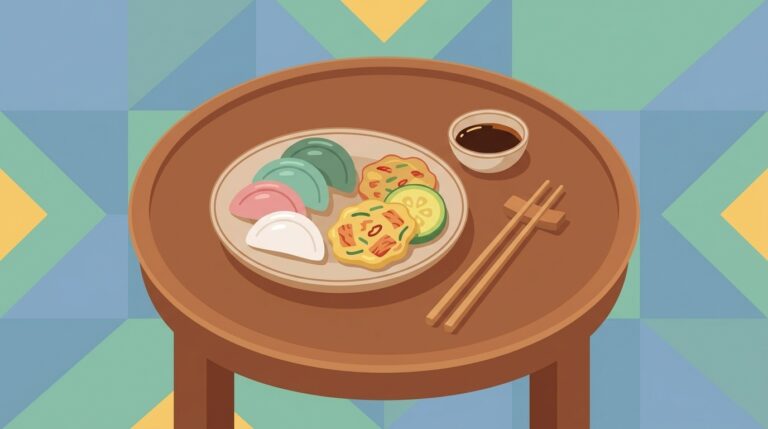
Survived and Thrived! Your Warm Guide to a Korean Chuseok Family Gathering
안녕하세요! (Annyeonghaseyo! – Hello!) Welcome back to Daily Hangul, your friendly neighborhood guide to speaking Korean like a true local. I’m your senior editor, and today, we are going to dive into one of the warmest, busiest, and most delicious times of the year in Korea: 추석 (Chuseok – Korean Thanksgiving)!
Imagine this: Your close Korean friend, Min-jun, invites you to his family home for Chuseok. You walk in, and the mouth-watering aroma of freshly pan-fried 전 (jeon – savory pancakes) fills the air. Grandparents, aunts, uncles, and cousins are all laughing in the living room. Suddenly, everyone looks at you with big, welcoming smiles.
Your heart races. “What should I say? Do I bow? What if I accidentally offend someone?”
Don’t panic! This is a common situation for many of my students. In this guide, we will transform you from a nervous guest into the most polite, charming visitor Min-jun’s family has ever met. Let’s learn the secret phrases and cultural tricks together!
1. Three Golden Chuseok Phrases You Need to Know
To make an amazing first impression, you only need three simple phrases. Let’s look at them step-by-step.
① 즐거운 추석 보내세요! (Have a happy Chuseok!)
- Pronunciation: Jul-gwon Choo-seok bo-nae-seh-yo! (Sounds like: “Jool-gwon” + Chuseok + “bo-nae-say-yo”)
- Meaning: Have a happy Chuseok! / Wish you a joyful Thanksgiving!
- K-Culture Moment: This is the exact phrase K-Pop idols write on their social media while wearing beautiful, colorful 한복 (Hanbok – traditional Korean clothing).
- Editor’s Insight: It is polite, cheerful, and absolutely perfect for greeting anyone—from Min-jun’s grandmother to his little cousins.
- Situation Spectrum:
- Friends & Peers (Casual): ⚠️ 즐거운 추석 보내! (Jul-gwon Choo-seok bo-nae!)
- Co-workers (Semi-formal): ✅ 즐거운 추석 보내세요!
- Elders & Bosses (Formal): ✅ 즐거운 추석 보내세요!
- 🤔 Think About It: In English, we say “Happy Thanksgiving.” In Korean, we wish for a “joyful” (즐거운) Chuseok. Why do you think sharing joy is so central to Korean holidays?
② 맛있게 드세요! (Please eat deliciously!)
- Pronunciation: Mah-sheet-ge deu-seh-yo! (Sounds like: “Mah-sheet-ge” + “deu-say-yo”)
- Meaning: Enjoy your meal! (Literally: “Eat deliciously!”)
- K-Culture Moment: Think of those comforting K-Drama scenes where a giant family sits around a low wooden table covered with dozens of side dishes. Before lifting their spoons, everyone smiles and says this to one another.
- Editor’s Insight: When you say this to the elders who cooked all day, their faces will light up with absolute joy!
- Situation Spectrum:
- Friends & Peers (Casual): ⚠️ 맛있게 먹어! (Mah-sheet-ge meok-eo!)
- Co-workers (Semi-formal): ✅ 맛있게 드세요!
- Elders & Bosses (Formal): ✅ 맛있게 드세요!
③ 도와드릴까요? (May I help you?)
- Pronunciation: Doh-wah-deu-reel-kkah-yo? (Sounds like: “Doh-wah” + “deu-reel” + “kah-yo?”)
- Meaning: Shall I help you? / Can I help you?
- K-Culture Moment: In Korean homes during Chuseok, there is a mountain of work—washing vegetables, setting the table, or making 송편 (Songpyeon – half-moon rice cakes). Standing up and offering to help is the ultimate way to show your golden heart.
- Editor’s Insight: Even if they say, “No, no, just sit and relax!” (which they usually do!), just asking this question earns you 100 bonus points as a polite guest!
- Situation Spectrum:
- Friends & Peers (Casual): 🚫 도와줄까? (Doh-wah-jool-kah? – Too casual for elders)
- Co-workers (Semi-formal): ✅ 도와드릴까요?
- Elders & Bosses (Formal): ✅ 도와드릴까요?
2. Textbook Korean vs. Real-World Korean
Sometimes, what you learn in a standard classroom sounds a bit too robotic or stiff in a cozy home environment. Let’s compare!
Scenario 1: Greeting the family when you walk in
- 📖 Textbook Korean: 안녕하십니까? 처음 뵙겠습니다. (An-nyeong-ha-sim-ni-ka? Cheo-eum boep-get-seum-ni-da. – “How do you do? Nice to meet you for the first time.”)
- 🗣️ Real-World Korean: 안녕하세요! 초대해 주셔서 감사합니다. (An-nyeong-ha-seh-yo! Cho-dae-hae joo-shyeo-seo gam-sa-ham-ni-da. – “Hello! Thank you so much for inviting me!”)
- 💡 Why it’s different: Textbook phrases can sound like a formal business meeting. Using “Thank you for inviting me” is warm, polite, and fits a cozy family setting perfectly.
Scenario 2: When you are full but grandmother keeps offering food
- 📖 Textbook Korean: 배가 부릅니다. 사양하겠습니다. (Bae-ga boo-reum-ni-da. Sa-yang-ha-get-seum-ni-da. – “My stomach is full. I decline.”)
- 🗣️ Real-World Korean: 진짜 맛있어요! 그런데 배가 너무 불러요. (Jin-jja mah-sheet-eo-yo! Geon-dae bae-ga neo-moo bool-leo-yo. – “This is truly delicious! But my stomach is so full!”)
- 💡 Why it’s different: Declining food directly can sound cold. Complimenting the food first (진짜 맛있어요!) before saying you are full keeps the atmosphere sweet and appreciative.
3. K-Culture Deep Dive & Non-Verbal Manners
In Korea, action speaks as loudly as words! Here are two essential tips to make you look like a cultural expert.
3-1. The Magic of Two Hands (두 손)
Whenever you receive a cup of water, a piece of fruit, or a gift from an elder, always use two hands. You can either hold the item with both hands, or place your left hand gently under your right forearm as you reach out. This small gesture shows immense respect!
3-2. The ‘Jeong’ (정) of Chuseok Food
Koreans express love through food. If Min-jun’s mother keeps piling food onto your plate, it’s not because she wants to overfeed you; it’s a display of 정 (Jeong – deep warm affection). Try to take at least a small bite of everything offered to show your appreciation.
4. Roleplay: Dinner with Min-jun’s Grandmother
Let’s practice! You are now sitting at the dining table. Warm yellow lights shine on a table filled with delicious food. Next to you is Min-jun, and across from you is his smiling Grandmother (Halmoni).
- Halmoni 👵: (Smiling warmly) 어서 와요! 배고프지요? (Eo-seo wa-yo! Bae-go-peu-ji-yo?)
(Translation: Welcome! You must be hungry, right?) - You 🙋♂️: 안녕하세요! 초대해 주셔서 감사합니다. (An-nyeong-ha-seh-yo! Cho-dae-hae joo-shyeo-seo gam-sa-ham-ni-da.)
(Translation: Hello! Thank you so much for inviting me.) - Min-jun 👦: (Passing a plate of jeon) 이거 우리 할머니가 직접 만드신 전이야. 얼른 먹어봐. (I-geo oo-ri hal-meo-ni-ga jip-jeop man-deu-sin jeon-i-ya. Eol-leun meok-eo-bwa.)
(Translation: My grandmother made these savory pancakes herself. Try one quickly!) - You 🙋♂️: (Using both hands to take the plate) 감사합니다! (Gam-sa-ham-ni-da!)
(Translation: Thank you!) - You 🙋♂️: (Looking at Grandmother politely) 맛있게 드세요! (Mah-sheet-ge deu-seh-yo!)
(Translation: Please eat deliciously!) - Halmoni 👵: (Happy) 그래요, 많이 먹어요! (Geu-rae-yo, man-i meok-eo-yo!)
(Translation: Yes, eat a lot!) - You 🙋♂️: (Takes a bite of the pancake) 와, 진짜 맛있어요! (Wa, jin-jja mah-sheet-eo-yo!)
(Translation: Wow, it is really delicious!) - Halmoni 👵: (Puts three more pancakes on your plate) 그래? 더 많이 먹어요! (Geu-rae? Deo man-i meok-eo-yo!)
(Translation: Really? Eat much more then!)
🔀 Decision Point!
Grandmother just put a giant pile of food on your plate, but your stomach is already reaching its limit. What do you do?
- Option A: Stop eating immediately, cross your arms, and say “No.”
- Option B: Eat a little bit more, smile, and say: “진짜 맛있어요! 그런데 배가 너무 불러요.”
- Option C: Secretly hide the food under the table.
💡 The Verdict:
- Best Choice is B! Complimenting the taste of the food before explaining that you are full is extremely polite and makes the cook feel respected and happy.
- Option A is too cold and can hurt Grandmother’s feelings. Option C might lead to a hilarious but highly embarrassing cleanup disaster!
5. 10-Second Emotion Shadowing Drill
Let’s practice saying these lines with the perfect feelings! Follow the emotional cues below:
- [😊 Bright & Cheerful]
즐거운 / 추석 / 보내세요!
(Jul-gwon / Choo-seok / bo-nae-seh-yo!) - [😋 Excited & Hungry]
맛있게 / 먹겠습니다!
(Mah-sheet-ge / meok-get-seum-ni-da! – I will eat deliciously!) - [💖 Polite & Eager to Help]
도와/드릴까요?
(Doh-wah / deu-reel-kkah-yo?)
6. Chuseok Mini Dictionary
| Word | English Meaning | How it’s used |
|---|---|---|
| 송편 (Songpyeon) | Half-moon rice cakes | The signature sweet rice cakes filled with honey, sesame, or sweet beans eaten during Chuseok. |
| 정 (Jeong) | Warm affection / Bond | The invisible feeling of warm connection, sharing, and love between people. |
| 한복 (Hanbok) | Traditional Korean dress | Beautiful clothing worn during traditional holidays and special ceremonies. |
| 차례 (Charye) | Ancestral memorial service | A respectful family ceremony of offering food and tea to ancestors on Chuseok morning. |
7. Traveler’s Survival Kit
If you are traveling in Korea during the Chuseok holiday, keep these three essential survival tips in mind:
- Use Navigation Apps: Google Maps is not fully optimized in Korea. Download Naver Map App or KakaoMap to find open restaurants and public transport schedules during the holiday.
- Chuseok Transit Note: Trains and buses are booked months in advance as everyone travels to their hometowns. Plan to stay in major cities like Seoul, where the streets become peaceful and quiet.
- Emergency Phrase: “오늘 영업 하나요?” (Oh-neul yeong-eob ha-na-yo? – “Are you open today?”) – Use this to call cafes or restaurants before visiting, as some independent shops close for Chuseok.
8. Deep Thoughts: The Heart of Chuseok
Chuseok is often translated as “Korean Thanksgiving,” but its roots go deeper into agriculture and community. In the past, harvest time was the only period when food was abundant. Families gathered to share this wealth so that no one would go hungry.
Even today, in a fast-paced, high-tech Korea, families drop everything to travel back home. It is a time to reconnect with your roots and slow down.
💬 Your Turn: How does your culture celebrate harvest or family reunions? What is your favorite family holiday dish? Let us know in the comments below!
9. FAQ & Avoiding Common Mistakes
Q: Do I need to bring a gift to a Korean family gathering?
A: Yes, absolutely! You don’t need to buy anything expensive. A nice box of fresh fruit, a set of Korean traditional snacks, or even a nice roll cake from a local bakery is highly appreciated.
Q: Should I take my shoes off when entering a house?
A: Yes, 100%! This is one of the most important rules. Take your shoes off at the entryway (현관 – hyeongwan) before stepping onto the wooden floor.
Q: Is it rude to start eating before the oldest person at the table?
A: Yes, it is. Always wait for the oldest family member (like Grandmother or Grandfather) to pick up their spoon or chopsticks first before you start enjoying your meal.
🚨 Common Mistakes Warning Board
- Mistake 1: Pouring drinks for others with only one hand. (Fix: Use both hands!)
- Mistake 2: Sticking chopsticks vertically into your bowl of rice. (Fix: Rest them flat on the table or chopstick holder. Vertical chopsticks resemble ancestral ritual incense and are considered bad luck!)
- Mistake 3: Saying “안녕” (Annyeong) to the grandparents. (Fix: Always add “하세요” to make it polite: 안녕하세요!)
10. Interactive Quiz Challenge
Test your Chuseok knowledge! Click on the boxes below to check your answers.
Q1. What is the correct phrase to wish someone a Happy Chuseok?
Answer: 즐거운 추석 보내세요! (Jul-gwon Choo-seok bo-nae-seh-yo!)
Q2. True or False: You should stick your chopsticks straight up into your bowl of rice during dinner.
Answer: False! This mimics ritual incense and is considered very bad luck. Place them flat next to your bowl.
Q3. What sweet, half-moon shaped rice cake is traditionally eaten during Chuseok?
Answer: 송편 (Songpyeon)!
11. Your 3-Step Action Mission!
- 🥉 Bronze Mission (Mirror Practice): Look in the mirror, smile warmly, and say “즐거운 추석 보내세요!” out loud three times.
- 🥈 Silver Mission (Social Media): Post a picture of your favorite holiday food on Instagram and caption it with “맛있게 드세요!”
- 🥇 Gold Mission (Real Life): If you have a Korean friend, classmate, or teacher, send them a text wishing them “즐거운 추석 보내세요!” during the next Chuseok holiday. They will be incredibly touched!







