

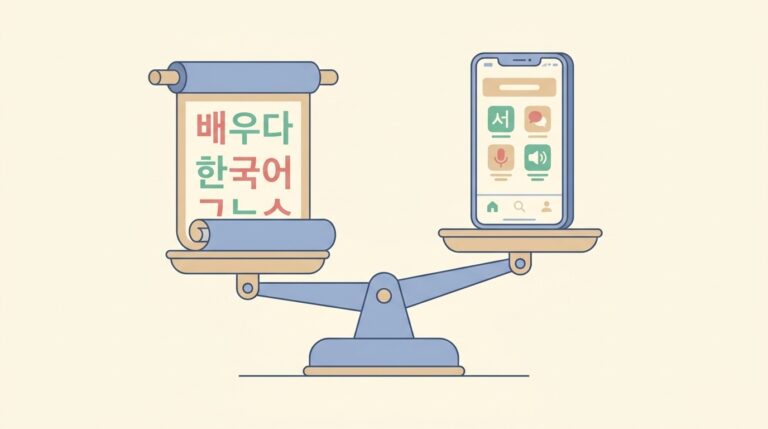
Beyond Squid Game: Decoding Justice in Korean Society via Rawls and Bentham
Phase 1: Empathy (An Intellectual Coffee Chat)
안녕하세요! Welcome back to another thought-provoking edition of Daily Hangul. I’m your head editor and resident cultural navigator.
Imagine you are watching a high-stakes K-Drama like Squid Game (오징어 게임) or The Devil Judge (악마판사). You see a cold, calculating protagonist argue that sacrificing a few is a necessary evil for the survival of the collective. On the other side, an idealist desperately screams that every single life must be valued equally under a “fair” system.
This isn’t just dramatic tension; it is a live, breathing philosophical debate echoing through the cafes of Hongdae and the offices of Yeouido. Today’s younger generation of Koreans is intensely obsessed with the concept of 공정 (gong-jeong)—fairness.
If you have ever found yourself struggling to articulate deep political philosophy, distributive justice, or the clash between Bentham’s Utilitarianism and Rawls’ Theory of Justice in sophisticated Korean, you are in the right place. Today, we are upgrading your Korean to C2-level proficiency so you can hold your own in late-night intellectual debates over craft beer and Han River breezes.
Phase 2: Core Expressions Deep Dive
1. 공리주의 (Gong-ri-ju-ui)
- Pronunciation: [gong-ri-ju-ui] / Sound-alike: “gong-ree-joo-ee”
- Meaning: Utilitarianism (Literally: “The ideology of public utility and benefit”).
- K-Culture Moment: In the legal thriller The Devil Judge, the protagonist often makes decisions that favor the absolute majority, ignoring the procedural rights of individuals—a perfect embodiment of extreme utilitarianism.
- Editor’s Insight: While in English “utilitarian” can sometimes sound purely practical or sterile, in Korean, 공리주의 is deeply tied to historical developmentalism (개발도상국 시절의 희생), where individual rights were often postponed for rapid national growth.
- Situation Spectrum:
- Casual / Friends: ✅ (Used when jokingly deciding on a menu that pleases the most people)
- Semi-formal: ✅
- Formal / Academic: ✅
- 🤔 Think About It: Does the Korean focus on rapid collective development (압축성장) make utilitarianism a default cultural setting? How does this compare to your home country’s historical path?
2. 차등의 원칙 (Cha-deung-ui Won-chik)
- Pronunciation: [cha-deung-ui won-chik] / Sound-alike: “cha-deung-uee won-cheek”
- Meaning: The Difference Principle (John Rawls). Literal: “Principle of graded differences.”
- K-Culture Moment: This principle is frequently referenced in Korean policy debates surrounding college admission quotas for rural students or “dirt-spoon” (흙수저) support initiatives.
- Editor’s Insight: This isn’t just academic jargon. If you want to discuss systemic equity in Korea, using “차등의 원칙” shows you understand that treating everyone identically is not the same as genuine justice.
- Situation Spectrum:
- Casual / Friends: ⚠️ (Slightly too academic for casual gossip, unless debating social issues)
- Semi-formal: ✅
- Formal / Academic: ✅
- 🤔 Think About It: John Rawls argues that inequalities are only justified if they work to the maximum benefit of the least advantaged. How does this apply to Korea’s hyper-competitive education system?
3. 무지의 베일 (Mu-ji-ui Be-il)
- Pronunciation: [mu-ji-ui be-il] / Sound-alike: “moo-jee-uee bay-il”
- Meaning: Veil of Ignorance (John Rawls). Literal: “Veil of lack of knowledge.”
- K-Culture Moment: Korean public corporations adopting “blind recruitment” (블라인드 채용)—where recruiters cannot see an applicant’s photo, university name, or family background—is a direct real-world application of the 무지의 베일.
- Editor’s Insight: This is a beautiful phrase to use when discussing how to build a fair society from scratch, stripping away privilege.
- Situation Spectrum:
- Casual / Friends: ⚠️ (Best reserved for deeper late-night conversations)
- Semi-formal: ✅
- Formal / Academic: ✅
- 🤔 Think About It: If we designed a university entrance exam behind the “Veil of Ignorance,” what would it look like in Korea?
Phase 3: Textbook Korean vs. Real Korean
Let’s see how native Koreans actually debate these heavy topics without sounding like a walking encyclopedic dictionary.
Situation 1: Objecting to sacrificing an individual for the group
- 📖 Textbook Korean: “소수의 희생을 통한 다수의 행복은 정당화될 수 없습니다.” (The happiness of the majority through the sacrifice of the minority cannot be justified.)
- 🗣️ Real Korean: “아무리 그래도 한 사람한테 독박 씌우는 건 완전 선 넘었지.” (Even so, making one person take the entire hit/blame is completely crossing the line.)
- 💡 Why the difference? While the textbook version is grammatically flawless, real Koreans use highly expressive idioms like 독박 (dok-bak) (getting stuck with all the loss) and 선 넘다 (seon neom-da) (crossing the line) to convey moral outrage dynamically.
Situation 2: Discussing structural inequality
- 📖 Textbook Korean: “사회 구조적인 불평등으로 인해 기회의 균등이 보장되지 않습니다.” (Due to social structural inequality, equality of opportunity is not guaranteed.)
- 🗣️ Real Korean: “애초에 운동장이 기울어져 있는데 어떻게 공정한 경쟁이 돼?” (In the first place, how can there be a fair competition when the playing field is tilted?)
- 💡 Why the difference? The metaphor 기울어진 운동장 (gi-ul-eo-jin un-dong-jang) (tilted playing field) is the single most common idiom used by Korean media and intellectuals alike to describe structural privilege.
Phase 4: K-Culture Deep Dive & Non-Verbal Manners
4-1. The Body Language of Intellectual Humility
When debating philosophy or politics in Korea, maintaining 눈치 (nunchi) (social intuitive reading) is paramount.
* The Softened Hand Gesture: When expressing a dissenting philosophical view (e.g., defending utilitarianism against Rawlsian critics), do not point fingers. Instead, keep your palm flat, facing upward, and tilt your head slightly as you say “제 생각에는…” (In my opinion…).
* The “Half-Turn” Sip: If you are debating with someone older than you over drinks, remember to turn your head slightly away when drinking. It shows that even during a heated intellectual debate, you respect social hierarchies.
4-2. The “Gong-jeong” (공정) Mania of the MZ Generation
To understand Korean philosophy today, you must understand the obsession of the Korean MZ generation (Millennials & Gen Z) with 공정 (fairness). Due to slowing economic growth and high housing prices, young Koreans feel that while they cannot guarantee equal outcomes, the rules of the game must be absolutely, ruthlessly fair. This is why any suspicion of favoritism (such as celebrity kids getting easy university admissions) causes massive public outrage. It is John Rawls’ worst nightmare and best case-study combined.
Phase 5: The Yeouido Late-Night Debate (Interactive Roleplay)
Setting: You are sitting at an outdoor plastic table at a convenience store in Yeouido, overlooking the Han River. Neon lights from the financial skyscrapers reflect off the water. Your friend Min-woo, a passionate policy researcher, is sipping a cold beer.
Cast:
* 민우 (Min-woo): An idealistic Rawlsian who believes in protecting the vulnerable.
* You (The exchange researcher): A sharp analyst pointing out the practical realities of policy-making.
- 민우: 🎭 (Takes a long sip of beer, looking at the glowing skyscrapers) 참… 저 빌딩들 보면 가끔 현타 와요. 저 많은 불빛 중에 우리 자리는 있을까요?
- Cham… jeo bilding-deul bomyeon gak-keum hyeon-ta wa-yo. Jeo man-eun bul-bit jung-e u-ri ja-ri-neun is-seul-kka-yo?
- “Sigh… looking at those buildings sometimes gives me a reality check. Out of all those lights, is there really a place for us?”
- You: 🎭 (Nodding gently, looking at the river) 그러게요. 한국의 경쟁은 정말 치열하니까요. 마치 유리병 속의 레이스 같아요.
- Geu-reo-ge-yo. Han-guk-ui gyeong-jaeng-eun jeong-mal chi-yeol-ha-ni-kka-yo. Ma-chi yu-ri-byeong sok-ui re-i-seu gat-a-yo.
- “Indeed. Competition in Korea is so fierce. It’s like a race inside a glass bottle.”
- 민우: 🎭 (Leans forward, tapping the table) 맞아요! 그래서 저는 우리 사회에 롤스의 정의론이 더 필요하다고 봐요. 특히 차등의 원칙 말이에요. 출발선이 다른데 똑같이 달리라고 하는 건 공정이 아니죠.
- Ma-ja-yo! Geu-rae-seo jeo-neun u-ri sa-hoe-e rol-seu-ui jeong-ui-ron-i deo pil-yo-ha-da-go bwa-yo. Teuk-hi cha-deung-ui won-chik mal-i-e-yo. Chul-bal-seon-i da-reun-de ttok-gat-i dal-li-ra-go ha-neun geon gong-jeong-i a-ni-jyo.
- “Exactly! That’s why I think our society needs Rawls’ Theory of Justice more. Especially the Difference Principle. Forcing people with different starting lines to run the same race isn’t fairness.”
- You: 🎭 (Smiling thoughtfully) 하지만 현실적인 정책 수립에서는 공리주의적 관점을 완전히 배제하기 어렵지 않을까요? 한정된 자원으로 최대의 효과를 내야 하니까요.
- Ha-ji-man hyeon-sil-jeok-in jeong-chaek su-rip-e-seo gong-ri-ju-ui-jeok gwan-jeom-eul wan-jeon-hi bae-je-ha-gi eo-ryeop-ji an-eul-kka-yo? Han-jeong-daen ja-won-eu-ro chae-dae-ui hyo-gwa-reul nae-ya ha-ni-kka-yo.
- “But in realistic policy-making, isn’t it hard to completely exclude the utilitarian perspective? We have to produce the maximum effect with limited resources.”
- 민우: 🎭 (Sighs, playing with his beer can) 그건 공리를 위해 사회적 약자의 권리를 타협할 수 있다는 뜻인데… 그게 진짜 정의일까요?
- Geu-geon gong-ri-reul wi-hae sa-hoe-jeok yak-ja-ui gwon-ri-reul ta-hyeop-hal su is-dan-eun tteus-in-de… geu-ge jin-jja jeong-ui-il-kka-yo?
- “That implies we can compromise the rights of the socially vulnerable for the sake of utility… is that truly justice?”
- You: 🎭 (Leans back, offering a balanced counter-view) 물론 무조건적인 희생은 안 되죠. 하지만 국가의 장기적 성장 동력이 멈추면, 결국 약자들에게 돌아갈 몫도 줄어들지 않을까요?
- Mu-ron mu-jo-geon-jeok-in hui-saeng-eun an doe-jyo. Ha-ji-man guk-ga-ui jang-gi-jeok seong-jang dong-ryeok-i meom-chu-myeon, gyeol-guk yak-ja-deul-e-ge do-ra-gal mok-do ju-reo-deul-ji an-eul-kka-yo?
- “Of course, unconditional sacrifice is unacceptable. But if the nation’s long-term growth engine stops, wouldn’t the share left for the vulnerable ultimately decrease too?”
- 민우: 🎭 (Pauses, impressed by your depth) 와, 듣고 보니 그렇네요. 결국 균형의 문제군요. 만약 우리가 무지의 베일을 쓰고 새로운 룰을 만든다면 어떨까요?
- Wa, deut-go bo-ni geu-reohn-nae-yo. Gyeol-guk gyun-hyeong-ui mun-je-gun-yo. Man-yak u-ri-ga mu-ji-ui be-il-eul sseu-go sae-ro-un rul-eul man-deun-da-myeon eo-tteol-kka-yo?
- “Wow, putting it that way makes sense. In the end, it’s a matter of balance. What if we put on the Veil of Ignorance and designed a new rule?”
🔀 Decision Point: How do you respond to Min-woo?
- Option A: “무지의 베일은 이상적이지만, 인간은 현실적으로 탐욕스럽기 때문에 작동하지 않을 거예요.”
- Option B: “바로 그렇기 때문에 우리가 정책을 세울 때 기계적인 평등이 아닌 실질적인 공정을 고민해야 하는 거겠죠.”
- Option C: “그런 복잡한 얘기는 머리 아프니까 그냥 치맥이나 더 시켜서 먹읍시다!”
💡 Choices Analysis:
- Best Choice (Option B): This choice keeps the intellectual depth alive while showing high empathy and structural understanding of Korean social issues. It aligns perfectly with C2 level rhetoric.
- Risk Choice (Option A): While philosophically valid, it can sound a bit too dismissive or cynical, shutting down Min-woo’s romantic academic passion abruptly.
- Bad Choice (Option C): Fun and casual, but it completely derails an engaging intellectual conversation. Use this only if you want to avoid deep thoughts entirely!
Phase 6: 10-Second Emotional Shadowing Drill
Practice these high-level philosophical phrases with the correct emotional rhythm!
1. [😤 Firmly and with conviction]
“아무리 / 다수의 행복이 / 중요하다 해도, / 한 사람의 독박은 / 선을 넘은 겁니다.”
- Pronunciation Guide: [A-mu-ri / da-su-ui haeng-bok-i / jung-yo-ha-da hae-do, / han sa-ram-ui dok-bak-eun / seon-eul neom-eun geom-ni-da.]
- Pause Points: Pause slightly at each
/to emphasize the contrast between collective utility and individual sacrifice.
2. [🥺 Earnestly and with empathy]
“출발선이 다른데 / 어떻게 / 똑같이 뛰라고 합니까? / 기울어진 운동장부터 / 바로잡아야죠.”
- Pronunciation Guide: [Chul-bal-seon-i da-reun-de / eo-tteoh-ge / ttok-gat-i twi-ra-go ham-ni-ka? / Gi-ul-eo-jin un-dong-jang-bu-teo / ba-ro-jab-a-ya-jyo.]
- Intonation Tip: Raise your voice slightly on “어떻게” (how) to sound deeply passionate about structural fairness.
Phase 7: K-Culture Mini Dictionary
+-----------------------+-----------------------+----------------------------------+
| Word (Korean/Rom)     | Target Translation    | Cultural & Contextual Nuance     |
+-----------------------+-----------------------+----------------------------------+
| 내로남불              | Double Standards      | Abbreviation of "If I do it,     |
| (Nae-ro-nam-bul)      |                       | it's romance; if you do it,      |
|                       |                       | it's adultery." Used constantly  |
|                       |                       | in political debates.            |
+-----------------------+-----------------------+----------------------------------+
| 수저계급론            | Spoon Class Theory    | The socioeconomic classification |
| (Su-jeo gye-geup-ron) |                       | of individuals based on family   |
|                       |                       | wealth (Gold spoon vs Dirt spoon)|
+-----------------------+-----------------------+----------------------------------+
| 기울어진 운동장       | Tilted Playing Field  | An uneven, inherently unfair     |
| (Gi-ul-eo-jin...)     |                       | starting environment or system.  |
+-----------------------+-----------------------+----------------------------------+
| 공정                  | Fairness / Equity     | The defining moral imperative of |
| (Gong-jeong)          |                       | modern Korean youth.             |
+-----------------------+-----------------------+----------------------------------+
Phase 8: Traveler’s Survival Kit (For the Traveling Intellectual)
Even if you’re not in a lecture hall, these survival phrases will help you navigate deep discussions in local bookstores or cafes near universities like SNU or Yonsei.
Survival Expressions TOP 3
- “혹시 이 책 번역본 있나요?”
- Hok-si i chaek beon-yeok-bon is-na-yo?
- “By any chance, do you have a translated version of this book?” (Extremely useful at Kyobo Book Centre!)
- “한국 사회의 공정성에 대해 어떻게 생각하세요?”
- Han-guk sa-hoe-ui gong-jeong-seong-e dae-hae eo-tteoh-ge saeng-gak-ha-se-yo?
- “What are your thoughts on fairness in Korean society?” (A perfect conversation starter with college students.)
- “토론 동아리에 참여해보고 싶어요.”
- To-ron dong-a-ri-e cham-yeo-hae-bo-go sip-eo-yo.
- “I would love to participate in a debate club.”
📌 Editor’s Travel Note
If you want to experience the intellectual heartbeat of Seoul, skip the typical tourist spots for an afternoon. Head to the Kyobo Book Centre in Gwanghwamun, sit in their massive wooden reading area, and browse through the social science section. To get around seamlessly, make sure you download the Naver Map Application as Google Maps does not update real-time walking or subway paths efficiently in South Korea due to national security regulations.
Phase 9: Thinking Deeper — “한 발 더 깊이”
Korea’s obsession with fairness is deeply rooted in both its rapid economic success and its Confucian heritage. In traditional Confucianism, the state is expected to act as a moral, benevolent parent. When the government or society fails to maintain ethical parity, the public reaction is visceral. Today, this manifest as a fierce clash between Bentham’s utilitarian efficiency (which drove the Miracle on the Han River) and Rawlsian justice (which demands protection for those who did not benefit from the economic boom).
As Korea moves forward, the delicate act of balancing rapid progress with humane, distributive justice remains its greatest challenge.
💬 Your Turn: How does your home country balance utilitarian economic goals with social welfare and the Difference Principle? Let’s spark a sophisticated discussion in the comments below! (영어나 한국어 모두 좋습니다!)
Phase 10: FAQ & Common Mistakes
Q: Can I use “공리주의” to describe someone who is just practical or materialistic?
A: No, “공리주의” (Utilitarianism) is strictly a philosophical term referring to the greatest happiness for the greatest number. If someone is just highly practical or pragmatic, use 실용주의 (sil-yong-ju-ui / Pragmatism) instead.
Q: What is the difference between “공정” (Gong-jeong) and “정의” (Jeong-ui)?
A: 정의 is a broad term for “Justice” (general moral rightness). 공정 is “Fairness” or “Equity” (unbiased application of rules). While Squid Game explores systemic 정의, the players themselves demand 공정 within the game’s rules.
Q: Is “독박” rude to use in professional settings?
A: Yes, 독박 is highly colloquial. In a professional academic setting, use 독단적인 희생 (dok-dan-jeok-in hui-saeng / unilateral sacrifice) or 일방적인 부담 (il-bang-jeok-in bu-dam / one-sided burden).
🚨 Common Mistakes Board:
- Mistake: Saying “나는 공리주의적이에요” to mean “I like practical things.”
- Correction: Use “저는 실용적인 걸 선호해요” instead.
- Mistake: Confusing “차등” (difference/grading) with “차별” (discrimination).
- Correction: Rawls’ principle is 차등의 원칙 (Principle of Difference). If you say “차별의 원칙”, it sounds like you are advocating for institutional discrimination!
Phase 11: Action Missions
- 🥉 Bronze (The Mirror Challenge): Record yourself saying: “기울어진 운동장을 바로잡는 것이 공정의 시작입니다.” three times. Focus on the emotional shift of a passionate orator.
- 🥈 Silver (The Social Media Challenge): Write a 2-sentence post on your social media discussing your favorite K-drama using the word 공리주의 or 무지의 베일.
- 🥇 Gold (The Live Dialogue Challenge): Next time you meet a Korean friend, ask them: “한국의 대학 입시 제도는 ‘무지의 베일’ 뒤에서 설계된 것 같아, 아니면 기울어진 운동장 같아?” and listen to their response!
Phase 12: Interactive Quiz Challenge
1. Situational Judgment
Which of the following describes a John Rawls-aligned policy in Korea?
* A) Prioritizing resources for elite high schools to boost global rankings.
* B) Allocating university admissions quotas for low-income and rural students.
* C) Lowering corporate tax rates unconditionally to increase overall GDP.
🔍 Reveal the Answer & Cultural Insight
Correct Answer: B
Allocating quotas for marginalized communities directly reflects Rawls’ 차등의 원칙 (Difference Principle), ensuring that inequalities work to the benefit of the least advantaged. Option A and C reflect utilitarian paradigms (공리주의).
2. Fill in the Blanks
“부모의 재력에 따라 아이들의 미래가 정해진다면, 그것은 애초에 ( )에서 경쟁하는 것과 같다.”
(If children’s futures are decided by their parents’ wealth, it is like competing on a tilted playing field from the start.)
🔍 Reveal the Answer
Answer: 기울어진 운동장 (gi-ul-eo-jin un-dong-jang)
3. True or False
True or False: “Blind recruitment” in Korea is a real-life application of Jeremy Bentham’s utilitarian philosophy.
🔍 Reveal the Answer
Answer: False
Blind recruitment is an application of John Rawls’ 무지의 베일 (Veil of Ignorance), as it strips evaluators of demographic biases to ensure structural fairness.
Now you’re fully equipped to dive deep into Korean philosophical and societal discussions! Keep practicing, stay curious, and see you in the next lesson of Daily Hangul! 다음에 또 만나요! 👋







