

Why You Can’t Eat Your Croissant in a Korean Cafe (And How to Say It Politely)
Phase 1: 안녕하세요! Welcome to Daily Hangul!
안녕하세요 (Annyeonghaseyo)! I’m your lead editor at Daily Hangul, your cozy digital Korean classroom and local guide.
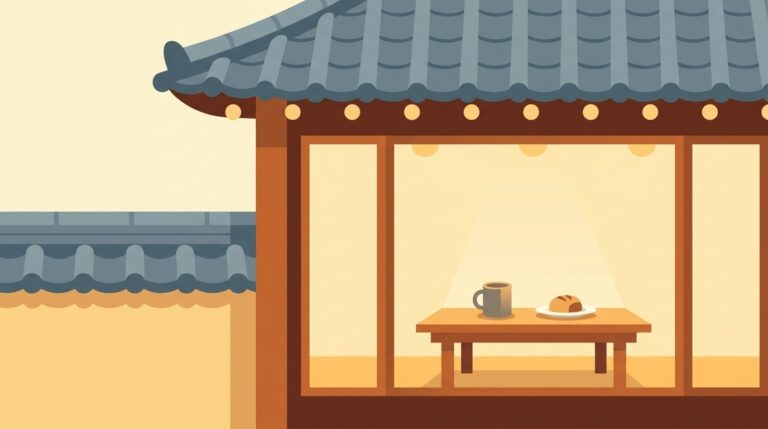
Picture this: You are exploring the charming, narrow alleyways of Yeonnam-dong on a beautiful autumn afternoon. You spot a legendary local bakery and buy a warm, buttery salt bread (소금빵 – sogeumbbang). Naturally, you want a fresh drink to go with it, so you step into a stunning, Instagram-worthy cafe next door. You order a tall, refreshing Iced Americano (아아 – Ah-Ah), sit down at a wooden table, and enthusiastically unwrap your bakery treat.
Suddenly, the barista makes direct eye contact. They look apologetic but slightly panicked. With a polite bow, they deliver the news: “죄송하지만 외부 음식은 반입 금지입니다.”
Oh no! Did you just break a sacred local rule?
Yes, you encountered 외부 음식 반입 금지 (Oebu eumsik banip geumji)—the “No Outside Food Allowed” policy. While in many Western countries it is common to eat outside snacks in a coffee shop, in Korea, doing so is a major social faux pas.
But do not worry! Today, we are going to learn exactly why this rule exists, how to politey ask if outside food is okay, and how to navigate Korean cafes like a seasoned Seoulite. Let’s dive in!
Phase 2: Core Expressions for Cafe Etiquette
Let’s master the three most important phrases you need to understand and use when dealing with outside food in Korea.
1. 외부 음식 반입 금지 (Oebu eumsik banip geumji)
- Pronunciation: /Way-boo eum-shik bahn-eep geum-jee/ (Sounds like: Way-boo [outside] + eum-shik [food] + bahn-eep [bringing in] + geum-jee [prohibition])
- Meaning: No Outside Food Allowed.
- K-Culture Moment: You will see this written on small, elegant signs near cafe entrances or register counters in trendy spots like Seongsu-dong or Gangnam.
- Editor’s Insight: This phrase uses formal Sino-Korean characters. Cafes use this written sign because it delivers a clear, firm policy without the staff having to say the direct word “prohibited” (금지) to your face.
- Situation Spectrum:
- Friends & Casual: 🚫 (Too formal to say out loud to a friend)
- Cafe Staff & Customers: ✅ (Standard written notice)
- Business Context: ✅
- 🤔 Think About It: In Korean, heavy Sino-Korean nouns are often used for signs to sound official yet neutral. How does your native language display similar warnings?
2. 혹시 이거 안에서 먹어도 돼요? (Hoksi igeo an-eseo meogeodo dwaeyo?)
- Pronunciation: /Hok-shee ee-guh ahn-eh-seo muh-guh-doh dway-yo?/
- Meaning: “By any chance, is it okay if I eat this inside?”
- K-Culture Moment: Think of a warm K-drama scene where the main character brings a sweet sweet-potato snack to a friend working at a local coffee shop.
- Editor’s Insight: The word 혹시 (hoksi – by any chance) is a magical “cushion word” in Korean. Adding it to the beginning of your sentence instantly softens the request, making you sound incredibly polite and considerate.
- Situation Spectrum:
- Friends & Casual: ✅ (Just drop the “요” at the end: 혹시 이거 안에서 먹어도 돼?)
- Cafe Staff & Customers: ✅ (The perfect polite inquiry)
- Business Context: ⚠️ (A bit too casual for formal meetings)
- 🤔 Think About It: Why do you think starting a sentence with “By any chance” makes such a big difference in Korean politeness? It shows you respect the other person’s right to say no!
3. 외부 음식은 가지고 들어오실 수 없습니다. (Oebu eumsigeun gajigo deureoosil su eopseumnida.)
- Pronunciation: /Way-boo eum-shee-geun gah-jee-goh deu-ruh-oh-shil soo up-seum-nee-dah/
- Meaning: “You cannot bring in outside food.”
- K-Culture Moment: The polite yet firm refusal you might receive at a high-end franchise cafe or a quiet book shop.
- Editor’s Insight: Even though the message is “No,” notice how the grammar uses the highly respectful honorific form
-실 수 없습니다(-sil su eopseumnida). The cafe is respecting you as a customer, even while enforcing the rules. - Situation Spectrum:
- Friends & Casual: 🚫 (Way too formal for friends)
- Cafe Staff & Customers: ✅ (Standard polite spoken refusal)
- Business Context: ✅
- 🤔 Think About It: Korean grammar actively inflects verbs based on the status of the person performing the action. Here, the verb “to enter” (들어오다) is elevated to “들어오시다” because you, the respected customer, are the one entering.
Phase 3: Textbook Korean vs. Real-World Korean
Sometimes, what you learn in a textbook sounds a bit too robotic or even aggressive in real life. Let’s compare!
Scenario 1: Asking if you can bring in a drink from another store
- 📖 Textbook Korean: 외부 음료를 마셔도 됩니까? (May I drink outside beverages?)
- Why it’s awkward: It sounds like you are reading a legal contract or taking a speaking exam.
- 🗣️ Real Korean: 혹시 다른 음료수 들고 들어가도 돼요? (Is it okay if I bring in another drink?)
- Why it’s better: It uses natural, active verbs like “holding and entering” (들고 들어가다) rather than stiff Chinese-derived nouns.
Scenario 2: When the staff informs you of the rule
- 📖 Textbook Korean: 외부 음식은 금지되어 있습니다. (Outside food is prohibited.)
- Why it’s awkward: It sounds incredibly cold, almost like a military command.
- 🗣️ Real Korean: 죄송한데 외부 음식은 취식이 어려우세요. (I’m sorry, but eating outside food is difficult/not possible here.)
- Why it’s better: Korean service staff love using the euphemism “어렵다” (to be difficult) instead of saying “No” directly. It saves face for both parties!
Phase 4: K-Culture Deep Dive & Non-verbal Manners
4-1. “Nunchi” (눈치) and Cafe Body Language
In Korea, 눈치 (Nunchi)—the art of sensing other people’s feelings and reading the room—is everything. If you must carry outside food into a cafe (for example, you just bought a cake for a friend’s birthday later), keep the bag tucked neatly under your table, out of plain sight. Leaving a bakery bag proudly on top of the cafe table is considered insensitive to the cafe owner. If you want to ask the staff for permission, slightly tilt your head and point subtly to your bag with a warm, apologetic smile.
4-2. The Economy of Space: Jaritse (자릿세)
Why are Korean cafes so strict about this? In Korea, cafes are considered shared cultural spaces. When you buy a coffee, you are not just purchasing a beverage; you are renting a highly curated space, often with fast Wi-Fi, heating/air conditioning, and beautiful interiors. This implicit rental fee is called 자릿세 (Jaritse – seat tax). Bringing outside food is seen as occupying this premium real estate without supporting the business owners who pay high rent in places like Seoul.
Phase 5: Live Cafe Roleplay Scenario
Setting: A gorgeous, wood-accented cafe in Bukchon Hanok Village. The scent of fresh espresso fills the air. You are holding a small, delicious box of traditional Korean rice cakes (떡) you bought at a nearby market.
Characters:
* Yumi: A friendly barista with a kind smile.
* You: A polite, coffee-loving traveler.
Dialogue:
- Yumi: (🎭 Smiling warmly behind the counter) 어서 오세요! 주문 도와드릴까요?
(Welcome! Can I help you order?) - You: 안녕하세요! 아이스 아메리카노 한 잔 주세요.
(Hello! One Iced Americano, please.) - Yumi: 네, 아아 한 잔이요! 매장에서 드시고 가시나요?
(Sure, one Iced Americano! Will you drink it in the shop?) - You: 네, 먹고 갈게요. 저 혹시… 아메리카노랑 이거 같이 먹어도 돼요? (🎭 Showing the small box of rice cakes)
(Yes, I’ll drink it here. By the way… is it okay if I eat this together with the Americano?) - Yumi: (🎭 Looking slightly apologetic, hands pressed together) 아, 정말 죄송한데 저희가 외부 음식은 반입이 안 되셔가지고요…
(Ah, I’m really sorry, but outside food is not allowed in our shop…) - You: 아, 그렇군요! 몰랐어요. 죄송합니다.
(Ah, I see! I didn’t know. I’m sorry.) - Yumi: (🎭 Waving her hands gently) 아니에요! 음료 나오면 진동벨로 알려드릴게요!
(No worries at all! Once your drink is ready, I’ll let you know with the buzzer!) - You: 네, 감사합니다. 도넛 상자는 가방에 넣을게요.
(Yes, thank you. I’ll put the donut box in my bag.) - Yumi: 네, 감사합니다! 편한 자리에 앉아주세요.
(Thank you so much! Please take any comfortable seat.) - You: 네!
(Okay!)
🔀 Decision Point: What do you do with your snack now?
- Choice A: Eat it secretly when Yumi turns her back to make coffee.
- Bad Choice! Korean cafes often have CCTVs, and doing this destroys the mutual trust. Yumi will feel uncomfortable having to remind you again.
- Choice B: Say “알겠습니다” (I understand), put it completely away, and enjoy your coffee.
- Best Choice! This shows high Nunchi, respects the local policy, and keeps your relationship with the barista wonderfully friendly.
- Choice C: Argue that since you bought an expensive coffee, you should be allowed to eat it.
- Risk Choice! Extremely rude. This will cause the entire cafe to look at you with cold Nunchi.
Phase 6: 10-Second Emotion Shadowing Drill
Let’s practice speaking with the right Korean soul and rhythm! The slash / marks where you should pause briefly.
- [🥺 Apologetic & Soft]
- “혹시… / 이거 안에서 / 먹어도 돼요? /”
- Hoksi… / igeo an-eseo / meogeodo dwaeyo? /
- [😊 Understanding & Polite]
- “아, 안 되는군요! / 가방에 넣을게요. /”
- Ah, an doeneungunyo! / gabange neoeulgeyo. /
Phase 7: K-Culture Mini Dictionary
| Word (Korean + Romanization) | English Translation | Real-world Contextual Meaning |
|---|---|---|
| 자릿세 (Jaritse) | Seat Tax / Space Value | The concept that cafe prices include the right to use the beautifully designed physical space. |
| 디저트 배 (Deijeoteu bae) | Dessert Stomach | The magical, separate stomach Koreans claim to have specifically for sweets, even after a massive K-BBQ dinner. |
| 아아 (Ah-Ah) | Iced Americano | Korea’s absolute favorite coffee drink, consumed icy cold even in the freezing depths of winter (known as 얼죽아 – Eol-juk-ah: Freezing to death but still drinking iced coffee). |
| 인스타 감성 (Insta Gamseong) | Instagram Aesthetic | Trendy, highly visual, minimalist interior styles designed specifically to look gorgeous in photos. |
Phase 8: Traveler’s Survival Kit
Top 3 Survival Expressions
- 테이크아웃 할게요. (Teikeuaut halgeyo.)
- Meaning: I’ll take it to go.
- Pro Tip: If you have outside food you really want to eat, take your coffee to go and enjoy both at a nearby park!
- 먹고 갈게요. (Meokgo galgeyo.)
- Meaning: I’ll consume it here (in the cafe).
- 이거 쓰레기 버려주실 수 있나요? (Igeo sseuregi beoryeojusil su innayo?)
- Meaning: Could you throw away this trash for me?
- Pro Tip: Only ask this for trash generated inside the cafe. Handing them outside trash is considered impolite.
📌 Editor’s Travel Note:
When navigating Korea’s beautiful cafe streets, Google Maps can often be outdated. To find the most charming, hidden local spots with real-time reviews, download and use the official Naver Map App Download Page for the ultimate local experience.
Phase 9: Deep Thinking — “One Step Deeper”
In many Western cultures, public spaces are viewed through the lens of individual convenience—if you buy a product, you have earned the flexibility of the space. In Korea, however, cafes are highly curated, shared sensory environments. The “No Outside Food” rule is not just about commercial greed; it is about preserving the harmony of the shared space. Strong smells from outside food (like savory street snacks or garlic-heavy bread) can easily ruin the delicate aroma of roasting coffee beans that other customers paid to enjoy.
💬 Your Turn: How does your hometown view outside food in local businesses? Is it relaxed, or do you have similar unspoken rules? Let us know in the comments below!
Phase 10: FAQ & Common Mistakes
Q: What if the outside food is just baby food?
A: Yes, this is generally allowed! Most Korean cafes are incredibly understanding when it comes to baby food (이유식 – iyusik). However, it is still polite to quickly ask the staff beforehand as a gesture of respect.
Q: Can I drink bottled water from a convenience store inside a cafe?
A: Generally, yes. Plain bottled water is acceptable, but drinking outside soda, sweet juices, or sports drinks is considered bad manners.
Q: What if the cafe doesn’t sell any bakery or dessert items at all?
A: The rule still stands. Even if they only sell beverages, bringing in outside solid food is still prohibited unless explicitly stated otherwise on their storefront.
🚨 Common Mistakes Warning Board
- Mistake: Unwrapping a bakery treat on the table just “to look at it” or photograph it.
- Correct Action: Keep outside food inside its original shopping bag and place it under the table.
- Mistake: Throwing away outside food wrappers in the cafe’s internal trash bin.
- Correct Action: Take your outside trash with you and dispose of it at home or in public street bins.
- Mistake: Using the cafe’s plates or forks to eat your outside snacks.
- Correct Action: Absolutely do not do this! It is highly offensive to the staff.
Phase 11: Action Missions
- 🥉 Bronze (Home Challenge): Practice asking the question out loud in front of your mirror with a soft, polite expression: “혹시 이거 안에서 먹어도 돼요?”
- 🥈 Silver (Network Challenge): Take a picture of your favorite coffee-and-snack pairing at home and post it on social media with the caption: “내 방에서는 외부 음식 반입 환영!” (Outside food is welcome in my room!)
- 🥇 Gold (Real-World Challenge): The next time you visit a Korean cafe with a shopping bag in hand, actively show your Nunchi by placing the bag beneath your chair before ordering!
- 🎮 K-Culture Mission: Watch your favorite modern K-drama and count how many times characters order an “아아” (Iced Americano) instead of a hot drink!
Phase 12: Interactive Quiz Challenge
Test your Korean cafe manners! Click the toggles below to see the answers.
1. Situation Judgment
You just bought a gorgeous box of macarons from a famous bakery and entered a beautiful cafe. What is the most polite action?
▶ Click to reveal the correct answer!
Answer: Keep the macaron box tucked inside your personal bag. Order a drink from the cafe, and wait until you leave the cafe to eat your macarons.
Feedback: You’ve got amazing Nunchi! Your local barista will love you.
2. Fill in the Blanks
Fill in the missing words to politely ask if you can eat a snack inside:
“혹시 이거 ________ 먹어도 돼요?”
▶ Click to reveal the correct answer!
Answer: 안에서 (an-eseo / inside)
Full Sentence: 혹시 이거 안에서 먹어도 돼요? (By any chance, is it okay to eat this inside?)
3. True or False
True or False: Since I paid for an expensive beverage at a Korean cafe, I have the cultural right to eat any small snack I want at my table.
▶ Click to reveal the correct answer!
Answer: False!
Explanation: Buying a drink pays for your personal space rental (자릿세) for that drink only. Bringing outside food disrupts the cafe’s business model and olfactory environment.







