

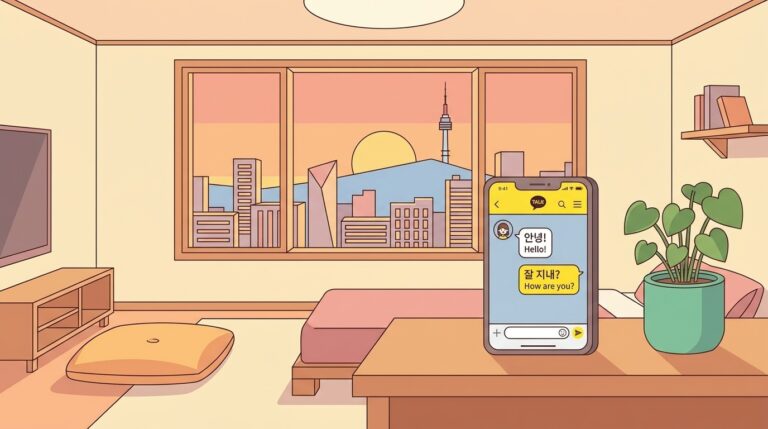
Master Your Lease: How to Legally and Politely Extend Your Stay in Korea
안녕하세요! It’s your favorite premium tutor and cultural guide from Daily Hangul.
Imagine this: You’ve finally found your dream studio apartment in Mapo-gu. The neighborhood is perfect—you’ve got your favorite local bakery just around the corner, a cozy Han River park within walking distance, and the local convenience store owner already knows your regular order. But one afternoon, your phone buzzes. It’s a message from your landlord (집주인, jip-ju-in). Your two-year lease is ending soon, and they are hinting at a massive rent increase or asking you to move out.
A cold sweat breaks out. If you’ve watched K-dramas like Because This Is My First Life (이번 생은 처음이라) or Monthly Magazine Home (월간 집), you know that housing drama in Korea is real, emotional, and legally intense.
But don’t panic! Under Korean law, you have a powerful legal shield: the Right to Contract Renewal (계약갱신청구권, gye-yak-gaeng-sin-cheong-gu-gwon). Today, we are going to learn how to claim this right confidently, politely, and with perfect Korean legal etiquette, so you can protect your cozy home without burning any bridges.
1. Deep Dive: Three Essential Expressions to Protect Your Home
When dealing with real estate contracts (부동산 계약, bu-dong-san gye-yak), using the correct, precise terminology is key. It shows your landlord that you are well-informed and respect the system. Here are three powerful expressions you need to master.
① 계약 갱신 청구권을 행사하겠습니다.
- Pronunciation: [Gye-yak gaeng-sin cheong-gu-gwon-eul haeng-sa-ha-gess-seub-ni-da]
- Sound Analogy: Think of “Gye-yak” (contract) as gay-yack, “gaeng-sin” (renewal) as gang-shin, “cheong-gu-gwon” (right of claim) as chuhng-gu-gwon, and “haeng-sa” (exercise/use) as hang-sah.
- Meaning: “I would like to exercise my right to request a contract renewal.”
- K-Culture Moment: This is the ultimate legal shield. In 2020, Korea introduced the “Three Tenant Protection Acts” (임대차 3법). This law gives tenants the right to extend a standard 2-year lease for another 2 years (often called the “2+2 rule”), and the landlord cannot refuse without legally valid reasons (such as moving in themselves).
- Editor’s Insight: Yes, this sounds very formal! But don’t worry about being too blunt. In Korea, when discussing legal rights, using precise terms actually prevents emotional misunderstandings. It keeps the conversation professional.
- Situation Spectrum:
- Casual: 🚫 (Do not use with friends—it’s strictly legal!)
- Semi-formal (with landlord): ✅
- Formal (via official text/mail): ✅
- 🤔 Think About It: In many Western countries, lease renewals are negotiated annually with fluctuating market rates. In Korea, the law specifically protects a “2+2” year tenure. Why do you think Korean society places such a high legal value on residential stability?
② 2년 더 연장하고 싶습니다.
- Pronunciation: [I-nyeon deo yeon-jang-ha-go sip-seub-ni-da]
- Sound Analogy: “I-nyeon” (two years) sounds like ee-nyuhn, “deo” (more) like duh, and “yeon-jang” (extension) like yuhn-jang.
- Meaning: “I would like to extend my lease for two more years.”
- K-Culture Moment: This is the gentler, softer cousin of expression ①. If you have a warm, friendly relationship with your landlord, starting with this softer phrase over a polite phone call is highly recommended.
- Editor’s Insight: Use this first to test the waters. If your landlord is agreeable and doesn’t push back, you might not even need to formally bring up the legal “청구권” (right to claim).
- Situation Spectrum:
- Casual: ⚠️ (A bit too formal for close friends, but okay for a landlord you are close to)
- Semi-formal (with landlord): ✅
- Formal: ✅
③ 임대료 인상 상한선은 5%로 알고 있습니다.
- Pronunciation: [Im-dae-ryo in-sang sang-han-seon-eun o-pro-ro al-go is-seub-ni-da]
- Sound Analogy: “Im-dae-ryo” (rent) sounds like eem-dae-ryo, “in-sang” (increase) like een-sang, “sang-han-seon” (ceiling/cap) like sang-hahn-suhn, and “o-pro” (5 percent, using the German-derived ‘프로’ for percent) like oh-pro.
- Meaning: “I understand that the rent increase cap is limited to 5%.”
- K-Culture Moment: Under the renewal law, if you exercise your right, the landlord cannot raise your rent (either deposit or monthly rent) by more than 5%. This is a massive relief for tenants in hot neighborhoods like Hongdae or Gangnam!
- Editor’s Insight: This is a gentle reality check. Instead of saying “You can’t raise it more than 5%!”, saying “I understand the cap is 5%” (~로 알고 있습니다) sounds polite, soft, yet legally unbreakable.
- Situation Spectrum:
- Casual: 🚫
- Semi-formal: ✅
- Formal: ✅
2. Textbook Korean vs. Real-World Korean
Let’s compare what you might find in an outdated grammar book versus what actually works in the high-stakes world of Seoul real estate.
Situation 1: Telling your landlord you want to renew
- 📖 Textbook: “저는 계약을 갱신하기를 희망합니다.” (Jeo-neun gye-yak-eul gaeng-sin-ha-gi-reul hui-mang-ham-ni-da. / I hope to renew the contract.)
- Why it’s awkward: It sounds like an essay or an automated robot. It lacks warmth.
- 🗣️ Real Korean: “사장님, 저 계약 연장해서 더 살고 싶어요!” (Sa-jang-nim, jeo gye-yak yeon-jang-hae-seo deo sal-go sip-eo-yo! / Landlord, I’d love to extend my lease and keep living here!)
- Why it works: In Korea, calling your landlord “사장님” (sa-jang-nim, literally “boss/president”) or “집주인 선생님” (jip-ju-in seon-saeng-nim) is a highly effective way to show respect and build quick rapport.
Situation 2: Discussing rent increases
- 📖 Textbook: “법에 따라 임대료는 5%만 올리십시오.” (Beop-e tta-ra im-dae-ryo-neun o-pro-man ol-li-sip-si-o. / According to the law, only raise the rent by 5%.)
- Why it’s awkward: This sounds incredibly demanding, almost like an ultimatum, which might make your landlord defensive.
- 🗣️ Real Korean: “보증금은 법정 한도 내에서 조율해 주시면 감사하겠습니다.” (Bo-jeung-geum-eun beop-jeong han-do nae-e-seo jo-yul-hae ju-si-myeon gam-sa-ha-gess-seub-ni-da. / I would be grateful if we could adjust the deposit within the legal limit.)
- Why it works: It uses the elegant grammar “~해 주시면 감사하겠습니다” (I would appreciate it if you could…) and frames the limit as the “legal limit” (법정 한도) without sounding combative.
3. Cultural Deep-Dive: Nunchi & KakaoTalk Evidence
3-1. “Nunchi” (눈치) & The KakaoTalk Strategy
In Korea, “Nunchi” (the art of reading the room and emotional context) is everything. When exercising your renewal right, timing and medium matter:
1. Do it in writing: Even if you have a friendly phone call, always follow up with a KakaoTalk message or text. Why? In Korea, written messages serve as legal proof of your intent. You must legally notify your landlord at least 2 months (and no more than 6 months) before your current contract expires.
2. Keep it sweet but clear: Start with warm greetings about the weather or holidays before diving into the legal stuff.
3-2. The “Jeonse” (전세) Culture Shift
If you live in Korea, you’ve likely heard of Jeonse (key money deposit)—a unique system where you pay a massive deposit (often 60–80% of the property value) instead of monthly rent, and get it all back when you move out. Because huge sums of money are tied up in Jeonse, the 계약갱신청구권 (renewal right) is a hot topic of national debate. Knowing how this works will make you sound like a true local expert during dinners with Korean friends!
4. Play the Game: The Landlord Negotiation Roleplay
Let’s test your skills! You are playing the role of Alex, a foreign researcher living in Hapjeong, Seoul. Your landlord, Mr. Kim (김 사장님), calls you to talk about your lease extension.
Mr. Kim: (🎭 Clearing his throat, sounding slightly apologetic but firm)
"아이고, 알렉스 씨. 요즘 합정동 집값이 너무 올라서 말이야. 다음 달 계약 끝날 때 보증금을 20% 정도 올려야겠어."
(Aigo, Alex-ssi. Yo-jeum Hapjeong-dong jip-gaps-i neo-mu ol-la-seo mal-i-ya. Dae-eum dal gye-yak kkeut-nal ttae bo-jeung-geum-eul i-sip-pro jeong-do ol-ryeo-ya-gess-eo.)
"Oh, Alex. House prices in Hapjeong have gone up so much lately. I'll need to raise your deposit by about 20% when your contract ends next month."

Alex (You): (🎭 Taking a deep breath, speaking politely but clearly)
"김 사장님, 늘 신경 써 주셔서 감사합니다. 하지만 갑자기 20%는 저에게 너무 부담스럽습니다."
(Gim sa-jang-nim, neul sin-gyeong sseo ju-syeo-seo gam-sa-ham-ni-da. Ha-ji-man gap-ja-gi i-sip-pro-neun jeo-e-ge neo-mu bu-dam-seu-rop-seub-ni-da.)
"Mr. Kim, thank you as always for looking out for me. But a sudden 20% increase is too much of a burden for me."

Mr. Kim: (🎭 Sighing softly)
"에이, 그래도 주변 시세가 다 올랐는데 어쩔 수 없지 않나? 다른 사람들은 다 그렇게 계약해."
(Ei, geu-rae-do ju-byeon si-se-ga da ol-rat-neun-de eo-jjeol su eop-ji an-na? Da-reun sa-ram-deul-eun da geu-reoh-ge gye-yak-hae.)
"Well, but all the surrounding market prices have gone up, so there's no choice, right? Everyone else contracts that way."
🔀 Decision Point: What is your next move?
- Option A: “법대로 해요! 법정 한도는 5%잖아요!” (Beop-dae-ro hae-yo! Beop-jeong han-do-neun o-pro-jan-ah-yo! / Do it by the law! The legal limit is 5%!)
- Option B: “죄송하지만 제가 계약 갱신 청구권을 행사하고 싶습니다. 법적 상한선인 5% 내에서 조율해 주시면 좋겠습니다.”
(Joe-song-ha-ji-man je-ga gye-yak gaeng-sin cheong-gu-gwon-eul haeng-sa-ha-go sip-seub-ni-da. Beop-jeok sang-han-seon-in o-pro nae-e-seo jo-yul-hae ju-si-myeon joh-gess-seub-ni-da.) - Option C: “네, 알겠습니다. 그렇게 올릴게요…” (Ne, al-get-seum-ni-da. Geu-reoh-ge ol-ril-ge-yo… / Yes, okay. I will raise it like that…)
💡 Analysis of Your Choice:
- Best Choice: Option B! This is perfect. You are using the magic words “계약 갱신 청구권” and “5%” in an incredibly polite, soft structure (~해주시면 좋겠습니다). It leaves no room for legal loopholes while maintaining complete respect.
- Bad Choice: Option A. Saying “법대로 해요!” (Do it by the law!) is highly confrontational and can damage your relationship with the landlord, who might find a loophole (like claiming a family member is moving in) to evict you.
- Risk Choice: Option C. You are giving away your legal rights and losing a huge sum of money unnecessarily!
5. Shadowing Drill: Speak with Native Emotion
Let’s practice saying these vital sentences with the exact right intonation and emotional delivery.
- [🥺 Polite & Appealing]
- “사장님, / 제가 이 집을 정말 좋아해서요, / 2년만 더 살고 싶어요.”
- [Sa-jang-nim, / je-ga i jip-eul jeong-mal jo-ah-hae-seo-yo, / i-nyeon-man deo sal-go sip-eo-yo.]
- Delivery Tip: Pause slightly at the
/marks, and make your voice warm and cozy.
- [😤 Firm & Professional]
- “이번 계약은 / 계약 갱신 청구권을 / 행사하는 것으로 하겠습니다.”
- [I-beon gye-yak-eun / gye-yak gaeng-sin cheong-gu-gwon-eul / haeng-sa-ha-neun geos-eu-ro ha-gess-seub-ni-da.]
- Delivery Tip: Keep your tone even, clear, and steady. Do not rush!
6. K-Culture Mini Dictionary
| Word (Korean + Romanization) | English Meaning | Real-world Context |
|---|---|---|
| 복비 (Bok-bi) | Realtor commission fee | The standard fee you pay to the real estate agent (부동산) when signing or renewing a contract. If you use your renewal right directly with the landlord without an agent, you save on this! |
| 확정일자 (Hwak-jeong-il-ja) | Fixed Date Stamp | A stamp you get from the local community center that legally secures your deposit priority in case the building goes into auction. Absolute must-do on moving day! |
| 집주인 (Jip-ju-in) | Landlord | Literally “home owner.” You can address them directly as “집주인 선생님” (respected homeowner) to be extra polite. |
| 역세권 (Yeok-se-gwon) | Subway-adjacent zone | Real estate gold in Korea. Any apartment within a 5-10 minute walk from a subway station. |
7. Resident Survival Kit: Essential Apps & Tips
If you are currently living or planning to live in Korea, put these resources in your digital pockets:
- Best Real Estate Apps: Use Naver Real Estate (네이버 부동산) or apps like Dabang (다방) and Zigbang (직방) to check current market prices in your neighborhood before negotiating with your landlord.
- Official Contract Verification: Always check your property’s register copy (등기부등본) via the Supreme Court Internet Registry Office Website to make sure your landlord hasn’t taken out massive new loans during your tenancy.
8. Deep Thinking: The Sanctity of “집” (Home) in Korea
In modern Korea, “집” (jip) carries a complex double meaning. On one hand, apartments in Seoul are massive financial assets, heavily discussed on the news and at family dinners. On the other hand, “집” represents a sanctuary of peace in a fast-paced society (빨리빨리 문화).
Because finding a stable home in Seoul is notoriously difficult, the legal system has evolved to heavily protect tenants. When you ask to extend your contract, you are not just negotiating money; you are securing your peace of mind. Knowing how to communicate during this process is a vital milestone in truly integrating into Korean society.
💬 Your Turn: How does lease renewal work in your home country? Is there a legal cap on how much a landlord can raise your rent? Let us know in the comments below!
9. FAQ & Avoiding Common Pitfalls
Q: Can my landlord refuse my renewal request if they want to move in themselves?
A: Yes. If the landlord or their direct family members plan to reside in the property, they can legally reject your renewal. However, if they lie about this and rent it to someone else for higher rent, you can legally claim compensation.
Q: Do I have to pay the realtor fee (복비) for a renewal?
A: No. If you and your landlord agree to write a simple extension contract between yourselves (or via KakaoTalk), you do not need to pay a realtor fee. If you do use a realtor to draft a new paper, the fee is usually a small flat administrative fee rather than the full commission.
Q: What is the absolute deadline to exercise my renewal right?
A: Exactly 2 months before your contract expires. If your contract ends on December 31st, your message claiming your right must reach your landlord before October 30th (11:59 PM). Do not miss this window!
🚨 Landlord Negotiation Mistakes to Avoid
- Waiting until the last minute: If you don’t say anything until 1 month before, a “tacit renewal” (묵시적 갱신) might happen, but it can complicate your right to use the official 5% cap rule.
- Being too aggressive over text: Avoid phrases like “그건 불법입니다” (That is illegal). Use “법적 기준을 확인해 주시면 감사하겠습니다” (I’d appreciate it if you could verify the legal standard).
- Forgetting the written paper trail: A verbal agreement on the phone is nice, but always back it up with a gentle KakaoTalk message summarizing the agreement.
10. Action Missions: Your Turn to Practice!
- 🥉 Bronze (The Mirror Challenge): Stand in front of a mirror and read our Shadowing Drill sentences with matching facial expressions. Make sure you sound polite yet unshakable!
- 🥈 Silver (The Kakao Draft): Write a draft KakaoTalk message to your imaginary landlord asking to renew your lease for 2 years, utilizing the 5% cap rule politely.
- 🥇 Gold (The Real-World Scan): Go to Naver Real Estate and search for your current neighborhood. Check if the average rent prices are currently higher or lower than what you are currently paying!
11. Interactive Quiz Challenge
Test your knowledge of Korean tenant rights and vocabulary!
1. Which of the following is the correct legal term for “Right to Contract Renewal”?
- A) 월세 계약서 (Wol-se gye-yak-seo)
- B) 계약 갱신 청구권 (Gye-yak gaeng-sin cheong-gu-gwon)
- C) 부동산 중개업소 (Bu-dong-san jung-gae-eop-so)
🔍 Click here for the Answer & Explanation
Correct Answer: B
계약 갱신 청구권 is the official legal term for your right to claim a lease extension. (A means “monthly rent contract,” and C means “real estate agency”).
2. True or False: If you exercise your renewal right, the landlord can legally raise your rent by up to 10%.
- True
- False
🔍 Click here for the Answer & Explanation
Correct Answer: False
The legal limit for rent increases under the contract renewal option is strictly capped at 5%.







