

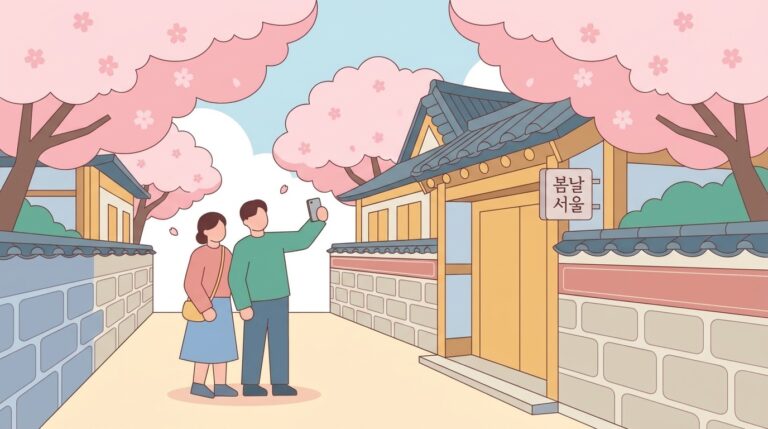
Chasing the Pink Rain: Master Korea’s Cherry Blossom Season Like a Local
안녕하세요! (An-nyeong-ha-se-yo!) I’m your senior editor at Daily Hangul.
Imagine this: You’ve booked your flights to Seoul, packed your favorite pastel-colored outfits, and visualized the perfect stroll under a canopy of pink blossoms. You head straight to Yeouido Park, only to find bare branches and a chilly wind. Or worse, you arrive just in time for a sudden spring rainstorm that sweeps every single petal away.
This is the ultimate heartbreaking moment for travelers and language learners alike. Missing the fleeting window of the Korean cherry blossoms (벚꽃 – beot-kkot) is a common pain point. But don’t worry! Today, we are going to dive deep into the cultural nuances, essential vocabulary, and local secrets of Korea’s spring weather so you can time your trip perfectly and talk about it like a true Seoulite.
Phase 2: 3 Essential Expressions for Spring
1. 벚꽃 엔딩 (Beot-kkot En-ding)
- Pronunciation: [beot-kkot en-ding] / Sounds like “but-coat ending”
- Meaning: Cherry blossom ending (The final phase of the blossom season when petals fall).
- K-Culture Moment: This expression was popularized by the legendary indie band Busker Busker’s song Cherry Blossom Ending. Every spring, this song climbs back to the top of the music charts, earned it the nickname “Cherry Blossom Pension” (벚꽃 연금) because of the annual royalties!
- Editor’s Insight: Locals use this not just for the song, but to describe the poetic, slightly bittersweet moment when the pink petals fall like snow.
- Situation Spectrum:
- Casual: ✅
- Semi-formal: ✅
- Formal: ⚠️ (Slightly casual, but acceptable in light conversations)
- 🤔 Think About It: Why do you think Koreans became so obsessed with a song about the “ending” of flowers rather than just their bloom? What does this say about how Koreans perceive transient beauty?
2. 꽃샘추위 (Kkot-saem-chu-wi)
- Pronunciation: [kkot-saem-chu-wi] / Sounds like “coat-sam-chu-we”
- Meaning: The last cold snap of early spring (Literally: “The cold that is jealous of the flowers blooming”).
- K-Culture Moment: You’ll hear this constantly on weather forecasts and in daily conversations in late March. Characters in K-dramas often use this weather as an excuse to share a warm coat or buy a hot drink for their crush.
- Editor’s Insight: It’s a beautifully personified word. The cold is “jealous” (시샘하다 – si-saem-ha-da) of the beautiful spring flowers, so it tries to freeze them one last time.
- Situation Spectrum:
- Casual: ✅
- Semi-formal: ✅
- Formal: ✅
- 🤔 Think About It: Does your language have a poetic word for a late-season cold snap, or is it purely scientific? How does personifying weather change how we feel about it?
3. 꽃구경 (Kkot-gu-gyeong)
- Pronunciation: [kkot-gu-gyeong] / Sounds like “coat-goo-gyeong”
- Meaning: Flower viewing excursion.
- K-Culture Moment: Every spring, offices practically empty out during lunch hours as coworkers go for a quick “꽃구경” around the office block. On weekends, families and couples pack picnics for full-day trips.
- Editor’s Insight: Unlike simply “looking at flowers,” 꽃구경 implies an active, celebratory journey to appreciate nature.
- Situation Spectrum:
- Casual: ✅
- Semi-formal: ✅
- Formal: ✅
- 🤔 Think About It: The suffix “-구경” (viewing/sightseeing) is used for active appreciation (e.g., 사람구경 – people watching). How does this differ from the simple verb “보다” (to see)?
Phase 3: Textbook Korean vs. Real Korean
Situation 1: Asking if the flowers have bloomed
- 📖 Textbook: 벚꽃이 피었습니까? (Beot-kkoti pieot-seumnikka? / Have the cherry blossoms bloomed?)
- 🗣️ Real Korean: 벚꽃 벌써 폈어? (Beot-kkot beol-sseo pyeosseo? / Are the blossoms already out?) or 벚꽃 만개했대! (Beot-kkot man-gae-haet-dae! / They say the blossoms are in full bloom!)
- 💡 Why the difference? Textbook Korean often uses highly formal, stiff verb endings. Real locals prefer quick, active updates using “만개” (full bloom) or dropping particles to keep the conversation flowing.
Situation 2: Describing falling petals
- 📖 Textbook: 꽃잎이 떨어집니다. (Kkot-ipi tteoreojimnida. / The petals are falling.)
- 🗣️ Real Korean: 벚꽃 비가 내려요. (Beot-kkot bi-ga naeryeoyo. / It’s raining cherry blossoms.)
- 💡 Why the difference? Koreans love sensory and poetic descriptions. Describing falling petals as “cherry blossom rain” (벚꽃 비) captures the emotional vibe of spring perfectly.
Phase 4: K-Culture Deep Dive & Non-verbal Manners
4-1. Nunchi (눈치) & Photoshoot Etiquette
When you visit famous spots like Seokchon Lake or Yeouido, you will witness the peak of Korea’s photo culture. To navigate this smoothly without being rude, keep these unwritten rules in mind:
* The Photo Line: If you see a particularly beautiful tree branch hanging low, a queue will naturally form. Do not cut in.
* The Exchange: It is highly polite to offer to take a photo for a couple or a group first. You can say: “사진 찍어드릴까요?” (Sa-jin jjig-eo-deu-ril-kka-yo? / Shall I take your photo?). They will almost certainly offer to take yours in return, helping you get that perfect solo shot!
4-2. The “Spring Anthem” Phenomenon
In Korea, seasons are defined by music. The song “Cherry Blossom Ending” by Busker Busker is so culturally significant that when it starts climbing the charts, people know spring has officially arrived, regardless of what the calendar says.
Phase 5: Real-Life Roleplay Scenario
Setting: A cozy, sunlit cafe with large windows overlooking Seokchon Lake in Seoul. The sound of distant laughter and acoustic spring music drifts inside.
Characters:
* You: An intermediate Korean learner exploring Seoul.
* Min-jun (민준): Your local Korean friend who knows all the secret spots.
- Min-jun: (Looking out the window excitedly) 와, 오늘 날씨 진짜 대박이다! 기온이 딱 좋네.
(Wa, o-neul nal-ssi jin-jja dae-bak-i-da! Gi-on-i ttak joh-ne.)
(Wow, the weather today is amazing! The temperature is just perfect.) -
You: (Nodding) 응, 정말 따뜻해. 근데 벚꽃은 다 폈을까?
(Eung, jeong-mal tta-tteut-hae. Geun-de beot-kkot-eun da pyeot-eul-kka?)
(Yeah, it’s really warm. But do you think the cherry blossoms are fully out?) -
Min-jun: (Checking his phone) 어, 어제 뉴스 보니까 지금 거의 만개했대! 이번 주말에 사람 엄청 많겠다.
(Eo, eo-je nyu-seu bo-ni-kka ji-geum geo-ui man-gae-haet-dae! I-beon ju-mal-e sa-ram eom-cheong manh-get-da.)
(Yeah, looking at the news yesterday, they say it’s almost in full bloom! There’ll be so many people this weekend.) -
You: (Slightly worried) 아, 사람 많은 건 좀 피하고 싶은데… 다른 좋은 곳 없을까?
(A, sa-ram manh-eun geon jom pi-ha-go sip-eun-de… Da-reun joh-eun got eops-eul-kka?)
(Ah, I want to avoid big crowds if possible… Is there any other good spot?) -
Min-jun: (Smiling warmly) 역시 그럴 줄 알았어. 그럼 여의도 말고 한적한 비밀 명소로 갈까?
(Yeok-si geu-reol jul ar-at-seo. Geu-reom Yeo-ui-do mal-go han-jeok-han bi-mil myeong-so-ro gal-kka?)
(I knew you’d say that. Then, instead of Yeouido, shall we go to a quiet, secret spot?)
🔀 Decision Point: How do you respond to Min-jun’s secret plan?
- Option A: “비밀 명소? 거기가 어디야? 빨리 가자!”
(Bi-mil myeong-so? Geo-gi-ga eo-di-ya? Ppal-li ga-ja!)
(A secret spot? Where is that? Let’s go quickly!) - Option B: “귀찮은데 그냥 여기서 커피나 마시자.”
(Gwi-chanh-eun-de geu-nyang yeo-gi-seo keo-pi-na ma-si-ja.)
(It’s too much hassle, let’s just drink coffee here.) - Option C: “와, 진짜? 민준이 최고! 기대된다.”
(Wa, jin-jja? Min-jun-i choe-go! Gi-dae-daen-da.)
(Wow, really? Min-jun you’re the best! I can’t wait.)
🏆 Choice Analysis:
- Best Choice: Option C. It shows high enthusiasm and appreciation for your friend’s effort to find a quiet spot. Using “[Name] 최고” is a friendly, natural way to show gratitude.
- Acceptable: Option A. Energetic and friendly, though slightly demanding with “빨리 가자!”
- Bad Choice: Option B. This shuts down Min-jun’s kind offer and might make him feel like he wasted his effort thinking of a special plan for you.
Phase 6: 10-Second Emotion Shadowing Drill
Practice saying these out loud with the right emotional rhythm!
- [😊 Super Excited & Breathless]
- 대박! / 벚꽃 비가 / 내리고 있어!
- Dae-bak! / Beot-kkot bi-ga / nae-ri-go is-seo!
- (Awesome! / Cherry blossom rain / is falling!)
- [🥺 Disappointed & Pouting]
- 아쉽다… / 벌써 / 벚꽃 엔딩이네.
- A-swip-da… / Beol-sseo / beot-kkot en-ding-i-ne.
- (What a pity… / It’s already / the cherry blossom ending.)
Phase 7: K-Culture Mini Dictionary
- 만개 (Man-gae)
- English: Full bloom
- Context: Used extensively in news and travel blogs to signal the absolute peak viewing days.
- 인생샷 (In-saeng-syat)
- English: The shot of a lifetime (A perfect photo)
- Context: Getting an “인생샷” under a blooming tree is a major spring goal for young Koreans.
- 돗자리 (Dot-ja-ri)
- English: Picnic mat / Straw mat
- Context: Essential gear for spring. People spread them out in parks to eat fried chicken (치맥 – Chi-maek) under the trees.
- 봄바람 (Bom-ba-ram)
- English: Spring breeze
- Context: Often used in songs and poetry to describe feelings of romance and fluttery excitement.
Phase 8: Traveler’s Survival Kit
Top 3 Survival Expressions
- 여기 사진 명당이 어디예요? (Yeo-gi sa-jin myeong-dang-i eo-di-yeo-yo?)
- Pro Tip: “Where is the best photo spot around here?”
- 돗자리 빌릴 수 있어요? (Dot-ja-ri bil-ril su is-seo-yo?)
- Pro Tip: “Can I rent a picnic mat?” (Many parks near Han River rent them out cheaply!)
- 날씨가 좀 쌀쌀하네요. (Nal-ssi-ga jom ssal-ssal-ha-ne-yo.)
- Pro Tip: “The weather is a bit chilly.” Useful during the late-afternoon drop in temperature.
📌 Editor’s Travel Note: Don’t rely solely on global map apps in Korea! Download the Naver Map App to find local paths, real-time bus arrivals, and find the exact secret pathways to less-crowded blossom spots.
Phase 9: Deep Reflection — “Going Deeper”
In Western cultures, spring is often associated with rebirth and permanent growth. In Korea, however, spring appreciation is deeply intertwined with the concept of transience. The cherry blossom season lasts barely a week, and its rapid end due to spring winds or rains is a metaphor for the fleeting nature of youth and beauty. This is why Koreans don’t just admire the blossoms; they actively celebrate them with a sense of urgency, packing parks to create memories before the “벚꽃 엔딩” arrives.
💬 Your Turn: How does your home country celebrate the arrival of spring? Do you have a flower or a season that evokes a similar feeling of beautiful transience? Let us know in the comments below!
Phase 10: FAQ & Common Mistakes
Q: When is the absolute best time to see the cherry blossoms in Seoul?
A: Generally, the last week of March to the first week of April. However, this changes slightly every year depending on the temperature, so keep an eye out for “개화 시기” (bloom forecasts) published in February.
Q: Is Yeouido the only good place in Seoul?
A: Absolutely not. In fact, locals often avoid Yeouido due to the massive crowds. Try Seokchon Lake (near Lotte World) for a beautiful lake backdrop, or Seoul Forest (서울숲) for a more relaxed picnic experience.
Q: What should I wear during the cherry blossom season?
A: Layering is key! Because of 꽃샘추위 (the spring cold snap), daytime can feel warm and sunny, but once the sun sets, the temperature drops rapidly. Always bring a light jacket or cardigan.
🚨 Common Mistakes Warning Board
- Saying “꽃을 봐요” instead of “꽃구경 가요”: Saying “Let’s look at flowers” sounds like a biology class assignment. Use “꽃구경 가요” to sound natural!
- Ignoring the wind: Don’t assume a warm day means a warm evening. Wind off the Han River can be incredibly cold in early spring.
- Not booking ahead: If you plan to visit a cafe with a blossom view, you must arrive early or book weeks in advance.
Phase 11: Action Missions
- 🥉 Bronze: Record yourself saying “벚꽃 비가 내려요” on your phone, focusing on the soft, flowing intonation of the phrase.
- 🥈 Silver: Go to Instagram or your favorite social media, find a photo of Korean cherry blossoms, and leave a comment in Korean: “여기가 진짜 사진 명당이네요!” (This place is a real photo hotspot!).
- 🥇 Gold: Plan a hypothetical 1-day spring itinerary in Seoul using Naver Map. Share your route in our community forum!
Phase 12: Interactive Quiz Challenge
1. Which term describes the chilly cold snap that occurs in early spring?
- A) 봄바람 (Bom-ba-ram)
- B) 꽃샘추위 (Kkot-saem-chu-wi)
- C) 벚꽃 엔딩 (Beot-kkot En-ding)
2. Fill in the blank:
“이번 주말에 우리 여의도로
_______ 가자!”
(This weekend, let’s go on a flower-viewing excursion to Yeouido!)
3. True or False:
“Koreans always use formal verbs like ‘피었습니까?’ when asking friends if the blossoms have opened.”
👉 Click to reveal the Answers & Explanations!
- Answer: B) 꽃샘추위. This is the poetic term for the cold “jealous of the flowers.”
- Answer: 꽃구경 (Kkot-gu-gyeong). The natural word for a spring flower outing!
- Answer: False. Friends will almost always use casual, short forms like “벌써 폈어?” (Are they already out?).







